



About this worksheet
This two-page Grade 1 printable offers 16 guided questions on regular plural nouns. Children choose the right ending, then write plural forms of words such as bird, lunch, puppy and berry in short sentences. The separate answer key supports quick checking and the practice connects plural nouns to CCSS L.1.1.c.
Aligned to L.1.1.c
How do most nouns become plural?
For many nouns, add -s to name more than one. One bird becomes two birds, and one cup becomes four cups.
- 1I see three birds in the yard.
- 2bird + s = birds
When do children add -es?
Nouns ending in s, x, sh or ch often add -es. The extra letters make the plural easier to say: box becomes boxes and dish becomes dishes.
- 1box + es = boxes
What happens to a noun ending in consonant plus y?
Change the y to i and add -es: puppy becomes puppies. Look at the letter before y to decide whether this pattern fits.
How can children check the plural?
Read the whole sentence and ask whether it names one or more than one. Then check the ending and spell the plural aloud.
How to use this worksheet
- 1Read the noun and decide whether the sentence means one or more than one.
- 2For most nouns, try adding -s.
- 3For words ending in s, x, sh or ch, try -es.
- 4For consonant plus y, change y to i and add -es.
- 5Read the finished sentence to check that it sounds right.
Common mistakes and quick fixes
The mistake
Adding only -s to box.
The fix
Words ending in x usually add -es, so box becomes boxes.
The mistake
Forgetting that dish needs -es.
The fix
Say dishes aloud and listen for the extra syllable.
The mistake
Writing puppys.
The fix
Change y to i before adding -es: puppies.
Common Core alignment
The worksheet practices plural noun forms in simple sentence contexts.
Use singular and plural nouns in simple sentence practice.
On this sheet: Use singular and plural nouns with matching verbs in basic sentences.
Show the official wordingHide the official wording
Use singular and plural nouns with matching verbs in basic sentences (e.g., He hops; We hop).
What to practice next
Make more practice
Further reading
Questions parents and teachers ask
How many questions are included?
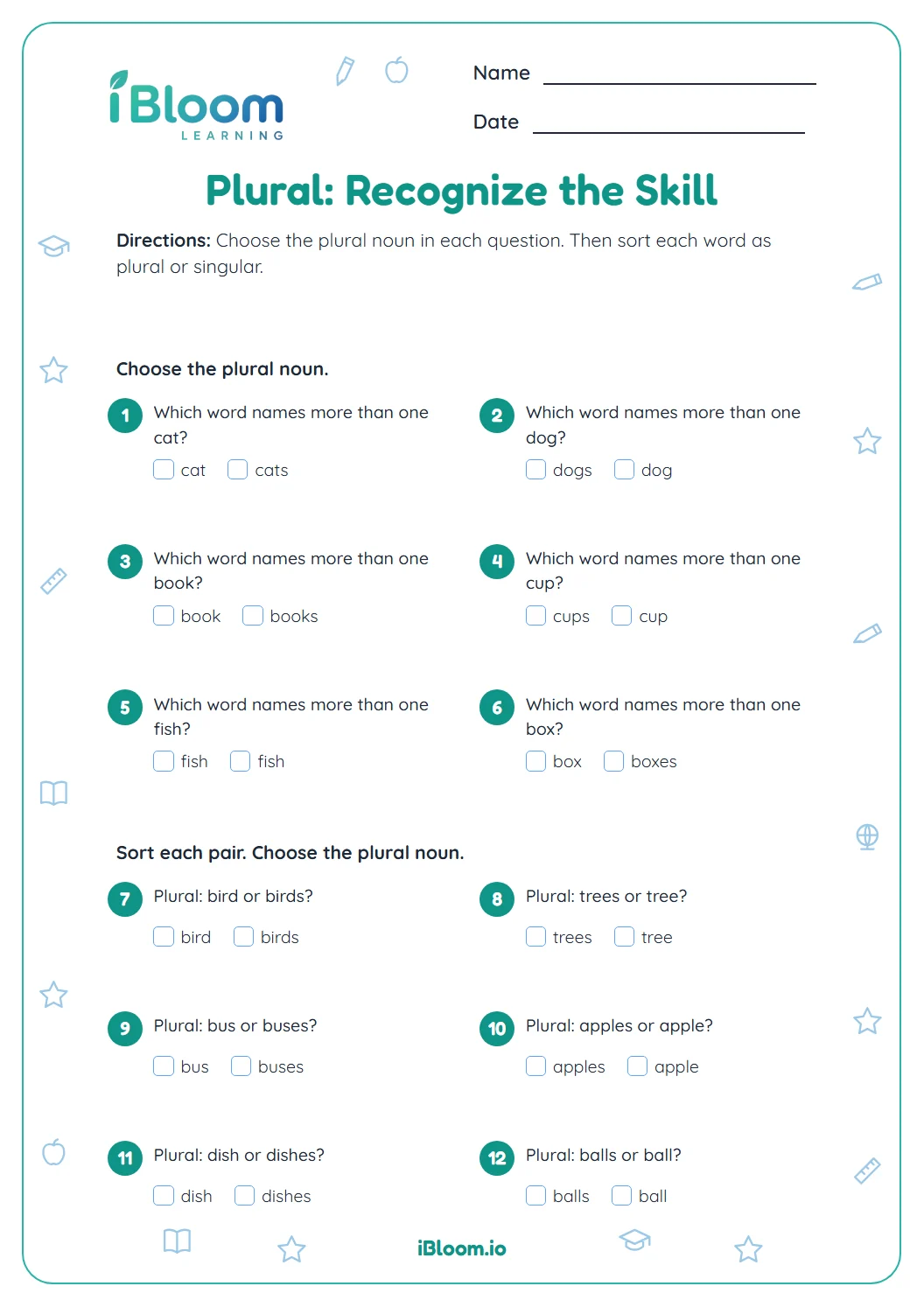
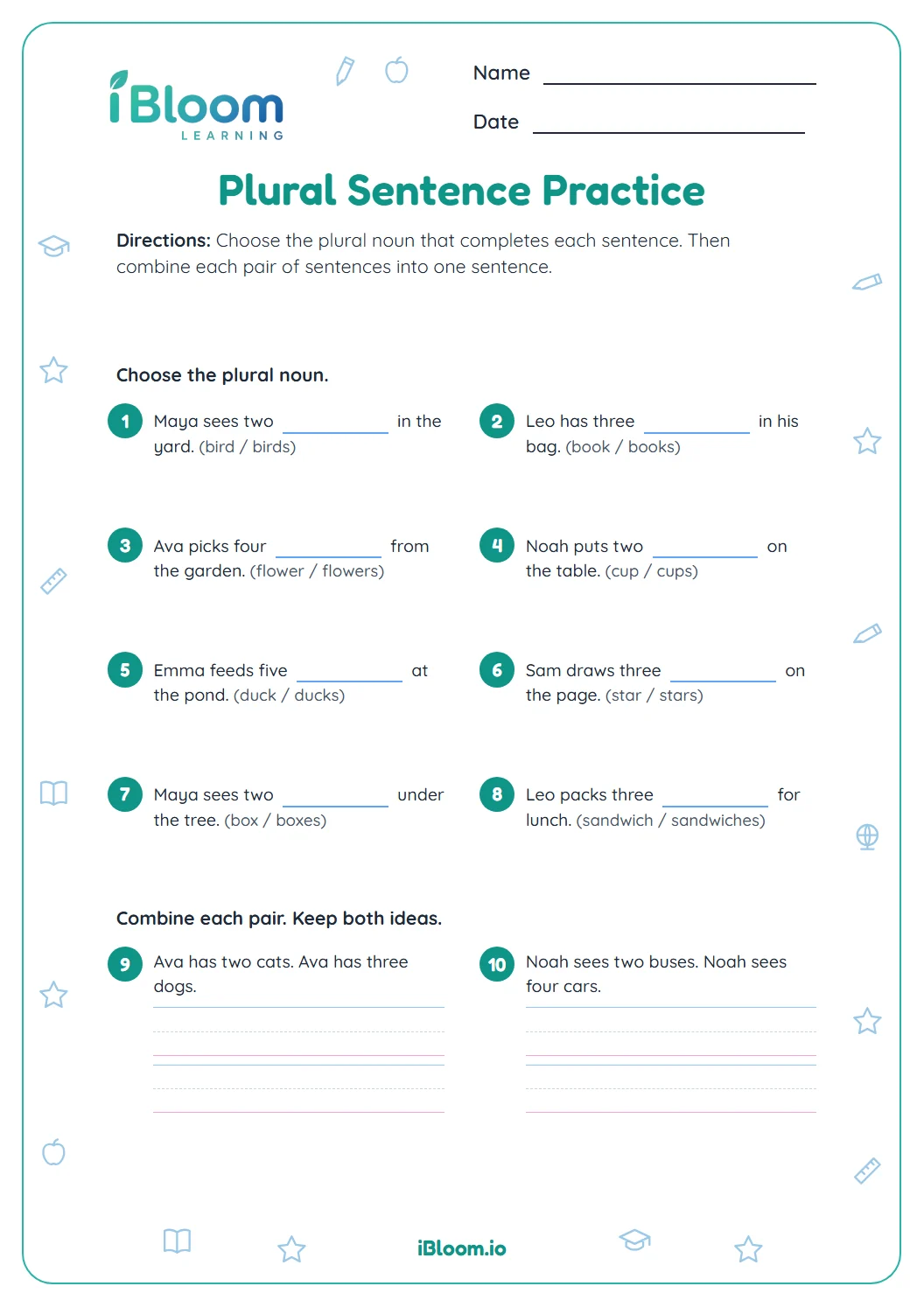
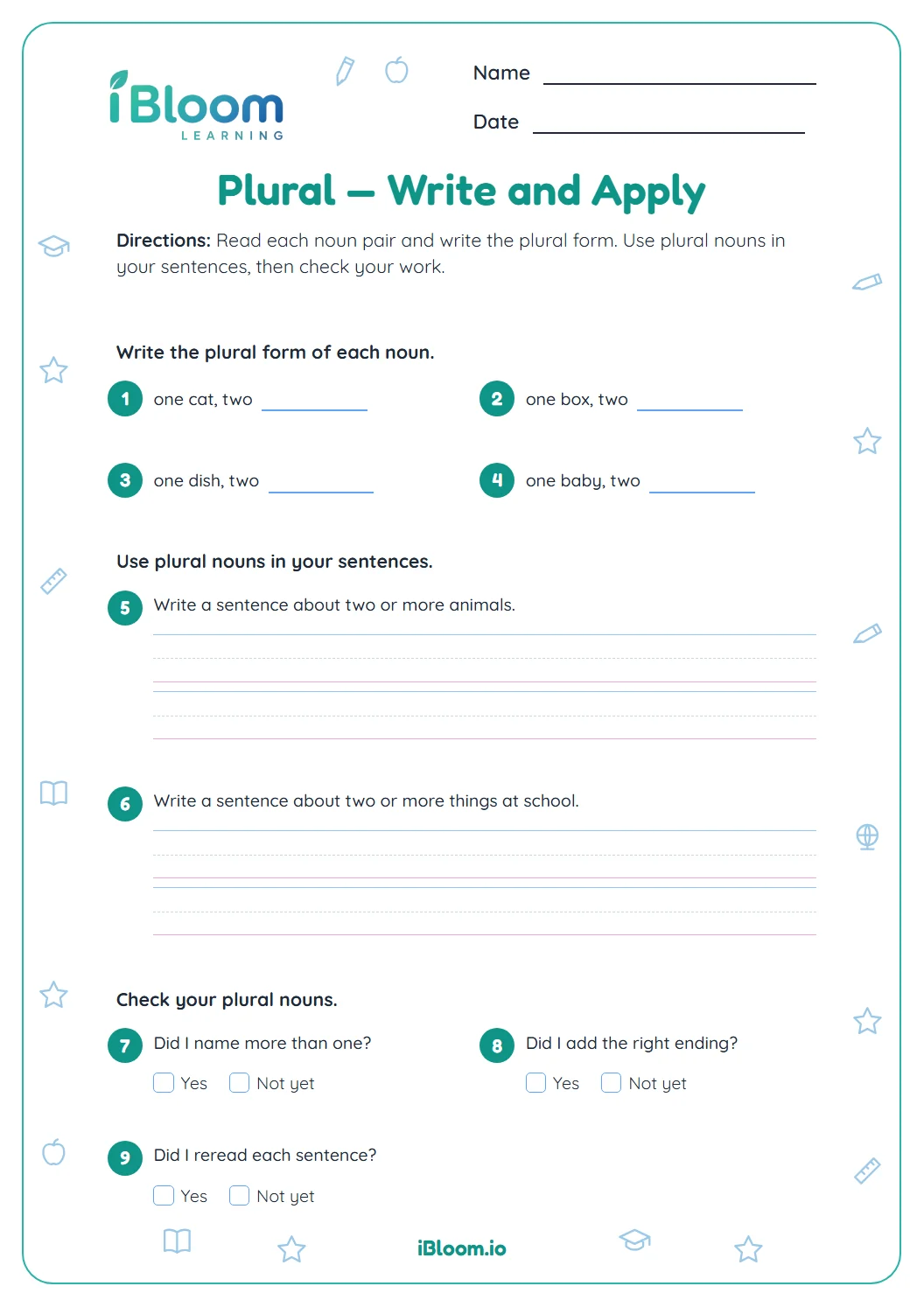
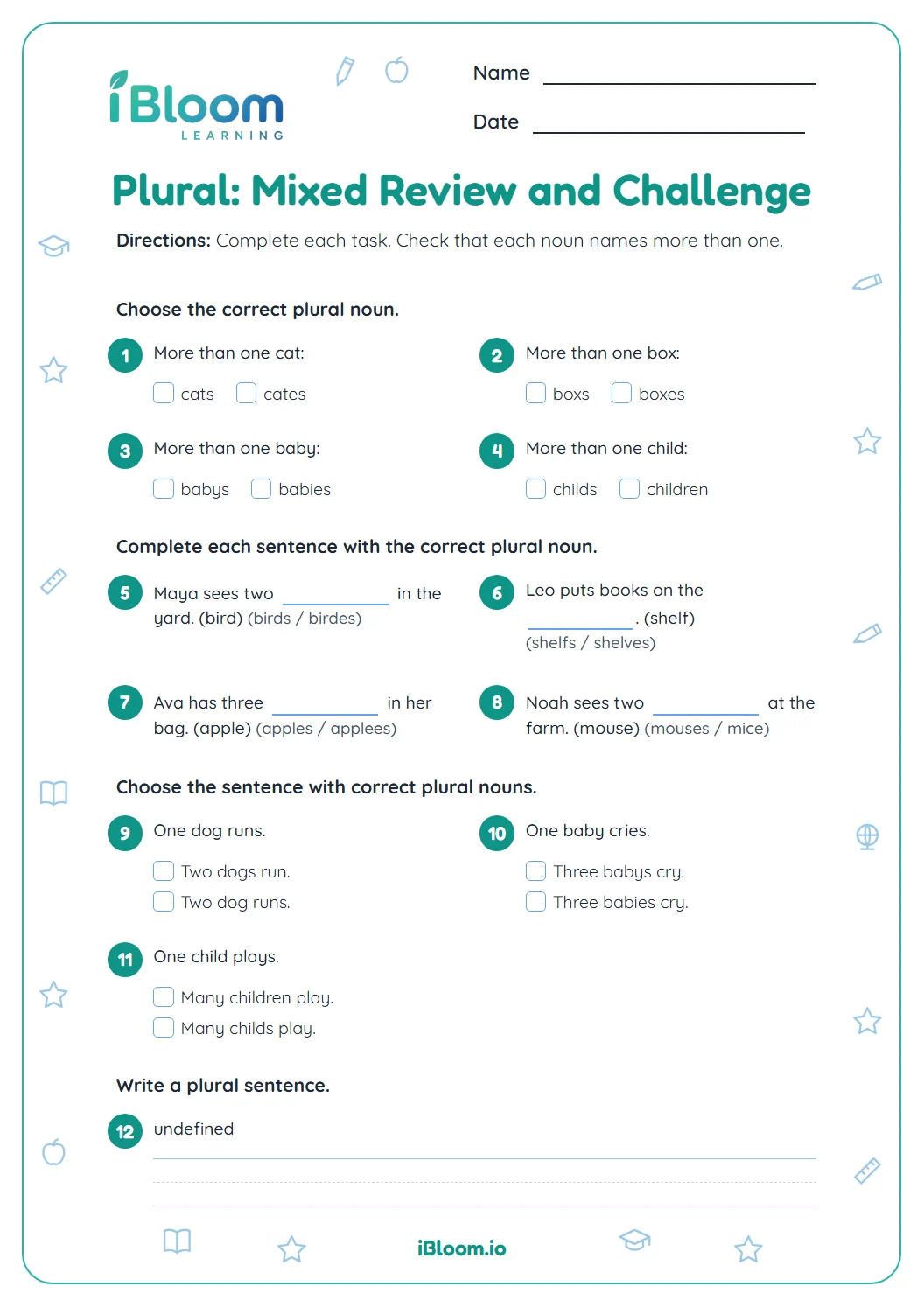
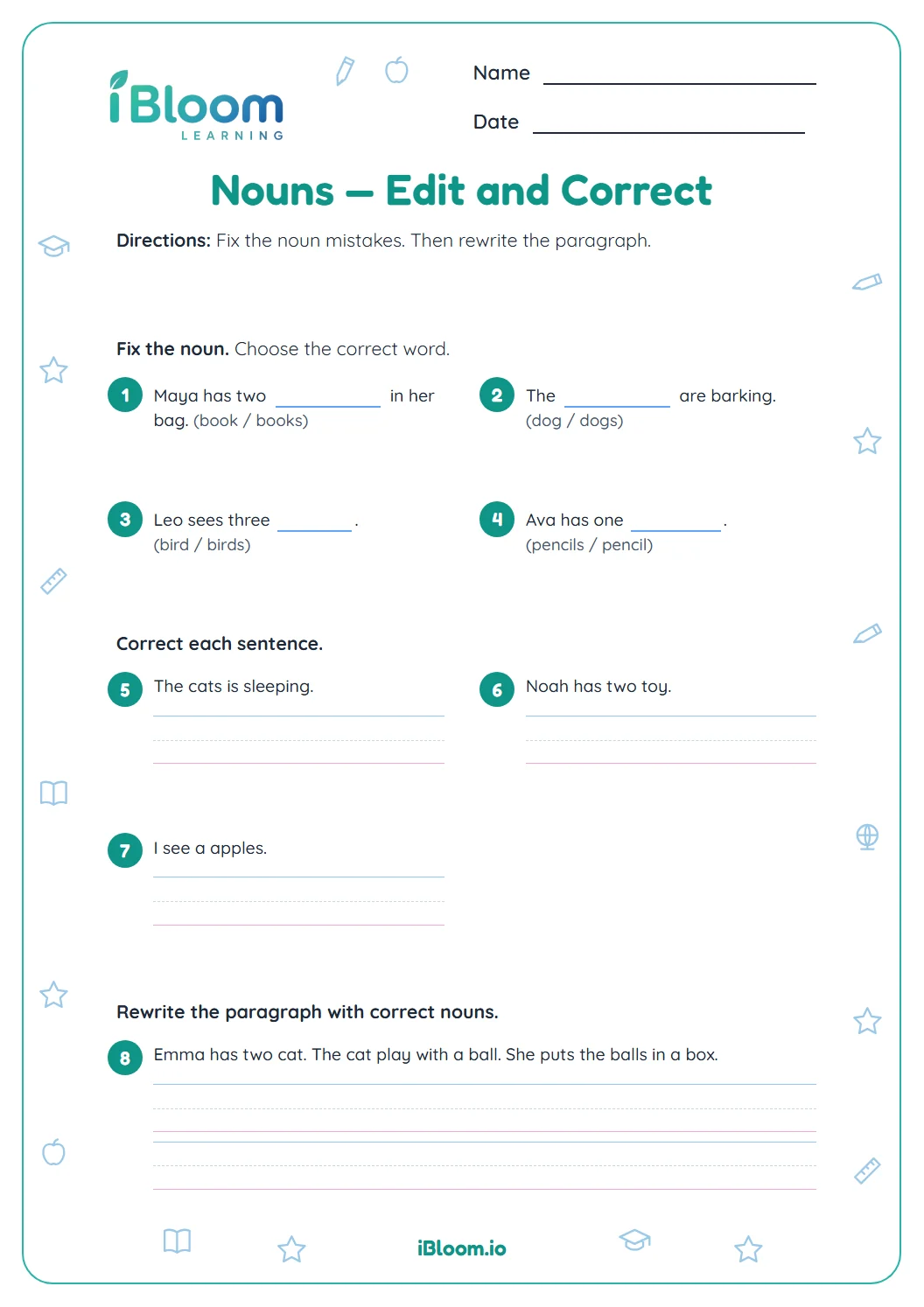
There are 16 questions in two parts. The first eight ask children to choose a plural form; the next eight ask them to write a plural noun in a short sentence. The two-page answer key shows the expected forms.
When does a noun usually add -s?
Most regular nouns add -s to name more than one: one cat becomes two cats, and one book becomes two books. Questions 1, 2, 6, 9, and 10 give children practice with this common pattern. They read each cue or sentence and write the plural form.
When should a noun add -es?
Many nouns ending in s, x, sh, or ch add -es. The worksheet practices buses, boxes, dishes, wishes, classes, lunches, and brushes. Have the child say the singular and plural aloud to hear how the ending changes the word.
Why does puppy become puppies?
When a noun ends in a consonant followed by y, change y to i and add -es. Puppy becomes puppies, and berry becomes berries. The final sentence items let children apply this spelling pattern while reading the whole sentence.
Can I accept another plural spelling?
The key gives the expected plural for each cue. In the open-response items, accept another spelling only if it correctly makes the given noun plural and fits the sentence. For the choices, use the printed answer because the options test a specific spelling.
How can we practice after the worksheet?
Pick nearby objects and name one, then more than one: one cup, three cups. Try a word ending in x or ch, such as box or lunch, and ask which letters change. This connects the worksheet’s -s and -es examples to everyday nouns.