




About this worksheet
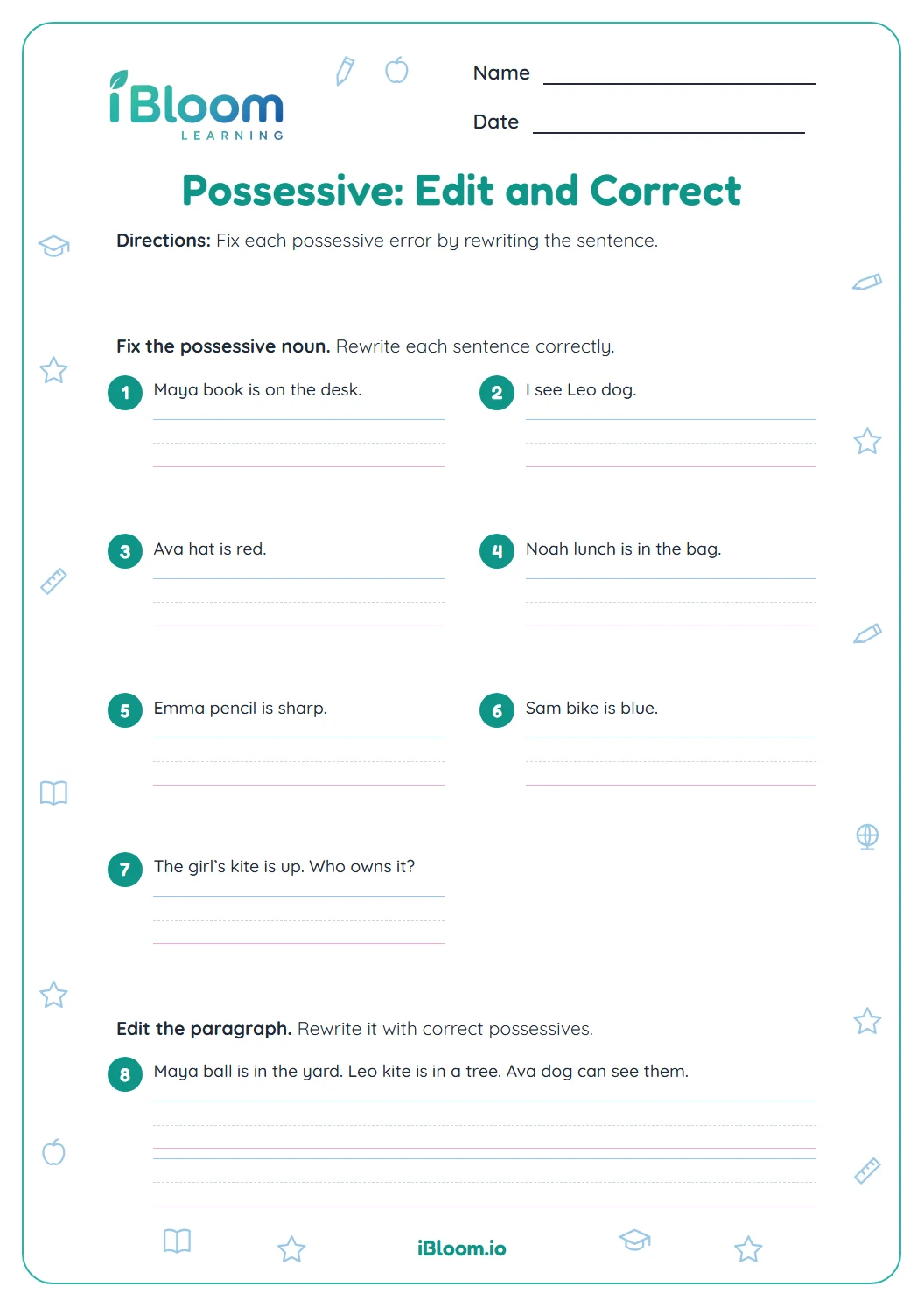
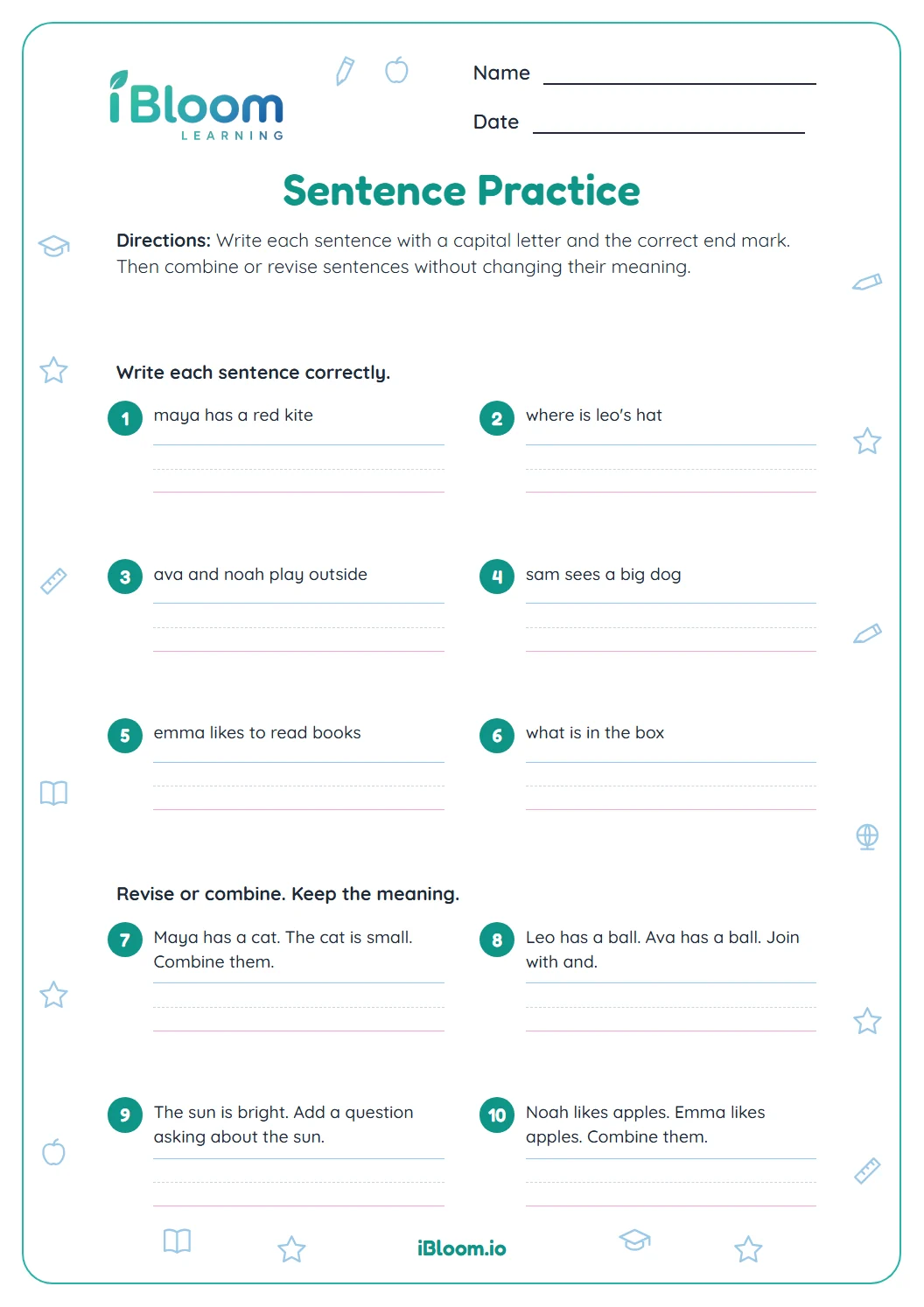
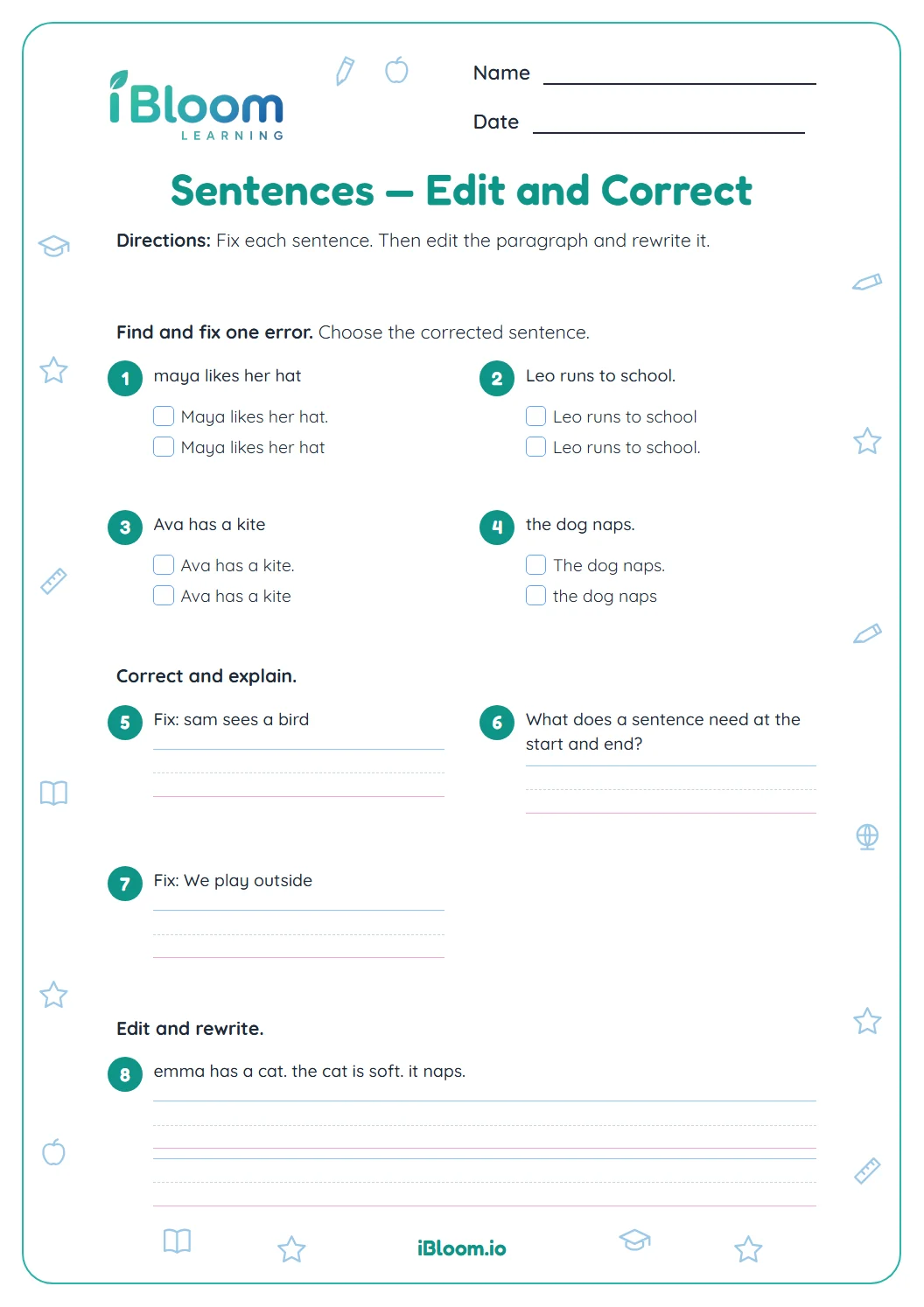
This Grade 1 grammar worksheet practices singular possessive nouns in short sentences. Students choose the phrase that shows ownership, combine two sentences, and correct possessive forms with apostrophe-s. The included answer key models each corrected sentence. Familiar people and objects let children focus on where the apostrophe belongs.
What does the worksheet ask students to do?
The questions ask students to choose possessive phrases and combine sentence pairs. Across 16 items, children practice putting apostrophe-s after the singular owner’s name or noun.
- 1Question 1: Maya has a red hat. It is ___.
- 2Answer: Maya’s hat
How can students work through each question?
Find the owner first. For one person or animal, write the noun, add an apostrophe, then s: “Noah’s dog.” Read the complete sentence to check that the possessive phrase makes sense.
How should families review the answers?
Check that the apostrophe comes after the complete owner noun and before the s. Then reread the sentence: “Mia’s drawing” shows the drawing belongs to Mia.
How to use this worksheet
- 1Read the direction for the first part together.
- 2Work through each question in order.
- 3Reread the prompt before writing an answer.
- 4Use the answer key to check each response.
Common mistakes and quick fixes
The mistake
Leaving out the apostrophe.
The fix
Place it before the s in a singular possessive.
The mistake
Putting the apostrophe after the s in these examples.
The fix
Write the singular owner followed by apostrophe-s: “Sam’s hat.”
The mistake
Making the item possessive instead of the owner.
The fix
Ask who owns it, then make that noun possessive.
What to practice next
Questions parents and teachers ask
What does a possessive noun show?
A possessive noun names who owns or has something. In this worksheet, students add apostrophe-s to a singular owner, as in “Mia’s lunch bag” or “the rabbit’s ears.” The owner is the noun that changes; the object stays the thing being owned.
Where does the apostrophe go?
For the singular possessives practiced here, put the apostrophe before the s at the end of the owner noun: dog’s, Sam’s, or teacher’s. The item being owned stays in its regular form. The examples focus on one owner, which keeps the apostrophe-s pattern consistent throughout.
How many parts and questions are included?
There are 16 questions in four parts. Students complete possessive forms, choose or edit sentences, fill in a possessive blank, and correct a sentence. The separate answer key gives the intended wording. Questions move from choosing forms to completing and correcting sentences with the same pattern.
What is one example from the sheet?
Question 1 reads, “The ___ tail wagged. (dog).” The owner is dog, so the completed phrase is “dog’s tail.” The apostrophe-s belongs to the owner, not to the tail. Notice that dog’s means the tail belongs to the dog, while tail remains unchanged.
Can students make their own possessive sentences?
Yes. After completing the page, invite the child to name an owner and an item, then say a sentence such as “Ava’s cup is blue.” The same singular owner + apostrophe-s pattern appears throughout the worksheet. An adult can read each sentence aloud and ask the child to identify the owner.