




About this worksheet
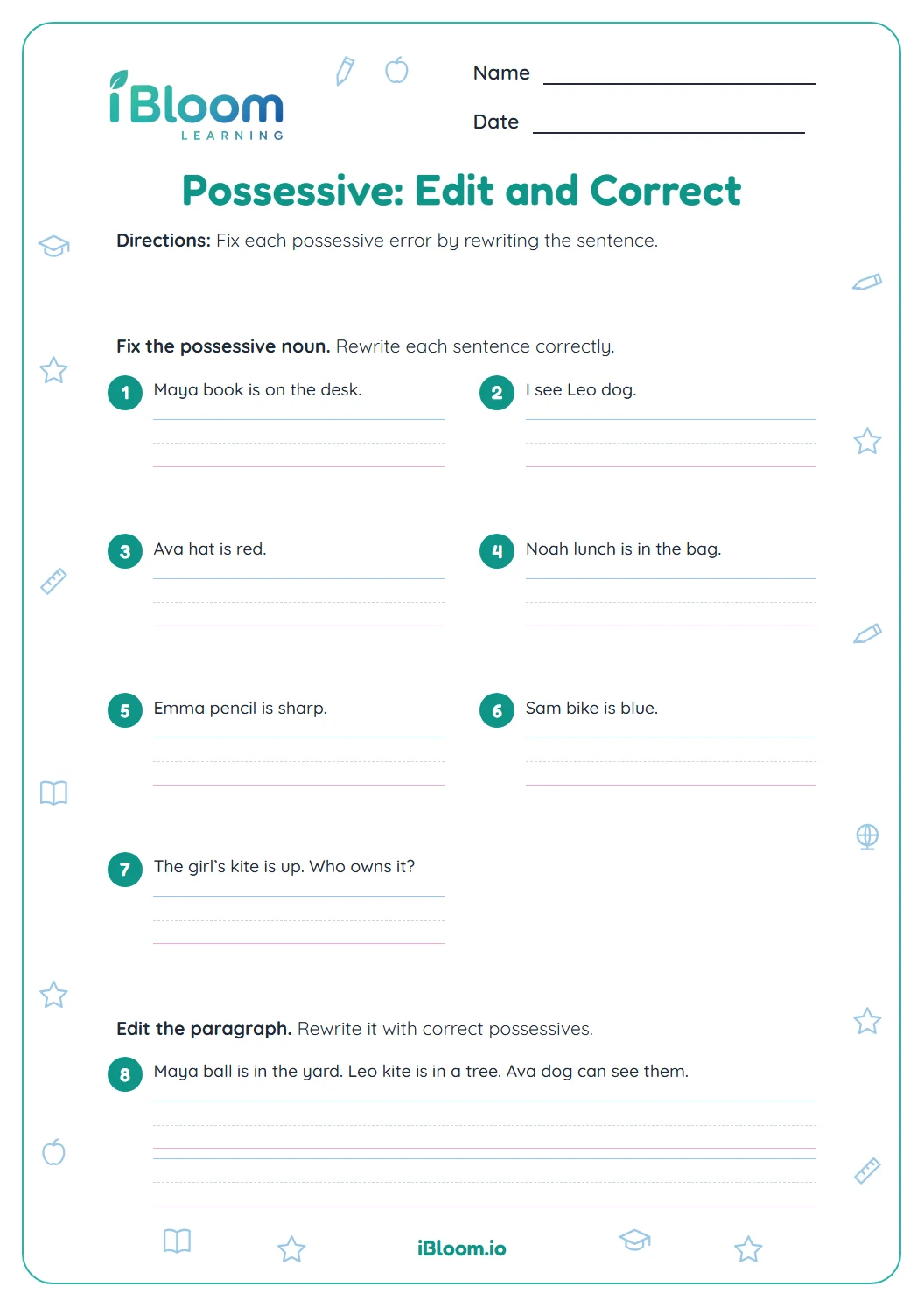
This Grade 1 printable practices possessive nouns, the forms that show who owns something. Part A chooses the form that completes a sentence; Part B makes singular, irregular plural, and regular plural nouns possessive; Part C reads and edits ownership phrases. Fifteen questions fill two worksheet pages, with a separate answer key and a final sentence-writing prompt. The practice aligns with L.1.1b.
Aligned to L.1.1b
What does each part ask students to do?
Part A chooses a possessive form for a sentence. Part B adds the correct ending to singular, irregular plural, and plural nouns. Part C identifies ownership in a phrase, edits a sentence, and writes an original example.
How can you form a singular possessive?
First name the owner, then add an apostrophe and s. For “The ___ bowl is full. (one cat),” the owner is one cat, so the completed phrase is “the cat’s bowl.”
Where does the apostrophe go for plural owners?
For a regular plural that already ends in s, add the apostrophe after the s: girls’ coats. An irregular plural such as children does not end in s, so add apostrophe-s: children’s room.
How to use this worksheet
- 1Read the owner clue in parentheses or sentence.
- 2Decide whether the owner is one or more than one.
- 3For a singular owner, add apostrophe-s.
- 4For a regular plural ending in s, place the apostrophe after the s.
- 5Reread the phrase and check that the owner matches the clue.
Common mistakes and quick fixes
The mistake
Writing girls’s for a plural owner.
The fix
Because girls already ends in s, put the apostrophe after that s: girls’.
The mistake
Using cats’ for one cat.
The fix
Count the owners: one cat takes cat’s; more than one cat takes cats’.
The mistake
Changing the owner while editing.
The fix
Keep the owner named in the sentence and add the apostrophe in the right place.
Common Core alignment
This sheet gives students practice with the following standard.
Use possessive nouns to show ownership in the sentence choices, word forms, and edits.
On this sheet: Use possessive nouns to show ownership in the sentence choices, word forms, and edits.
Show the official wordingHide the official wording
Use common, proper, and possessive nouns.
What to practice next
Make more practice
Further reading
Questions parents and teachers ask
What is a possessive noun?
A possessive noun names who owns something. In “the dog’s leash,” dog’s shows that one dog owns the leash. This worksheet asks children to choose possessive forms, make nouns possessive, and edit ownership sentences, then gives a separate answer key.
How do you write a singular possessive?
For one owner, add apostrophe-s to the noun: the boy’s hat or grandma’s garden. Part B gives clues such as “one cat” so learners can practice choosing the singular form before writing the whole word. Learners can explain the owner aloud before writing the form.
How is a plural possessive different?
A regular plural noun ending in s takes an apostrophe after the s, as in girls’ coats. An irregular plural like children takes apostrophe-s: children’s room. Both patterns appear in the formation section. Learners can say the owner aloud before choosing where the apostrophe goes.
What does the answer key include?
The separate key lists the correct possessive forms and sentence edits. The final prompt is open-ended, so the key provides one sample sentence; another sentence is also correct if it clearly shows something a friend owns. This gives children a chance to apply the rule to a new example.
How can an adult help without giving the answer?
Ask the learner to point to the owner and say whether it is one owner or more than one. Then have them explain where the apostrophe belongs. This keeps attention on the clue that determines the written form. This keeps the review focused on the owner and the written form.