
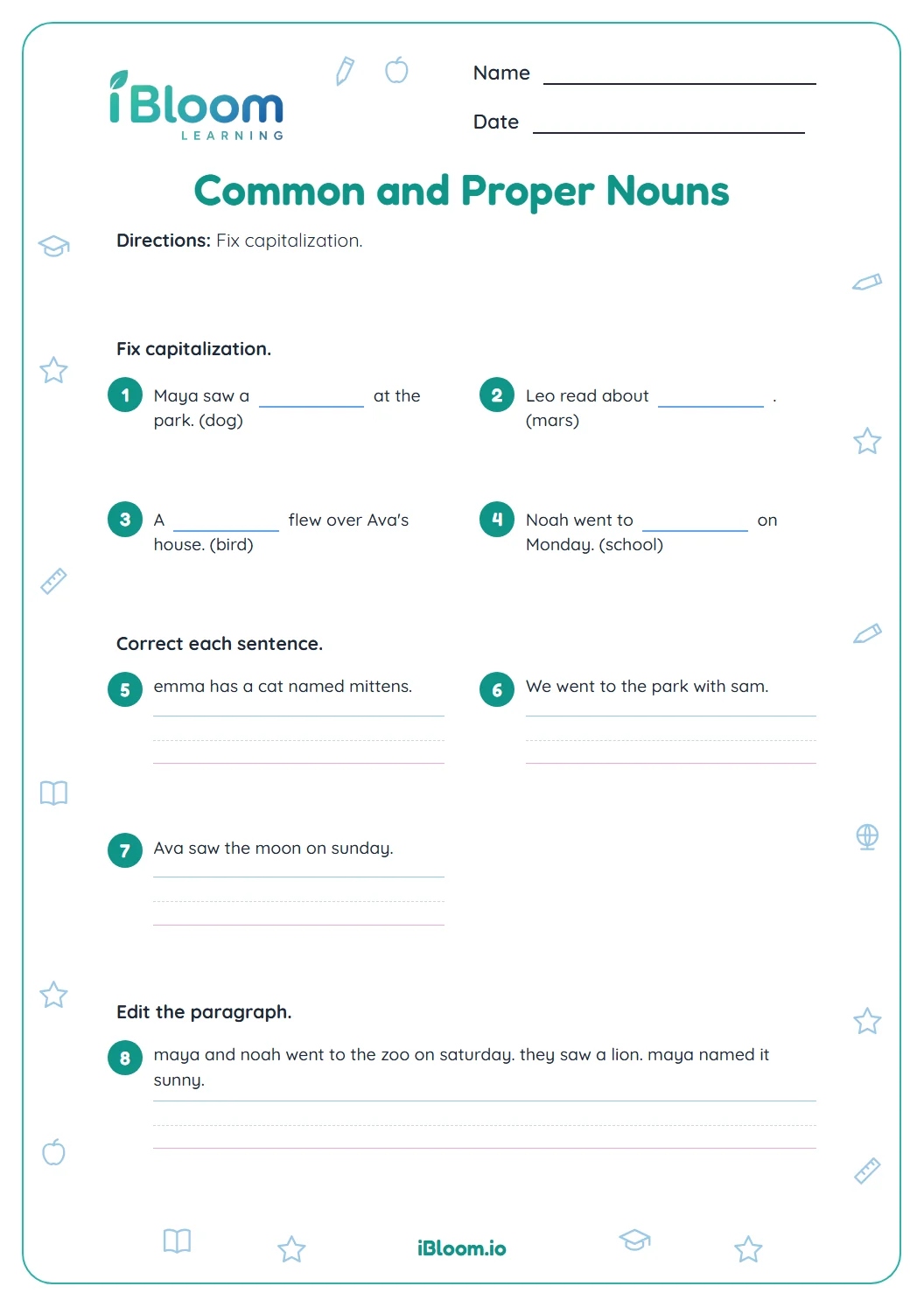
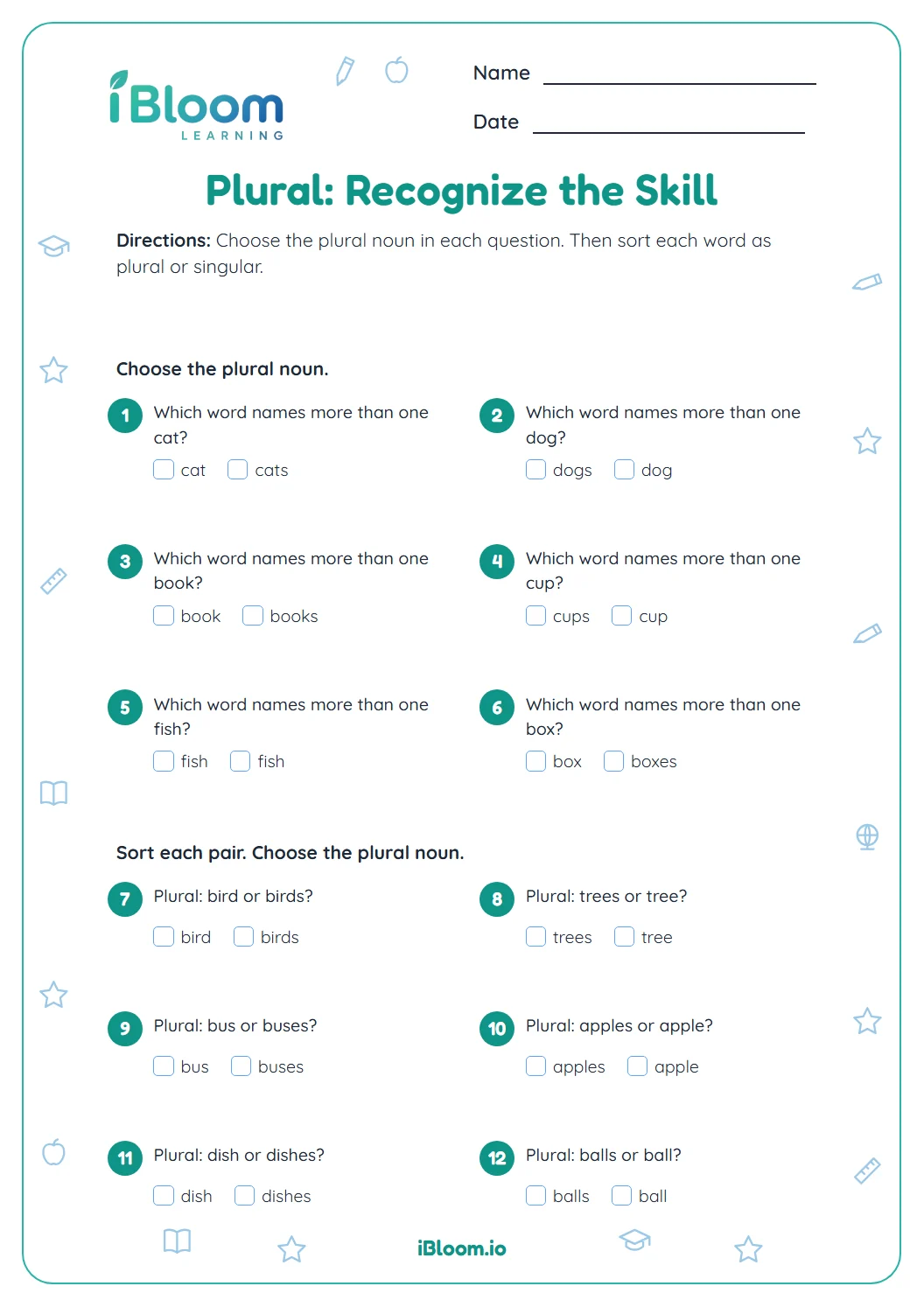
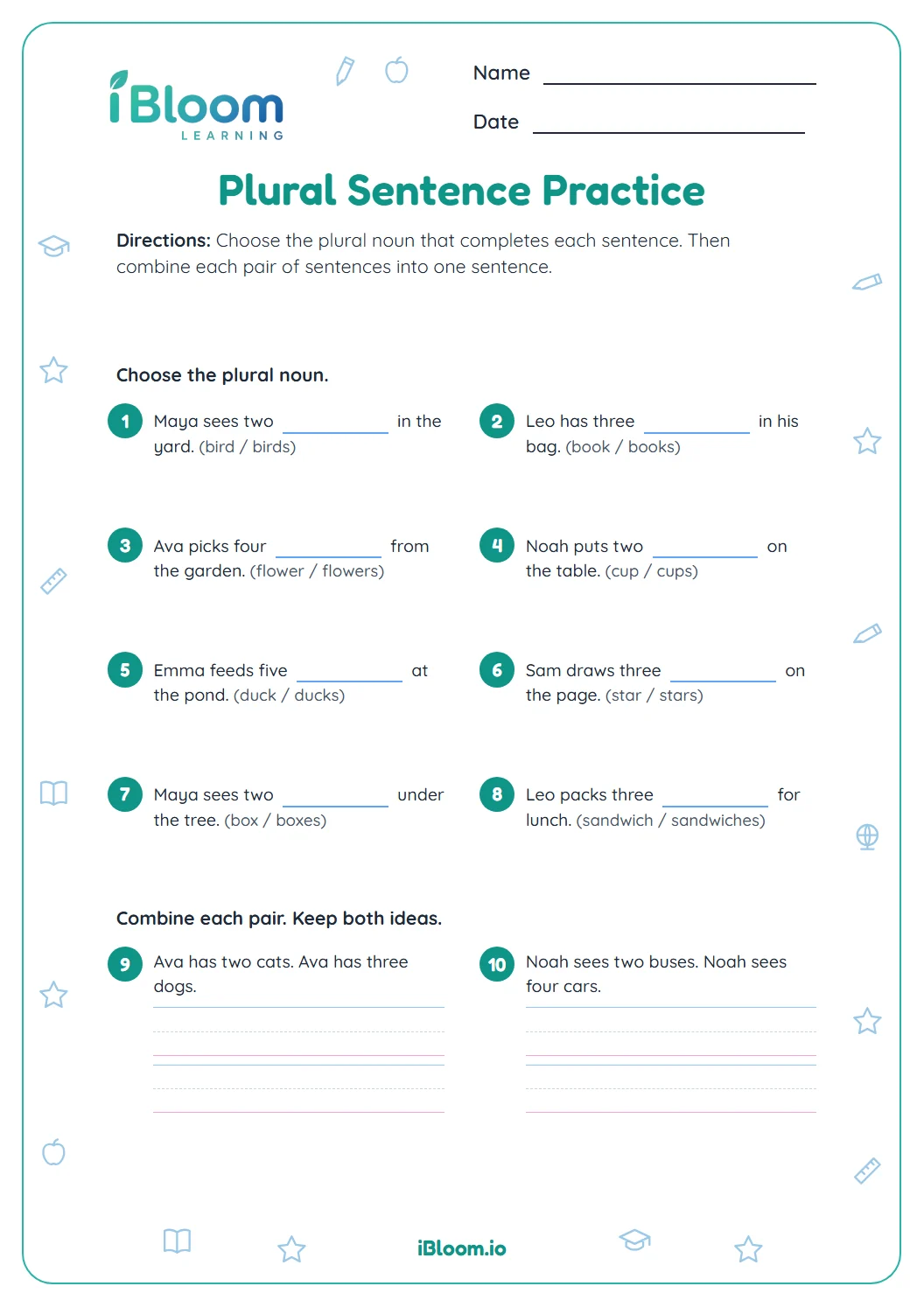

About this worksheet
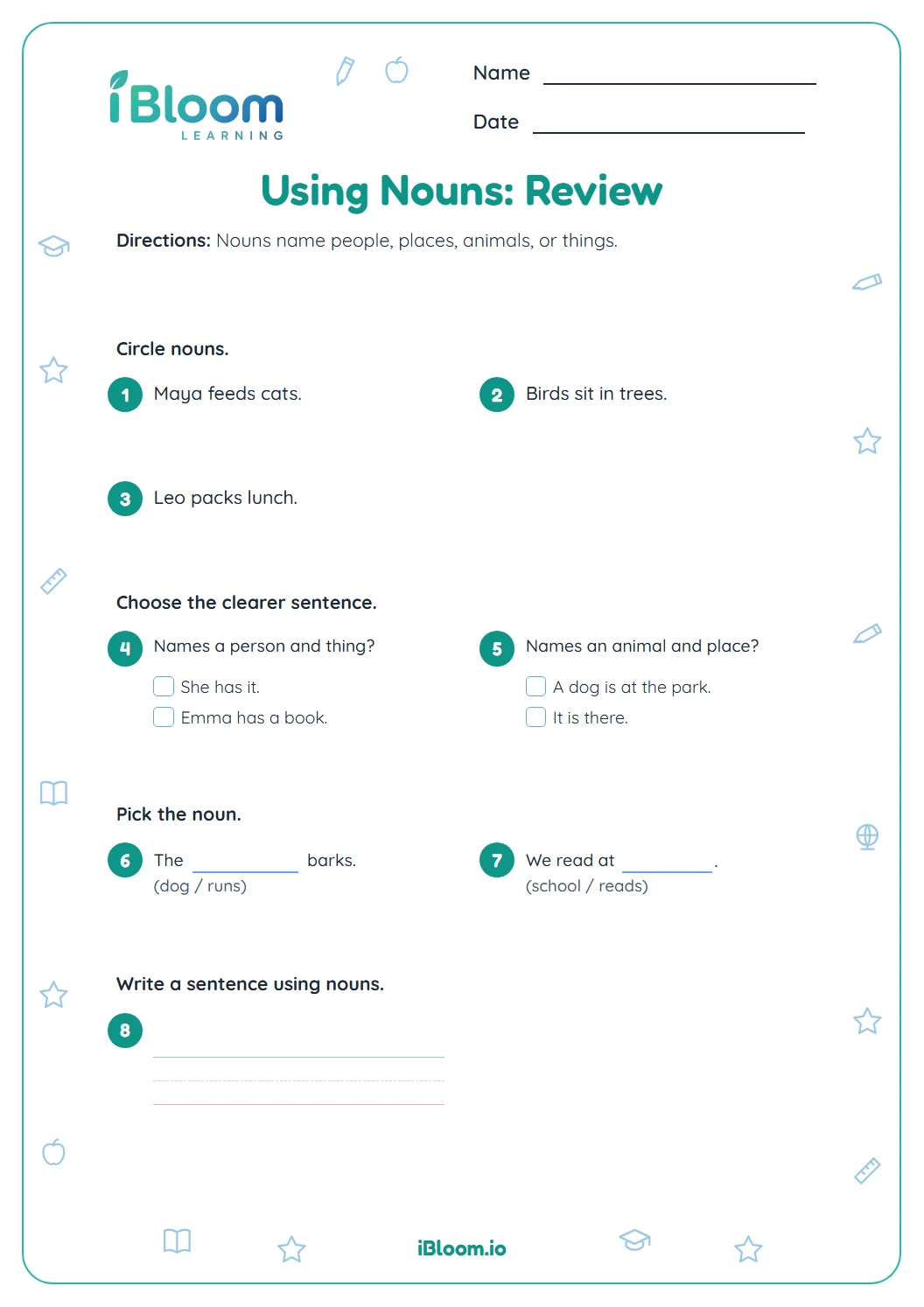
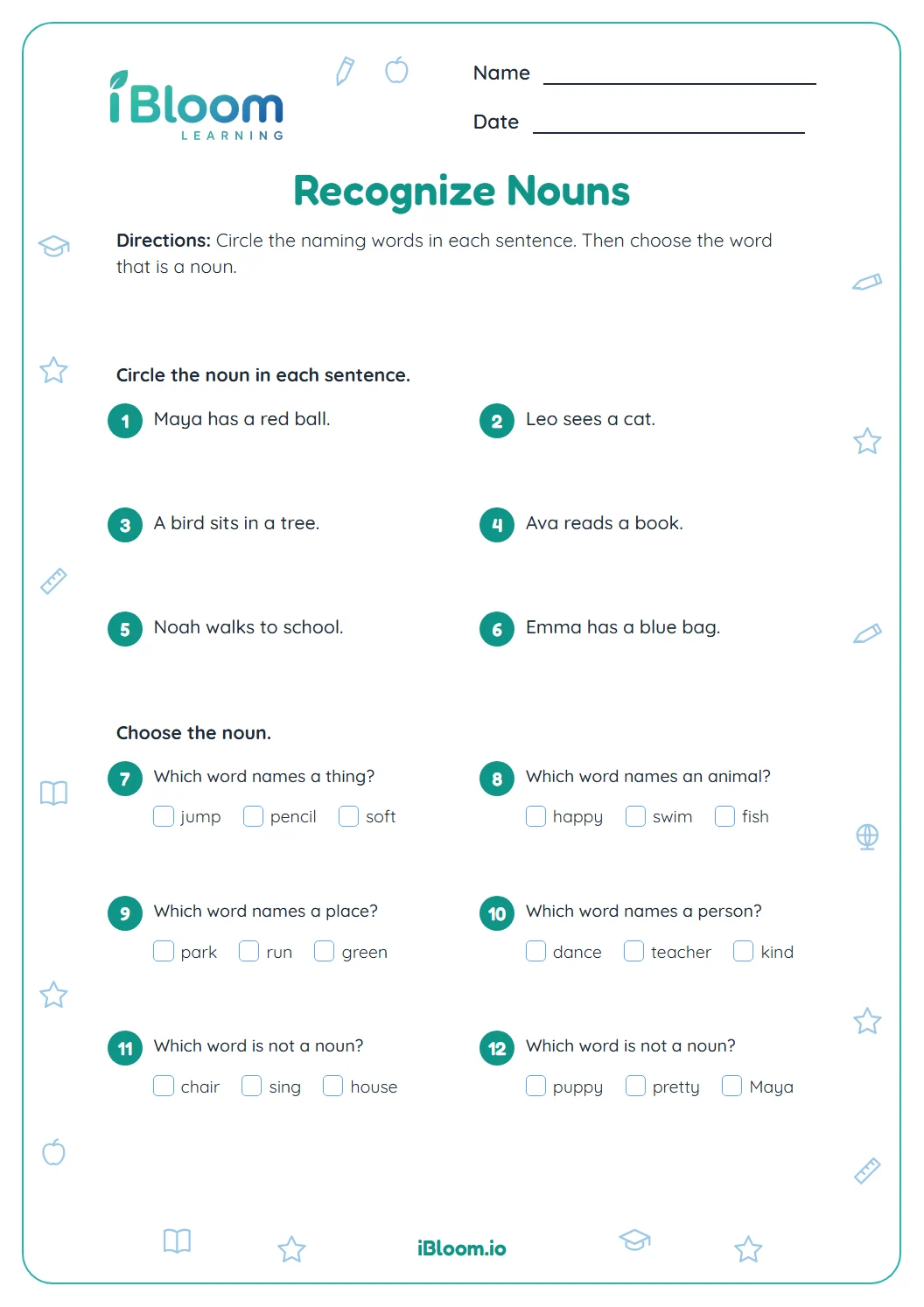
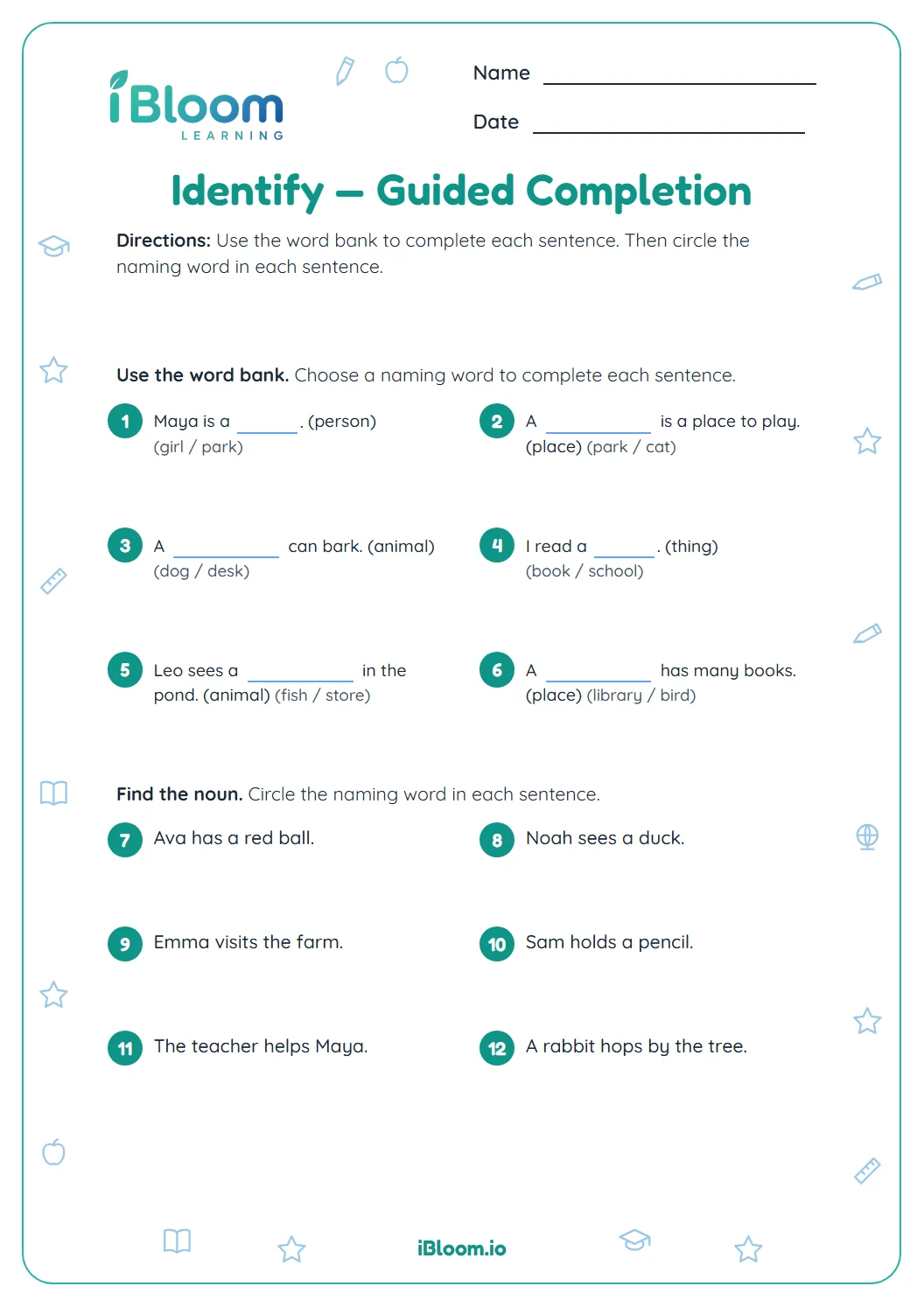
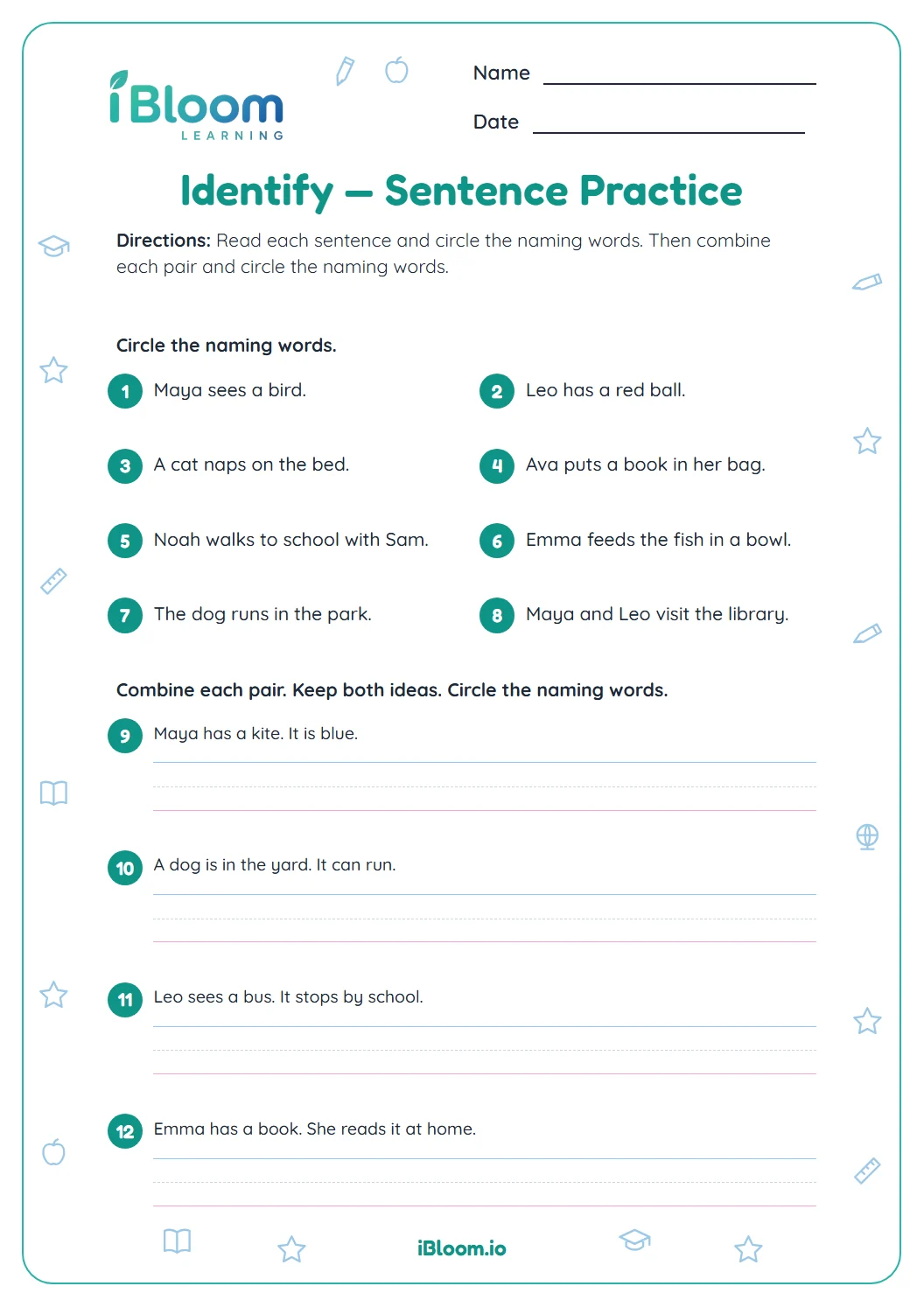
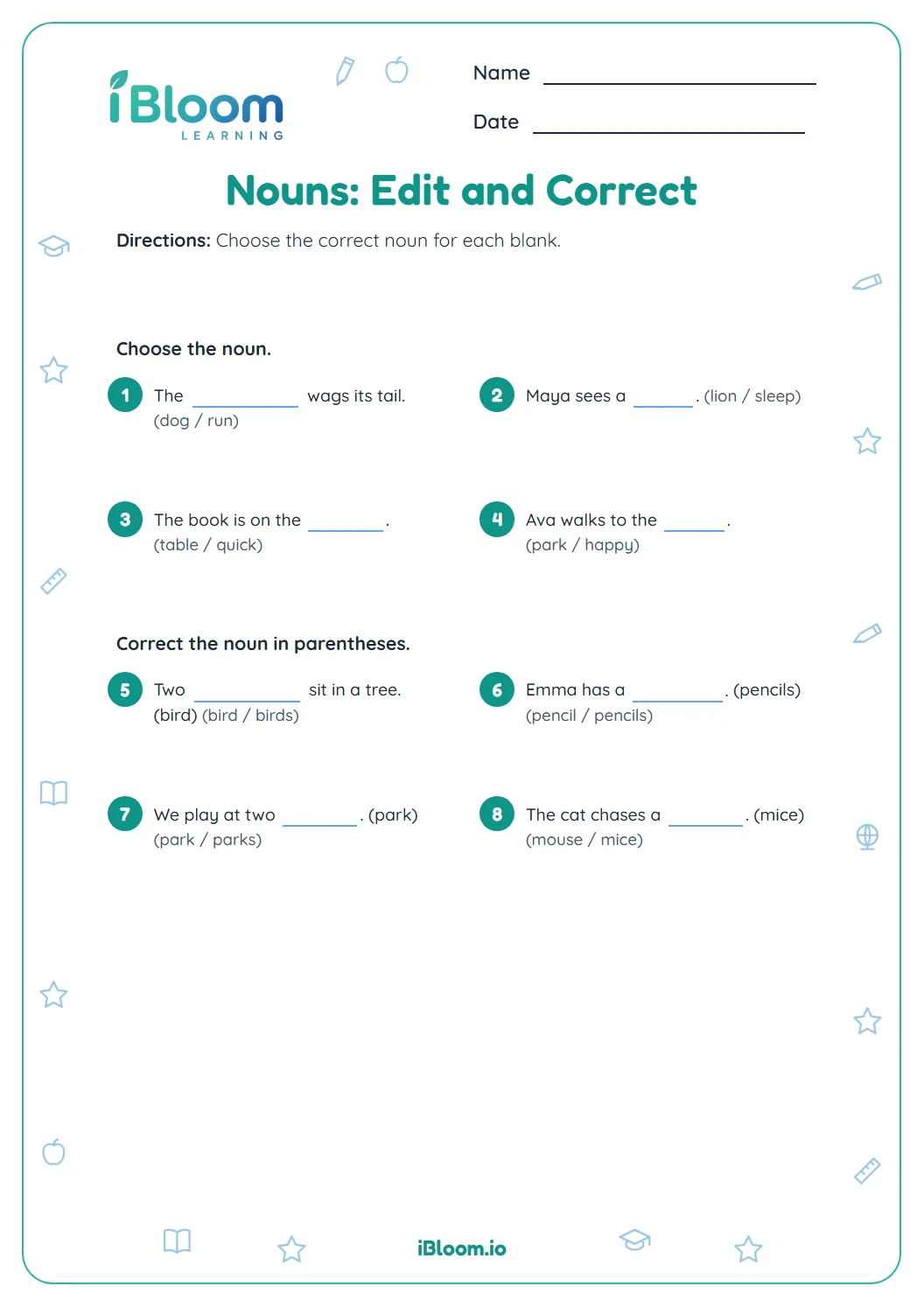
This free Grade 1 printable gives students 15 chances to recognize nouns and use them in sentences. Children first select nouns and sentences with naming words, then fill sentence blanks with nouns, and finally write three original sentences. The practice connects common nouns to people, places, animals, and things and aligns with CCSS L.1.1.b. The answer key gives the correct selections and sample sentences for the open responses.
Aligned to L.1.1.b
How can a student spot a noun?
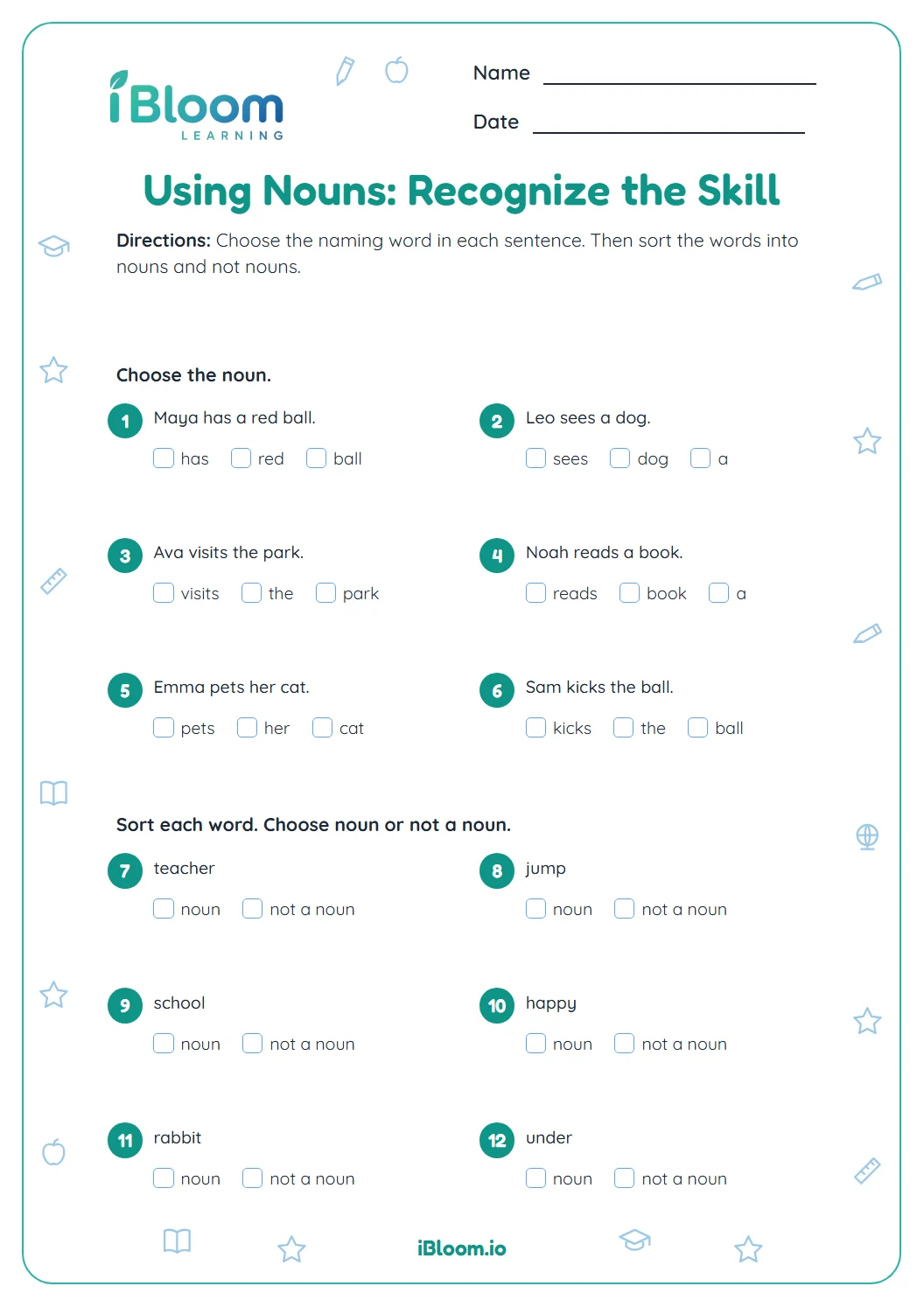
Look for a word that names someone or something. “Teacher,” “school,” “rabbit,” and “book” are nouns. Questions 1–7 ask students to identify nouns or choose a complete sentence that includes one.
How does a noun complete a sentence?
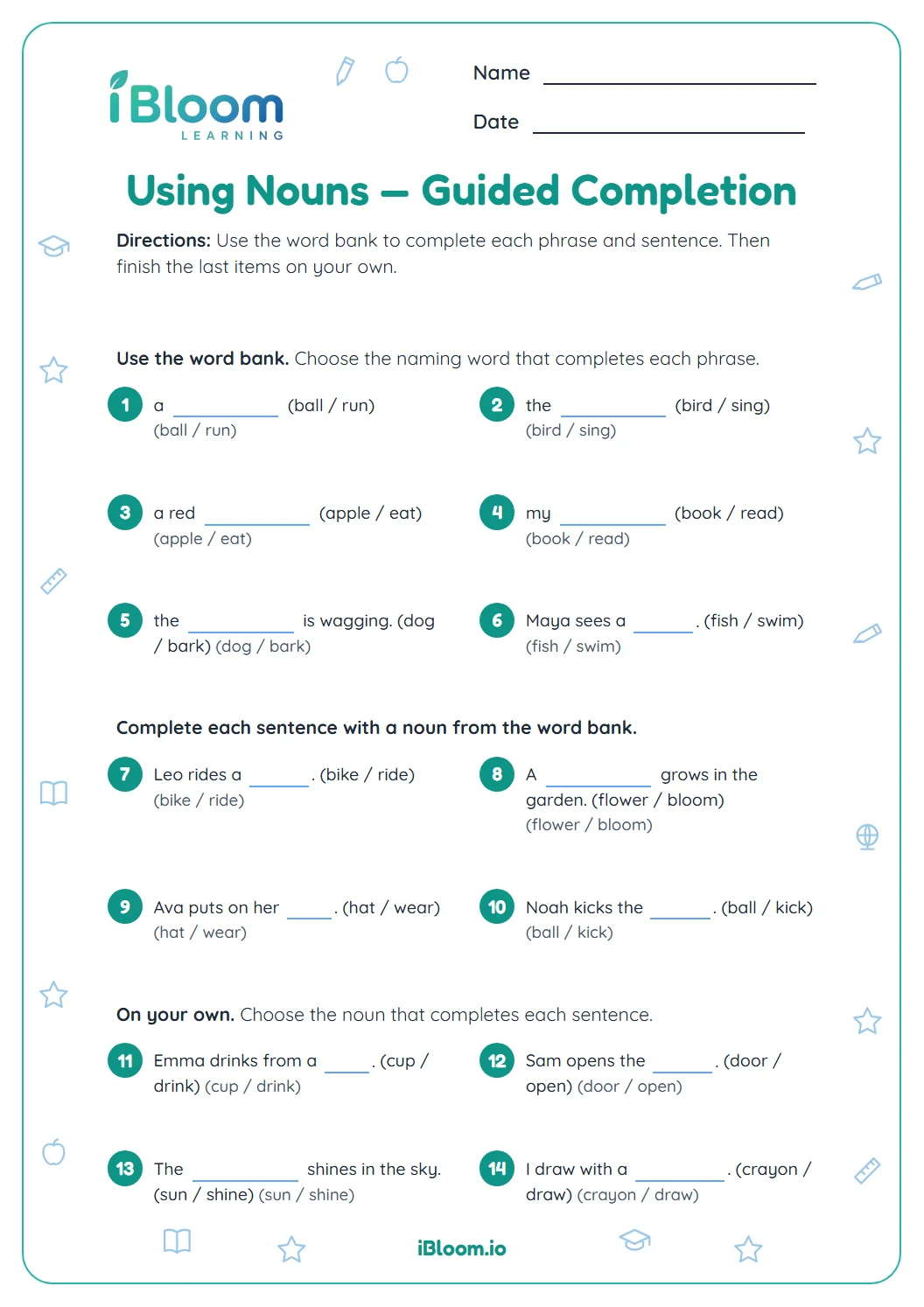
A sentence needs words that tell who or what it is about. In “A ___ shines in the sky,” the missing noun names what shines. Read the sentence to find a naming word that fits.
- 1A ___ shines in the sky.
- 2The sentence names what shines: sun.
How can students use nouns in their own sentences?
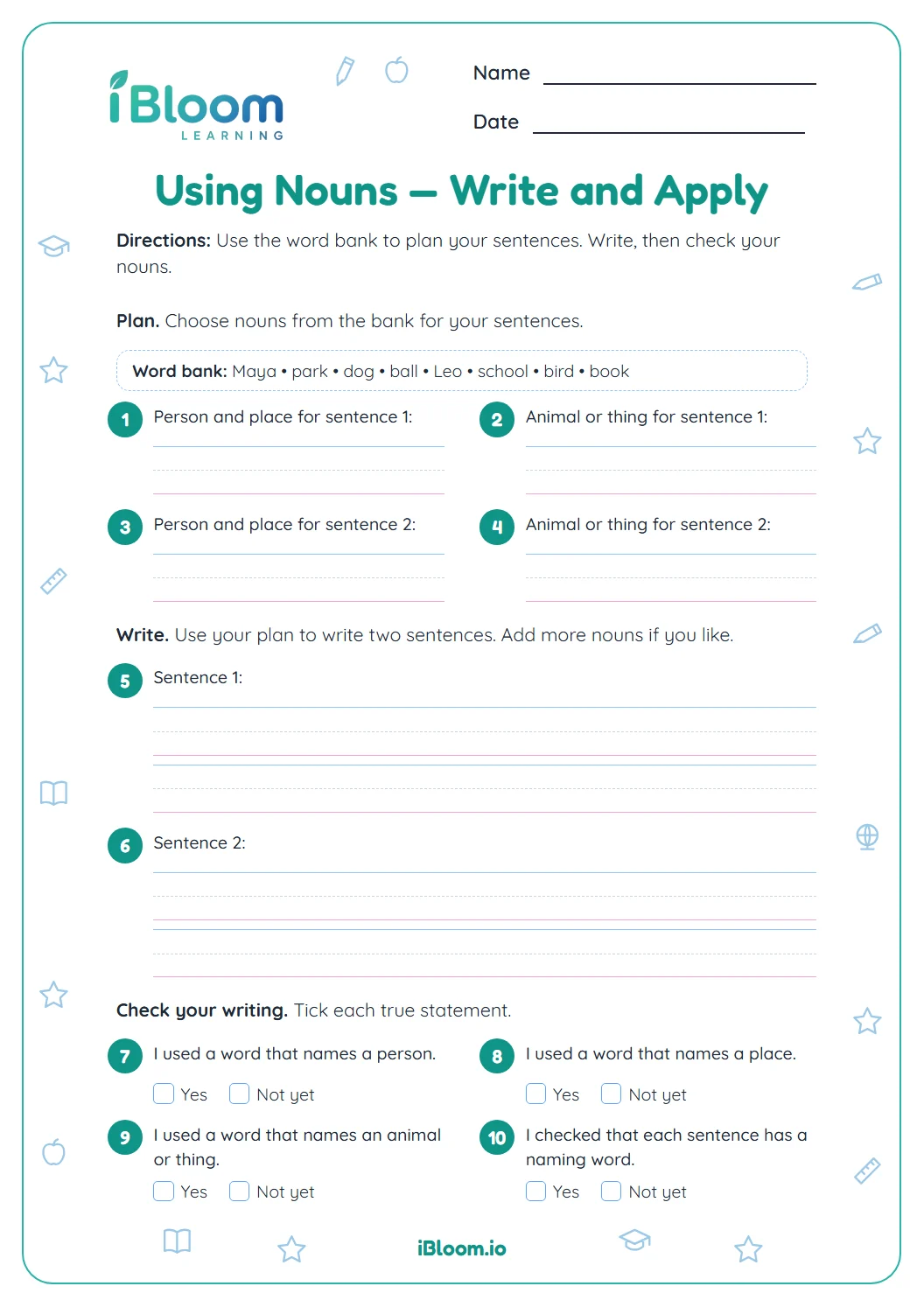
The last three prompts ask students to use a named noun in a complete thought. A useful response has a person or thing and tells what it does or is.
How can a student work through the page?
- 1Read the whole sentence before choosing.
- 2Ask who or what the sentence names.
- 3Check that a noun fits the blank.
- 4For the writing prompts, include the requested noun.
- 5Reread each sentence to check that it is complete.
What should students check?
The mistake
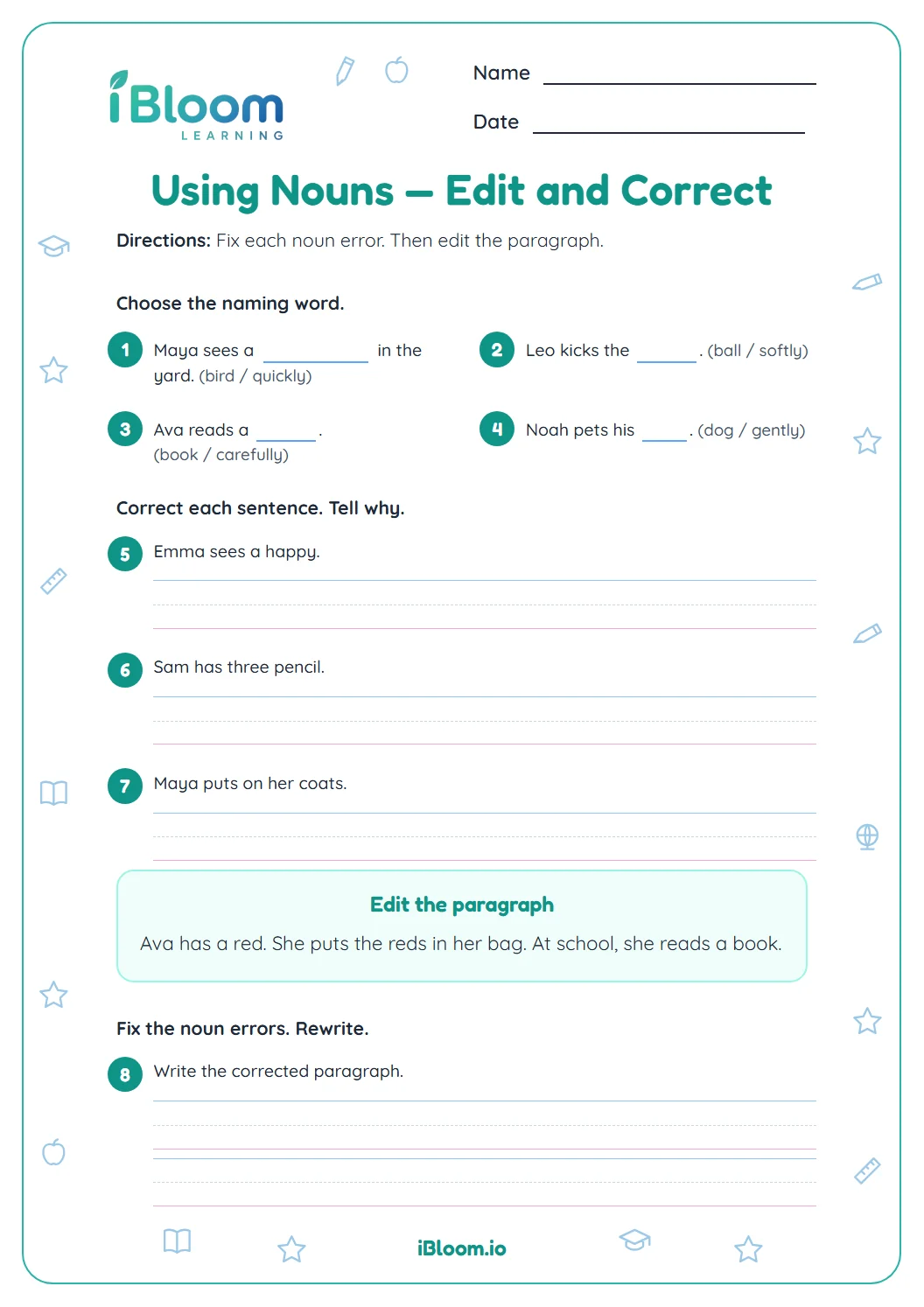
Choosing an adjective such as “blue” as the noun.
The fix
Ask what person, place, animal, or thing the word names.
The mistake
Writing only the requested noun instead of a sentence.
The fix
Add who or what the sentence is about and what it does.
The mistake
Adding a noun that does not make sense in the sentence.
The fix
Read the whole sentence aloud with the noun in place.
Students identify and use common nouns in their own sentences.
On this sheet:
Show the official wordingHide the official wording
Use common, proper, and possessive nouns.
What to practice next
Make more practice
Further reading
Questions parents and teachers ask
What does a noun name?
A noun names a person, place, animal, or thing. Examples on this page include teacher, school, rabbit, book, and kite. Students first identify nouns in choices, then use them in complete sentences. Invite the student to name the person or thing in each sentence.
How many questions are included?
There are 15 questions across two worksheet pages: seven selection questions, five sentence blanks, and three original sentence prompts. A separate answer key gives the selections and sample responses. The questions move from recognizing nouns to using them in complete sentences.
Can answers to the last three prompts vary?
Yes. The final prompts ask children to write their own complete sentences using specified nouns. The key gives one sample for each; another sentence is correct if it uses the named noun and forms a sensible complete thought. A sample answer is a guide; another sensible complete sentence can work.
Should children circle every noun in a sentence?
This page focuses on choosing and using nouns rather than marking every noun in a longer passage. For each item, children can ask who or what is named, then check that their chosen noun fits the sentence. Read each whole choice and ask what person, place, animal, or thing it names.
What makes a sentence complete?
A complete sentence gives a whole thought. These writing prompts work well when the child names a person, place, animal, or thing and adds what it does or what it is, such as “The rabbit hops.” A subject and an action or description help a sentence express a whole thought.
What practice can follow this page?
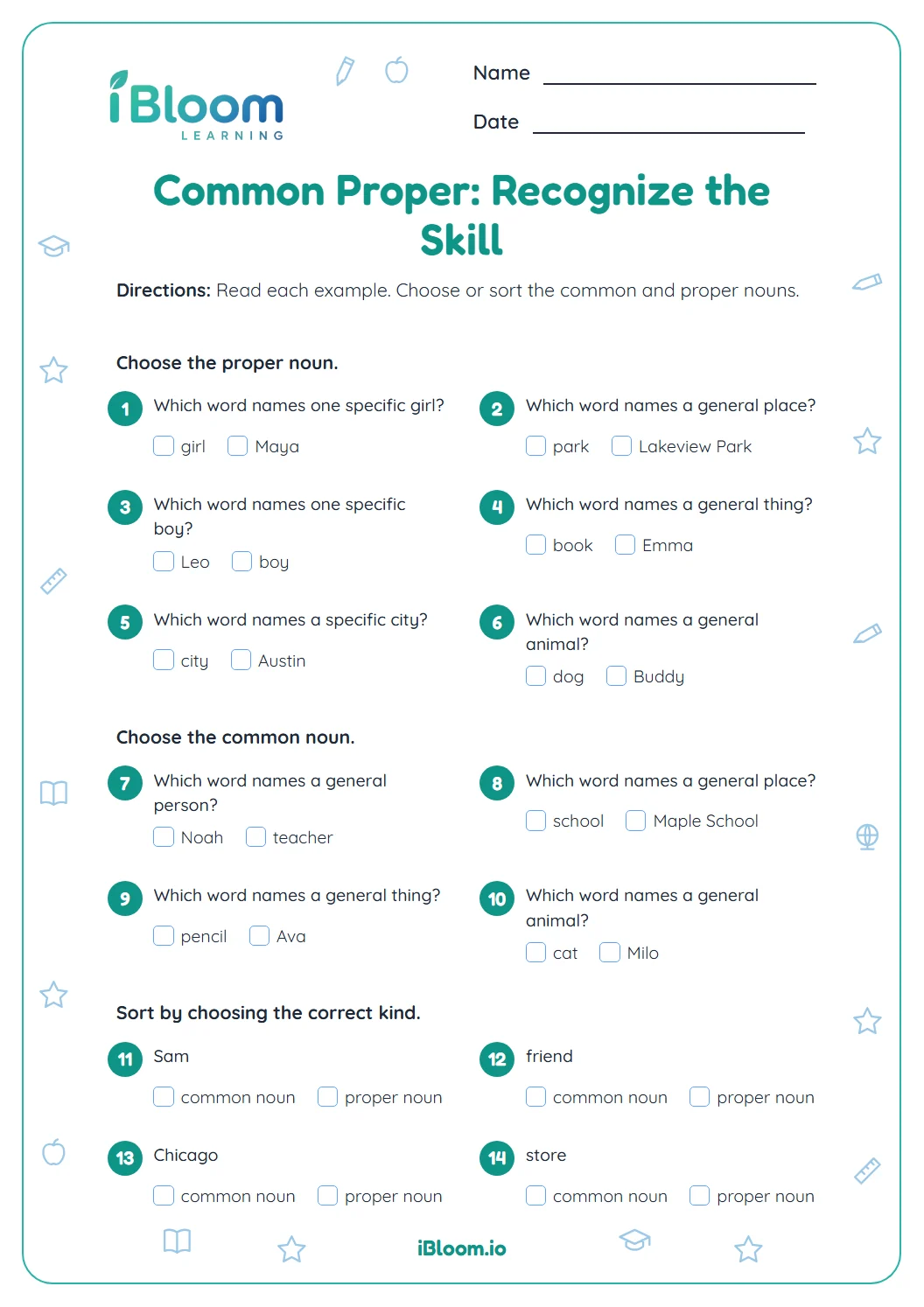
After students are comfortable with common nouns, they can sort common and proper nouns or explore plural nouns. Those skills build on recognizing what a noun names. Students can build on this by noticing how nouns change when they name more than one.