







About this worksheet
This Grade 1 narrative writing worksheet uses a first-day story about Maya, who arrives at school feeling shy and leaves with a new friend. Students recall story details, sequence events with time words, and write short narratives with a closing sentence. The answer key includes sample responses for open writing prompts. The writing practice aligns with CCSS W.1.3: recounting sequenced events with details, temporal words, and closure.
Aligned to W.1.3
How can a story show events in order?
Look for what happens first, next, and at the end. In Maya’s story, she arrives at school before meeting Ava at recess. Time phrases make the order clear.
- 1Which event happens first?
- 2Maya arrives at the school door.
- 3She meets Ava later at recess.
Which words help readers follow time?
First, then, and at the end tell when events happen. A time word works best when it connects directly to an event in the sentence.
What gives a first-day story a clear ending?
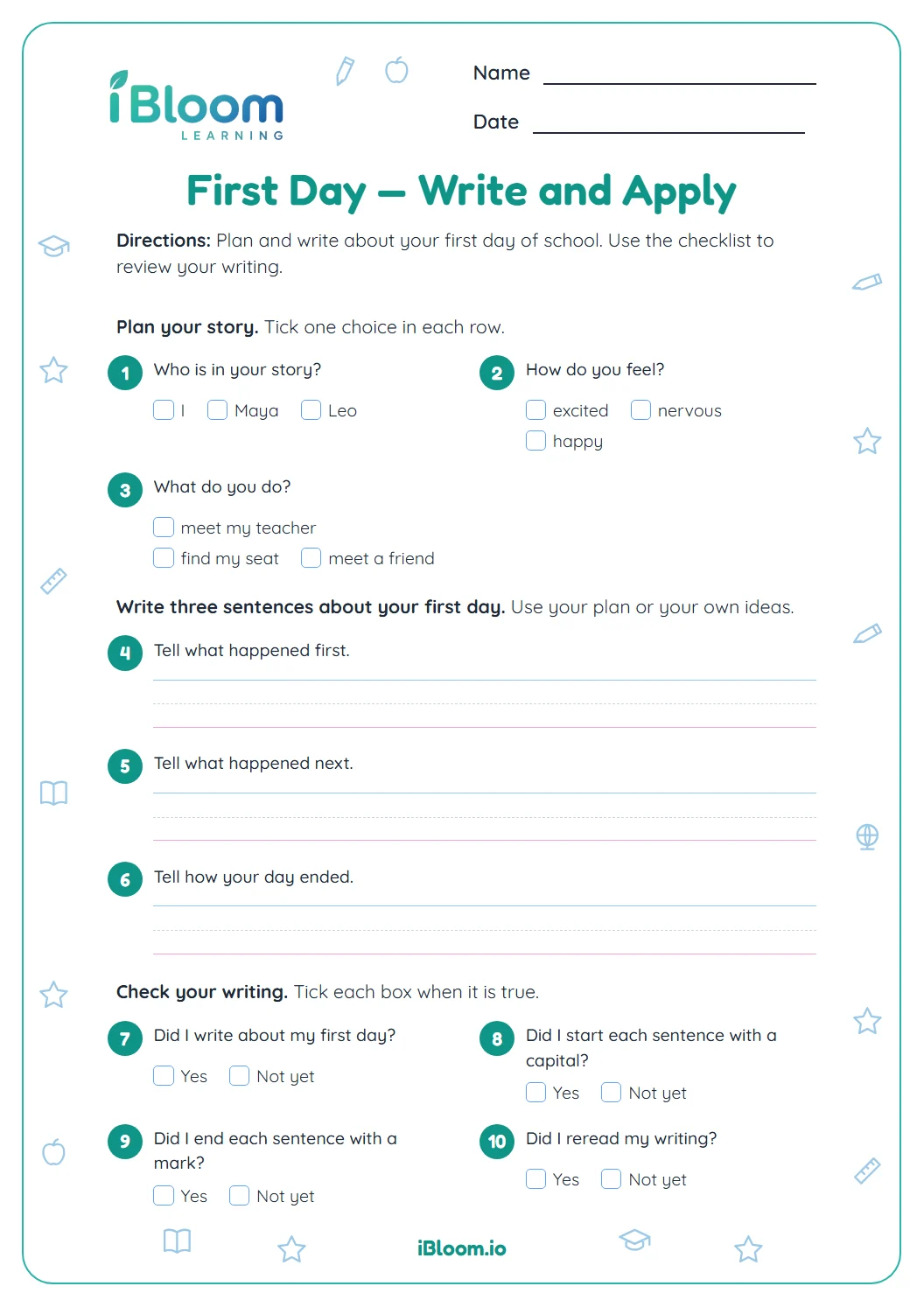
A short narrative can introduce a moment, tell two events in order, include a detail, and finish with a closing sentence. The final questions invite students to build those pieces with their own first-day ideas.
How to use this worksheet
- 1Read the passage once for the whole story.
- 2Reread to find who, where, and how Mina feels.
- 3Use first, then, and at the end to track event order.
- 4Answer with a story detail when a question asks how or why.
- 5For the writing prompts, tell events in order and add one useful detail.
- 6Read the final sentence to check that it closes the story.
Common mistakes and quick fixes
The mistake
Listing events in an order that changes what happened.
The fix
Reread the passage and point to the first, next, and last event.
The mistake
Using a time word without connecting it to an event.
The fix
Put the time word at the start of a sentence that tells what happened then.
The mistake
Stopping after the middle event.
The fix
Add a final sentence that tells how the moment ends.
Common Core alignment
Students write sequenced events with details, time words, and a closing sentence.
Write sequenced story events with details, time words, and a closing.
On this sheet: The final prompts ask students to write connected events with temporal words and an ending.
Show the official wordingHide the official wording
Write narratives in which they recount two or more appropriately sequenced events, include some details regarding what happened, use temporal words to signal event order, and provide some sense of closure.
What to practice next
Make more practice
Further reading
Questions parents and teachers ask
What happens in the passage?
Maya arrives at school holding Dad’s hand and feels shy. Ms. Lee shows her a desk; at recess, Maya meets Ava and plays with a red ball. Later she tells Dad about her new friend. Students use these details to answer the questions and organize a short narrative.
How does the worksheet practice event order?
Questions 5 through 7 ask students to identify what happens first, what follows, and which detail belongs near the end. The next part uses time phrases. In the writing part, students put events in order and add details or a closing sentence.
What time words do students use?
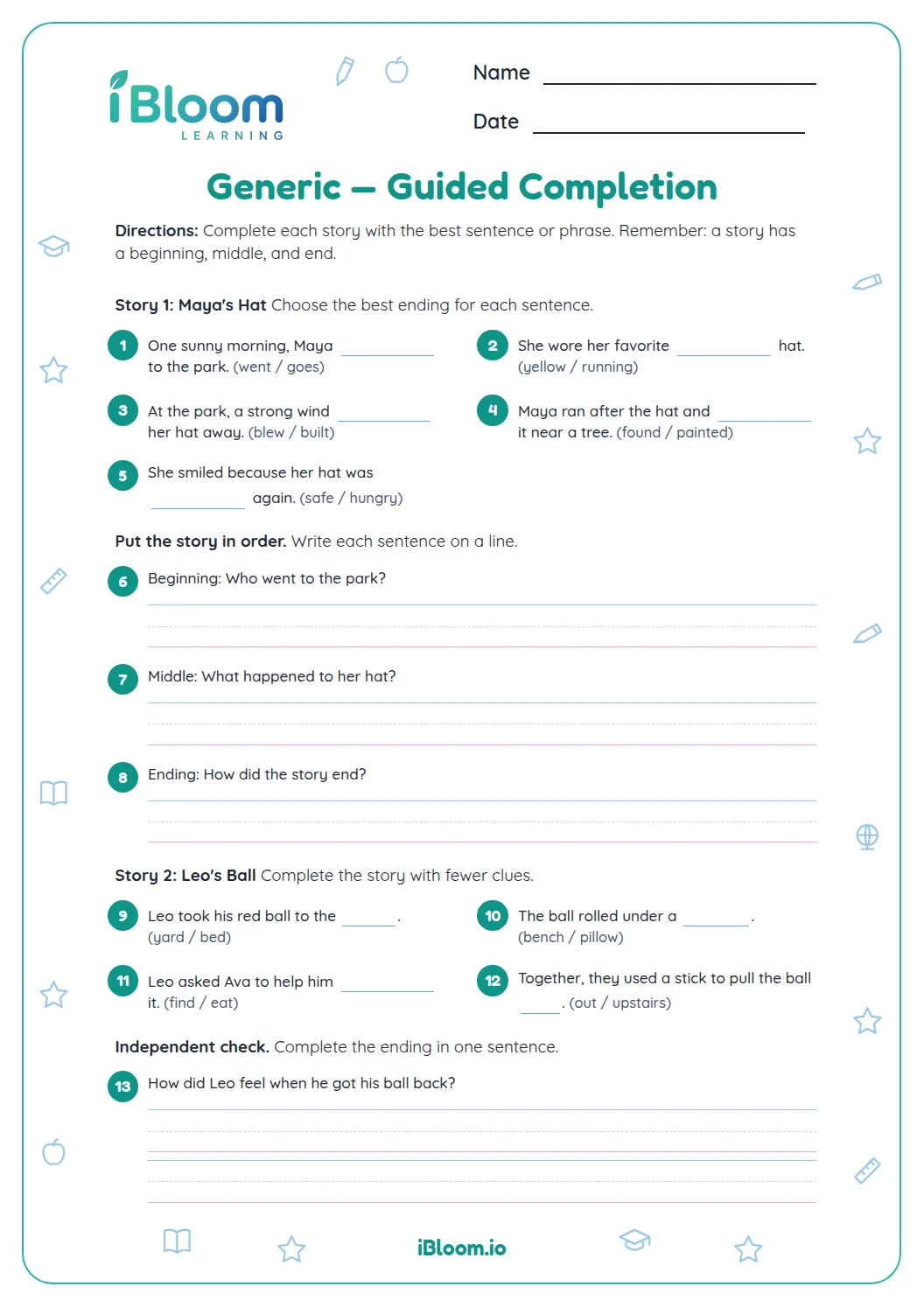
The fill-in questions ask students to complete sentences with time language that fits the passage, such as first, then, and at the end of the day. These words help connect one event to another so a reader can follow the sequence.
What should a Grade 1 narrative include?
A simple narrative can tell two or more events in an order that makes sense, add a detail, and give the reader a sense of closure. The final five questions practice those pieces with both the Maya passage and students’ own first-day ideas.
Does the key give one required story answer?
The key gives direct answers for the passage questions and sample responses for open writing prompts. Students may use different details or sentences when their writing is clear, stays in order, and answers the prompt. The examples are models rather than the only possible responses.