







About this worksheet
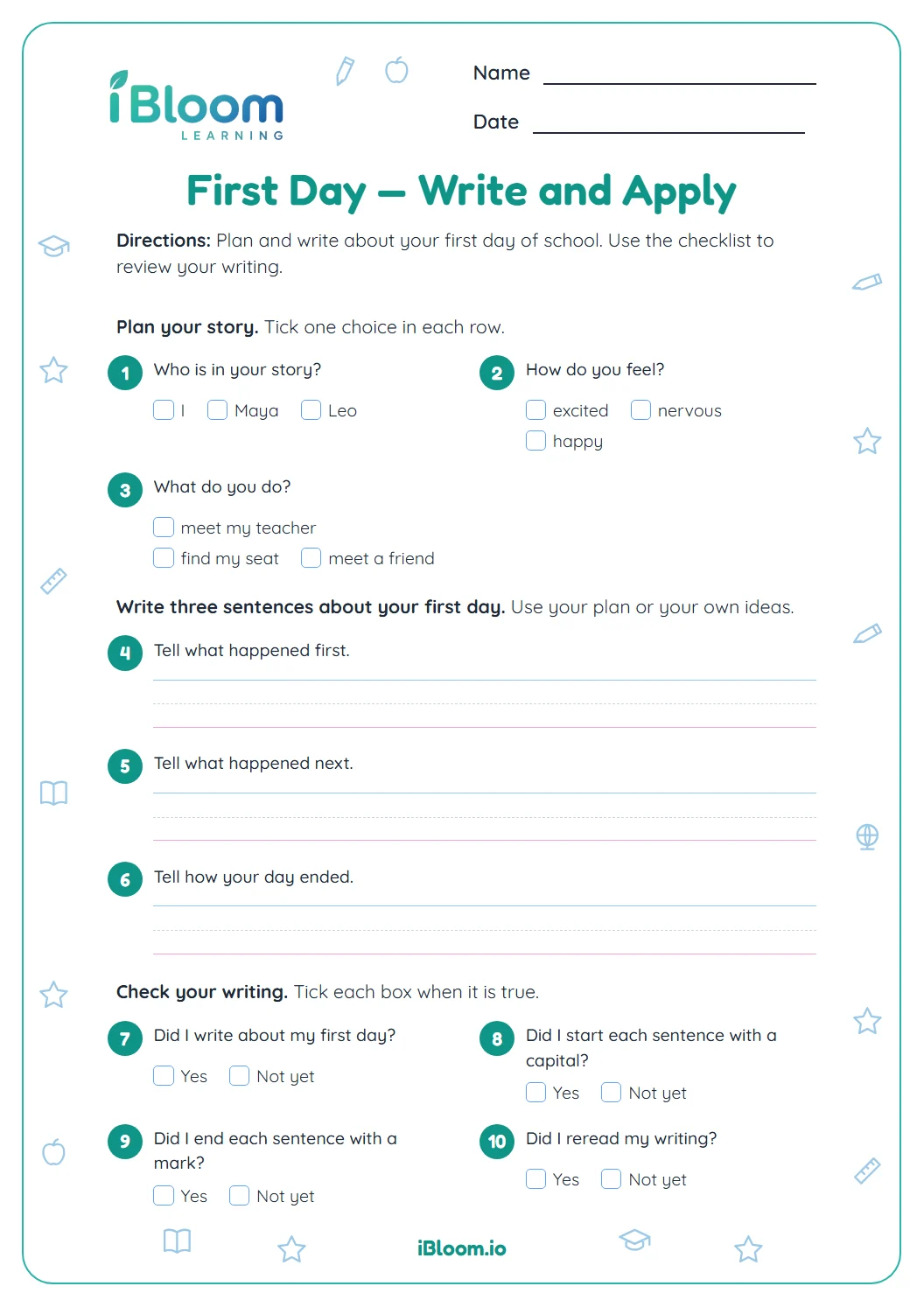
This free Grade 1 worksheet helps children complete a short narrative about a first day at school. Eight word-choice sentences model a sequence: hanging a bag, greeting a teacher, reading, and saying goodbye. Six sentence starters then guide children through their own opening feeling, four events in order, and a closing feeling. Children may recall a real day or imagine one, adding details while keeping the same day throughout. The writing practices Common Core W.1.3. A separate answer key gives the four missing words and six connected sample sentences.
Aligned to W.1.3
What first day should my child write about?
Part A asks children to finish eight short sentences about a first day at school. They choose sensible words for the blanks, such as hanging a bag, greeting a teacher, reading, playing, and saying goodbye. Part B guides them through their own opening feeling, four events in order, and a closing feeling.
A quick spoken plan helps: how did the day begin, what happened during it, and how did it end? The writing can use ordinary events, such as finding a seat, reading a book, playing, and packing a bag.
How do the time words connect the sentences?
Part A supplies eight word-choice sentence completions about a school day. Children choose the word that makes each school-day event make sense, then read the four completed sentences in order. Part B uses the same time words to guide their own events.
For question 10, children finish “First, I” with something that happened early. The key’s sample is “First, I found my seat.” In question 11, they add the next event. Their own events should follow a sensible order.
- 1Starter: First, I
- 2Sample completion: First, I found my seat.
- 3Starter: Next, I
- 4Sample completion: Next, I read a book.
- 5Read both sentences together to check the order.
How do six sentence starters become a paragraph?
Each completed sentence contributes to the same first-day narrative. Question 9 opens with a feeling, questions 10 through 13 tell four events, and question 14 closes with another feeling. Have children read the six completed sentences aloud in order as one paragraph.
The worksheet separates the sentences to give young writers room. If you want a continuous paragraph afterward, children can copy their finished sentences together on writing paper. Keep their chosen events and wording when doing that final copy.
How to use this worksheet
- 1Talk about one real or imagined first day at school.
- 2Complete the eight Part A sentences with words that make sense, then reread the story.
- 3Say the six Part B starters aloud, adding an idea to each before writing.
- 4Write each complete sentence on its lines, including the printed starter.
- 5Read all six sentences in order and check that the last one ends the same school-day story.
Mistakes to check and ways to help
The mistake
Listing events from several different days.
The fix
Return to the first day at school and choose events that could belong to that one day.
The mistake
Putting going home before a classroom activity but keeping Next between them.
The fix
Say the events aloud in the order they happened, then move the ideas to the matching starters.
The mistake
Stopping after “At the end of the day, I felt”.
The fix
Add a feeling word to finish the thought and give the paragraph an ending.
Common Core alignment
Complete a first-day narrative with ordered events, details, time words, and an ending.
On this sheet: Six connected sentence starters guide children through a beginning, four events, and a closing thought.
Show the official wordingHide the official wording
Write narratives in which they recount two or more appropriately sequenced events, include some details regarding what happened, use temporal words to signal event order, and provide some sense of closure.
What to practice next
Make more practice
Further reading
Questions parents and teachers ask
Must the child describe a real first day?
No, an imagined first day at school works too. The six starters keep the setting consistent, and children supply the feelings and events. Before writing, ask the child to say what happened first and what happened at the end so the imagined day has a clear order.
Should children copy the sentence starters?
Yes, each written response should include the starter and the child’s own completion. That creates six complete sentences that can be read together as a paragraph. Say the full sentence aloud first, then write it on the lines and check that it starts with a capital and ends with punctuation.
Why does Part A come before the writing?
Part A models a school-day sequence through eight word-choice completions, including greeting a teacher, reading, playing, packing a bag, and saying goodbye. The printed time words connect those events before children use the starters to write their own narrative.
Do the answers need to match the sample key?
Only the four multiple-choice answers have fixed responses. The six writing answers are samples, and a child’s events and feelings may be different. Check that each sentence is complete, the events follow a sensible sequence, and the final thought closes the first-day story the child chose.
How much help can an adult give?
An adult can read the directions and help the child rehearse each sentence aloud. Ask for a concrete detail, such as what the child read or played, then let the child choose the wording. For writing support, spell a requested word while keeping the child’s own ideas.