


About this worksheet
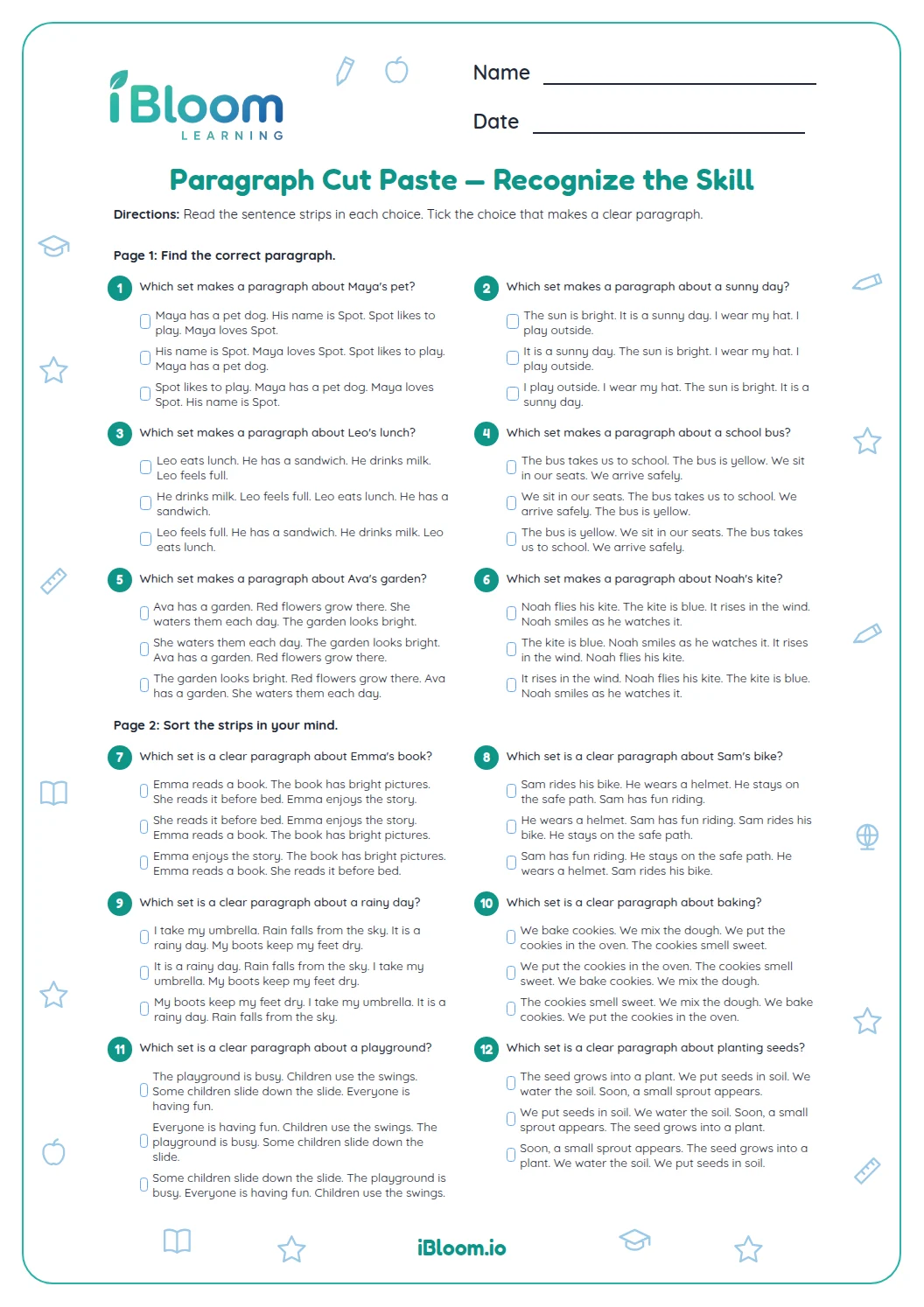
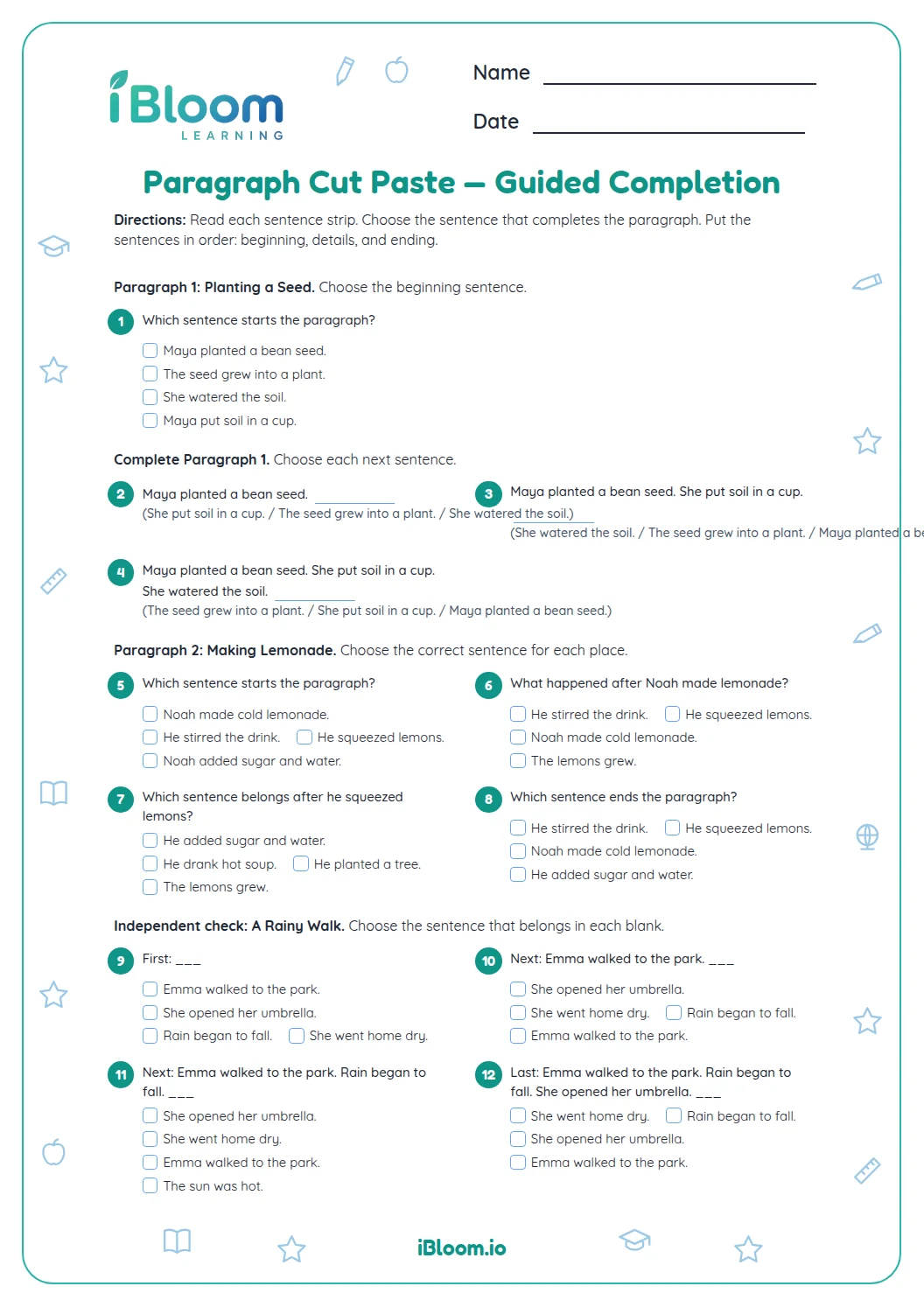
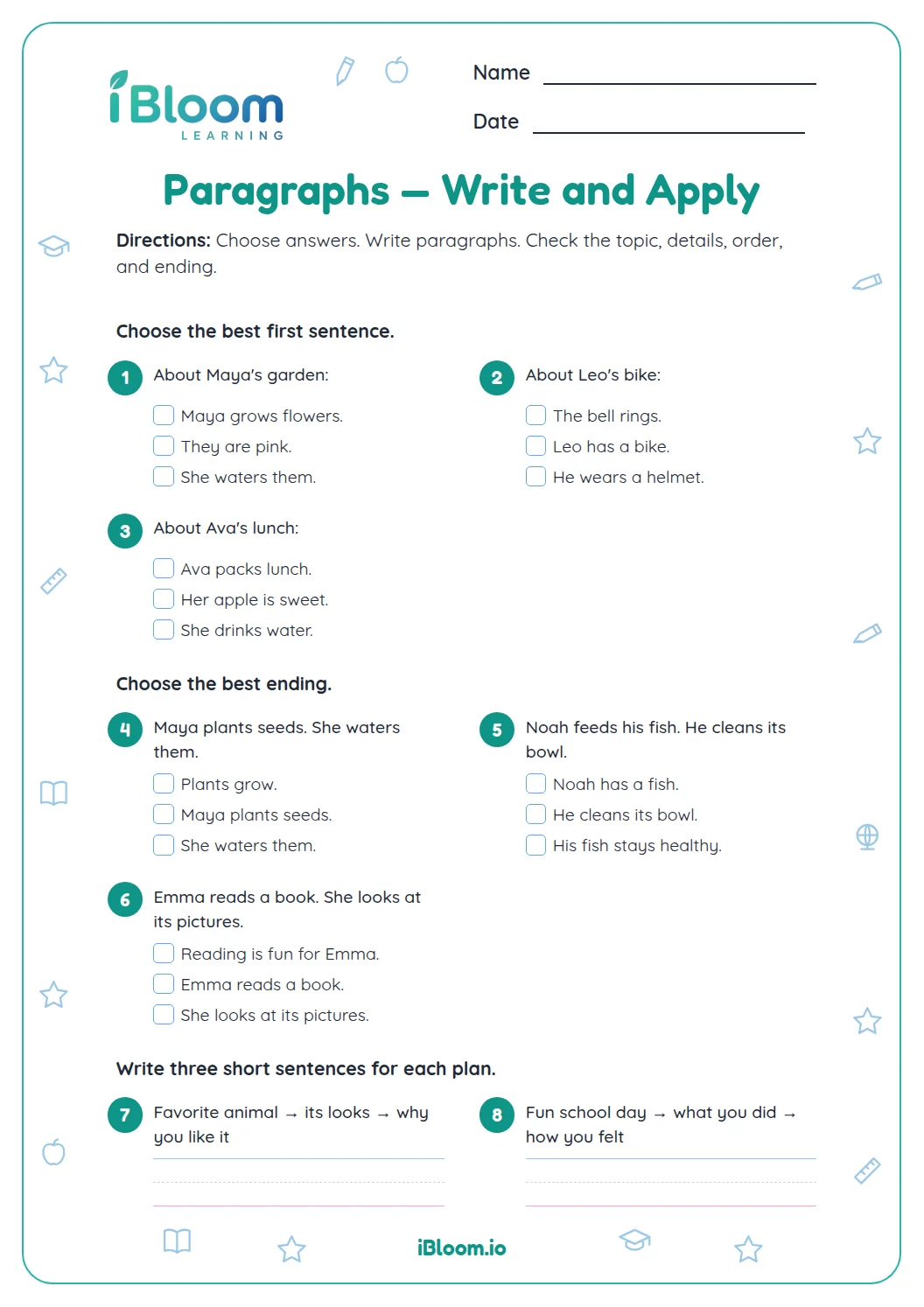
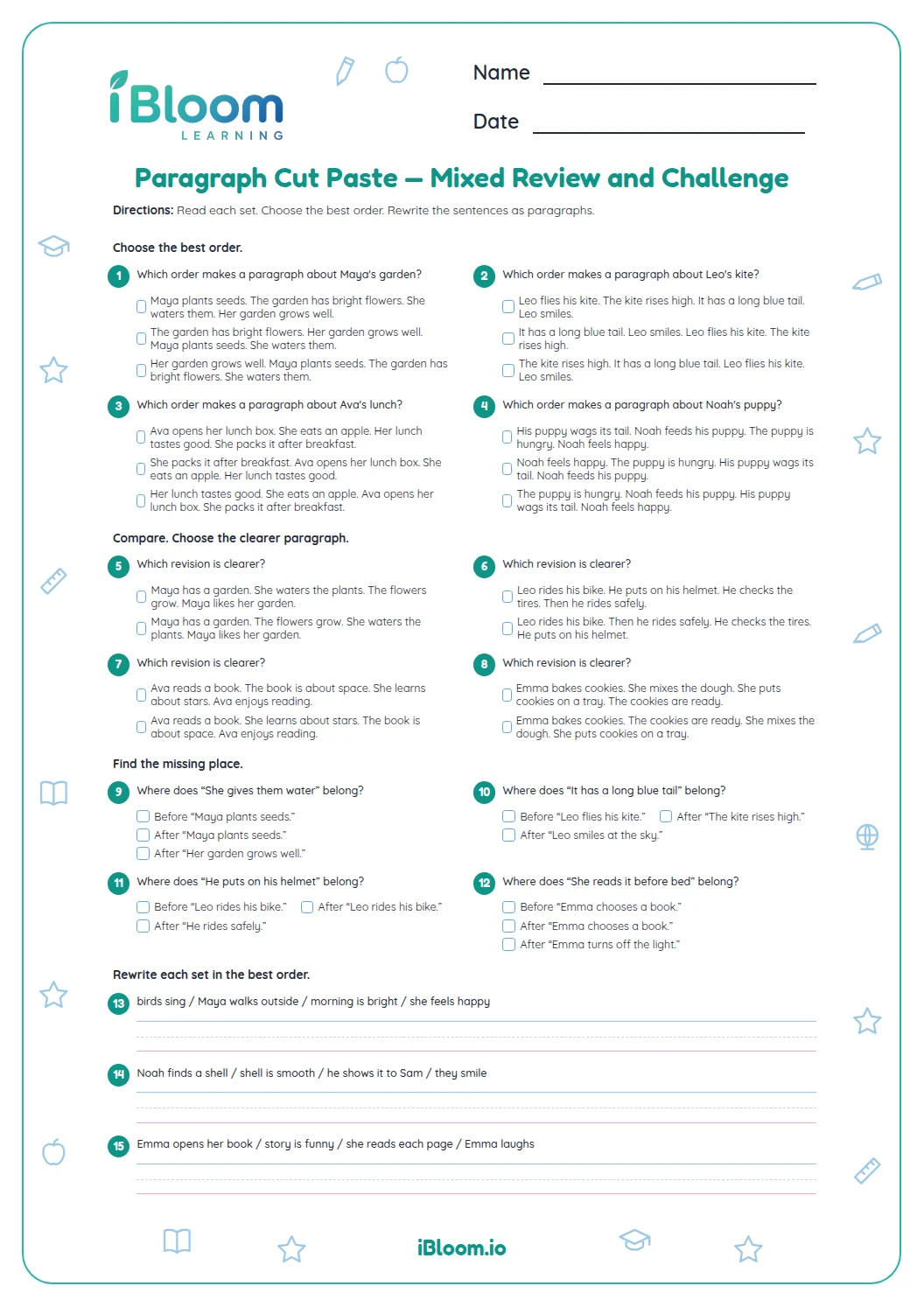
This Grade 1 printable worksheet helps children put related sentences in a clear order. Fourteen fill-in items use time words such as first, next, then, and last to show what happens at the beginning, middle, or end of a short paragraph. A separate answer key lists the sequence word for each item. The practice supports Common Core W.1.3, which asks students to write narratives with sequenced events, details, temporal words, and closure. The original cut-and-paste activity is rebuilt as fill-in sentence sequencing for this worksheet template.
Aligned to W.1.3
How do you tell which sentence comes first?
For a seed story, “I put soil in a cup” comes before “A green sprout came up.” Look for an action that must happen before another event.
Words like first, next, then, and at last also give clues about sequence.
- 1First: I put soil in a cup.
- 2Next: I water the soil.
- 3Last: A green sprout came up.
What makes the sentences work as a paragraph?
The sentences stay on one topic and tell related events in order. A beginning introduces an event, the middle adds what happened, and an ending gives the reader a stopping point. The worksheet practices that sequence with short sentence completions.
How can a child add a useful detail?
Name an action or object so a reader can picture the event. In “I found a shell. I washed it. Then I put it on my desk,” each sentence adds one step.
How to use this worksheet
- 1Read both parts of each sentence before filling the blank.
- 2Ask what happens first, next, and last.
- 3Choose a time word that matches the event order.
- 4Reread the completed sequence aloud.
- 5Use the answer key to check each item.
Mistakes to watch for
The mistake
Putting the ending before the action that causes it.
The fix
Retell the events aloud using first, next, and last.
The mistake
Changing topics in the middle of a paragraph.
The fix
Ask whether every sentence belongs to the same event.
The mistake
Leaving off capitals or periods.
The fix
Point to the first word and final mark in each sentence while rereading.
Common Core alignment
This worksheet practices sequencing events with temporal words.
Write a short narrative with sequenced events, details, temporal words, and closure.
On this sheet: Students complete short event sequences with temporal words, including a beginning and ending.
Show the official wordingHide the official wording
Write narratives in which they recount two or more appropriately sequenced events, include some details regarding what happened, use temporal words to signal event order, and provide some sense of closure.
What to practice next
Questions parents and teachers ask
What is sentence sequencing?
Sentence sequencing means arranging related events in an order that makes sense, such as what happened first, next, and last. This sheet shows three events in each item and asks children to fill one missing time word. Read all three parts together to check the order.
What should a Grade 1 paragraph include?
A short paragraph can tell related events in order, add a few details, use time words, and finish with a clear ending. Children practice the sequence part by choosing a time word in each three-event set. A paragraph stays focused on one topic.
How long does the practice take?
Plan for about 15 minutes for the 14 time-word choices. Allow a little more time to reread each three-event sequence aloud and check that its events stay in order. The answer key lists the missing word for every item.
How does this worksheet practice paragraph order?
Each item gives three related events with one missing time word. For example, putting on pajamas, brushing teeth, and getting into bed make the middle event clear. Children select the word, then reread the whole sequence to check its order.
Does the worksheet include cutting and pasting?
This printable uses multiple-choice time words to complete three-event sequences. The original cut-and-paste format is rebuilt for the worksheet template, and a separate answer key shows each choice. Children still practice recognizing what belongs at the beginning, middle, and end.