






About this worksheet
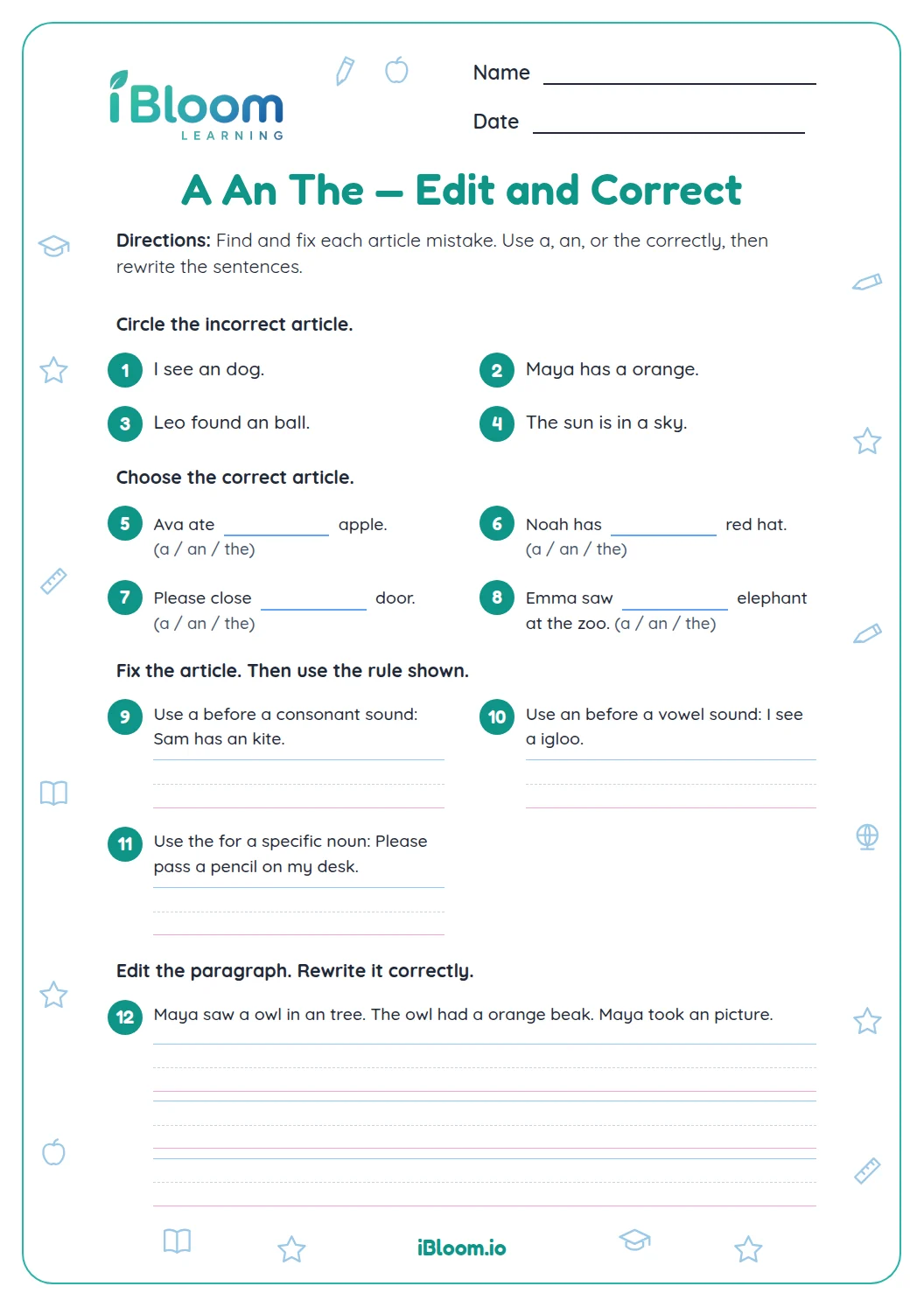
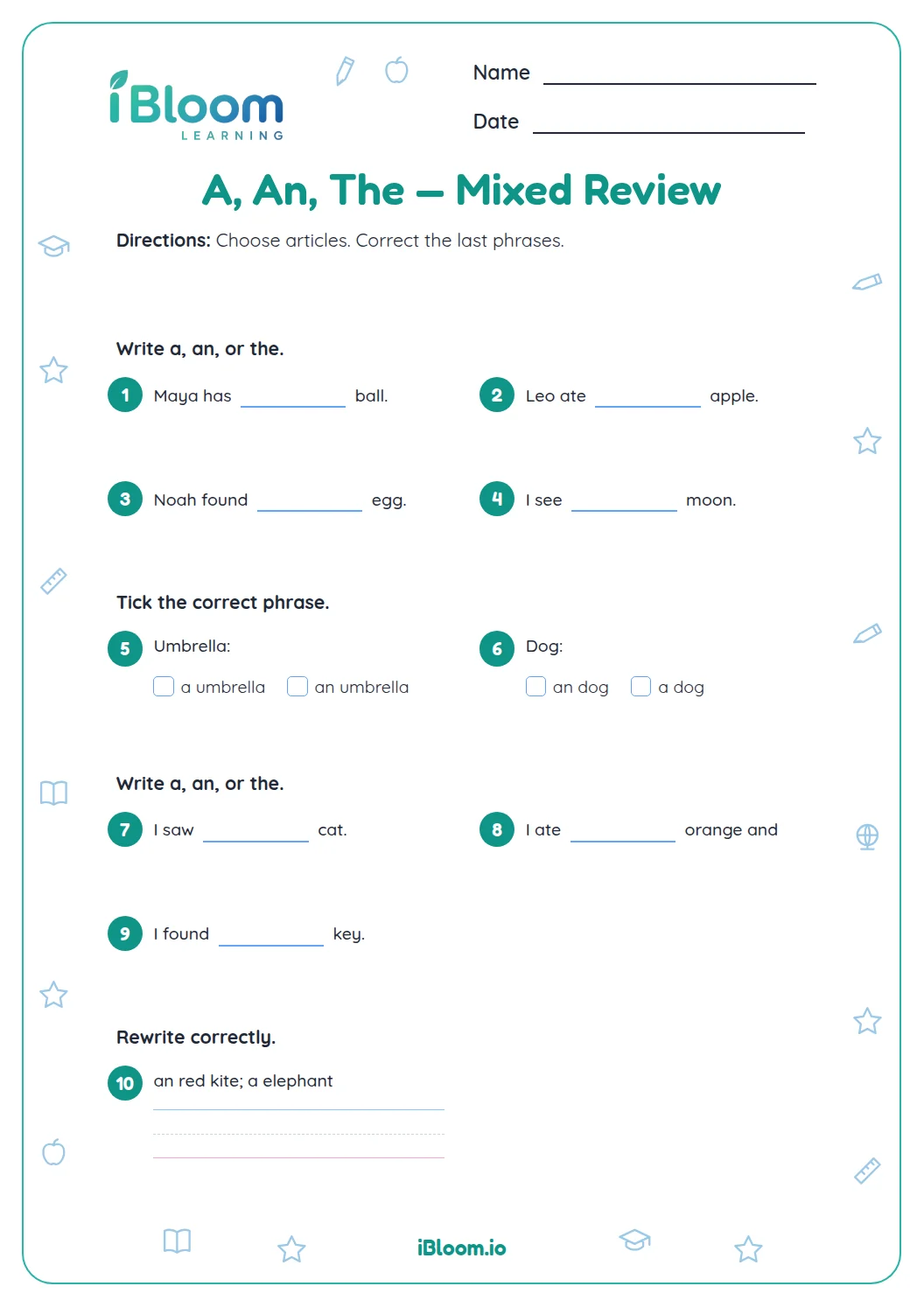
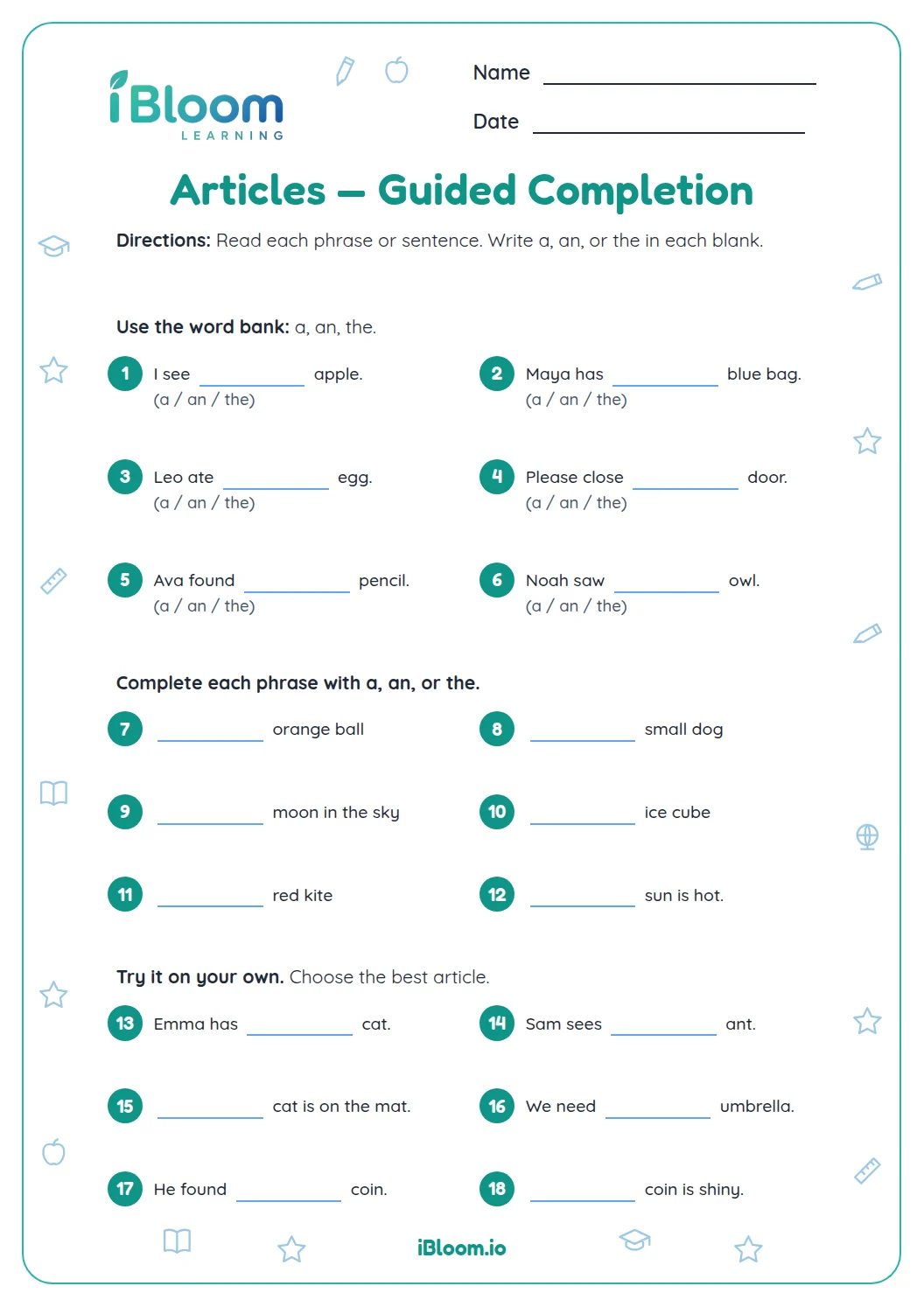
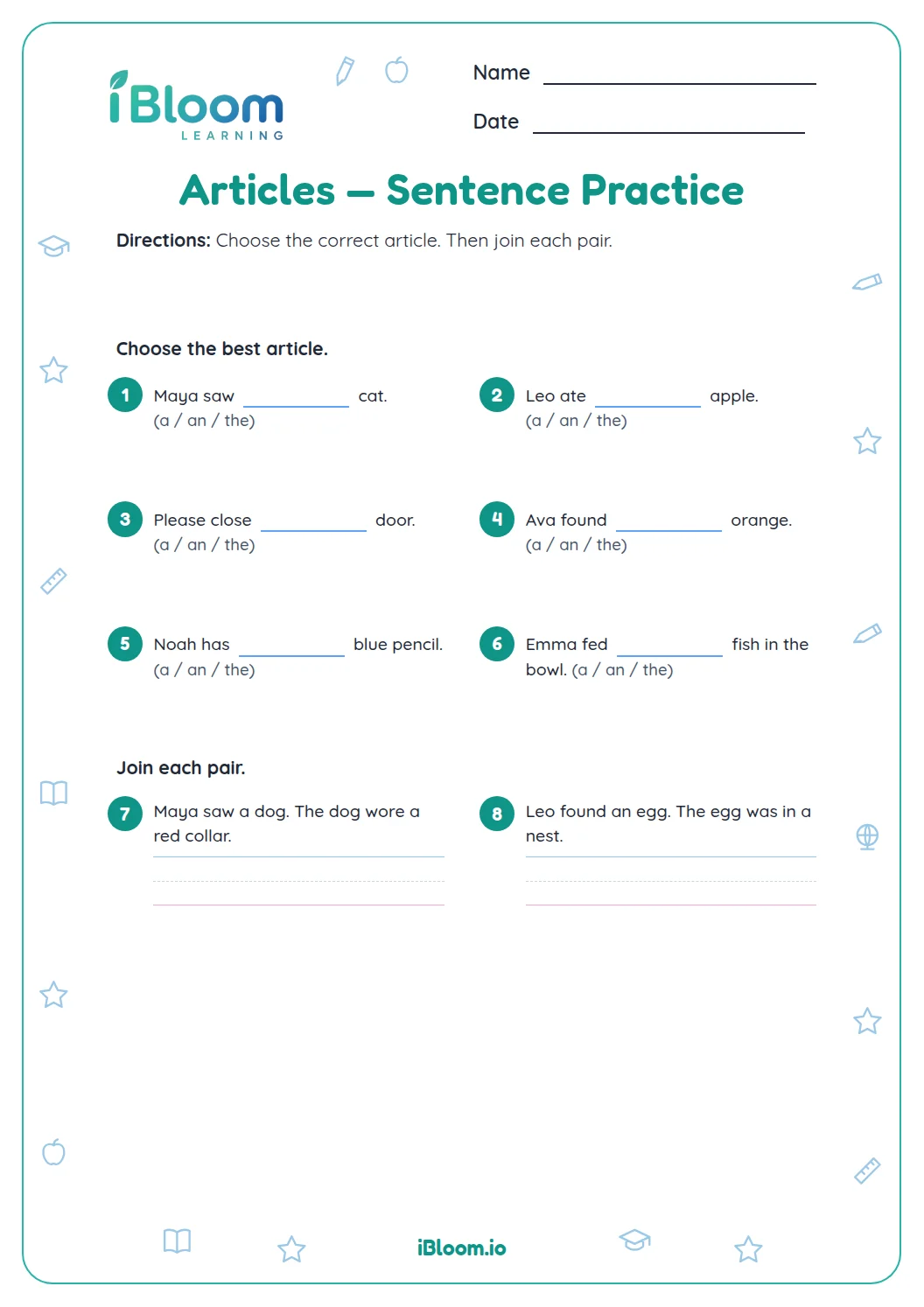
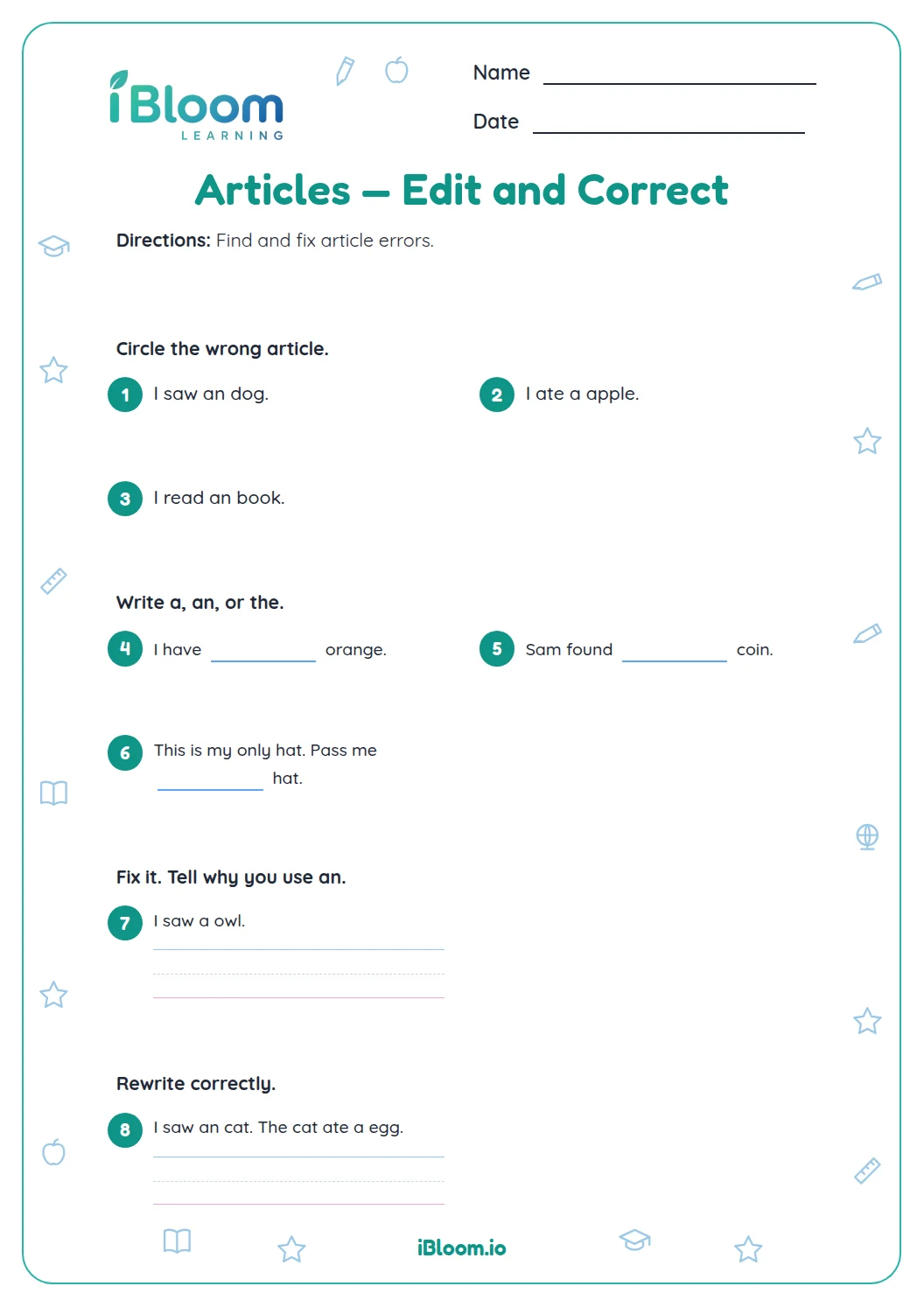
This Grade 1 worksheet helps children choose the articles a, an, and the in complete sentences. Part A offers six choices, Part B has six fill-in sentences, Part C corrects two article errors, and Part D asks students to write two original sentences. The examples use sound clues (an apple, a bird) and context (the sun, the door). A separate answer key gives fixed answers and sample sentences for the open responses. It aligns with CCSS L.1.1.h for using determiners such as articles, and L.1.1.j for writing complete sentences in response to prompts.
Aligned to L.1.1.h and L.1.1.j
What will a child practice on the three parts?
Part A asks children to choose a, an, or the in six short sentences. Part B removes the choices, so the child must use the first sound or sentence context. Part C corrects two article errors. Part D asks for one sentence with an and one with the.
- Part A: 6 article choices
- Part B: 6 fill-in sentences
- Part C: 2 corrections
- Part D: 2 original sentences
How can a child choose between a and an?
Listen to the first sound of the word that follows the blank. Use an before a vowel sound, as in an apple or an owl; use a before a consonant sound, as in a red ball. Use the whole sentence to decide whether the specific article the makes sense.
- 1We ate ___ apple.
- 2Apple begins with a vowel sound, so the answer is an.
When does the worksheet use the?
Part C asks students to choose the corrected version of two sentences with an article error. Part D asks for one sentence with an and one with the. The key provides a sample for each original sentence.
How should families use the answer key?
The key gives one expected article for each fixed item. Part D answers are samples: another complete, sensible sentence can also be correct if it uses the requested article naturally.
How to work through the article practice
- 1Read each sentence aloud before choosing an article.
- 2For a or an, listen to the first sound after the blank.
- 3For the, ask whether the sentence means a particular thing.
- 4In Part C, choose the corrected sentence; in Part D, write a complete sentence for each prompt.
- 5Compare fixed answers with the key; accept other complete, sensible original sentences.
Common article mix-ups
The mistake
Choosing a by the first letter rather than the first sound, as in “a apple.”
The fix
Say the next word aloud. Apple starts with a vowel sound, so write an apple.
The mistake
Using the when a sentence introduces any one object.
The fix
Ask whether the reader knows which particular object is meant; if not, a or an may fit.
The mistake
Writing a fragment such as “An apple” for a sentence prompt.
The fix
Add who or what and an action or description: “An apple fell.”
Curriculum alignment
These standards describe the grade-level skills practiced on this worksheet.
Use determiners (e.g., articles, demonstratives).
On this sheet: The worksheet directly practices this grade-level skill through sentence and context-based application.
Show the official wordingHide the official wording
Use determiners (e.g., articles, demonstratives).
Produce and expand complete sentences in response to prompts.
On this sheet: The worksheet directly practices this grade-level skill through sentence and context-based application.
Show the official wordingHide the official wording
Produce and expand complete simple and compound declarative, interrogative, imperative, and exclamatory sentences in response to prompts.
What to practice next
Make more practice
Further reading
Questions parents and teachers ask
How do you choose a or an?
Choose by the first sound of the next word. Use a before a consonant sound, as in a red ball, and an before a vowel sound, as in an apple. The worksheet includes both patterns in its choice and fill-in sections, so children can say the phrase aloud as they decide.
When should a child use the?
Use the when a sentence points to a particular person, place, or thing. “The sun is bright today” names the familiar sun, while “the door to Room 4” identifies a particular door. The worksheet uses these context clues so children can tell the specific article from a or an.
How many questions and pages are included?
There are 16 questions in four parts. The worksheet and its separate answer key each use two pages. The key shows the expected article for fixed items and sample responses for the two Part D prompts, where more than one sentence can be correct.
What happens in Part C?
Part C presents two sentences with an article error and asks children to choose the corrected version. Part D gives a prompt for a sentence with an and another with the. The key provides a sample for each, while other complete sentences may also work.
What should I check in a child’s original sentence?
Check that it is a complete thought and uses the requested article naturally. For the an prompt, the following word should begin with a vowel sound. For the prompt with the, the sentence should refer to a particular person or thing.