


About this worksheet
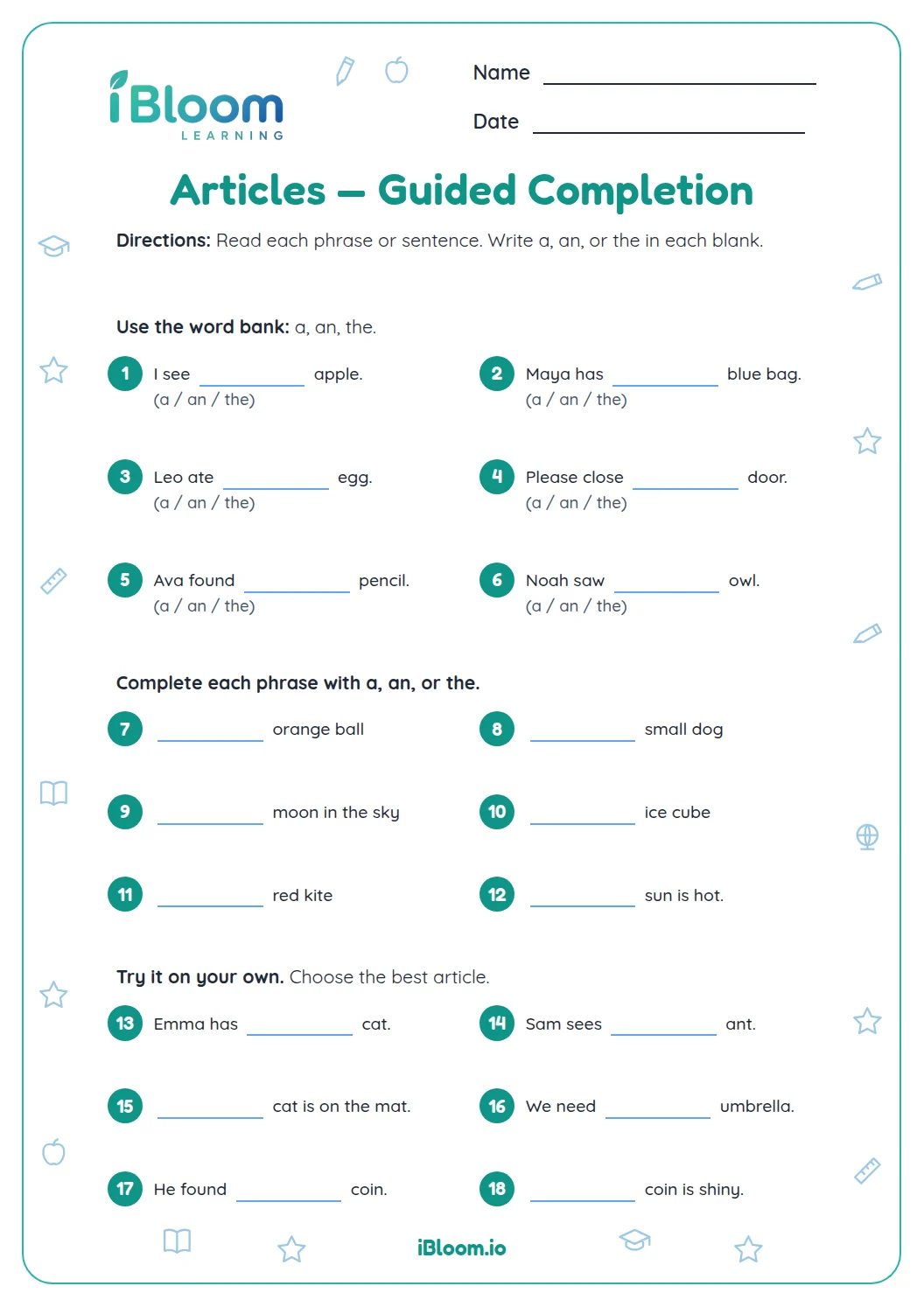
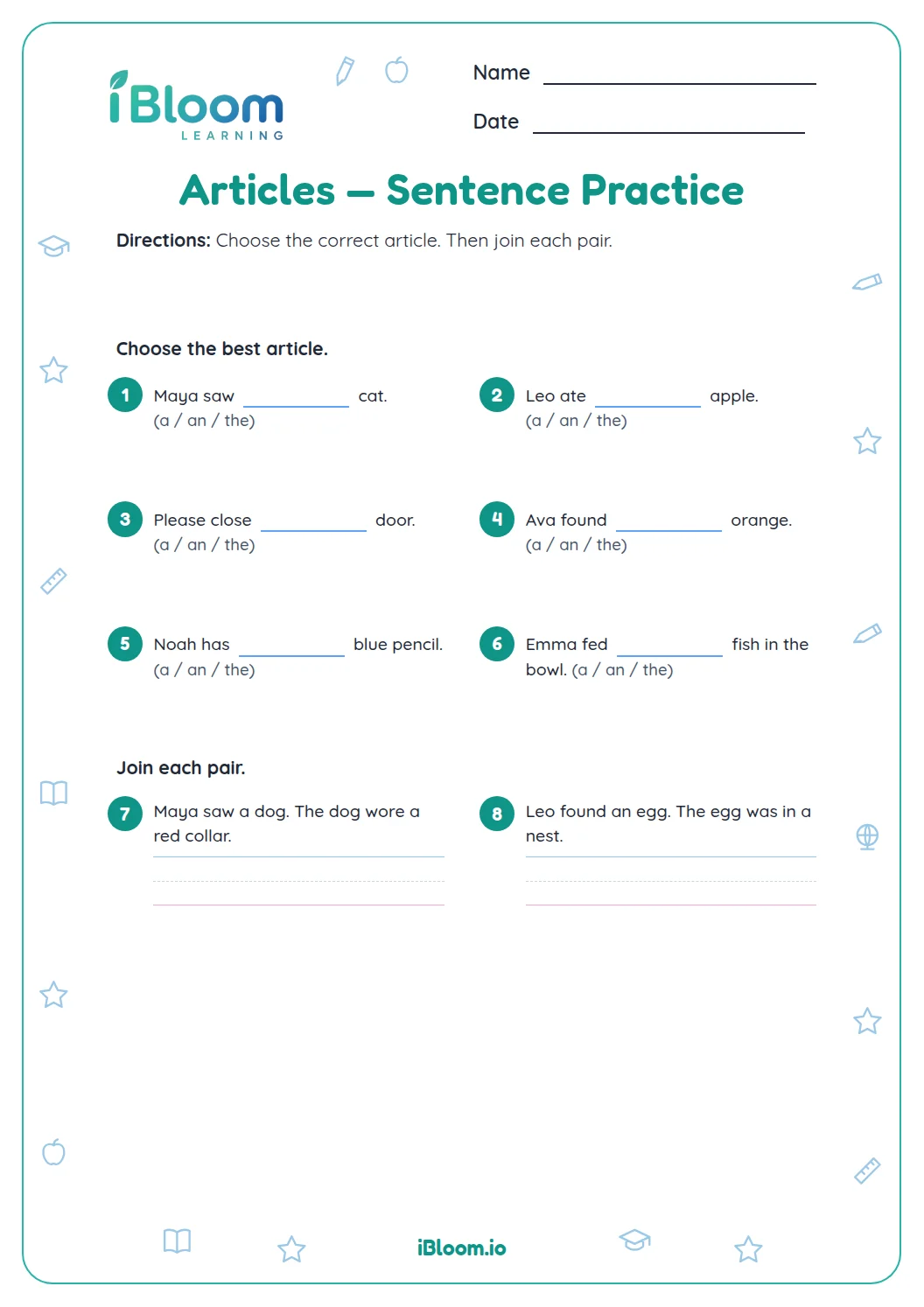
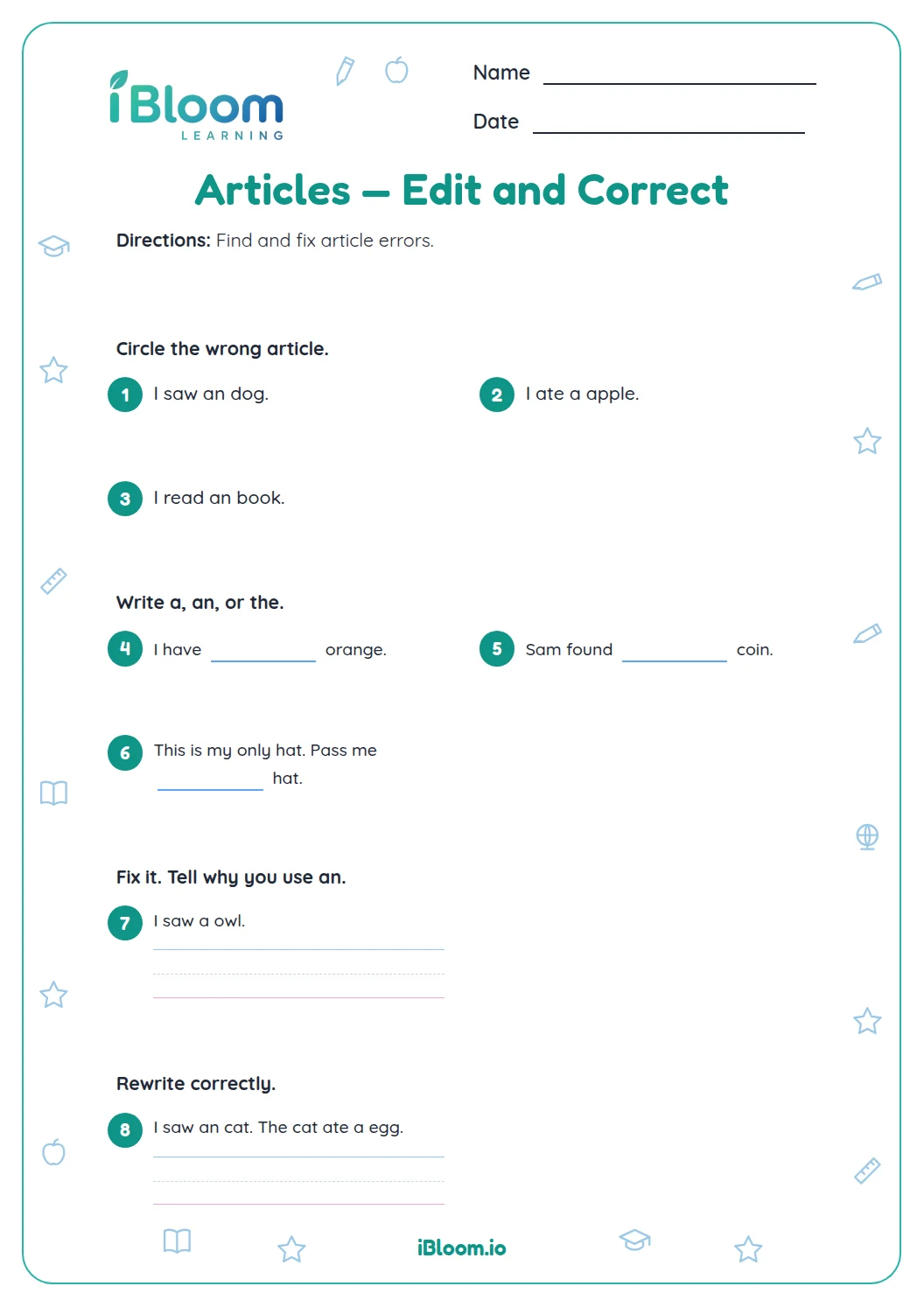
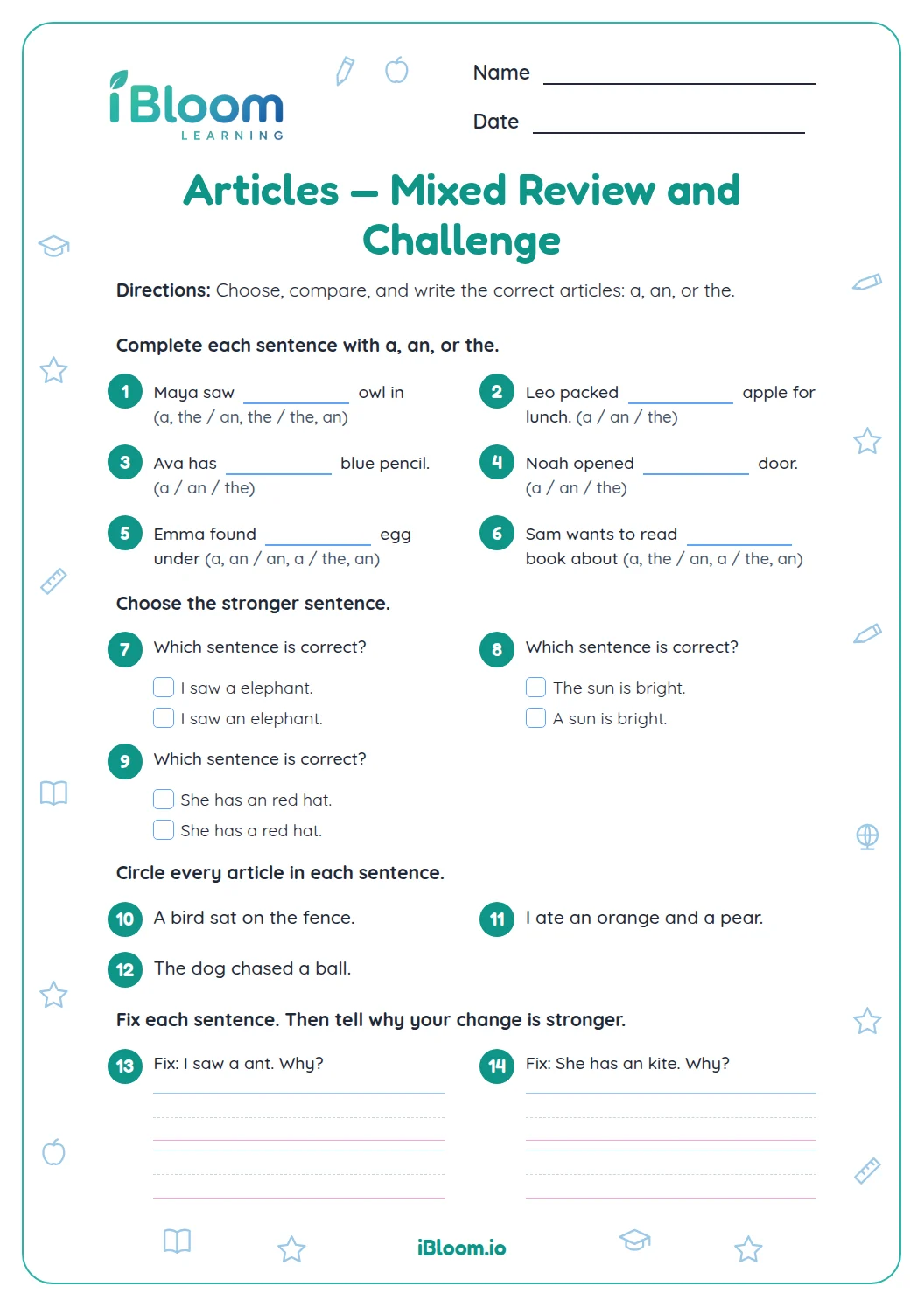
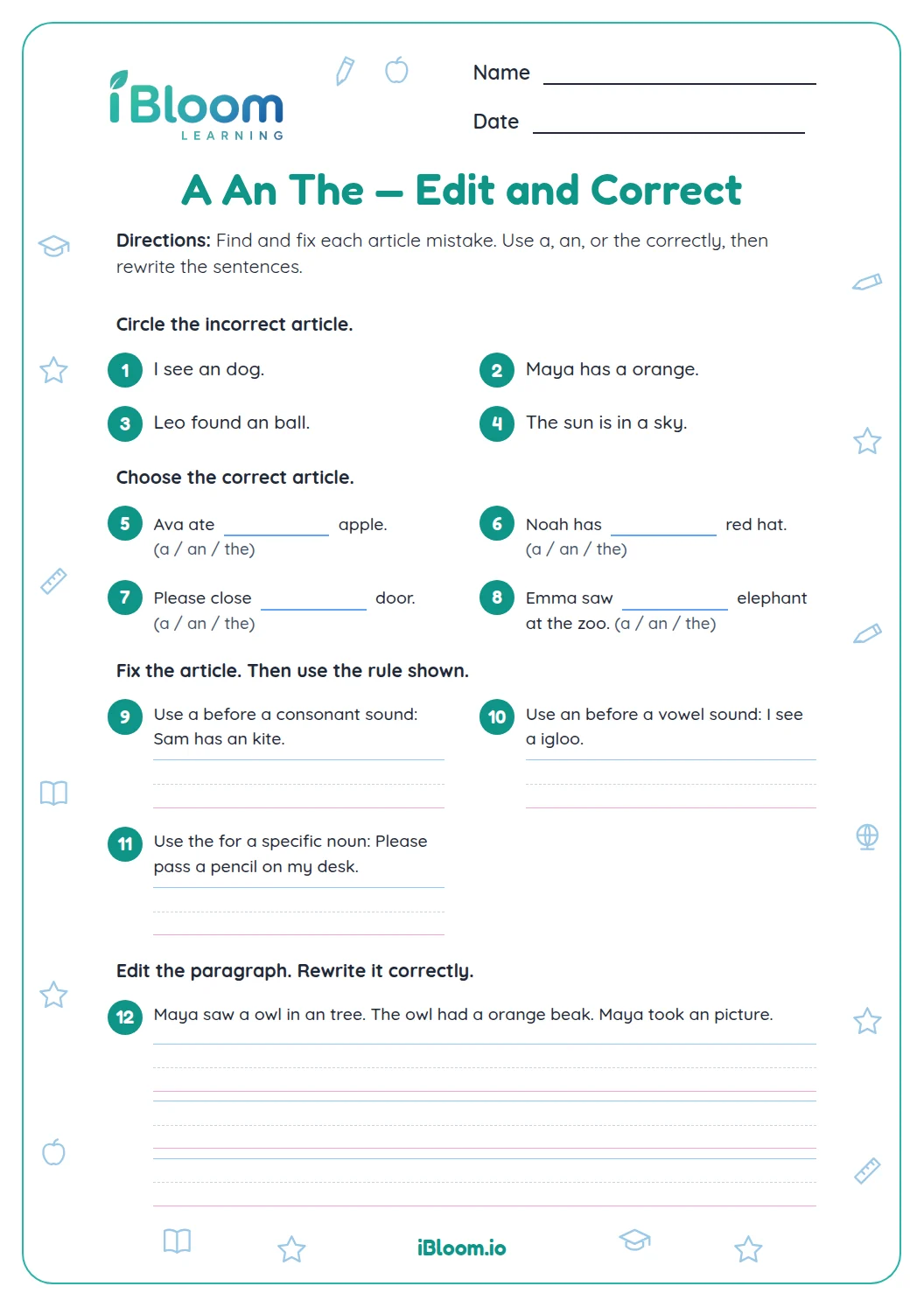
This Grade 1 grammar worksheet practices the articles a, an, and the. Learners choose articles for sentences, identify articles already in print, and complete new sentences. It gives sentence-level practice with conventions of standard English under CCSS L.1.1.
Aligned to L.1.1
How do a, an, and the work?
A and an name one general person, place, or thing. Use an before a vowel sound, as in an owl. The points to a particular thing the reader can identify.
Question 2 names one owl without identifying a particular owl.
- 1I see an owl.
- 2Owl begins with a vowel sound, so use an.
What does the worksheet practice?
Learners first choose an article, then spot an article in a complete sentence, and finally complete fresh sentences.
- Part A: choose an article to complete each sentence
- Part B: use article meaning and sounds as clues
- Part C: complete five more sentences
How can a learner check an article?
Read the sentence aloud with the article. Ask whether it names one general thing or a particular thing, and listen to the first sound of the next word.
- 1“I have a map” names one general map.
- 2“The sun” names the particular sun we see.
How to use this worksheet
- 1Read the whole sentence before choosing an article.
- 2Say the noun after the blank aloud.
- 3Use an before a vowel sound when naming one general thing.
- 4Use the when the sentence means a particular thing.
- 5Read the completed sentence again to check that it makes sense.
Common mistakes and quick fixes
The mistake
Using a before a vowel sound
The fix
Say the next word and try an when it begins with a vowel sound.
The mistake
Using the for every noun
The fix
Use a or an for one general thing; use the for a particular thing.
The mistake
Picking an article without reading the full sentence
The fix
Read the sentence aloud with each possible article.
Curriculum alignment
This printable gives focused practice with the stated skill.
Demonstrate command of the conventions of standard English grammar and usage when writing or speaking.
On this sheet: The worksheet asks learners to apply this skill in each part.
Show the official wordingHide the official wording
Demonstrate command of the conventions of standard English grammar and usage when writing or speaking.
What to practice next
Further reading
Questions parents and teachers ask
When do I use an instead of a?
Use an before a word that begins with a vowel sound, such as an ant or an egg. Use a before a word that begins with a consonant sound, such as a kite or a fish. Say the next word aloud if you are unsure.
What does the mean in a sentence?
The points to a particular person, place, or thing that the reader can identify. For example, “the moon” means the one moon we see in the sky. The sheet uses familiar objects so children can hear how the article fits the noun.
How can children recognize an article?
An article is a small word before a naming word. The words a, an, and the are articles. To find one, read the sentence and notice the short word that comes just before the person, place, animal, or thing being named.
Does a always go before a consonant letter?
The choice depends on the first sound of the next word. Most familiar examples match the first letter, as in a map and an egg. Encourage children to say the word aloud and listen to its first sound before choosing.
How can I help a child choose between a and an?
Say the word that follows the blank and listen to its first sound. Use an before a vowel sound, as in an egg, and a before a consonant sound, as in a map. Then read the entire sentence aloud to check the choice.