






About this worksheet
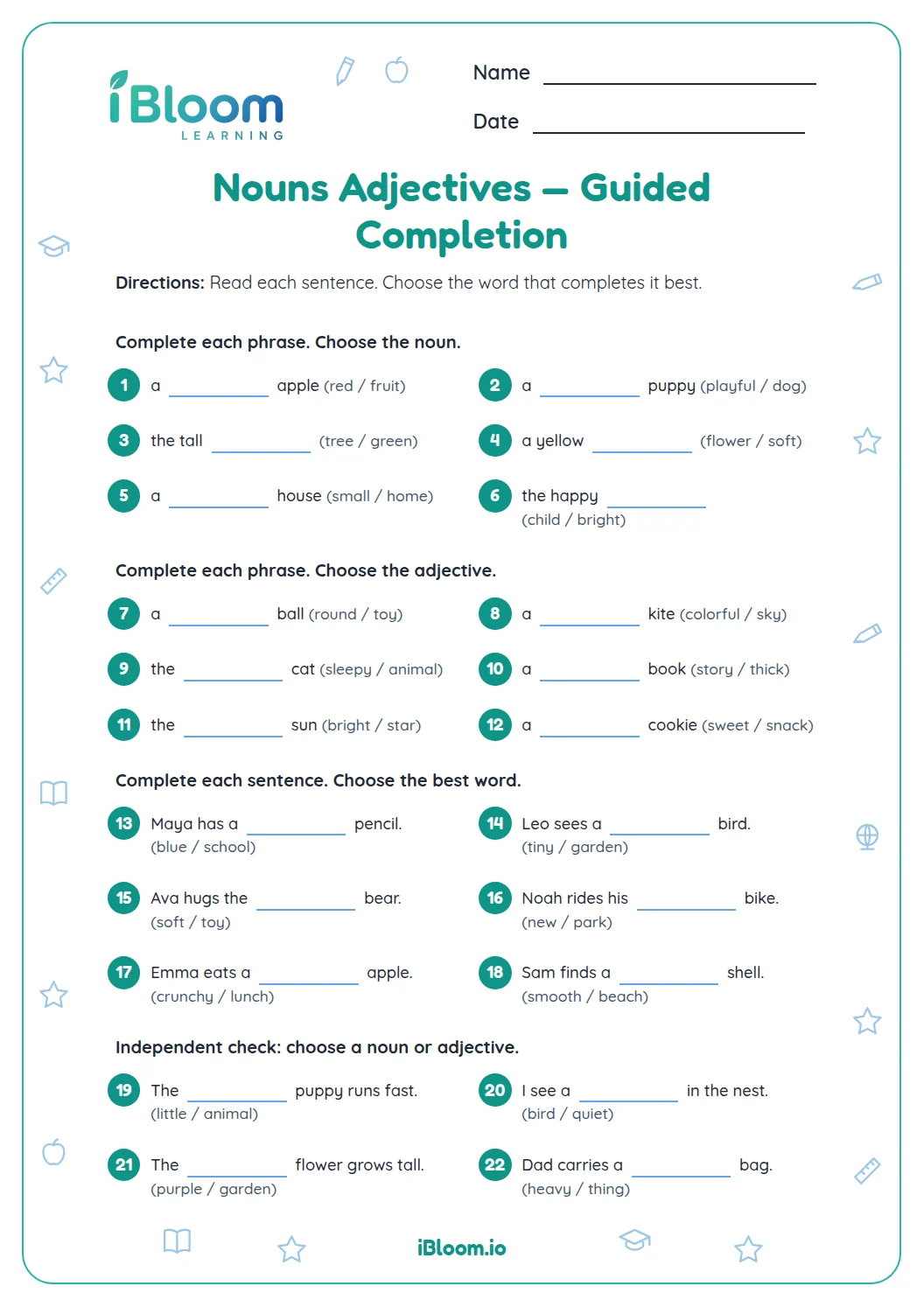
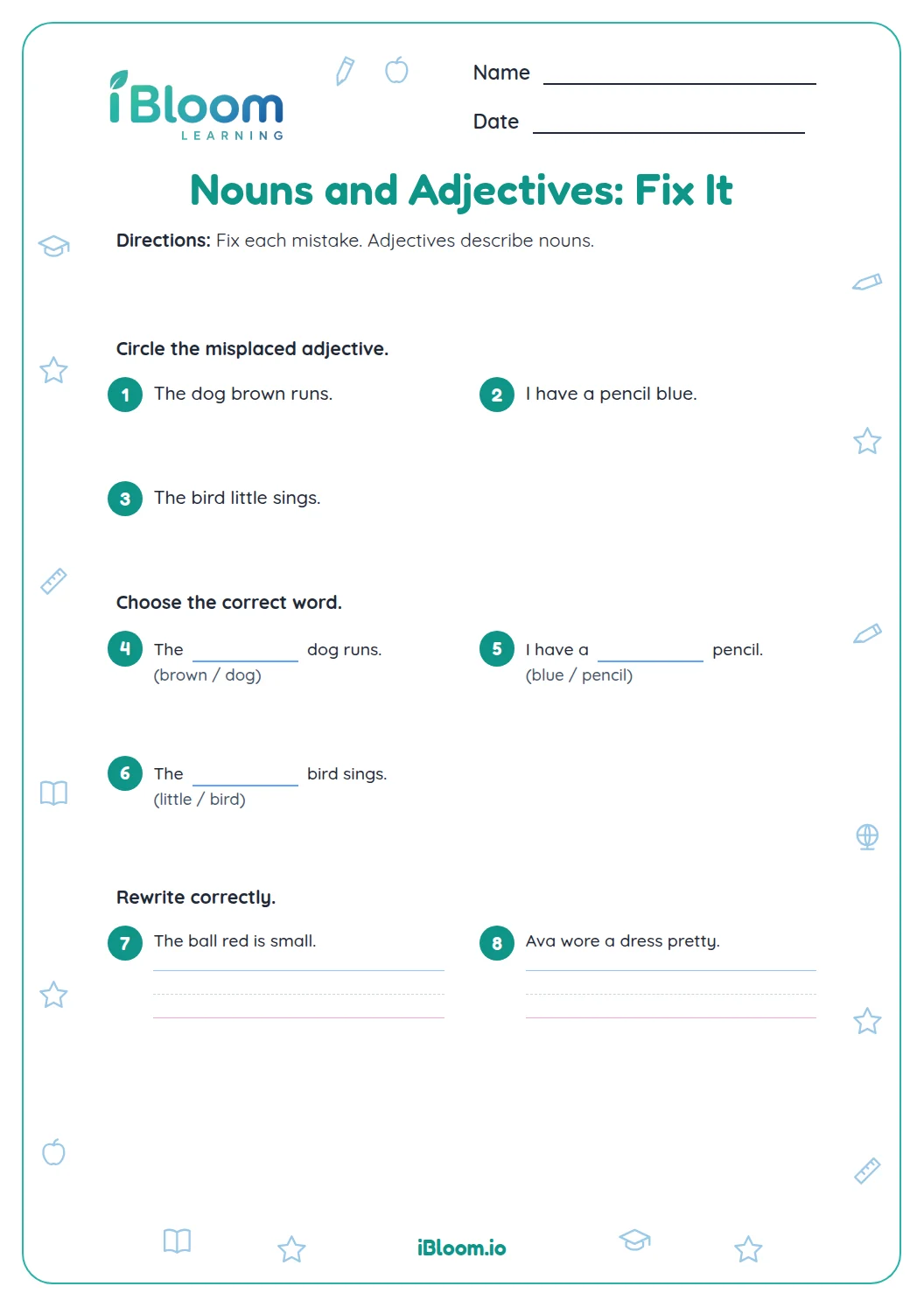
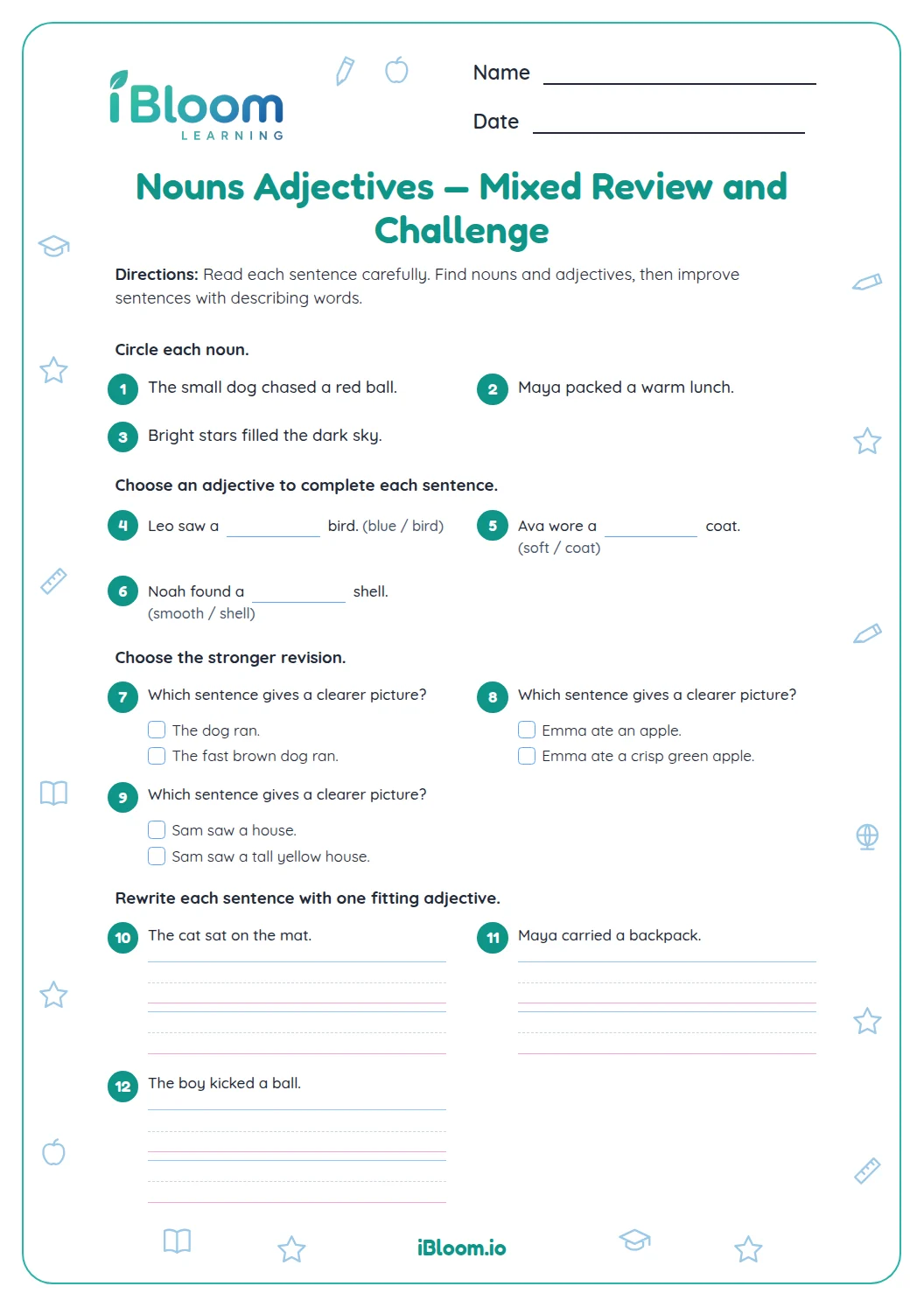
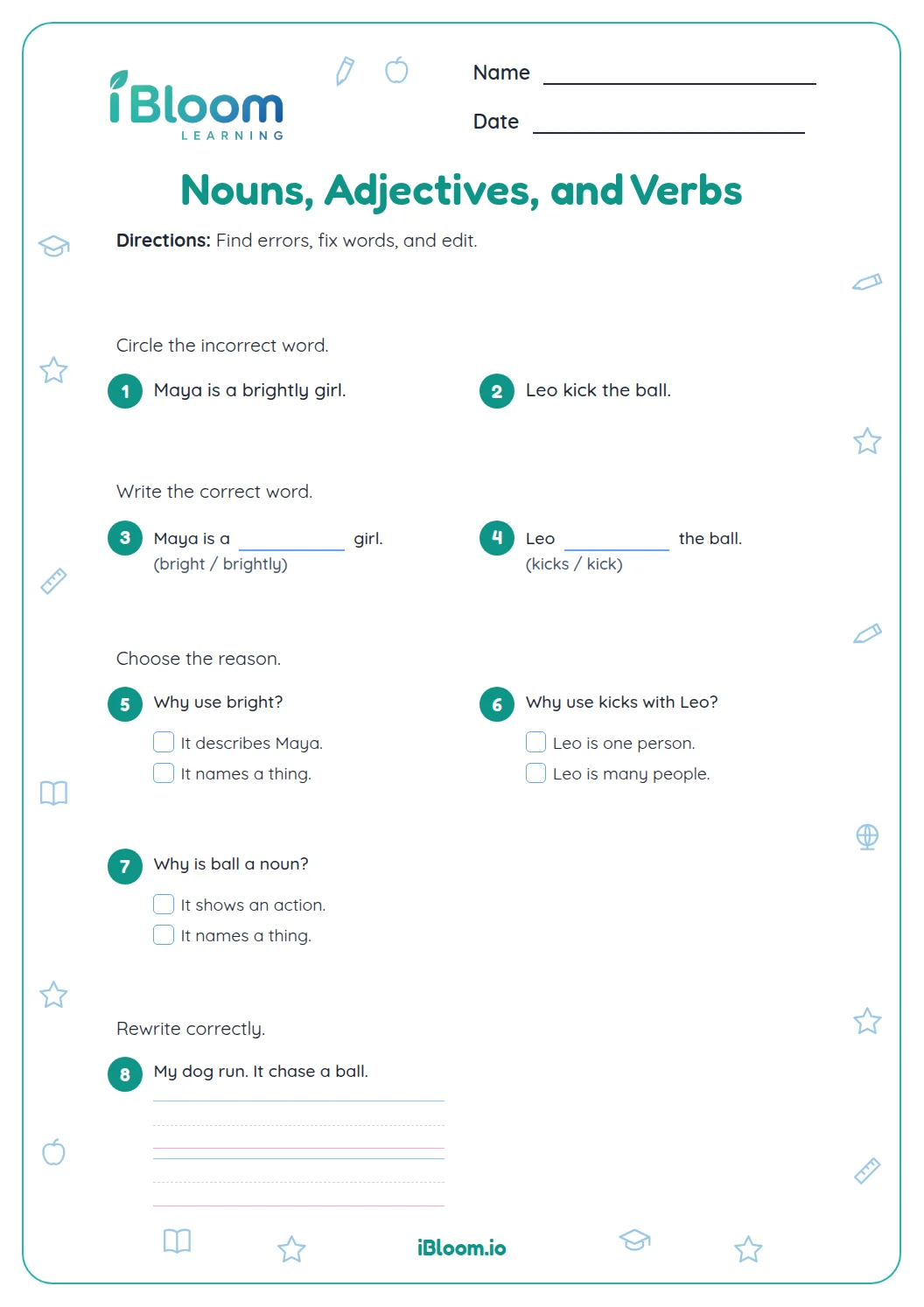
This Grade 1 worksheet helps children identify nouns and adjectives in short sentences, choose words by their job, and use both kinds of words in original writing. The questions move from spotting a noun or describing word to writing sentences with clear examples. In the final question, the learner marks a noun and an adjective in a sentence about a snack. The answer key includes sample writing, so other sentences are fine when they use the words correctly. The adjective work practices CCSS L.1.1.f: using frequently occurring adjectives.
Aligned to L.1.1.f
What does this worksheet practice?
A noun names a person, place, animal, or thing. An adjective describes a noun. The first five items ask students to choose a naming or describing word that fits a sentence.
How can a learner solve one question?
Use the question as a model, then check each step against the words, numbers, or clues in the prompt.
- 1Sentence: “The small bird sings.”
- 2Bird names an animal, so it is a noun.
- 3Small describes the bird, so it is an adjective.
How should an adult use the answer key?
Check the answer after the learner completes a part. For open responses, accept a different answer when it is clear and uses the target skill.
How to use this worksheet
- 1Read the instructions and the first part heading.
- 2Complete each question in order, showing a step when useful.
- 3Reread the prompt before choosing or writing an answer.
- 4Use the answer key after finishing a part.
- 5Review a missed answer by explaining the word, value, or clue that supports the correction.
Common mistakes and quick fixes
The mistake
Rereading only part of the prompt
The fix
Read the complete sentence or expression before responding.
The mistake
Using a familiar answer without checking the target skill
The fix
Point to the specific word, number, or clue that supports the answer.
The mistake
Leaving a question blank
The fix
Return to the question and write one clear answer before checking the key.
Common Core alignment
This worksheet practices the listed Common Core skill.
Identify and use frequently occurring adjectives to describe nouns.
On this sheet: The learner identifies adjectives and uses them to describe nouns.
Show the official wordingHide the official wording
Use frequently occurring adjectives.
What to practice next
Make more practice
Further reading
Questions parents and teachers ask
What is the difference between a noun and an adjective?
A noun names a person, place, animal, or thing. An adjective describes a noun. In “The small bird sings,” bird names an animal and small tells what the bird is like. Learners can use that question to notice how the adjective gives information about the noun.
What does the worksheet ask children to write?
The last part asks learners to supply describing and naming words, complete a sentence with an adjective, and write sentences that use nouns and adjectives together. The final prompt asks the child to identify those words in a snack sentence.
Does the key allow different sentence answers?
Yes. The key gives examples such as “The tiny bird sings” and “I ate a crunchy apple.” A different response is correct if it forms a clear sentence and uses an adjective to describe a noun. Check that the new sentence is complete and that the describing word matches its noun.
Why does one question ask children to underline and circle?
That question asks the learner to show both word jobs in one sentence: underline the noun and circle the adjective that describes it. Adults can accept a sentence with another clear snack noun and adjective. This gives practice noticing the adjective and its noun together in context.
What standard does the adjective practice address?
The adjective questions align with CCSS L.1.1.f, using frequently occurring adjectives. Children identify describing words and apply them in short sentences, while the noun questions provide context for seeing which word an adjective describes. The examples are common describing words, such as small, bright, and soft.