


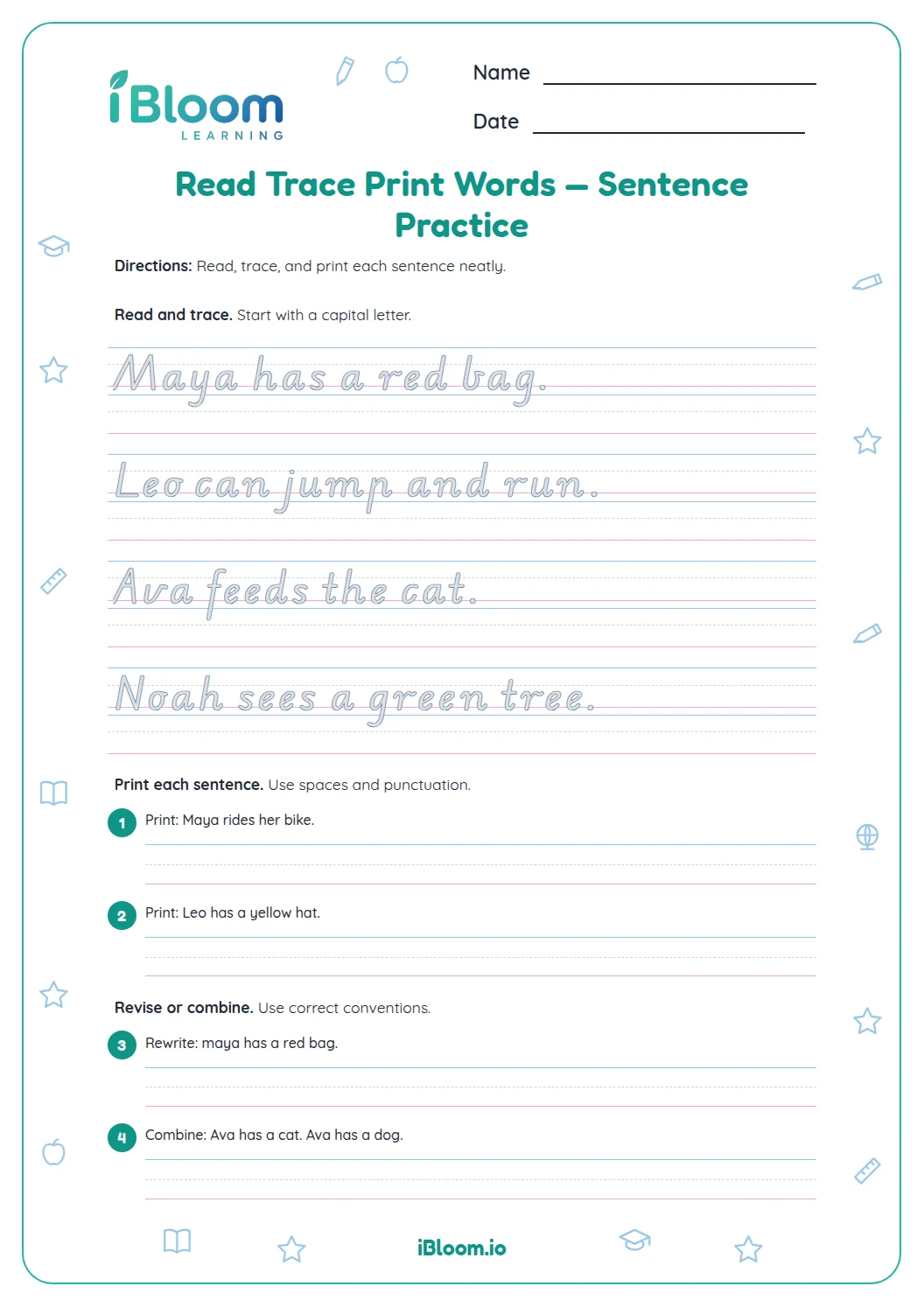
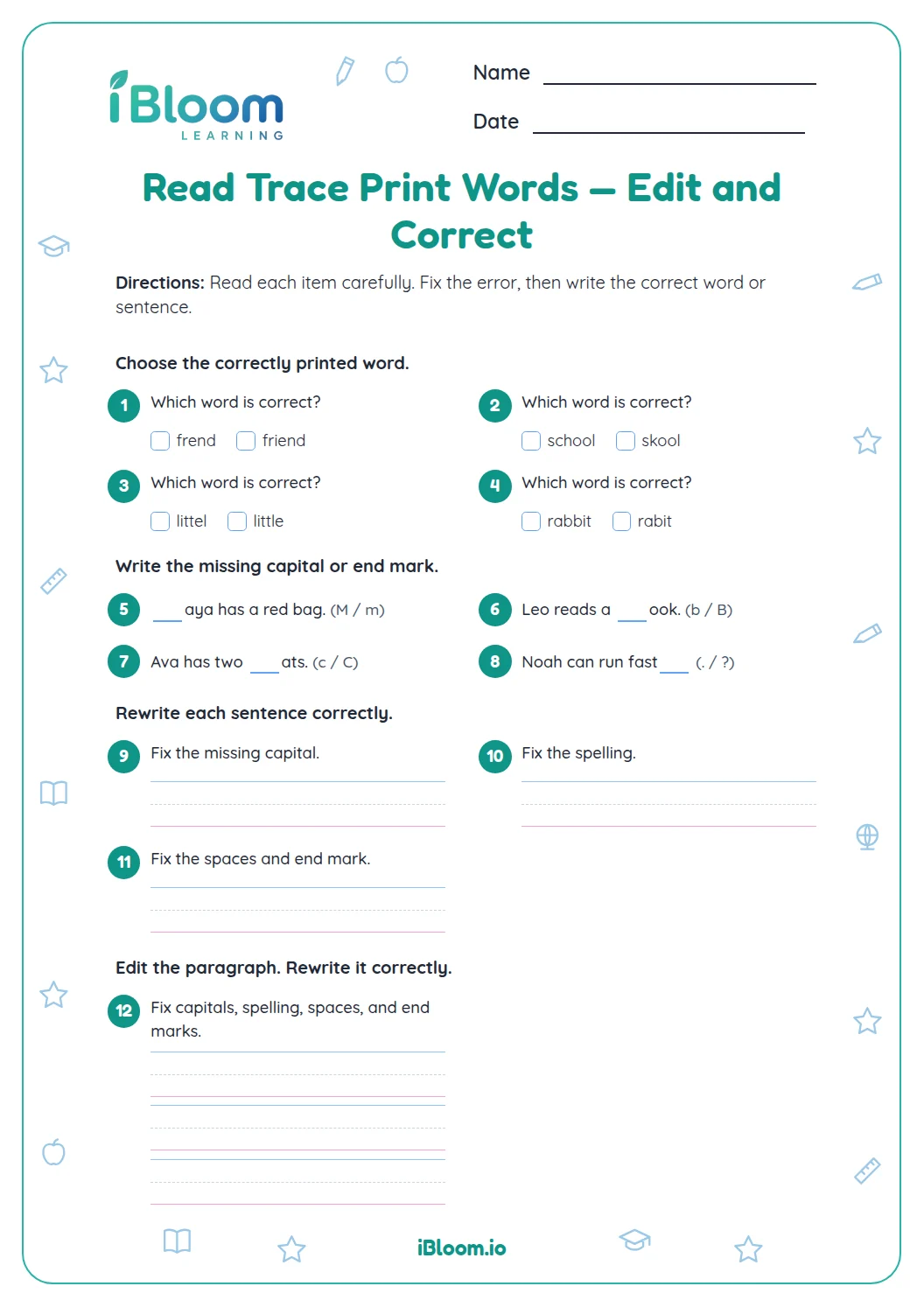
About this worksheet
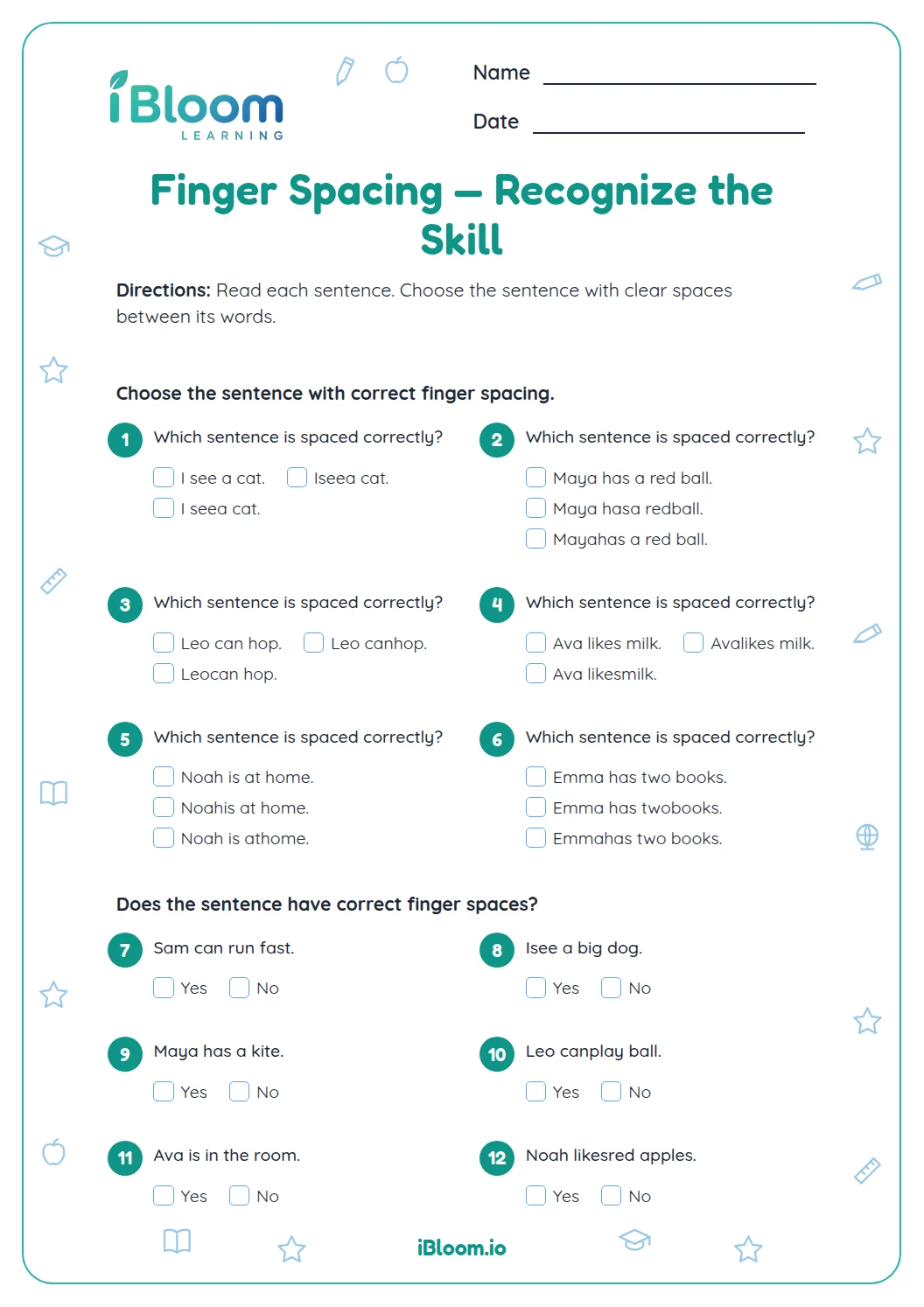
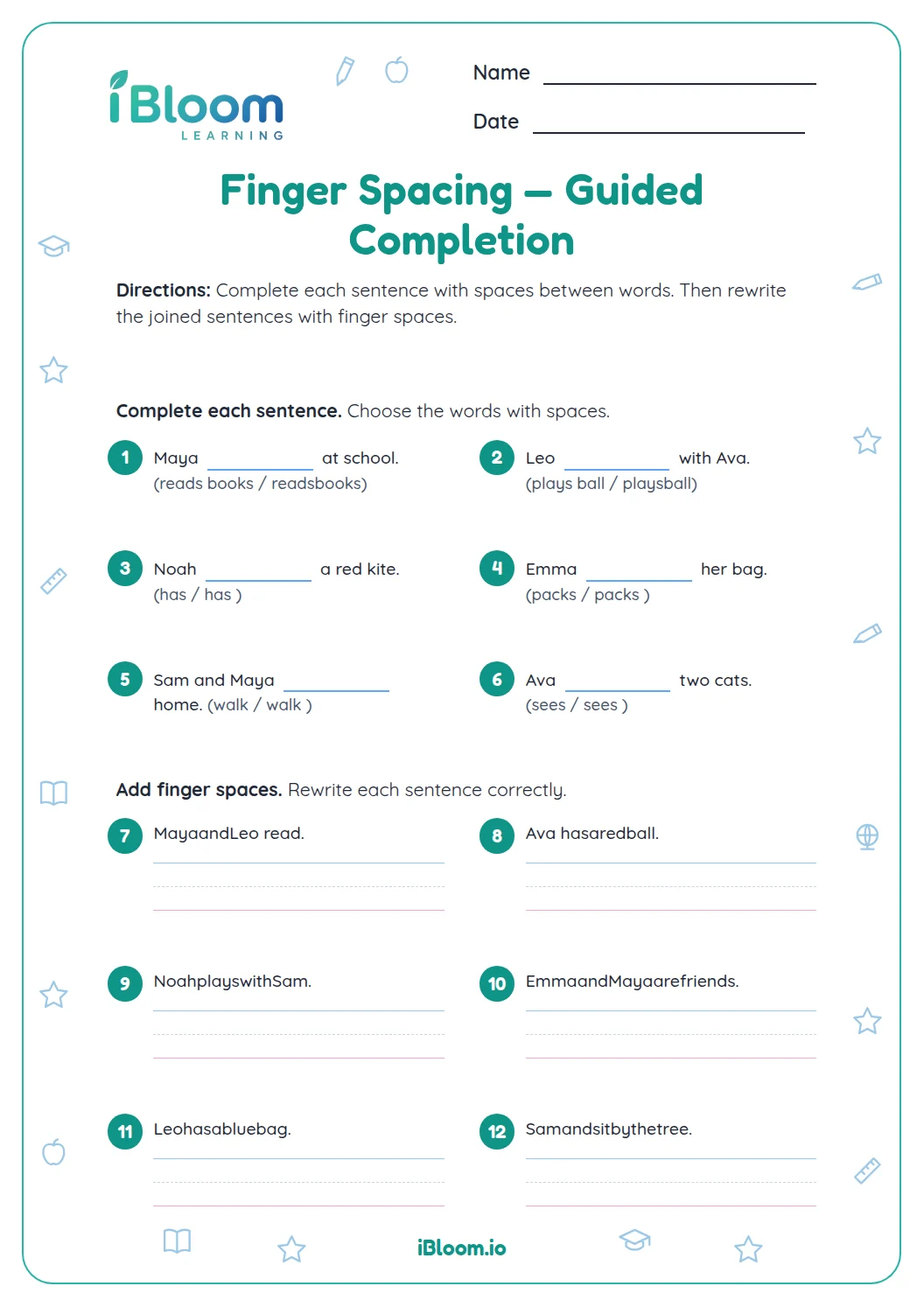
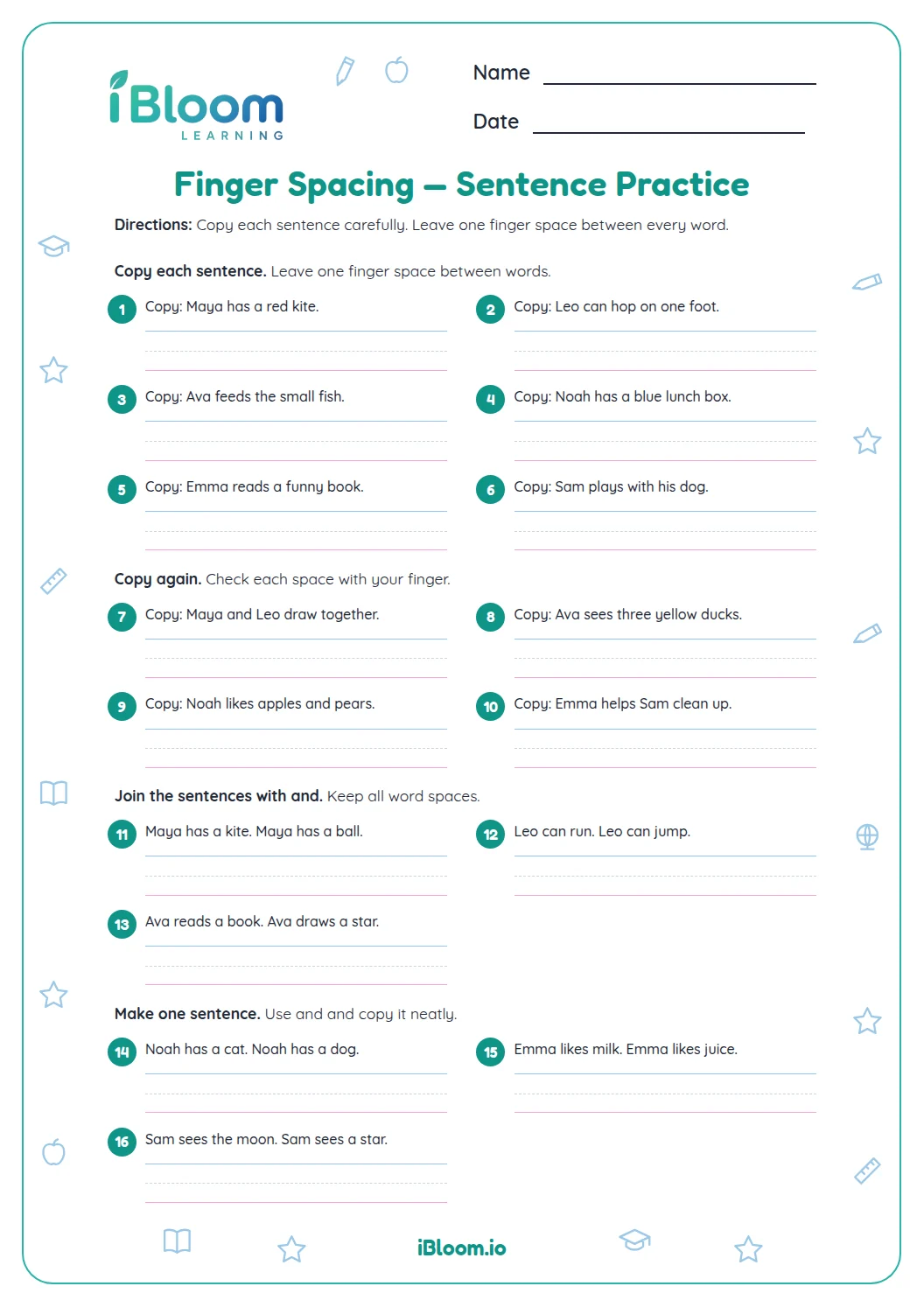
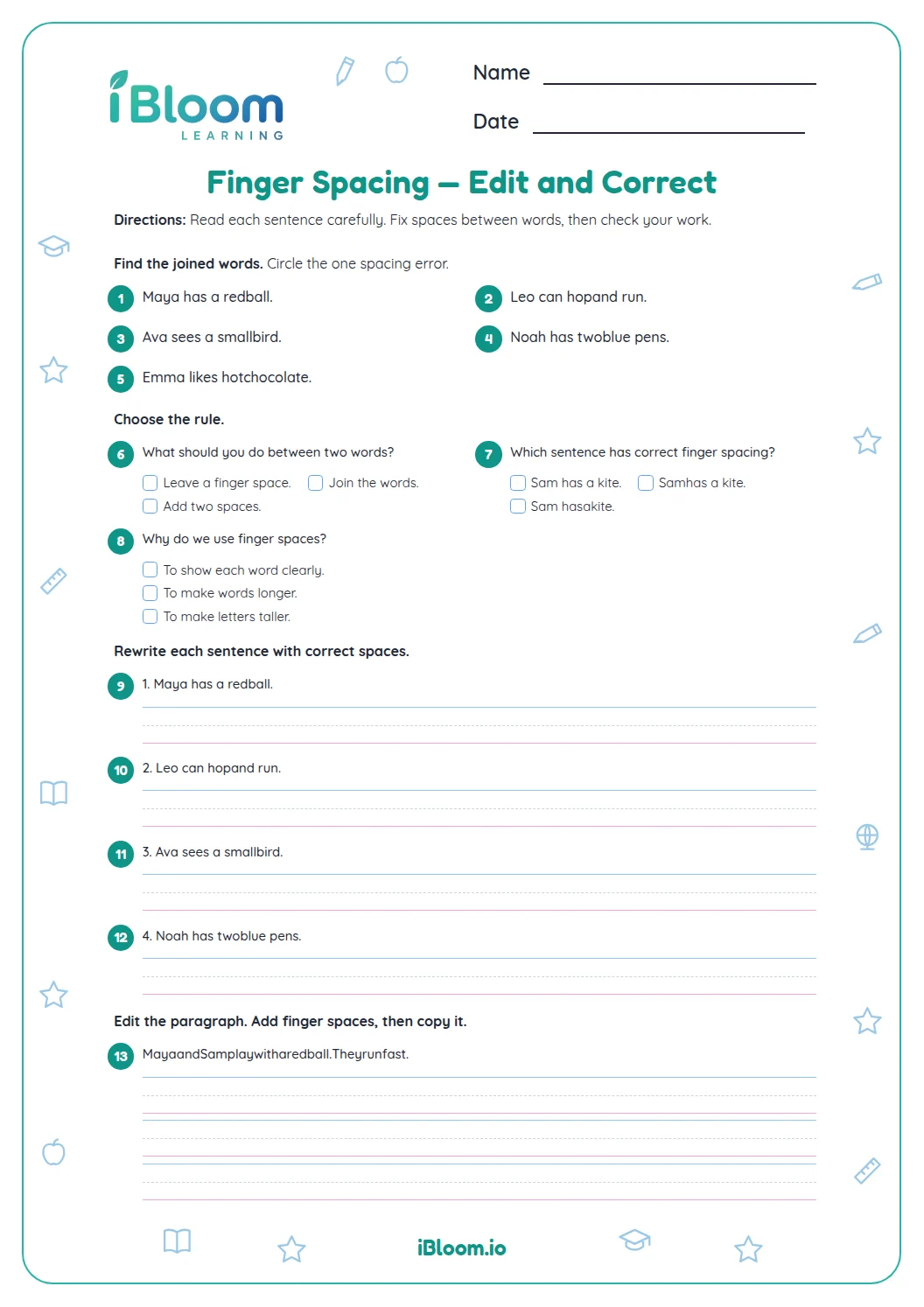
This Grade 1 writing worksheet gives children 14 chances to notice and create clear spaces between words. Students compare readable and run-together sentences, count words, choose complete thoughts, and repair two sentences with no spaces. The final choices revisit sentence clarity, so children use spacing to make their writing easier to read. A separate answer key shows the expected choices and rewrites.
How can a child spot a missing finger space?
Read from left to right and look for a small gap between each word. In question 9, “Weseeducks.” needs spaces to become “We see ducks.” The gaps separate three words and make the sentence easier to read.
How do word counts connect to spacing?
Each group of letters between spaces is one word. Question 5, “Birds can fly high.” has four words: Birds, can, fly, and high. Count each word once, including short words such as “can.”
What will students revise on the page?
Students correct two run-together sentences, then select complete sentences and clear spacing in the final part. They can point to each word as they reread, leaving one finger-width gap as a visual reminder.
A short finger-spacing routine
- 1Read the sentence aloud once before marking it.
- 2Point to each word and notice the gap after it.
- 3Count words by counting the separate groups.
- 4Rewrite a run-together sentence, leaving a finger space between words.
- 5Reread the new sentence to check both spacing and meaning.
Common finger-spacing mix-ups
The mistake
Leaving out a short word when counting “I like my new book.”
The fix
Point to each separate word, including “my,” as you count.
The mistake
Putting spaces inside a word while fixing a sentence.
The fix
Separate words at their boundaries; keep the letters in each word together.
The mistake
Choosing a group of words that does not finish a thought.
The fix
Read it aloud and ask whether it tells a complete idea, such as “The dog runs.”
What to practice next
Make more practice
Further reading
Questions parents and teachers ask
What is a finger space?
A finger space is a small gap between two words in a written sentence. On this worksheet, children spot clear and unclear spacing, count words, and repair two run-together sentences. A finger can serve as a quick guide while a child is learning to leave consistent gaps.
How many questions are on this page?
There are 14 questions in three parts. Children compare sentence spacing, count words, choose complete sentences, and rewrite two sentences with missing spaces. A separate answer key shows the choices and corrected versions. Have the student explain the reasoning aloud before moving to the next item.
How should my child fix “Weseeducks”?
Read the sentence aloud, then separate the words: “We see ducks.” There are three words, so the corrected sentence has two spaces. Question 9 uses this exact kind of repair; question 10 asks children to do the same with another sentence.
Does the worksheet include handwriting practice?
It includes two sentence rewrites with room to write, along with multiple-choice items about spacing and sentence clarity. It does not ask children to trace letters. Children can write each corrected sentence and reread it to check that the words are separated.
What does the answer key show?
The separate key marks the correct sentence choices and word counts, then gives the expected spacing for both rewrites. For the rewrite items, accept handwriting variations as long as the words are correctly separated and the sentence remains readable. Have the student explain the reasoning aloud before moving to the next item.
How long should the practice take?
Plan for about 15 to 20 minutes, depending on how much time a child spends writing the two corrections. An adult can model one spacing choice, then let the child finish the remaining items and check them together. Have the student explain the reasoning aloud before moving to the next item.