






About this worksheet
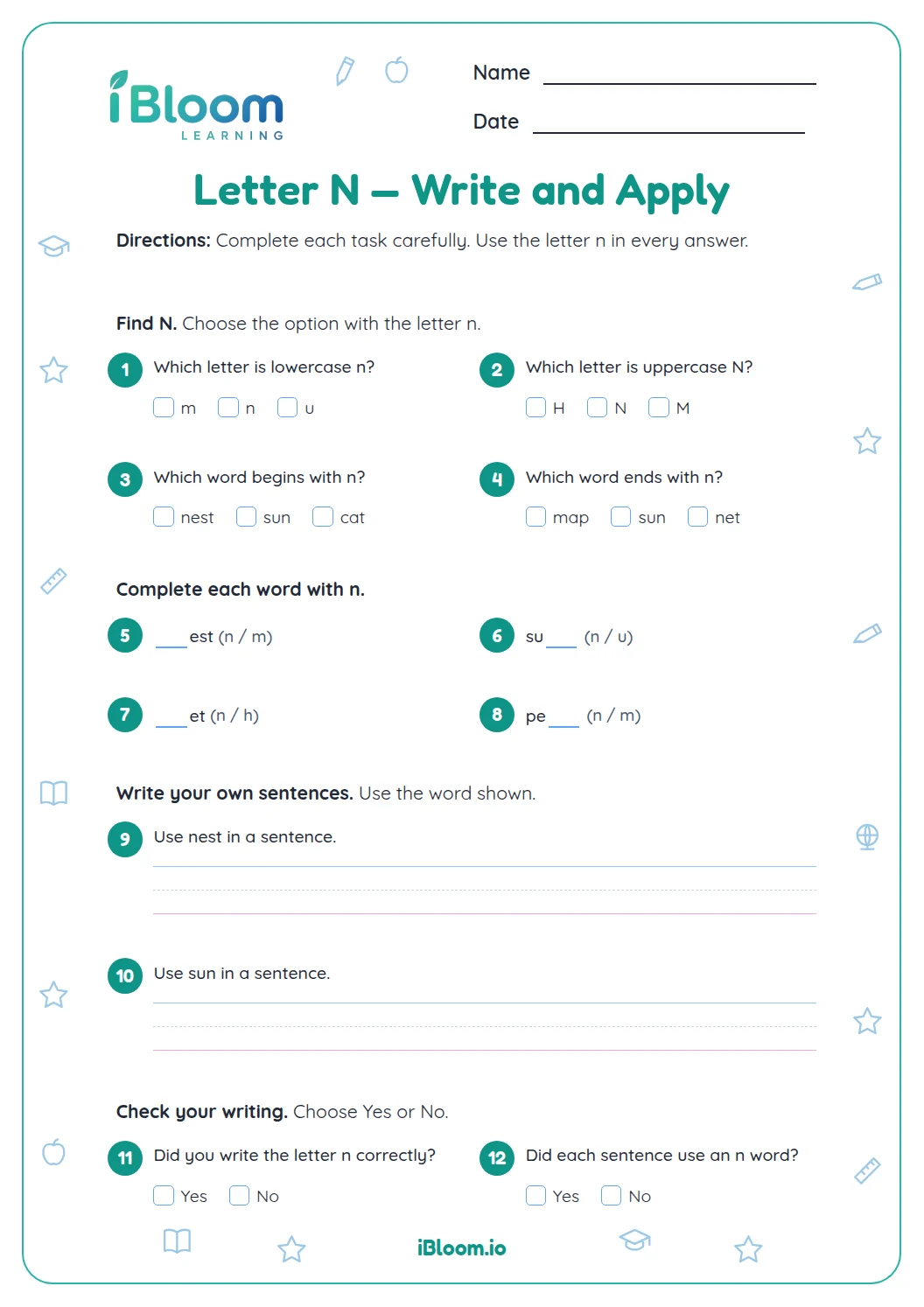
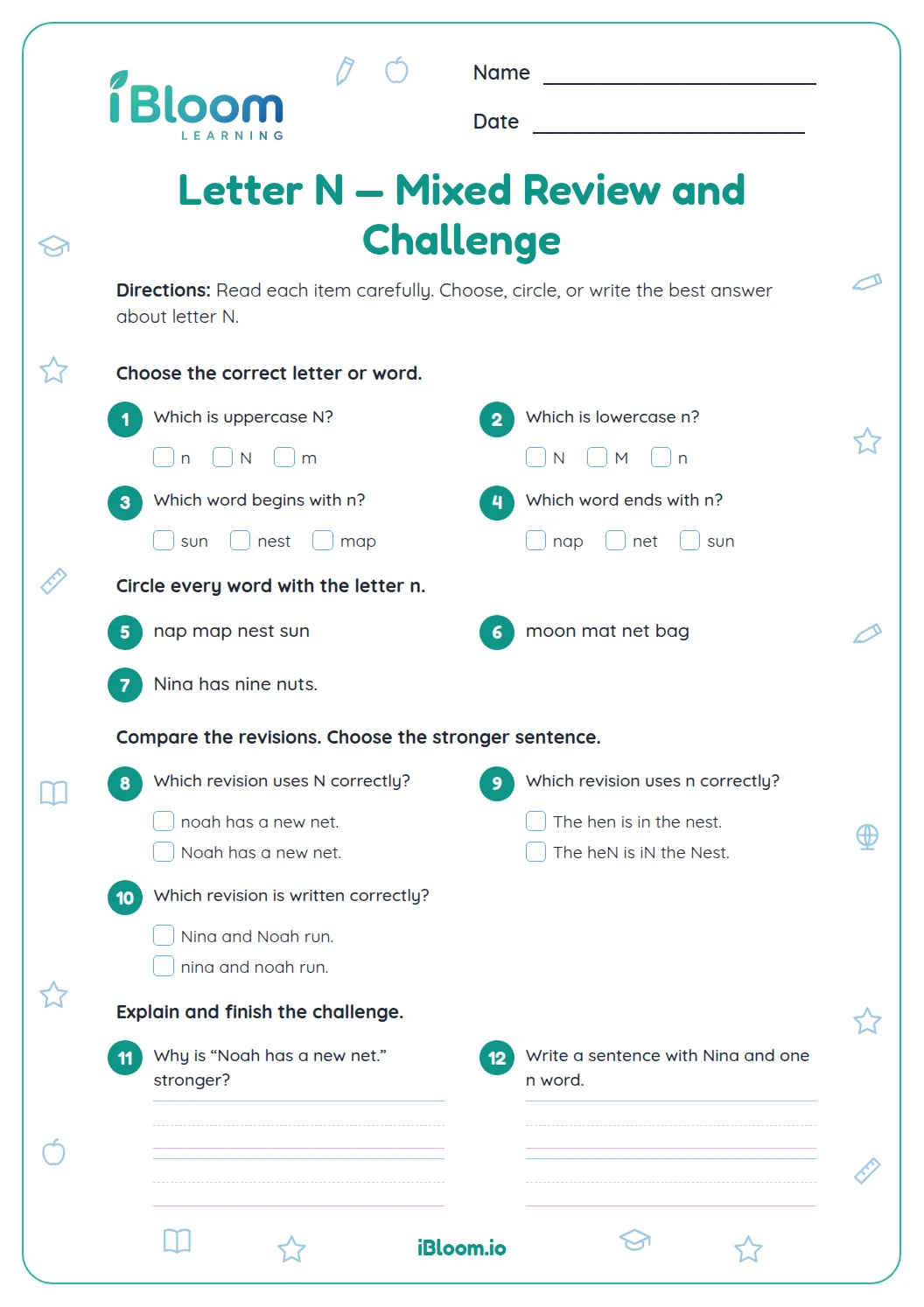
This Grade 1 printable offers 14 multiple-choice questions about uppercase N and lowercase n. Children identify both forms, recognize the letters in names and words, and distinguish N/n from similar letters. The separate answer key marks each correct choice.
How can children distinguish N from n?
Uppercase N is taller than lowercase n. Compare the shape and size of each option, then check that the selected form matches the question.
- 1Which letter is uppercase N?
- 2Choose N from M and H.
Where do N and n appear in words?
Some questions ask children to find n at the start or end of a word. Other prompts use names or words with more than one n. Read each choice and look for the target letter.
How should the answer key be used?
Complete the choices first, then use the key to check each response. Return to the letters in the word or name whenever an answer needs another look.
How to use this worksheet
- 1Read whether the prompt asks for uppercase N or lowercase n.
- 2Compare all answer choices before selecting one.
- 3For word questions, scan the beginning, ending, or whole word as directed.
- 4Finish all 14 questions before checking the key.
- 5Review any missed answer by finding N or n in its choices.
Common letter-recognition slips
The mistake
Mixing uppercase N with a similar capital.
The fix
Check the diagonal joining the two upright strokes.
The mistake
Choosing uppercase N when the prompt asks for lowercase n.
The fix
Match the size and form requested in the question.
The mistake
Scanning only the first letter when asked about a word ending.
The fix
Look at the final letter before choosing.
What to practice next
Make more practice
Questions parents and teachers ask
How many questions are included?
The worksheet has 14 multiple-choice questions about uppercase N and lowercase n. Children identify letter forms and find N or n in names and words. A separate answer key marks each correct choice, so an adult can check the work after the learner finishes.
Does this page ask children to trace N and n?
The questions focus on recognizing the printed letter forms. Children choose uppercase N or lowercase n among similar letters and identify the target in names and words. The worksheet includes an answer key for checking each choice. Invite the child to explain how the selected answer matches the letter or word clue.
What is the difference between uppercase N and lowercase n?
Uppercase N is taller and has two upright strokes joined by a diagonal. Lowercase n is smaller and has one upright stroke with a rounded arch. The choices ask children to notice which form the prompt names. Invite the child to explain how the selected answer matches the letter or word clue.
How can I help with word questions?
Read the direction carefully, such as asking for a word that begins or ends with n. Have the learner look at the requested part of each word, then select the option that contains the target form in that position.
How should we check the answer key?
Let the child finish a few questions before checking. Compare each response with the key, and revisit the letter or word choices for any missed item. This keeps the focus on noticing N and n in print. Invite the child to explain how the selected answer matches the letter or word clue.