








About this worksheet
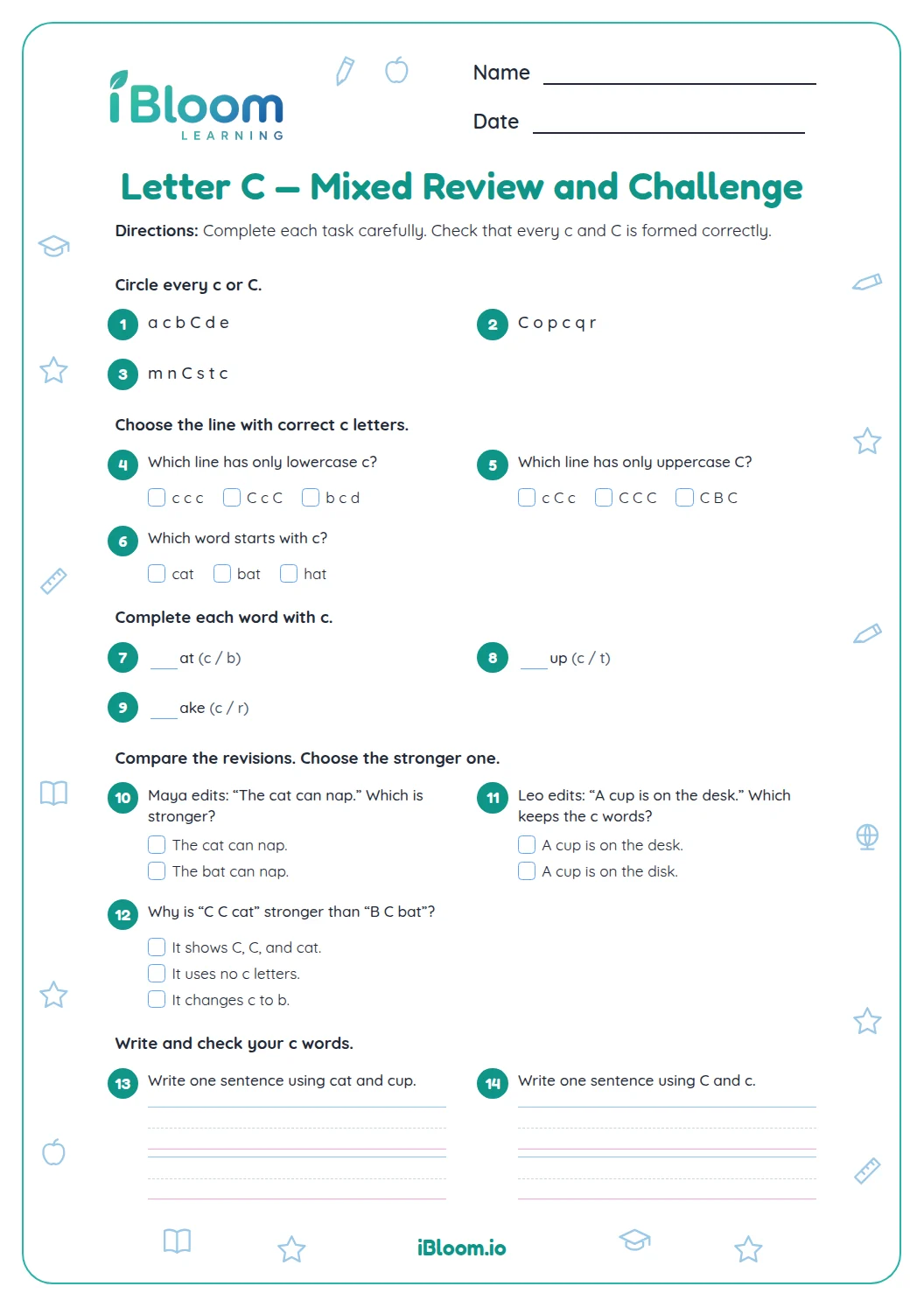
This Grade 1 Letter C worksheet combines editing with handwriting practice. Learners find C/c capitalization errors in sentences, correct six additional sentences, and trace uppercase C, lowercase c, and familiar examples. The editing focuses on capital C at the start of a sentence or in a person’s name, and lowercase c in common words. The activities practice CCSS L.1.1a and L.1.2a.
Aligned to L.1.1a and L.1.2a
When should C be uppercase?
Part A compares correctly and incorrectly capitalized sentences. A person’s name and the first word of a sentence start with a capital letter; a common word such as cat uses lowercase c inside a sentence.
- 1The Cat naps on a mat.
- 2Circle Cat.
How can I correct C and c in a sentence?
In the sentence-editing set, find the C word that needs a capital change. Rewrite the whole sentence with that letter fixed.
- 1Fix the sentence: We pet a Camel.
- 2Answer: We pet a camel.
What letter forms can I trace?
The tracing set moves from uppercase and lowercase forms to short examples. Trace each model, then print it on the line.
- 1Trace and print: Cc
- 2The model shows uppercase C followed by lowercase c.
How to use this worksheet
- 1Read each full sentence before choosing an answer.
- 2Check whether C begins a sentence or names a person.
- 3Keep c lowercase inside common words such as cat and cup.
- 4Rewrite each edited sentence with its corrected capital letter.
- 5Trace each model before printing it on the line.
C and c reminders
The mistake
Using uppercase C in a common word inside a sentence
The fix
Use lowercase c in words such as cat, cup, and camel.
The mistake
Leaving a person’s name lowercase
The fix
Capitalize names such as Clara and Caleb.
The mistake
Changing every C in a sentence to uppercase
The fix
Capitalize only where the sentence or name calls for it; keep common words lowercase.
Common Core alignment
Print uppercase and lowercase letters, including C and c.
On this sheet: The tracing part practices uppercase C and lowercase c in letters and words.
Show the official wordingHide the official wording
Print all upper- and lowercase letters.
Capitalize people’s names, including names that begin with C.
On this sheet: The editing items practice capitalizing people’s names such as Clara, Caleb, and Cora.
Show the official wordingHide the official wording
Capitalize dates and names of people.
What to practice next
Make more practice
Further reading
Questions parents and teachers ask
When should a child write uppercase C?
Use uppercase C at the start of a sentence and in a person’s name, such as Clara or Caleb. A common word such as cat or cup uses lowercase c in the middle of a sentence. The worksheet asks children to compare these cases and edit examples.
What does the tracing part include?
The six trace items include uppercase C, lowercase c, both forms together, and familiar examples such as cat, cup, and Cora. Learners trace each model and then print it on the line. The answer key repeats the model for checking.
How many editing questions are included?
There are six questions that ask learners to find a C/c capitalization error, six sentence edits, and six trace items, for 18 questions in all. The editing examples focus on uppercase C or lowercase c in names, sentence beginnings, and common words.
Does this worksheet practice punctuation?
The worksheet focuses on uppercase and lowercase C, correct capitalization in names and sentences, and letter formation. The sentence examples include end marks so they read naturally, while the answer task centers on the C/c capitalization choice and the tracing models.
Is an answer key provided?
Yes. A separate answer key shows the correctly capitalized sentence for each choice and the corrected version of each edit. It also repeats the letters and words used for tracing so an adult can compare the child’s printed form with the model.