




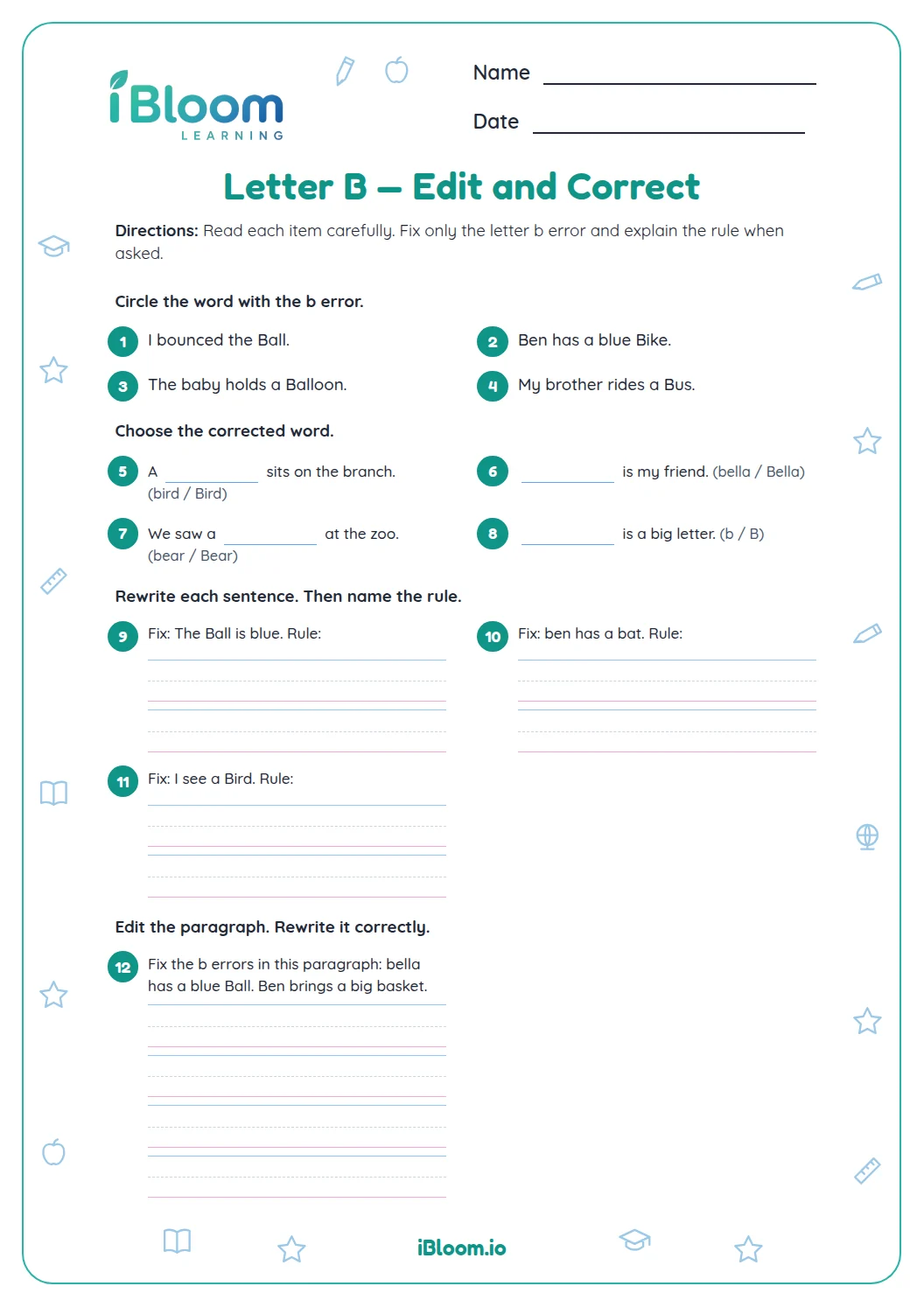
About this worksheet
This Grade 1 printable combines print-letter and sentence practice. Students identify uppercase and lowercase forms, recognize complete thoughts, and choose or write sentences with capitals and end marks. A separate answer key includes a sample sentence.
Aligned to L.1.2
What letter and word practice is included?
Part A starts with Aa and Mm, then moves to the short word map. Children trace each printed model and copy sun to practice controlled letter formation.
- 1Trace Aa, paying attention to the tall capital and the rounded lowercase a.
- 2Then copy sun, leaving a small space between letters.
How can a child spot a complete sentence?
Parts B and C contrast a complete thought with a fragment. “Birds can fly.” tells who and what they can do; “Birds can” leaves the thought unfinished. The final punctuation is part of the sentence.
- 1Birds can fly. → complete thought
- 2Birds can → still needs what birds can do
What should a finished sentence include?
Start with a capital letter, say a complete thought, and finish with an end mark. Questions 10–14 let children add a period, write their own idea, and repair a lowercase name.
How to use this worksheet
- 1Read each trace model aloud before starting.
- 2Trace Aa and Mm slowly, keeping lowercase letters close to the line.
- 3Copy “sun” with spaces between letters, not between every stroke.
- 4For the choices, read both options aloud and ask which one feels finished.
- 5Use a capital at the start and a period at the end of original sentences.
Common mistakes and quick fixes
The mistake
Leaving out a word that completes the thought.
The fix
Ask who is doing what; add the missing action to “Birds can.”
The mistake
Writing a name with a lowercase first letter.
The fix
Names begin with capitals: Ben, not ben.
The mistake
Forgetting sentence-ending punctuation.
The fix
Read the sentence aloud, then place a period at the end of a statement.
Curriculum alignment
Practice capitalization and sentence-ending punctuation while writing complete sentences.
On this sheet:
Show the official wordingHide the official wording
Demonstrate command of the conventions of standard English capitalization, punctuation, and spelling when writing.
What to practice next
Make more practice
Further reading
Questions parents and teachers ask
How many activities are included?
There are 14 activities in three parts. The first five ask children to trace or copy letters and words, the next four recognize complete sentences, and the final five give sentence writing and editing practice with capitals, end marks, and simple ideas of their own.
What does a complete sentence mean?
A complete sentence tells a whole thought. “Birds can fly.” is finished because it tells what birds can do, while “Birds can” leaves the reader waiting for the rest of the idea. Children can read each choice aloud to hear the difference.
Should children trace before copying?
Trace the displayed letters and word first, then copy a word on the response line. Tracing gives a model to follow; copying asks the child to form the same letters independently. Keep the pencil relaxed and leave clear spaces between words.
How can a child check the writing?
Most items ask for statements, so a period is the expected end mark. Read the sentence aloud and listen for the point where the thought is complete, then place the period there. Question 12 also practices capitalizing a name at its start.
What should the answer key be used for?
The key gives exact answers for choices and corrected sentences. Open prompts include sample responses, so another sensible answer can also be correct when it follows the direction and forms a complete, readable sentence with appropriate punctuation. It helps families review each item together.