





About this worksheet
This free printable worksheet gives Grade 1 children practice printing the letter P inside whole sentences, not only on its own. Children pick the P word that fits a sentence, copy two sentences about Pam and a puppy, fix two sentences that are missing a capital letter and a period, and join two short sentences into one. It practices Common Core L.1.2a and L.1.2b: capitalizing names of people and ending a sentence with the right mark. The two-page answer key shows every choice and a model sentence for each written question.
Aligned to L.1.2a and L.1.2b
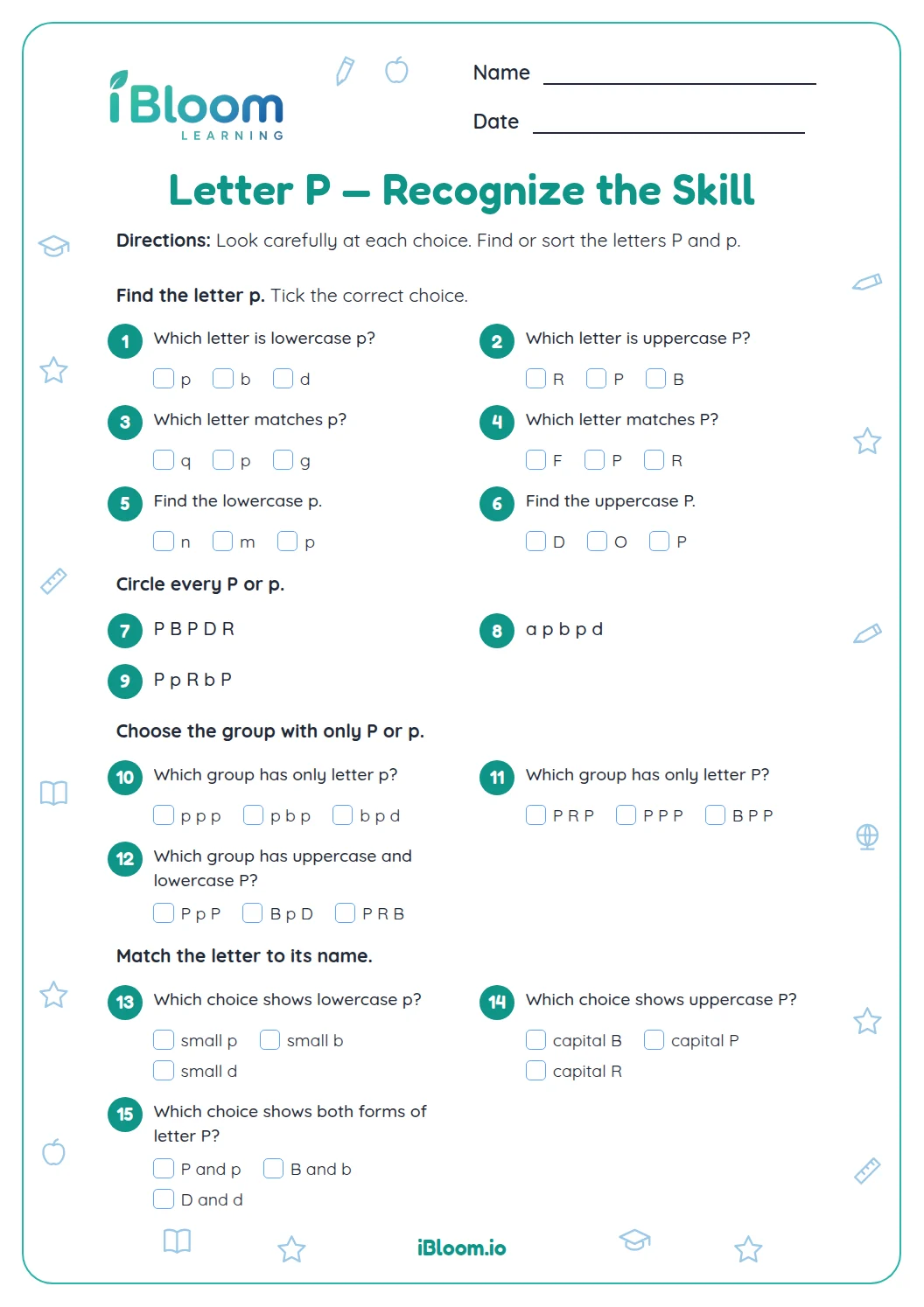
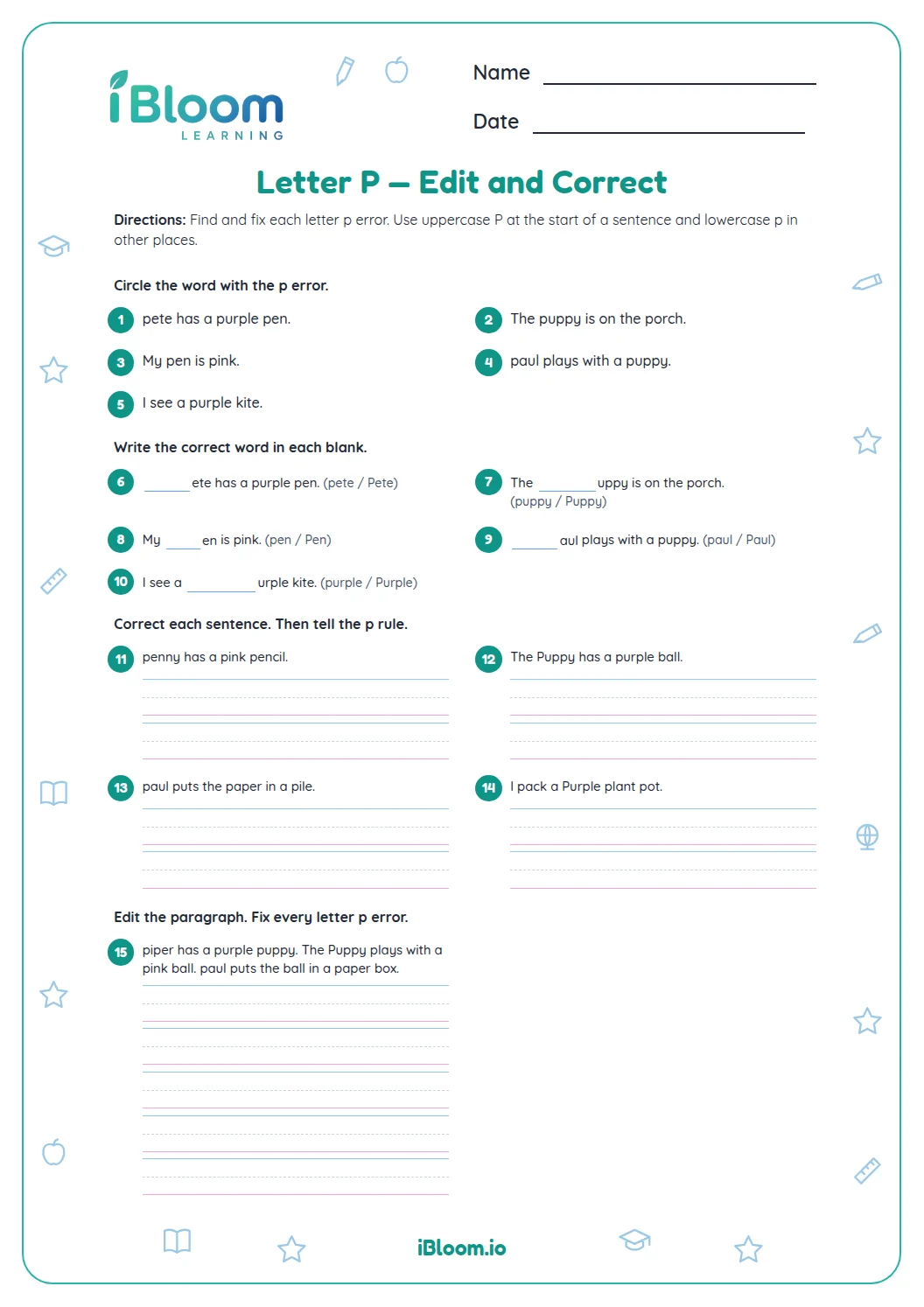
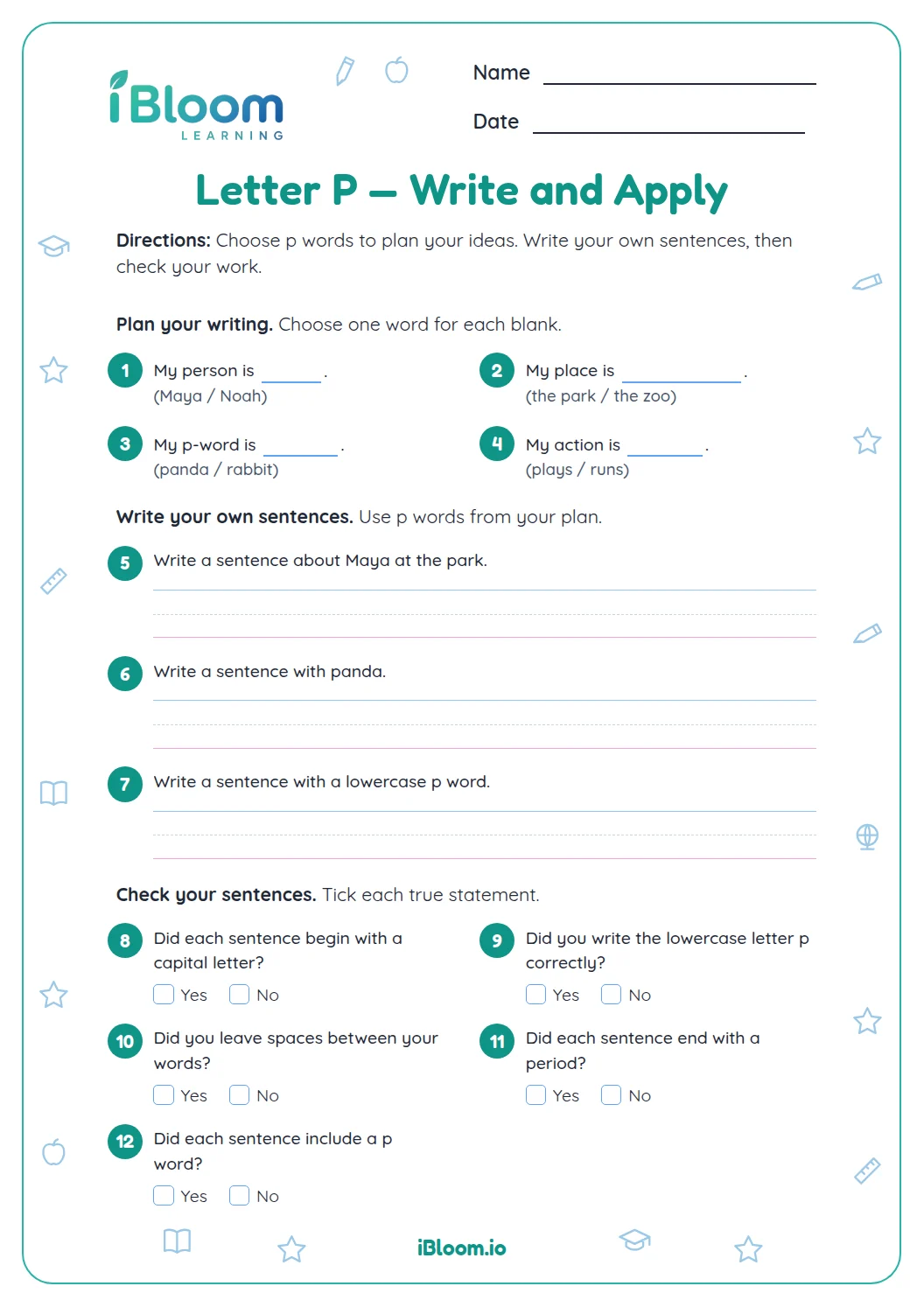
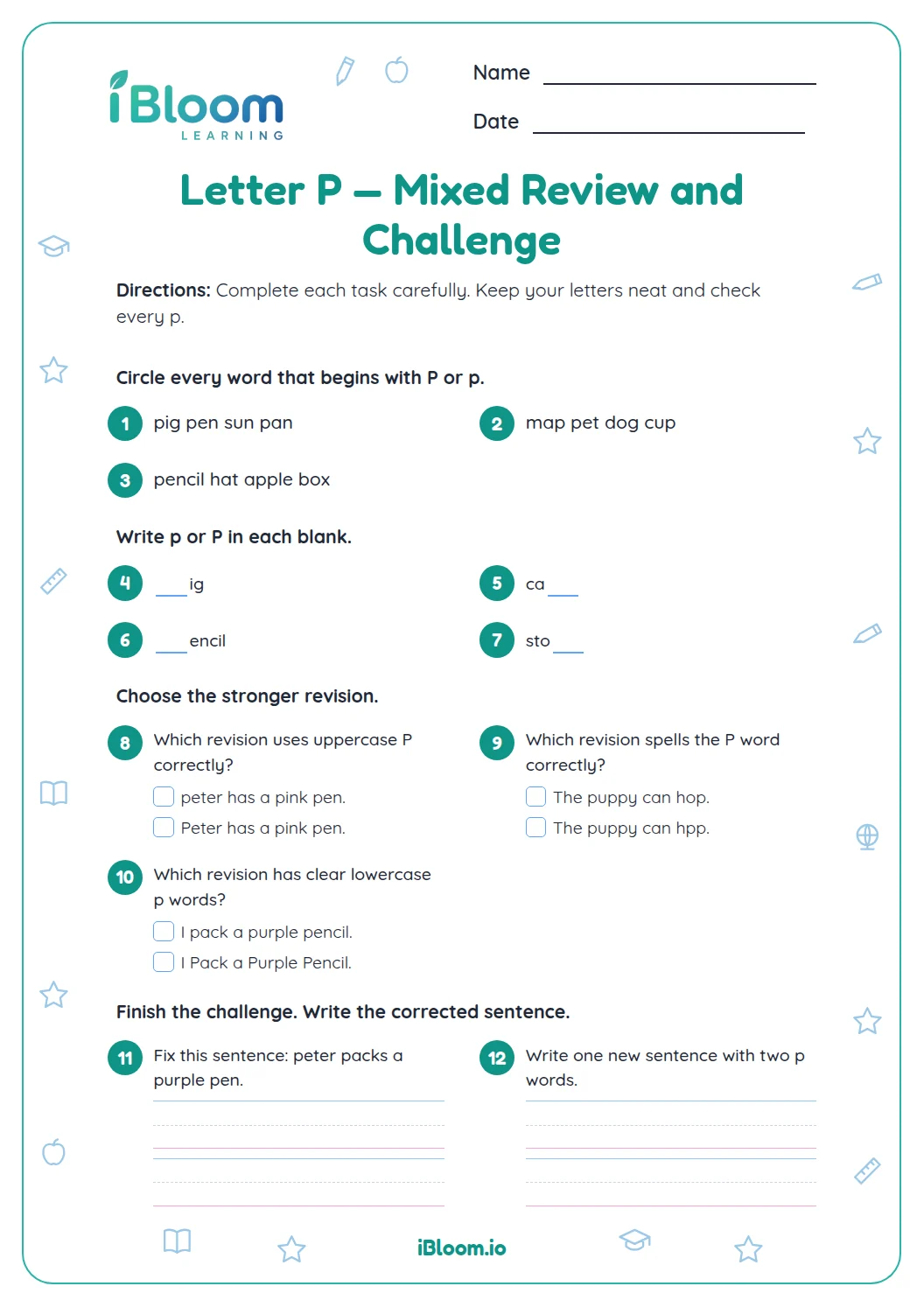
What is on this Letter P worksheet?
The sheet has four short parts that move from choosing to writing. In Part A, children read a sentence with one missing word and color the P word that makes sense, such as pillow, pencil, pond or pizza. Parts B, C and D are written work on lines: copy a sentence, fix a sentence, then join two sentences.
The copy, fix and join sentences are packed with P words: Pam, plants, purple, pea, puppy, pad, Pete, pets, pig, pink, pen and playful, plus pillow, pencil, pond and pizza in the Part A choices. Children print capital P in Pam and Pete and lowercase p at the start and in the middle of words, such as puppy, so they practice both forms in real sentences.
- Part A: 4 questions, pick the P word that fits
- Part B: 2 sentences to copy
- Part C: 2 sentences to fix (capital letter and period)
- Part D: 2 pairs of short sentences to join
How do children fix a sentence with no capital letter?
Ask two questions about every sentence a child writes: Does it start with a capital letter? Does it end with a mark? In "pete pets a puppy," Pete needs a capital P for two reasons: it is a person's name, and it is the first word. In "the pig is pink," only the first word needs a capital, so The gets a capital T and pig stays lowercase.
Have your child say the sentence aloud, then touch the first letter and the last spot on the line before writing it again.
- 1pete pets a puppy
- 2Is Pete a name? Yes, so it starts with a capital P.
- 3How does the sentence end? It needs a period.
- 4Fixed sentence: Pete pets a puppy.
How do you join two short sentences into one?
Joining shows children that writing can be smooth, not a list of tiny sentences. In "Pam has a pen. The pen is pink." both sentences are about the same pen. Move the describing word pink in front of pen and keep one period: "Pam has a pink pen."
Other good answers are fine, such as "Pam has a pen and it is pink." On the second pair, "The puppy is small and playful" uses the word and to bring the two ideas together.
How should a first grader print a capital P and a lowercase p?
A common way to teach the capital P is a straight line down from the top line, then a bump that starts at the top and curves back in to the middle. The lowercase p starts at the middle line, goes straight down below the bottom line, then comes back up for a round bump on the right.
Watch the tail of the lowercase p. It drops below the bottom line, and that tail is what makes p look different from o, a or b. Praise neat, evenly sized letters and good spacing between words more than speed.
How to use this worksheet at home or in class
- 1Read the sentence in question 1 aloud together and say the word choices slowly before your child colors one.
- 2Let your child finish Part A alone, then talk about any P word that was a hard pick.
- 3For Part B, point out the capital letter at the start and the period at the end before your child copies.
- 4In Part C, have your child circle the letter that needs to change, then print the fixed sentence.
- 5For Part D, read both short sentences and ask which word can move so only one sentence is left.
- 6Check with the answer key and praise one thing, such as a tidy P that sits on the line.
Common mistakes and quick fixes
The mistake
Writing "pete" with a small p because it does not look like a name.
The fix
Ask, "Is Pete a person?" Then remind your child that every name starts with a capital letter, and let them circle the first letter.
The mistake
Copying every word but leaving off the period at the end of the sentence.
The fix
Have your child touch the last mark in the model with a finger, and say "period" before printing it.
The mistake
Printing the lowercase p sitting on the line with no tail, so it looks like a small o with a stick.
The fix
Trace the tail slowly in the air, then on the line. Remind your child that p starts at the middle line and goes down through the bottom line.
Common Core alignment
The Grade 1 Language standards ask children to use capital letters and end marks when they write.
Start the names of people with a capital letter, as in Pam and Pete.
On this sheet: Pam in Part B and pete in Part C need a capital letter, and Part D keeps Pam capitalized.
Show the official wordingHide the official wording
Capitalize dates and names of people.
End each sentence with a period, as in "The pig is pink."
On this sheet: Children copy, fix and join sentences, and each one needs its period.
Show the official wordingHide the official wording
Use end punctuation for sentences.
What to practice next
Make more practice
Further reading
Questions parents and teachers ask
What does a Letter P sentence worksheet teach?
It teaches children to print the letter P in whole sentences and to remember capital letters and end marks. On this sheet they pick P words, copy two sentences, fix two sentences and join two pairs. That is more useful than writing the letter alone, because it is the same job they do in real writing.
Why are there so many P words in the sentences?
Every sentence to copy, fix or join was written around P words, such as Pam plants a purple pea, so your child prints p many times in one short line. Small words like a, the and on keep the sentences natural, and the Part A choices add pillow, pencil, pond and pizza.
When does the letter P need to be a capital?
A P is a capital when a sentence begins with it or when it starts the name of a person. On this sheet, Pam and Pete both start with a capital P. A P in the middle of a sentence, like puppy in "Pete pets a puppy," stays lowercase unless it begins a name.
What are the answers for the joining questions?
The answers can vary, so the key shows a sample: "Pam has a pink pen" and "The puppy is small and playful." Any complete sentence that keeps both ideas, starts with a capital letter and ends with a period is a good answer. Accept a child's version if it says the same thing.
My child cannot spell every word yet. Is that a problem?
No. Every word they print is already shown in the question, so the work is copying, capitals and punctuation, not spelling. You can read the sentences aloud and point to each word while your child prints. For the joining part, a short sentence they can say aloud is enough.
Is there an answer key, and how long does the sheet take?
Yes. The answer key has two pages: it marks the right choice in Part A and gives a model sentence for every written question. Plan on about 15 minutes, a little longer for careful printing. If writing takes a lot of effort, stop after Part B or C and finish the rest another day.