



About this worksheet
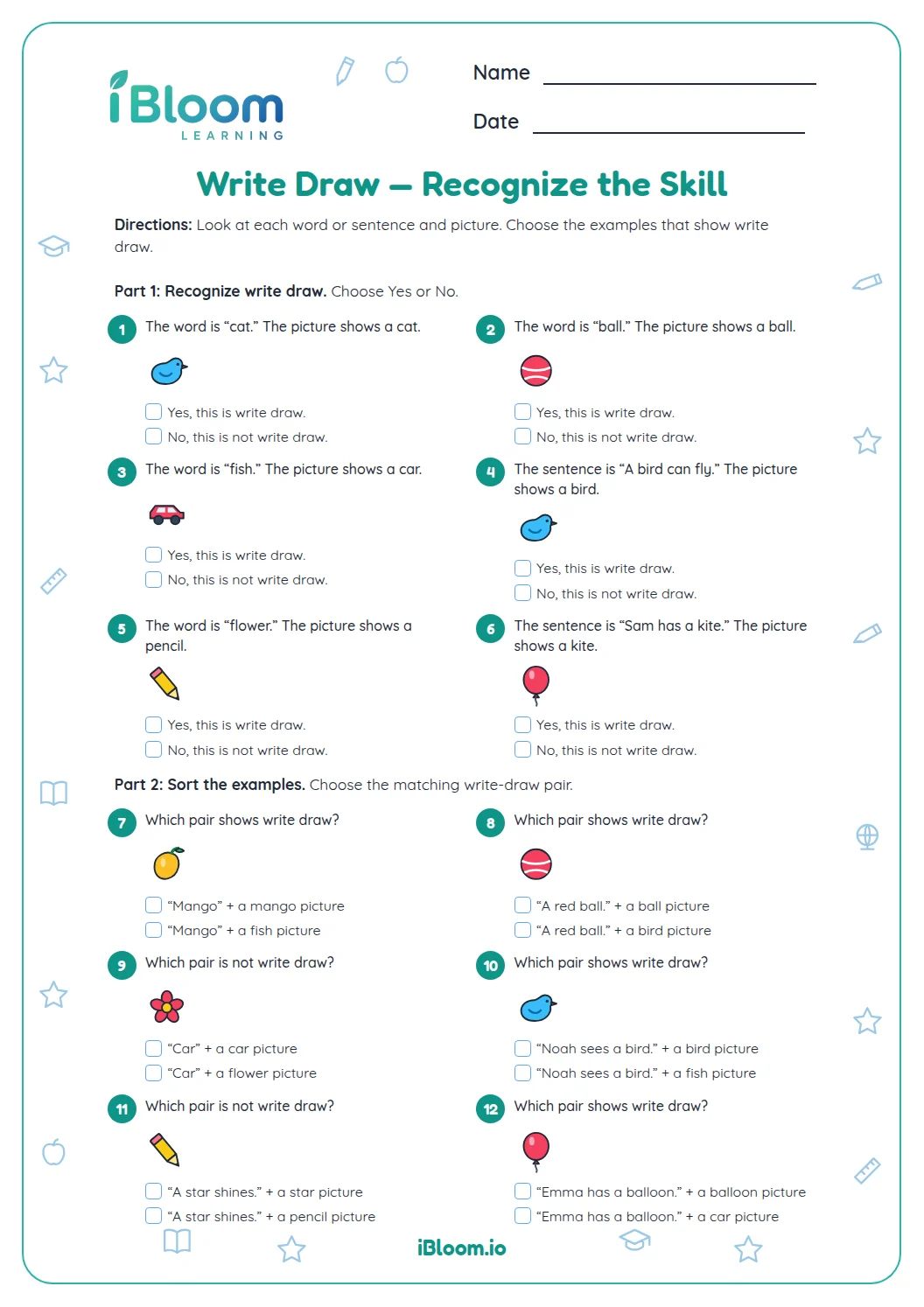
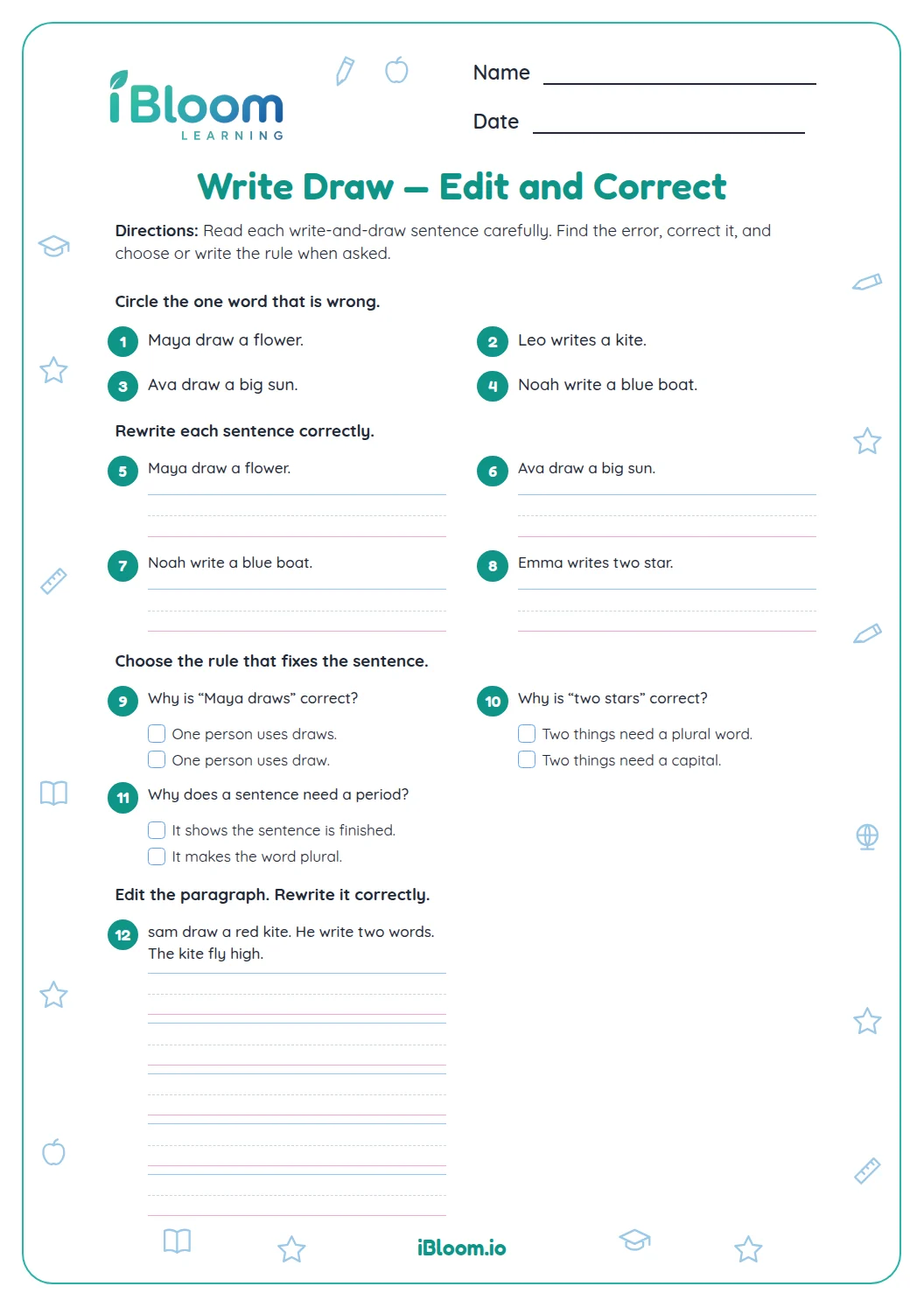
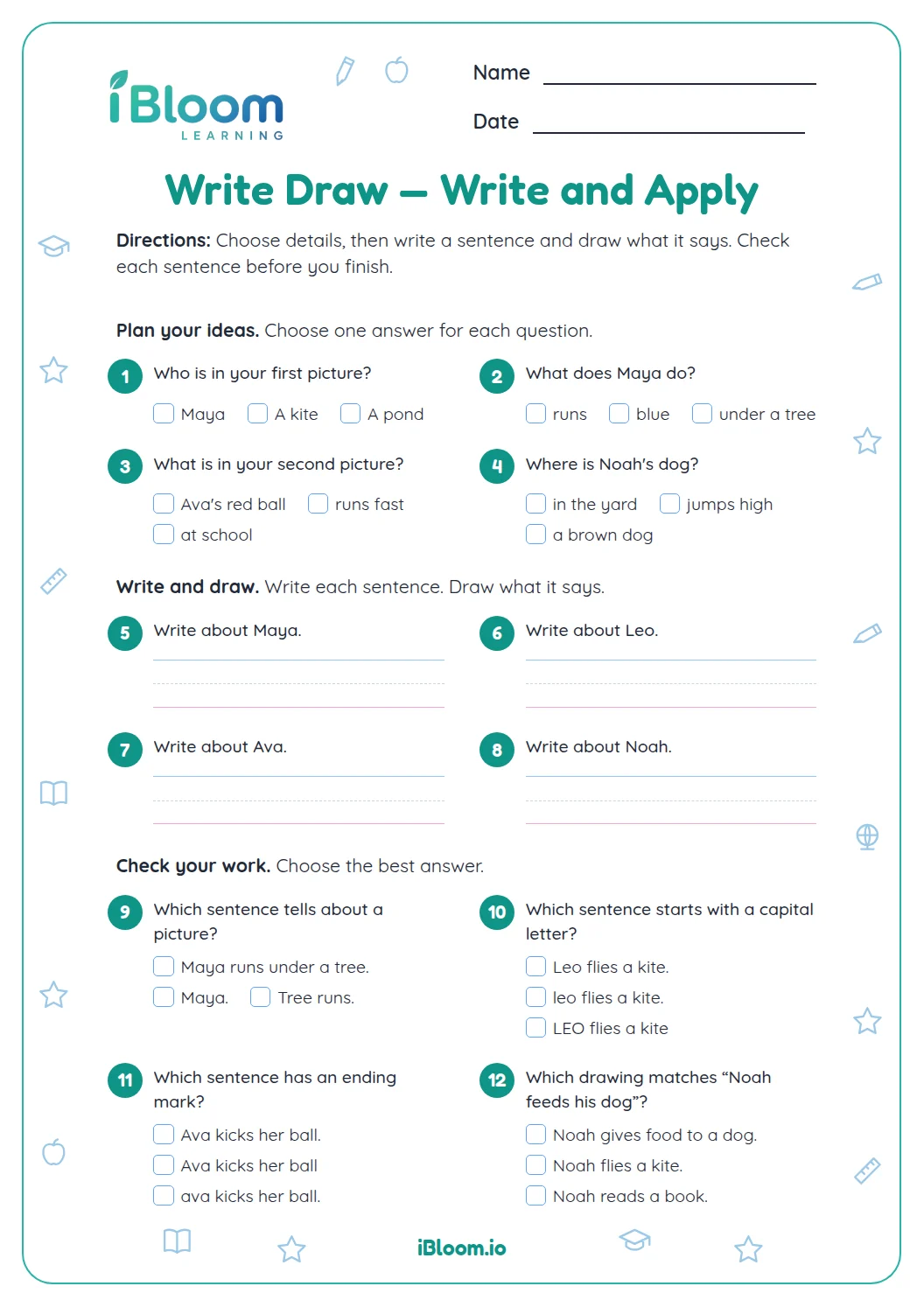
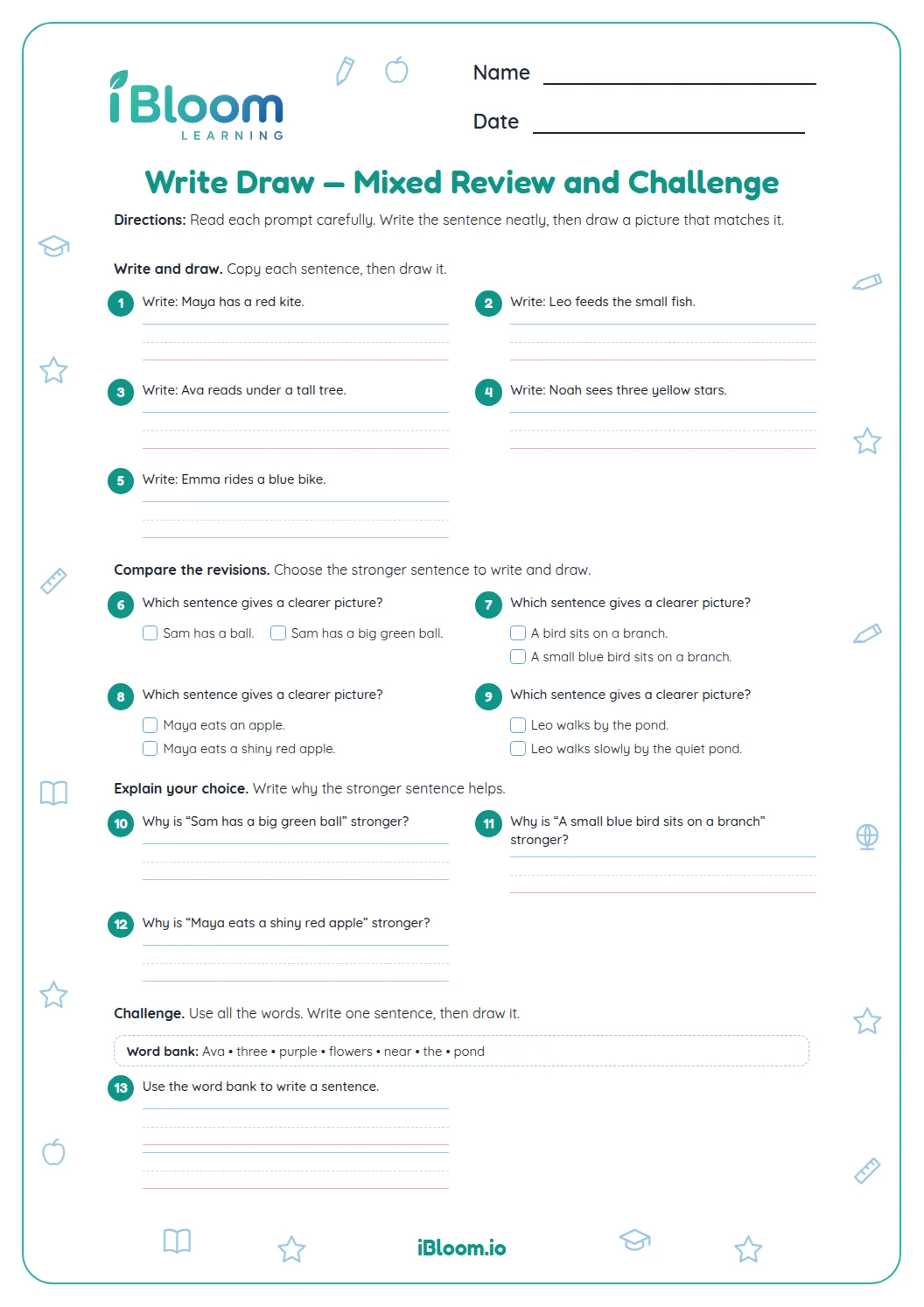
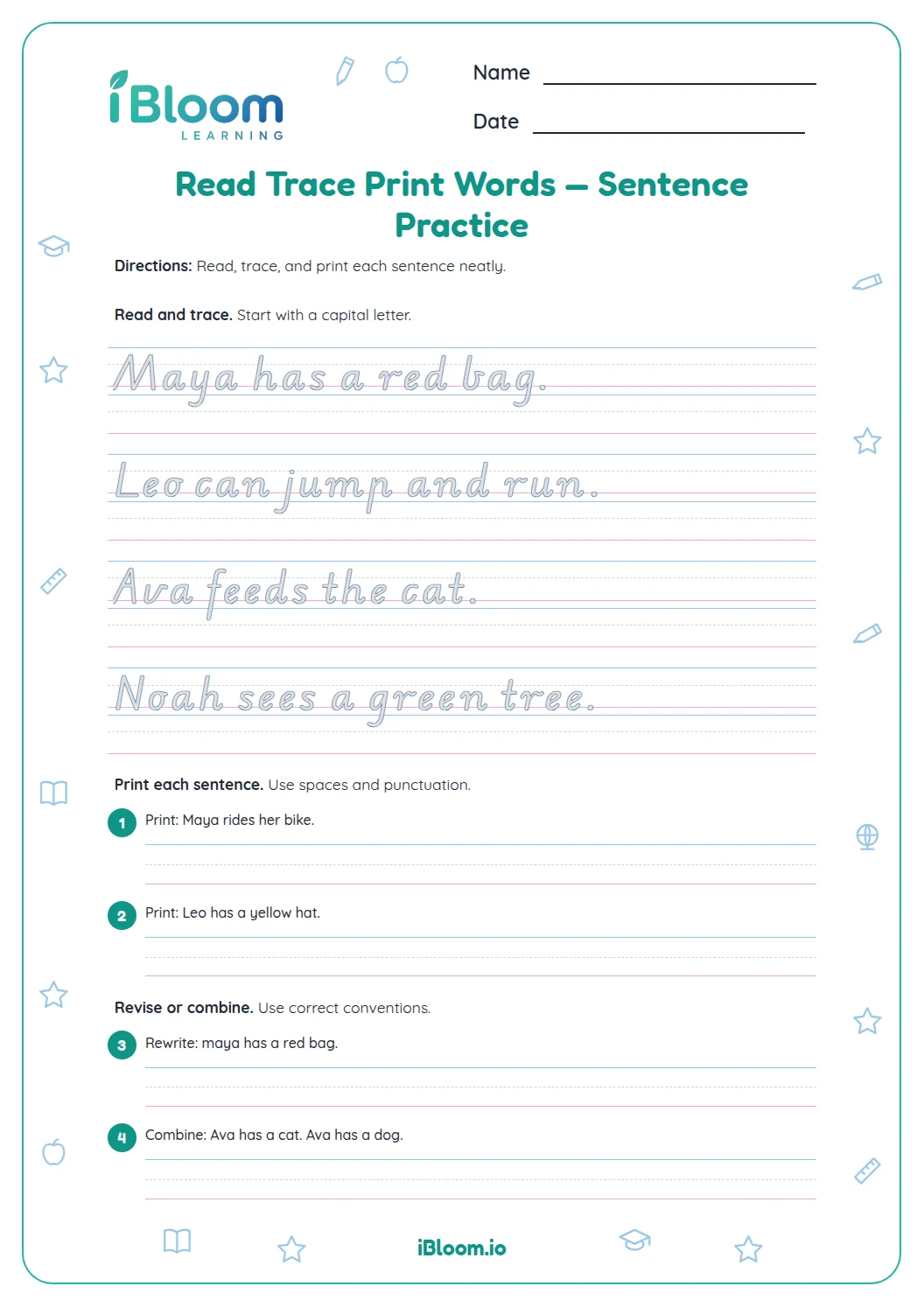
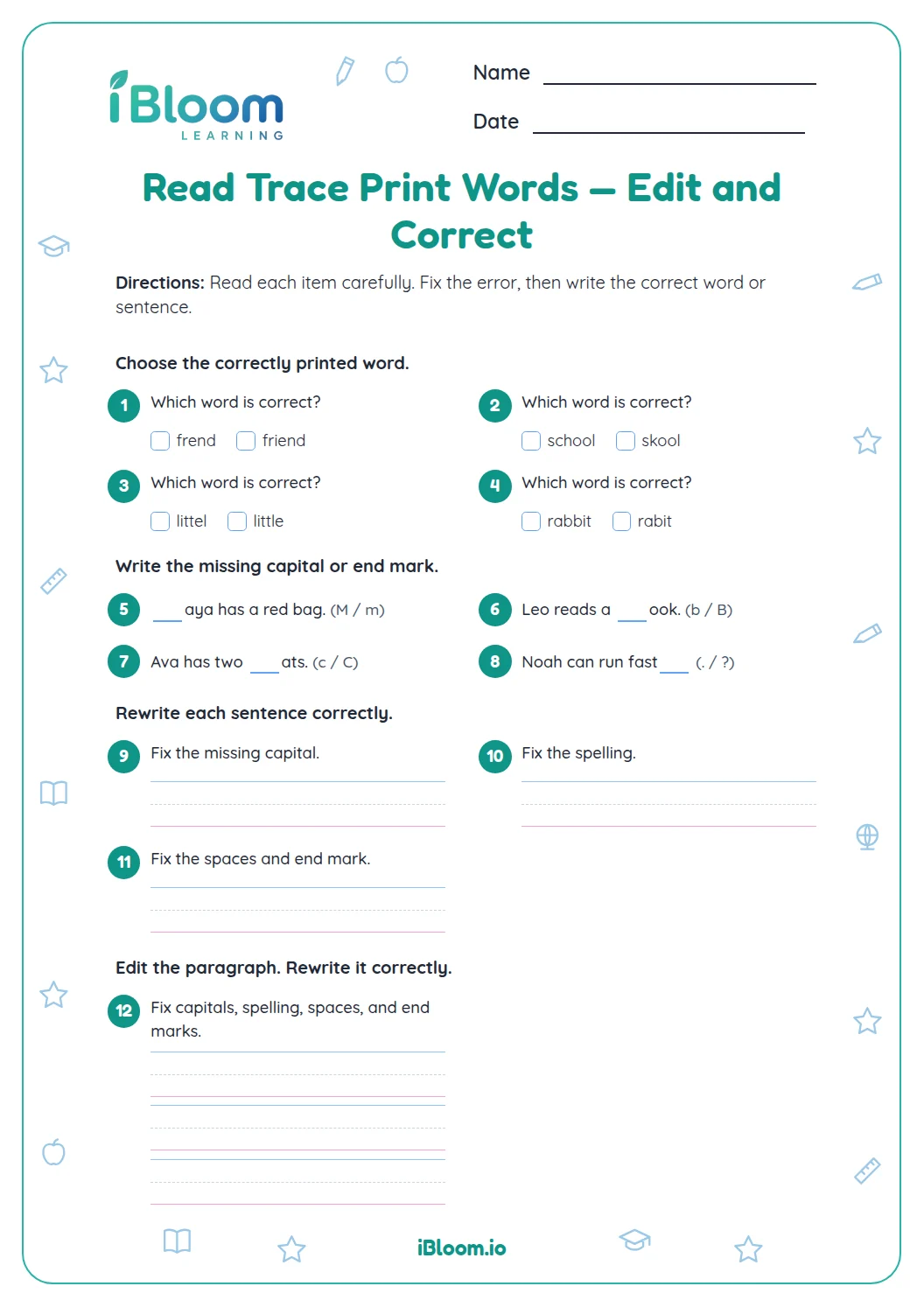
This Grade 1 printable gives learners 15 sentence-writing activities in four parts. First they copy or write short complete sentences and draw an idea for several prompts. Next they revise sentences by adding a capital letter and end mark. The final pair of questions joins two related ideas into one sentence. The answer key shows the copied sentences and sample responses for open-ended writing and drawings. The practice supports CCSS L.1.2 by asking learners to use capitalization and punctuation when writing.
Aligned to L.1.2
How does copying support sentence practice?
Copying a short model gives a child a chance to form each word and notice the capital at the beginning and punctuation at the end. Other prompts invite an original sentence about a familiar topic.
Question 1 is “The cat naps.” The child copies the full sentence, including its capital T and period. For an original prompt, “Write a sentence about a dog,” many answers can work if they form a complete thought.
How do drawing prompts connect to writing?
A drawing gives the child an idea to describe in words. Draw the named object, then write a sentence that matches the sketch.
Question 6 asks the child to draw a ball and write about it. “I can toss the ball” is one possible sentence; the drawing may show a ball in any setting that fits the words.
What should a child check when revising a sentence?
Check the first letter, the spaces between words, and the end mark. Read the sentence aloud to hear whether it says a complete thought.
Question 11 gives “my dog can run.” A corrected version is “My dog can run.” with a capital M and a period.
How can two ideas become one sentence?
Keep the important information from both sentences and remove repeated words when they are not needed. A joining word can connect the ideas.
Question 14 combines “I see a cat. The cat is small.” One sample is “I see a small cat.” Other clear sentences that keep both ideas are acceptable.
How can two ideas become one sentence?
Keep the important information from both sentences and remove repeated words when they are not needed.
Question 14 combines “I see a cat. The cat is small.” One sample is “I see a small cat.” Other clear sentences that keep both ideas are acceptable.
How to use this worksheet
- 1Read the prompt aloud together if a word is unfamiliar.
- 2Copy the whole model sentence, including its capital and end mark.
- 3For a draw-and-write prompt, sketch the named idea and describe it in one sentence.
- 4Reread each revision and check the first letter and punctuation.
- 5For a combine prompt, keep both ideas and remove repeated wording when it reads smoothly.
- 6Compare writing with the sample key; accept other clear sentences that fit the prompt.
Helpful checks
The mistake
Leaving off the capital at the start.
The fix
Point to the first word and check that its first letter is uppercase.
The mistake
Ending a sentence without punctuation.
The fix
Read the sentence aloud, then add a period for a statement.
The mistake
Writing a sentence that does not match the drawing.
The fix
Read the sentence and check that the picture includes the named idea or action.
This worksheet supports the following Common Core skill.
Write readable sentences with a capital first letter and an appropriate end mark.
On this sheet:
Show the official wordingHide the official wording
Demonstrate command of the conventions of standard English capitalization, punctuation, and spelling when writing.
What to practice next
Make more practice
Further reading
Questions parents and teachers ask
How many activities are on the worksheet?
There are 15 activities in four parts: copying and writing, drawing and writing, revising sentences, and combining ideas. The worksheet prints on four pages, followed by a separate four-page answer key. Several prompts invite a drawing that matches the child’s sentence.
Does the child need to draw for every question?
No. Five prompts in the second part ask the child to draw and write about a familiar object or place. The other questions ask the child to copy, write, revise, or combine sentences. For each sketch, encourage a simple picture that matches the child’s words.
What should a complete sentence include?
For these prompts, a complete sentence should express one clear thought, begin with a capital letter, and end with punctuation. A child can read the sentence aloud to check that it sounds finished. The answer key gives examples, but many original responses can be correct.
How should I check a child’s original sentence?
Check that it answers the prompt, names an idea clearly, and begins and ends correctly. The key’s sample answer is only one model. For drawing questions, check that the sketch matches the sentence rather than expecting one exact picture. A complete thought matters most.
What does the answer key show for drawings?
The key gives a sample sentence describing a reasonable drawing, rather than requiring the child to copy an exact picture. Accept a different sketch and sentence if the drawing matches the prompt and the sentence tells a complete thought. It is a guide for checking.
What can a child try next?
A child who is comfortable copying and revising short sentences can practice writing words independently or tracing and writing full sentences. The Grade 1 links below lead to related practice with printed words, spacing, and sentence writing. These activities build on the skills used here.