

About this worksheet
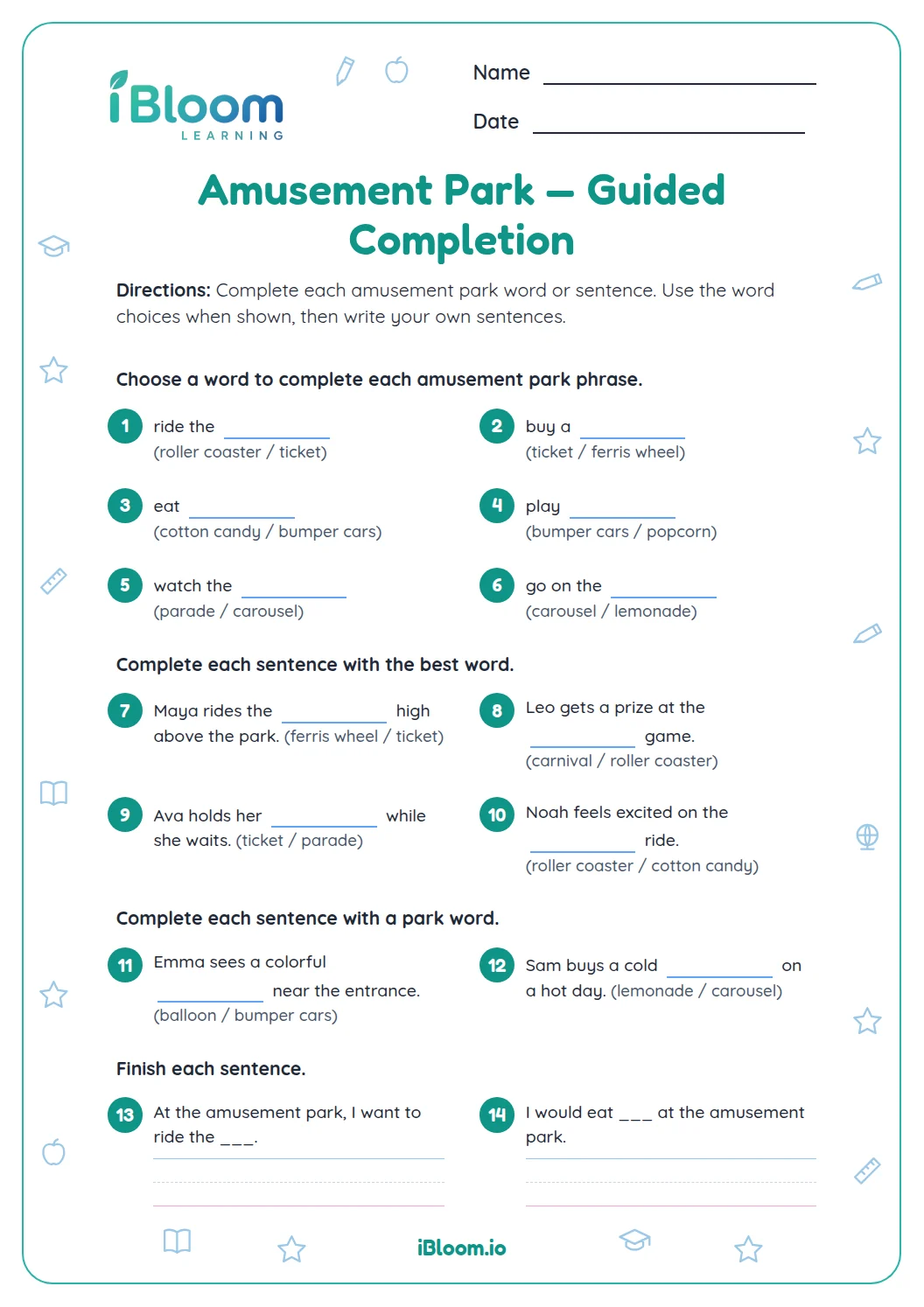
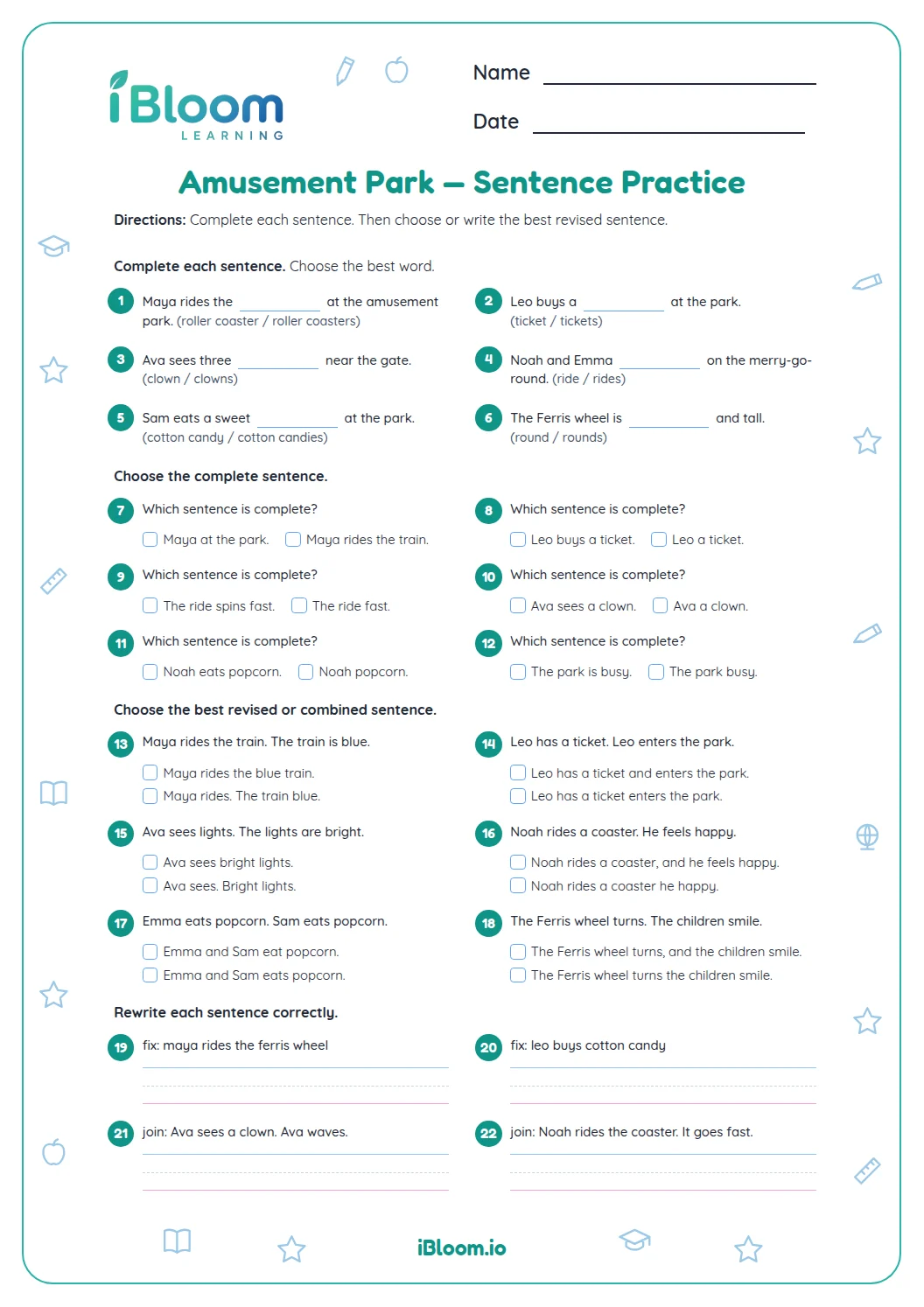
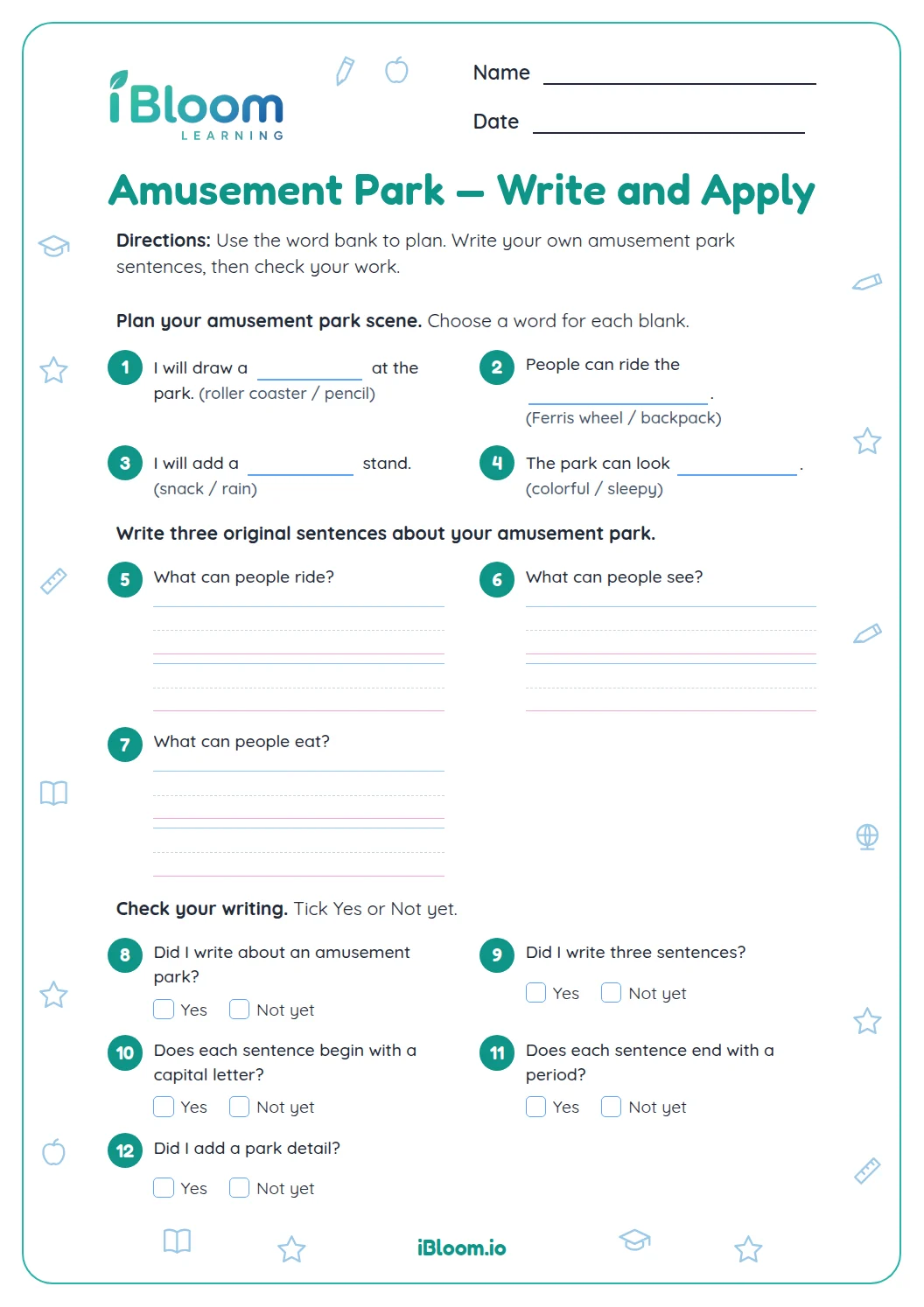
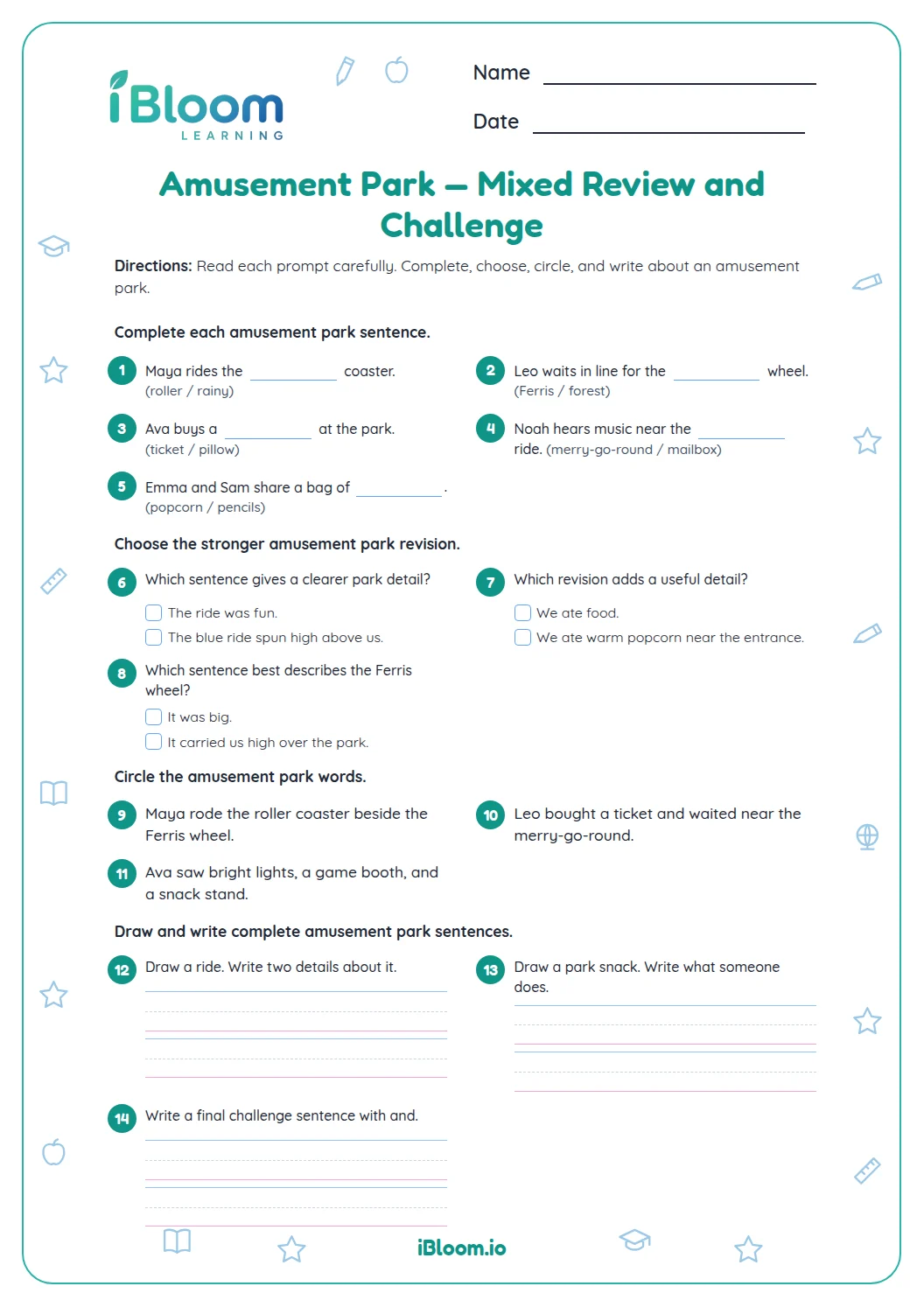
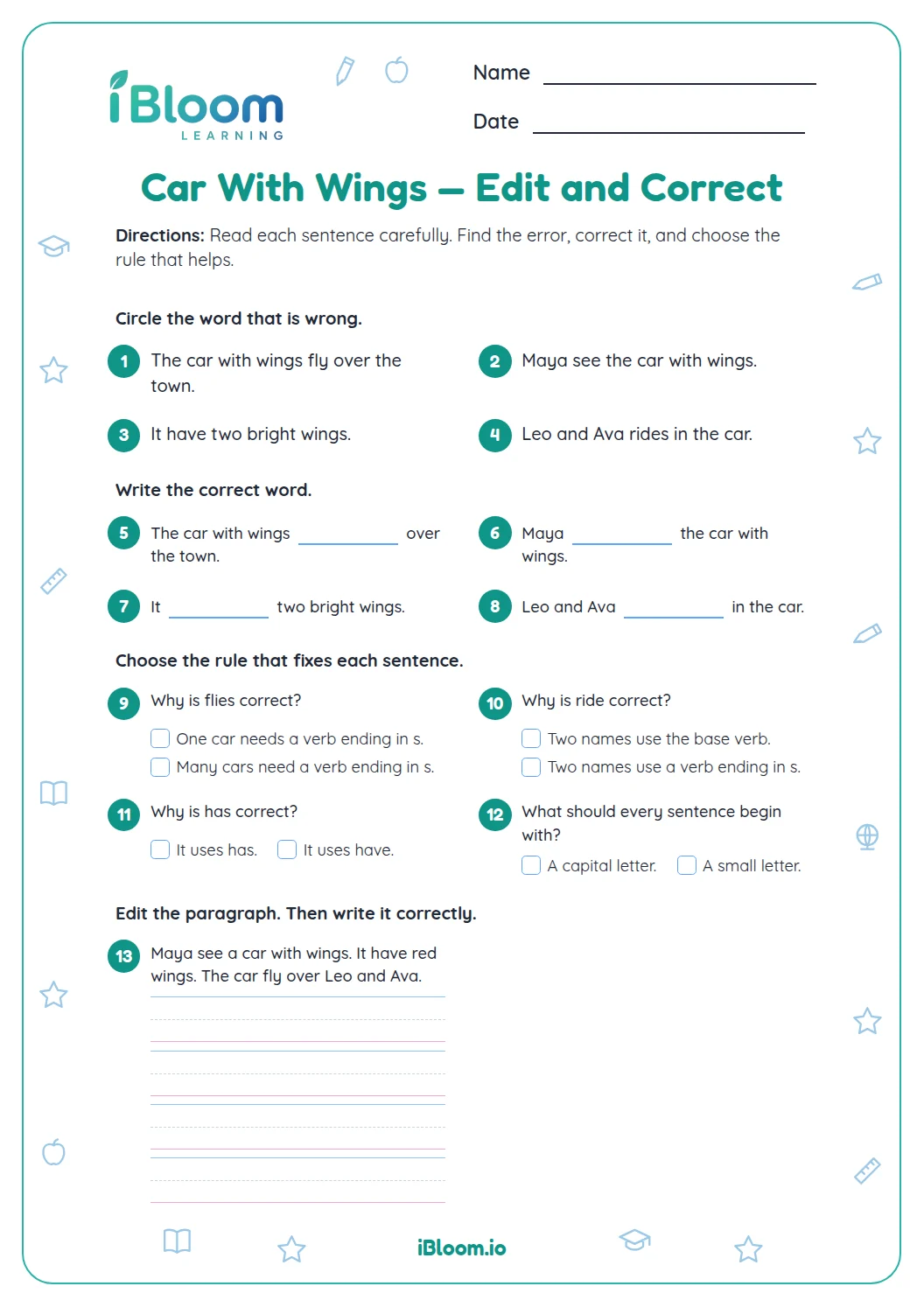
This Grade 1 amusement-park worksheet gives children 14 editing questions. They circle words that need correction, complete verb sentences, then edit a short paragraph for verbs, capitals, and punctuation. The practice supports CCSS L.1.1c and L.1.2. A separate answer key lists the corrections.
Aligned to L.1.1.c and L.1.2
Which word needs a correction?
Part A has six short amusement-park sentences. Circle the word that needs a change; most require a verb correction and one calls for a capital letter.
- Questions 1–6 ask for one word in each sentence.
How do students match a verb to its subject?
Questions 7–11 give a subject and two verb forms. Read the subject first, then complete the sentence with the matching form. Questions 12–13 ask for a capital and an end mark.
- 1Question 10: Noah and Emma ___ happy.
- 2Noah and Emma names two people, so use are.
- 3Noah and Emma are happy.
What should students check in the paragraph?
In the final item, reread each sentence after fixing the verbs. Check the beginning capital and the punctuation at each sentence ending.
How to use this worksheet
- 1Read the part direction before starting.
- 2Complete the first item together and name the strategy.
- 3Work through the remaining items one at a time.
- 4Reread each response and check its units or punctuation.
- 5Use the answer key to correct any missed step.
Common mistakes and quick fixes
The mistake
Leaving the verb unchanged in “Ava see three balloons.”
The fix
Ava is one person, so use sees.
The mistake
Using “is” with two people in “Noah and Emma is happy.”
The fix
The compound subject is plural, so write “Noah and Emma are happy.”
The mistake
Editing the paragraph but leaving a verb that does not match its subject.
The fix
Read each subject with its verb: “Maya and Leo visit,” “They ride,” and “they eat.”
This worksheet practices sentence conventions and subject–verb agreement.
Use matching verbs with singular and plural nouns in basic sentences.
On this sheet: Students correct singular and plural subjects paired with the appropriate verb.
Show the official wordingHide the official wording
Use singular and plural nouns with matching verbs in basic sentences (e.g., He hops; We hop).
Use standard capitalization and punctuation when writing.
On this sheet: Students add capitals and sentence-ending punctuation while rewriting.
Show the official wordingHide the official wording
Demonstrate command of the conventions of standard English capitalization, punctuation, and spelling when writing.
What to practice next
Make more practice
Further reading
Questions parents and teachers ask
What words do children circle?
The first six sentences each contain one word that needs a correction. Five sentences call for a verb change, such as “eat” to “eats,” and the Ferris wheel item calls attention to capitalization. The key lists the target word for each row and supports checking the correction.
What does the verb question ask students to do?
Questions 7–11 ask children to complete five present-tense sentences. “Mia” takes “rides,” “we” takes “were,” “Ava” takes “sees,” two people take “are,” and “the bright lights” take “shine.” The answer key shows each form in order. Read each completed sentence aloud to double-check.
Why do students rewrite complete sentences?
Question 14 asks students to revise a short amusement-park paragraph. They change “visits,” “rides,” and “eats” to match the plural subjects, capitalize the sentence beginnings, and check the end marks. The answer key provides the complete corrected paragraph.
How can I help without giving the answer?
Ask the child to find who or what is doing the action, then read that subject with the verb. For punctuation, have them point to the first word and the end of the sentence. These checks guide attention to the exact skills on the page.
How many questions are included?
The worksheet has 14 questions in three parts: six word-circling items, one verb completion, and seven sentence edits. The parts move from noticing a word to making a correction in a complete sentence. The separate key follows the same question order.