


About this worksheet
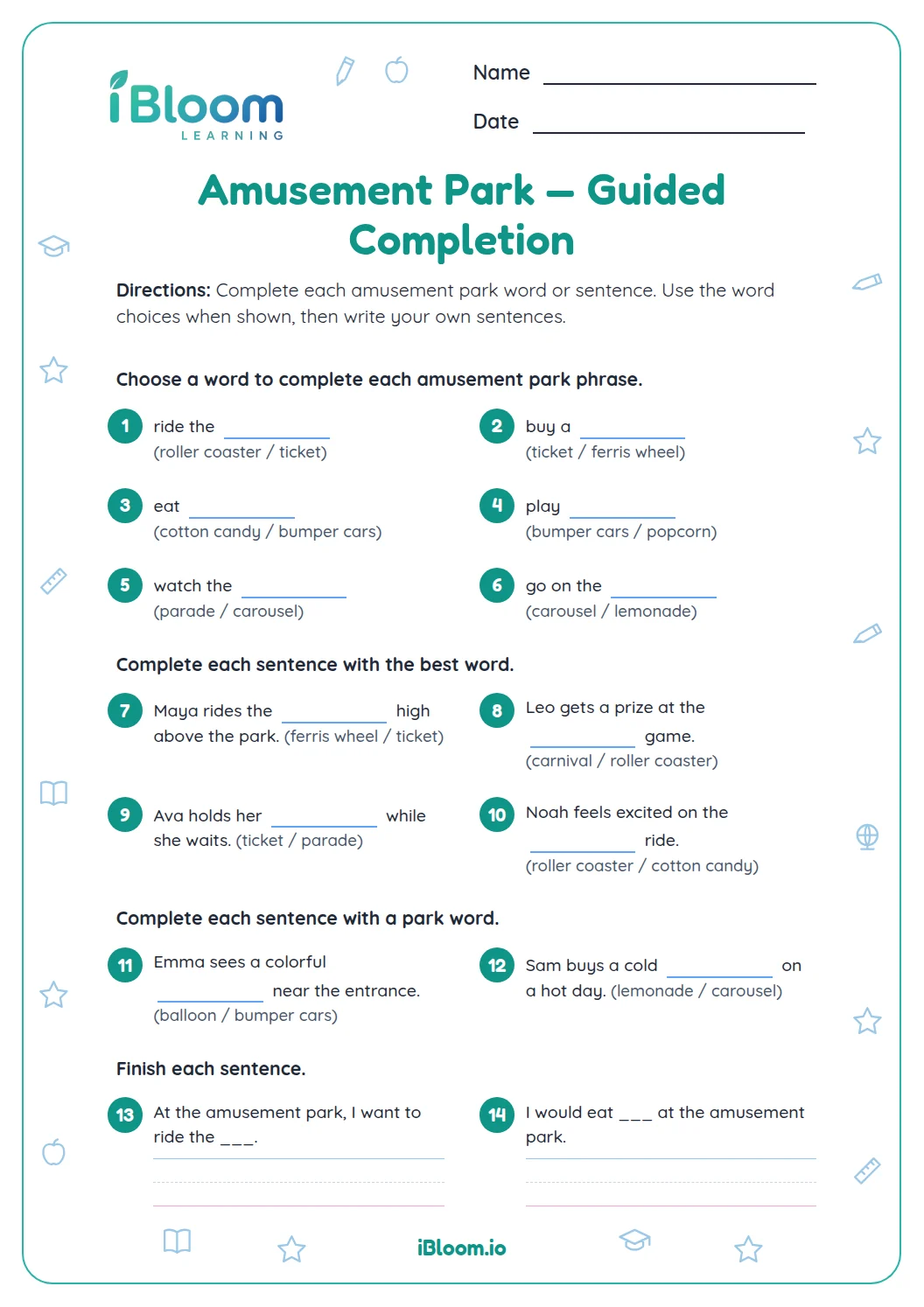
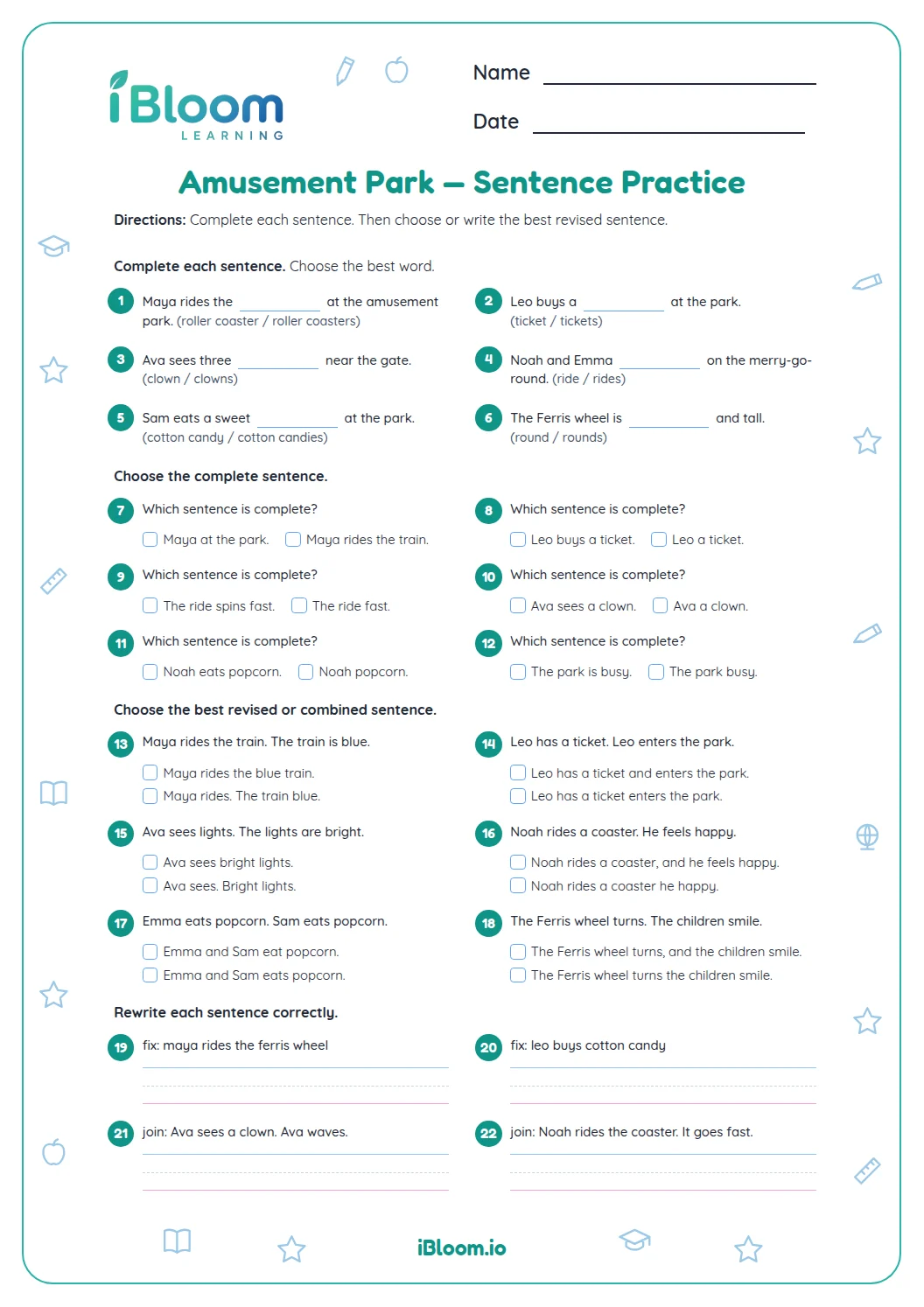
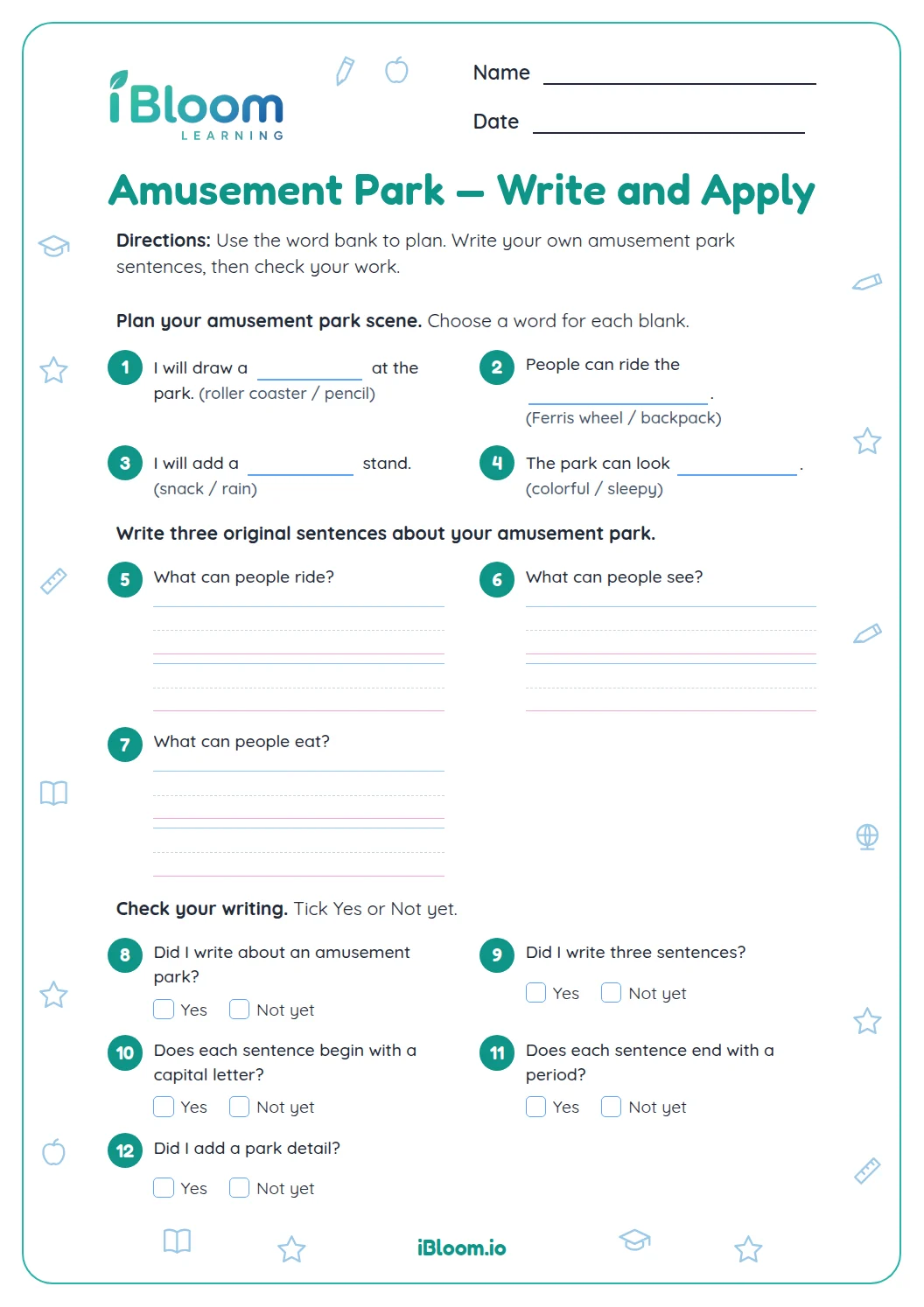
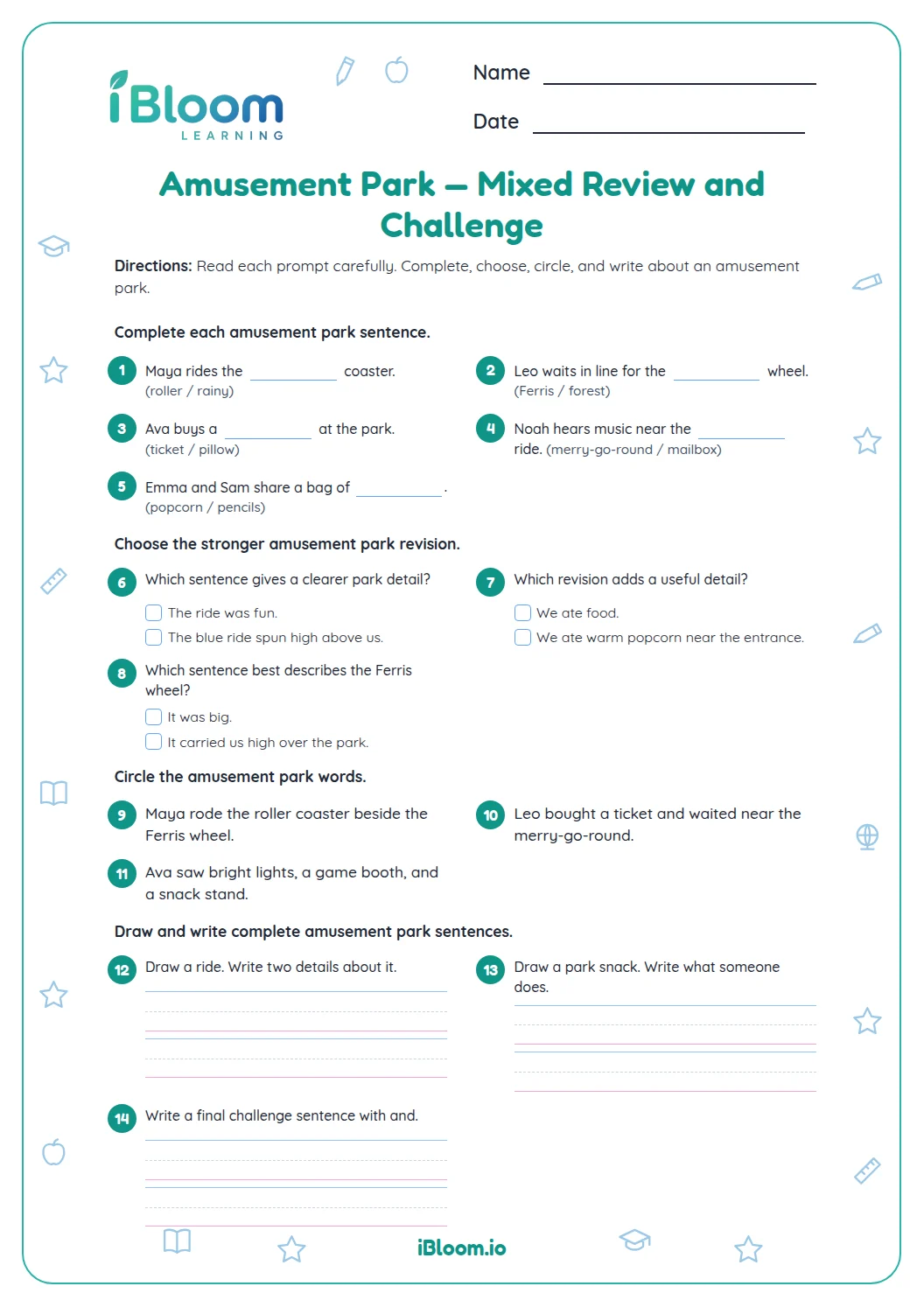
This free printable is for Grade 1 learners practicing amusement park words and sentence writing. It includes 14 questions across the worksheet’s different parts, followed by a separate answer key. The items move from guided recognition to applying the skill in short tasks. Use it for independent practice, a small group, or a quick review together.
Aligned to L.1.1.j
Which words belong at an amusement park?
The first six questions ask learners to choose rides, food, a ticket location, and other park items from word choices. The examples make the setting clear before learners write about their own visit.
- 1Choose an amusement park ride. → roller coaster
How can learners turn park ideas into sentences?
The writing prompts ask for complete sentences about a ride, a sound, a ticket booth, a visitor, or a first activity. Two drawing prompts give learners room to picture a ride and a snack.
What makes a sentence complete?
A complete sentence tells one whole idea. The open-ended prompts invite learners to write about familiar parts of a park visit and check capitals and end marks.
How to use this worksheet
- 1Read each word-choice question and select the park-related answer.
- 2Say your idea aloud before writing.
- 3Begin each sentence with a capital letter.
- 4Add an end mark and reread the sentence.
- 5Draw a ride and a snack in the two drawing spaces.
Common mistakes and quick fixes
The mistake
Choosing a word that does not fit the park setting.
The fix
Ask whether a visitor could see or use the item at an amusement park.
The mistake
Writing a phrase instead of a complete sentence.
The fix
Say who or what the sentence is about and what happens.
The mistake
Forgetting the capital or end mark.
The fix
Check the first letter and the final punctuation.
Curriculum alignment
Write complete sentences in response to amusement-park prompts.
On this sheet: The writing prompts invite complete sentences about a park visit.
Show the official wordingHide the official wording
Produce and expand complete simple and compound declarative, interrogative, imperative, and exclamatory sentences in response to prompts.
What to practice next
Make more practice
Further reading
Questions parents and teachers ask
What does the first part ask learners to recognize?
The first six questions focus on amusement park vocabulary, including rides, food, and the place to buy a ticket. Learners choose park-related words from three options before moving to open-ended writing. The separate answer key offers a quick way to review each response.
How many questions are on the worksheet?
The worksheet has 14 questions in four parts, including word choices, sentence writing, and two drawing prompts. A separate answer key includes sample sentences and descriptions of what a suitable drawing can show. The separate answer key offers a quick way to review each response.
Does every written response need to match the sample?
No. The key gives sample sentences for open-ended prompts. Another complete sentence is appropriate when it answers the prompt and uses an amusement-park idea. The separate answer key offers a quick way to review each response. Then compare with the answer key.
What should a Grade 1 sentence include?
A sentence should tell a complete idea, begin with a capital letter, and end with punctuation. A learner might write, “I would ride the carousel,” then reread it to check that it sounds complete. The separate answer key offers a quick way to review each response.
What can a learner draw for the two picture prompts?
One prompt asks for a fun amusement park ride, and the other asks for a snack a visitor might eat there. The drawings can vary; each should clearly show the ride or snack named by the prompt. The separate answer key offers a quick way to review each response.