






About this worksheet
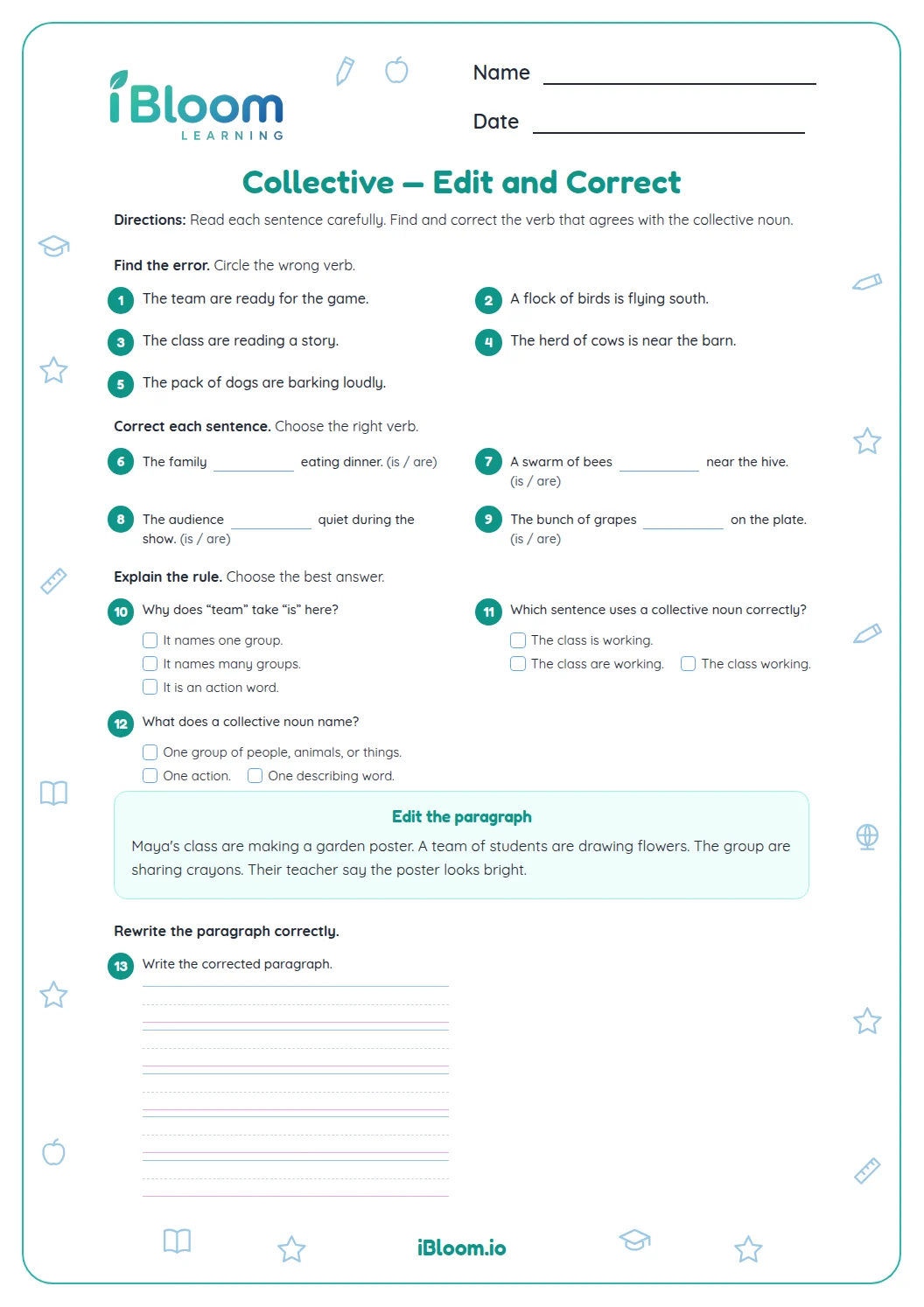
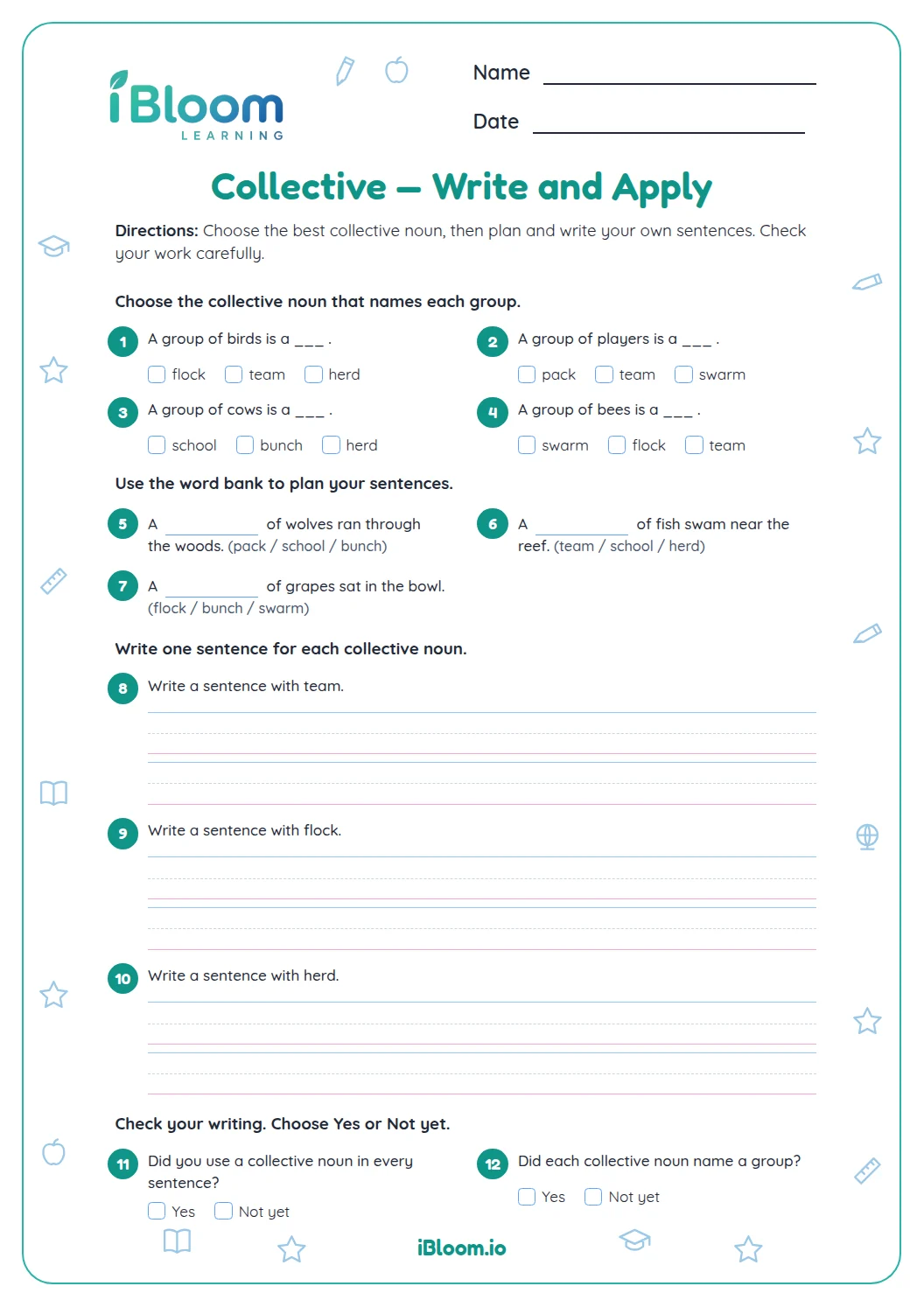
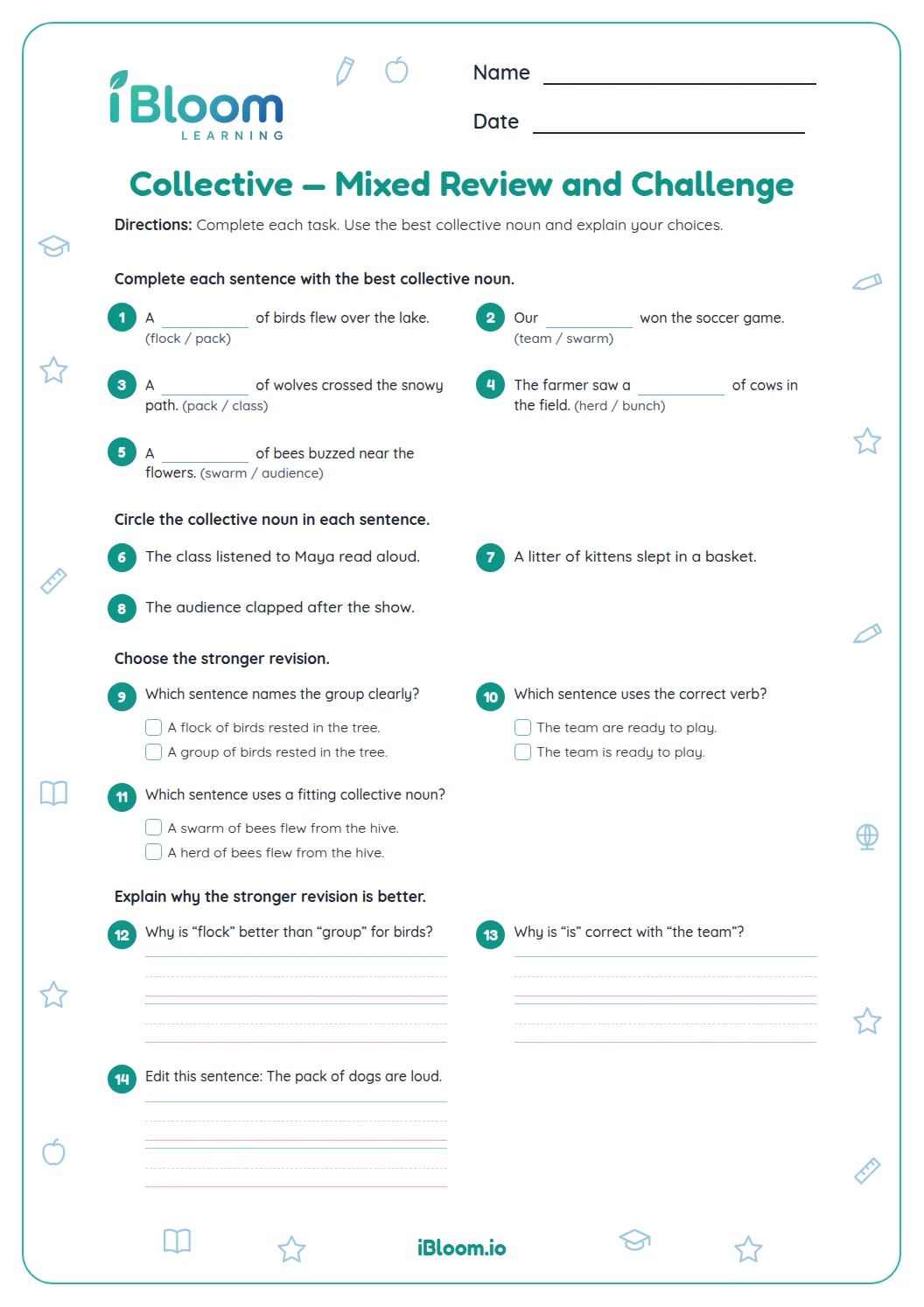
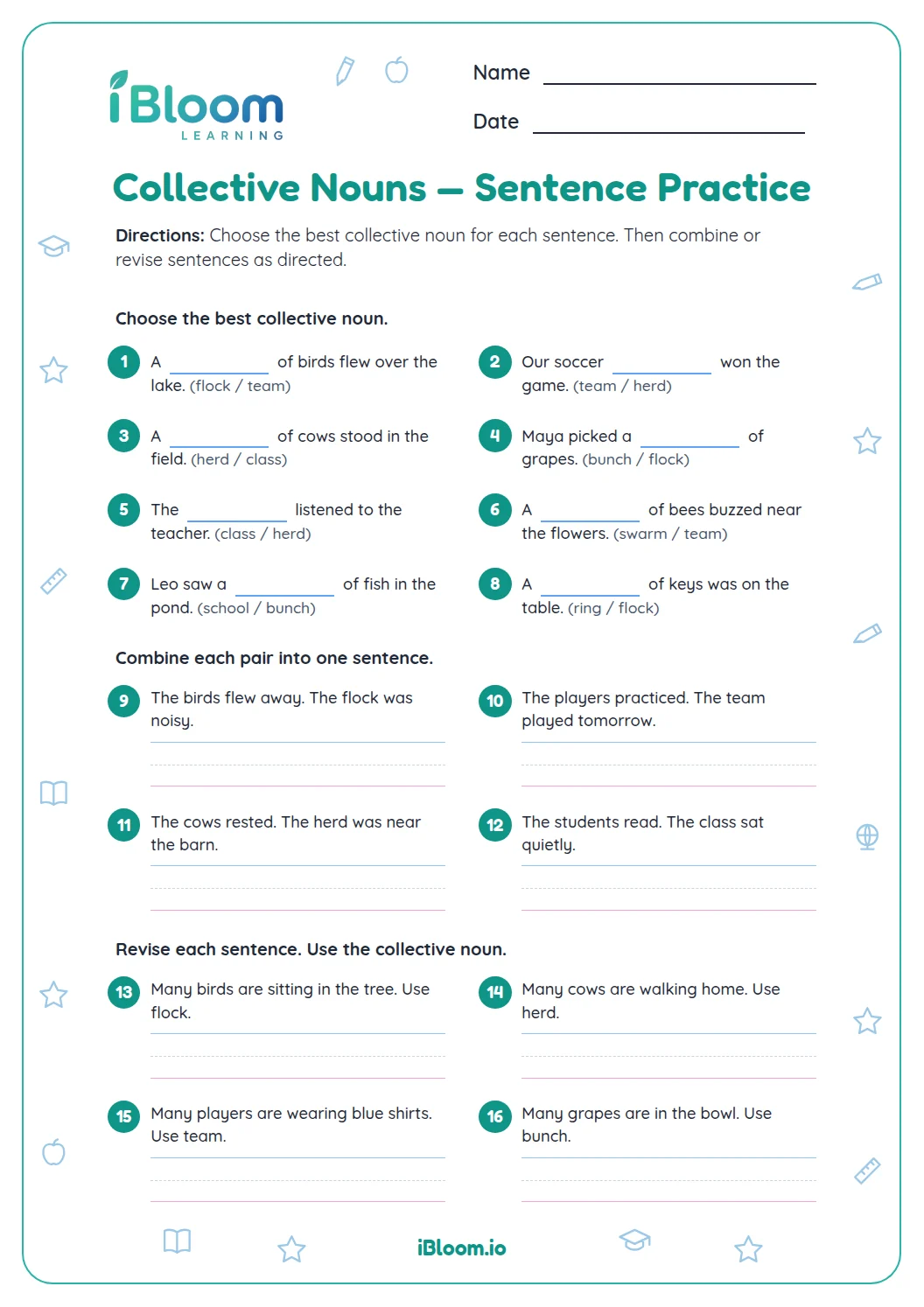
This Grade 2 worksheet practices collective nouns in two ways. In Part A, students choose a group name that completes ten sentences about bees, players, birds and other familiar groups. In Part B, they write two sentence repairs and two sentence combinations using collective nouns such as “flock,” “team” and “crew.” The key identifies each choice and provides sample sentences. This page supports Common Core L.2.1.a: using collective nouns in speaking and writing.
Aligned to L.2.1.a
How can you spot a collective noun?
A collective noun names a group as one unit. “Flock” names a group of birds, and “team” names a group of players. In Part A, use the other words in the sentence to choose the group name that fits.
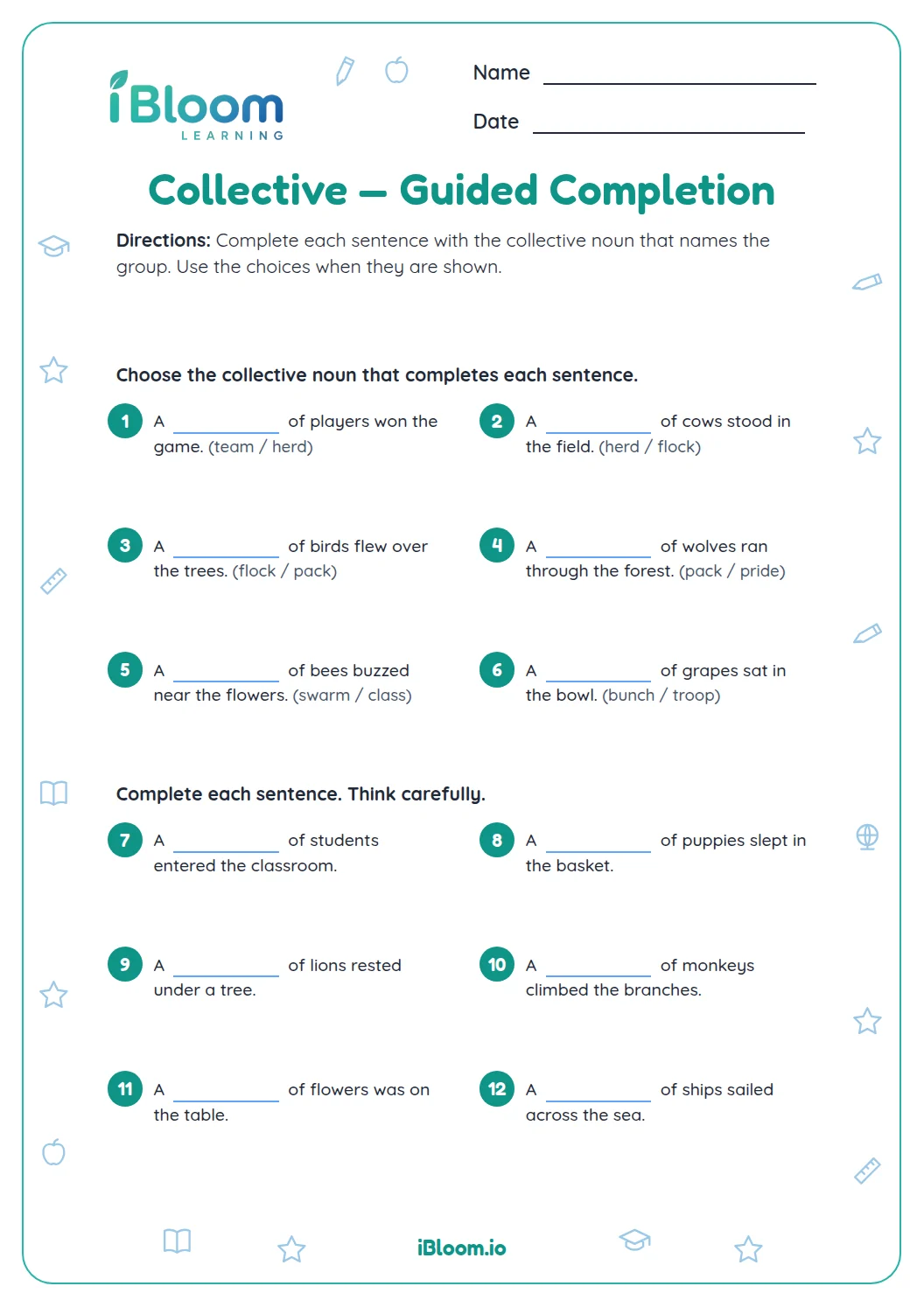
- 1A ___ of bees buzzed near the flowers. → swarm
- 2“Swarm” names the group of bees.
How can a collective noun fit into a sentence?
Part B asks students to repair two mismatched group names, then combine two pairs of short sentences using a collective noun. The key gives one possible revision for each item.
How can students check their sentences?
Read a revised or combined sentence aloud. Check that the group name fits, the idea is complete, and the sentence begins with a capital and ends with punctuation.
How to use this worksheet
- 1Read the whole sentence before looking at the choices.
- 2Ask which choice names a group of the kind described.
- 3For Part B, say the sentence aloud before writing it.
- 4Include an action or detail so the sentence is complete.
- 5Reread for a capital letter and ending punctuation.
Common mistakes and quick fixes
The mistake
Choosing a word that names one animal instead of a group.
The fix
Ask whether the word can name several members together.
The mistake
Mixing up similar group words, such as flock and herd.
The fix
Match the noun to the group in the sentence: birds flock; cows herd.
The mistake
Writing only the group name for a sentence prompt.
The fix
Add a subject and an action, then reread the complete thought.
Common Core alignment
Students identify collective nouns and use them in complete sentences.
Use a collective noun to name a group in speaking or writing.
On this sheet: Part A selects collective nouns in sentence context; Part B repairs mismatched group names and combines sentence pairs.
Show the official wordingHide the official wording
Use collective nouns (e.g., group).
What to practice next
Make more practice
Further reading
Questions parents and teachers ask
What is a collective noun?
A collective noun names a group as one unit. Examples include “team” for players, “flock” for birds and “crew” for people working on a boat. Part A asks students to recognize a group name in a sentence, and Part B asks them to use one in writing.
How many questions are on the page?
There are 14 questions across two worksheet pages. Ten are multiple-choice sentence completions, two ask students to repair a mismatched group name, and two ask them to combine sentence pairs. The separate answer key includes the correct choices and a sample for each written response.
Are the sample sentences the only correct answers?
No. The answer key gives one clear model for each repair or combination. Students can use different wording as long as the collective noun fits the group and the result is a complete sentence. Check that the revised sentence begins with a capital and ends with punctuation.
How can I explain flock, herd and team?
Connect each word to a familiar group: a flock of birds, a herd of cows and a team of players. Ask what kind of members are being named together. The sentence context and answer choices help students connect the group noun with its members.
What should a complete sentence include?
For the Part B prompts, a sentence should use the given collective noun and tell a complete thought, usually by adding an action or detail. “A crew” is only a group name; “The crew raised the sail” tells what the group did.
What can students study next?
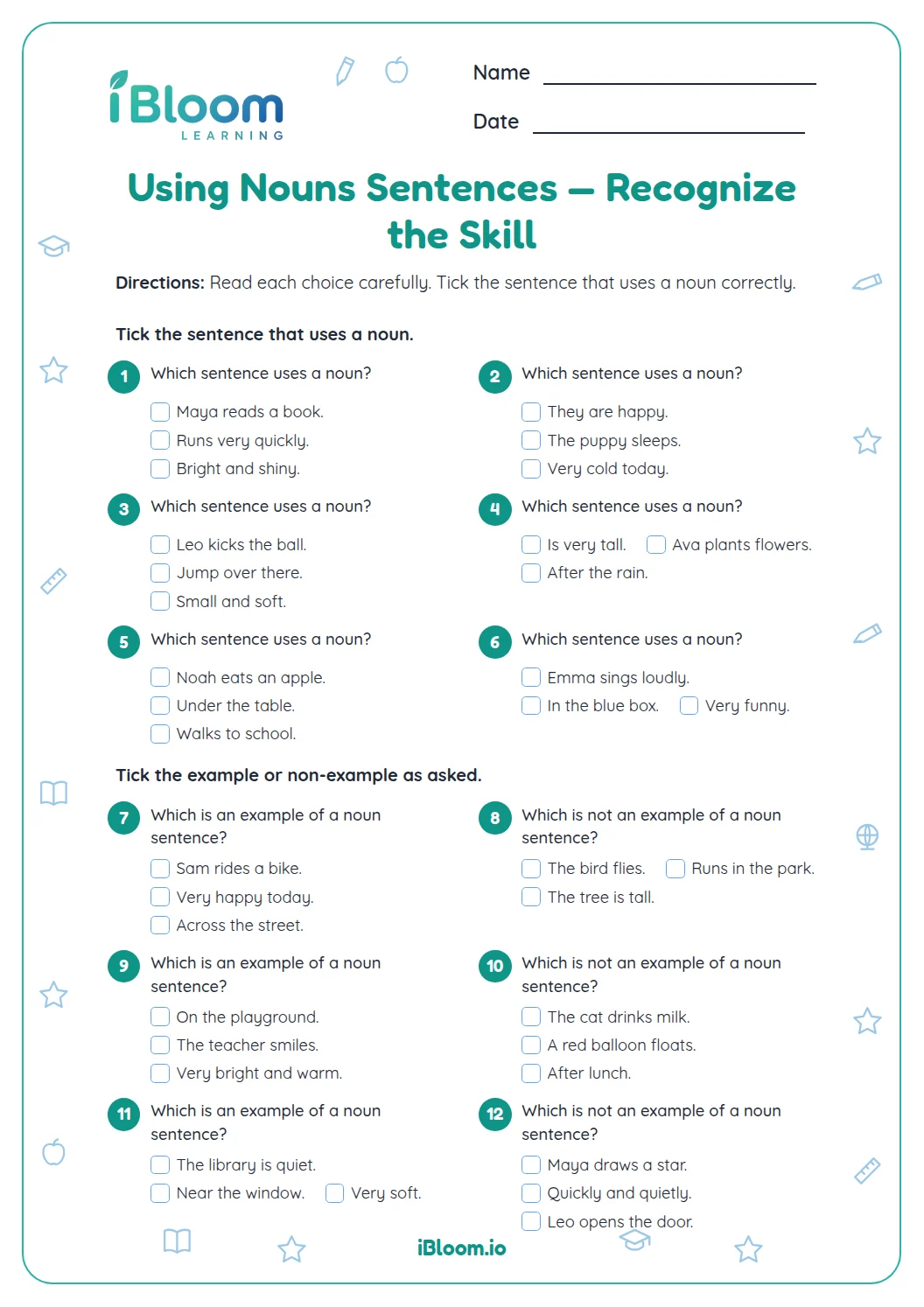
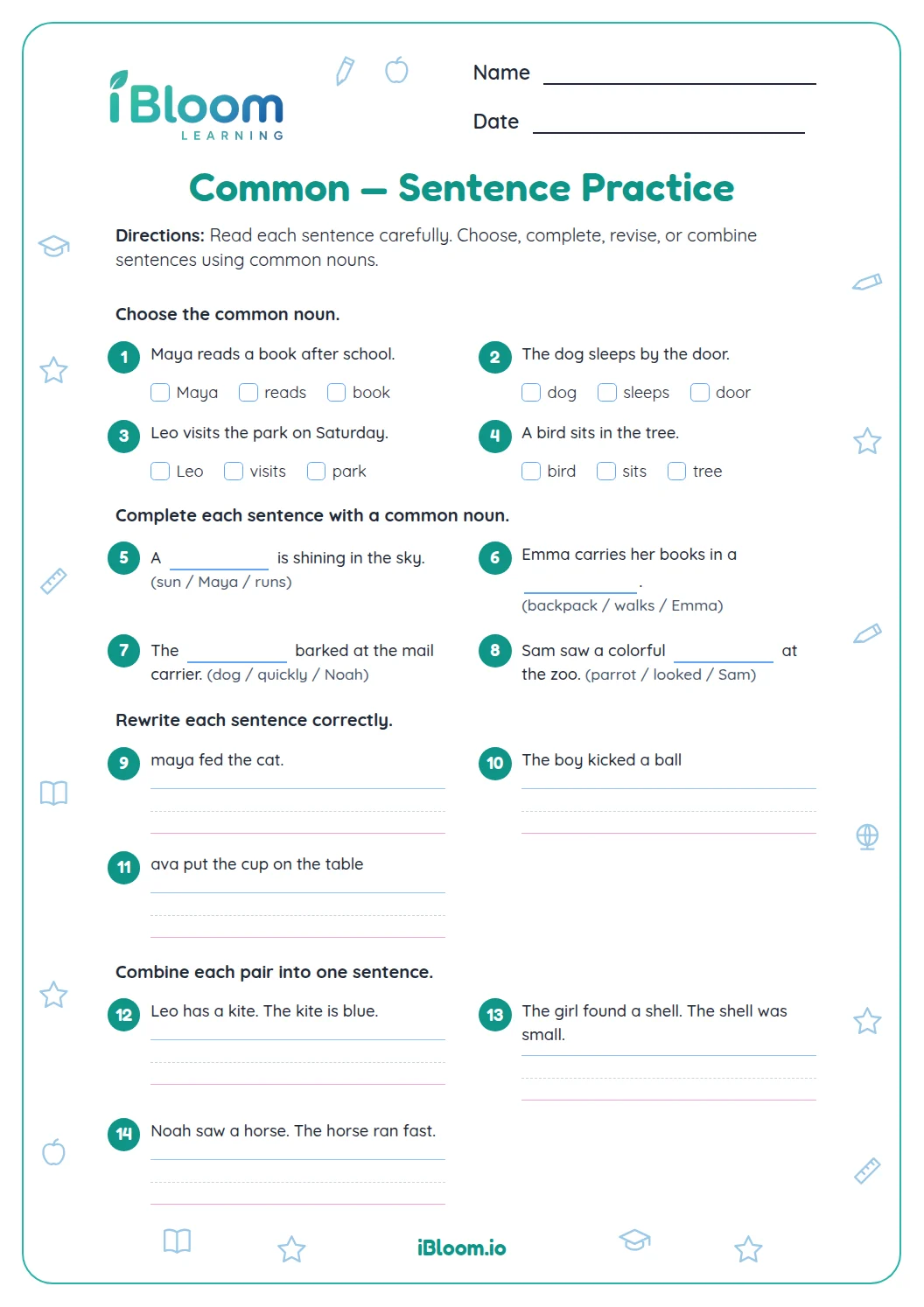
The linked Collective Nouns page reviews group names, while Using Nouns in Sentences gives more practice using nouns in complete thoughts. Common Nouns adds practice recognizing names for people, places and things. Students can revisit this sheet to use those group words in fresh sentences.