




About this worksheet
Identify group nouns, choose one that fits a sentence, and practice singular verb agreement. Includes 14 questions and an answer key. Learners identify group nouns, choose fitting collective nouns, and select verbs that agree with a group treated as one unit. Two final prompts let them use pack and herd in original sentences. This printable practices CCSS L.2.1a.
Aligned to L.2.1a
What is on the worksheet?
Part A asks learners to correct a group word that does not fit its members. Part B uses context to choose a collective noun; Part C practices singular verb agreement; Part D asks for two original sentences.
How do collective nouns work with verbs?
A collective noun names a group as one unit. In “The team practices,” team is treated as one group, so the verb is practices.
- 1A flock of birds ___ in the tree.
- 2The subject is flock, a group treated as one unit.
- 3Choose is: The flock of birds is in the tree.
How do you choose a collective noun?
Look at the people, animals, or things in the sentence. The word should name their group: a band of musicians, a herd of cattle, or a litter of puppies.
How to use this worksheet
- 1Read each sentence and identify the group noun.
- 2Use the context to choose a collective noun that fits.
- 3Find the group noun before choosing its verb.
- 4Read the corrected sentence aloud to check agreement.
- 5Write each final sentence with pack or herd naming a group.
Common mistakes and quick fixes
The mistake
Treating every noun for a group’s members as the collective noun.
The fix
Look for the single word naming the group, such as flock or team.
The mistake
Using a group word that does not fit the members.
The fix
Check the sentence clue: a herd is cattle, while a band is musicians.
The mistake
Choosing a plural verb because the group has many members.
The fix
In these sentences, treat the collective noun as one unit: the team practices.
Common Core alignment
This worksheet gives students direct practice with collective nouns.
Recognize and use collective nouns in sentences.
On this sheet: The numbered activities directly practice this skill.
Show the official wordingHide the official wording
Use collective nouns (e.g., group).
What to practice next
Further reading
Questions parents and teachers ask
What does this worksheet teach about collective nouns?
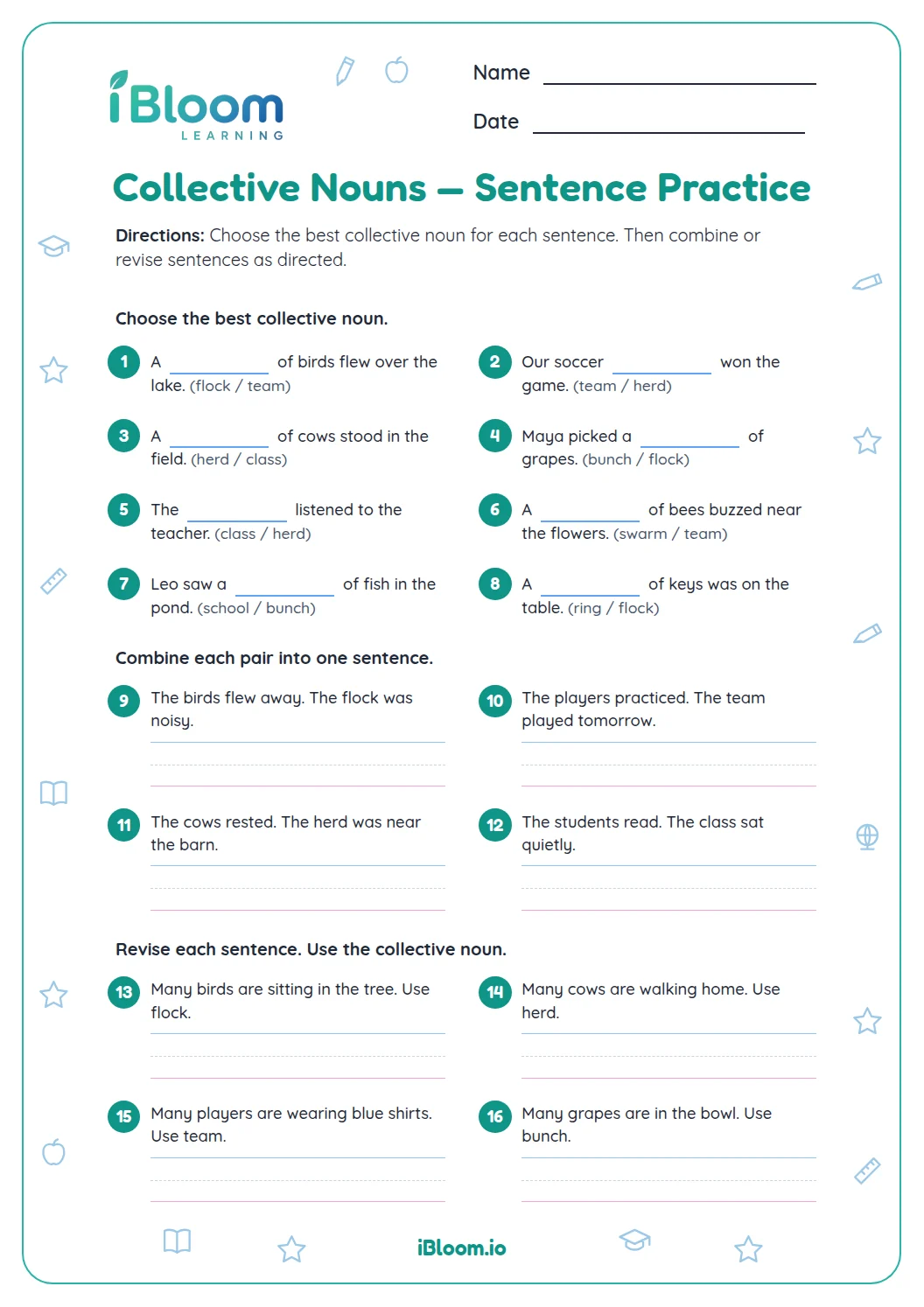
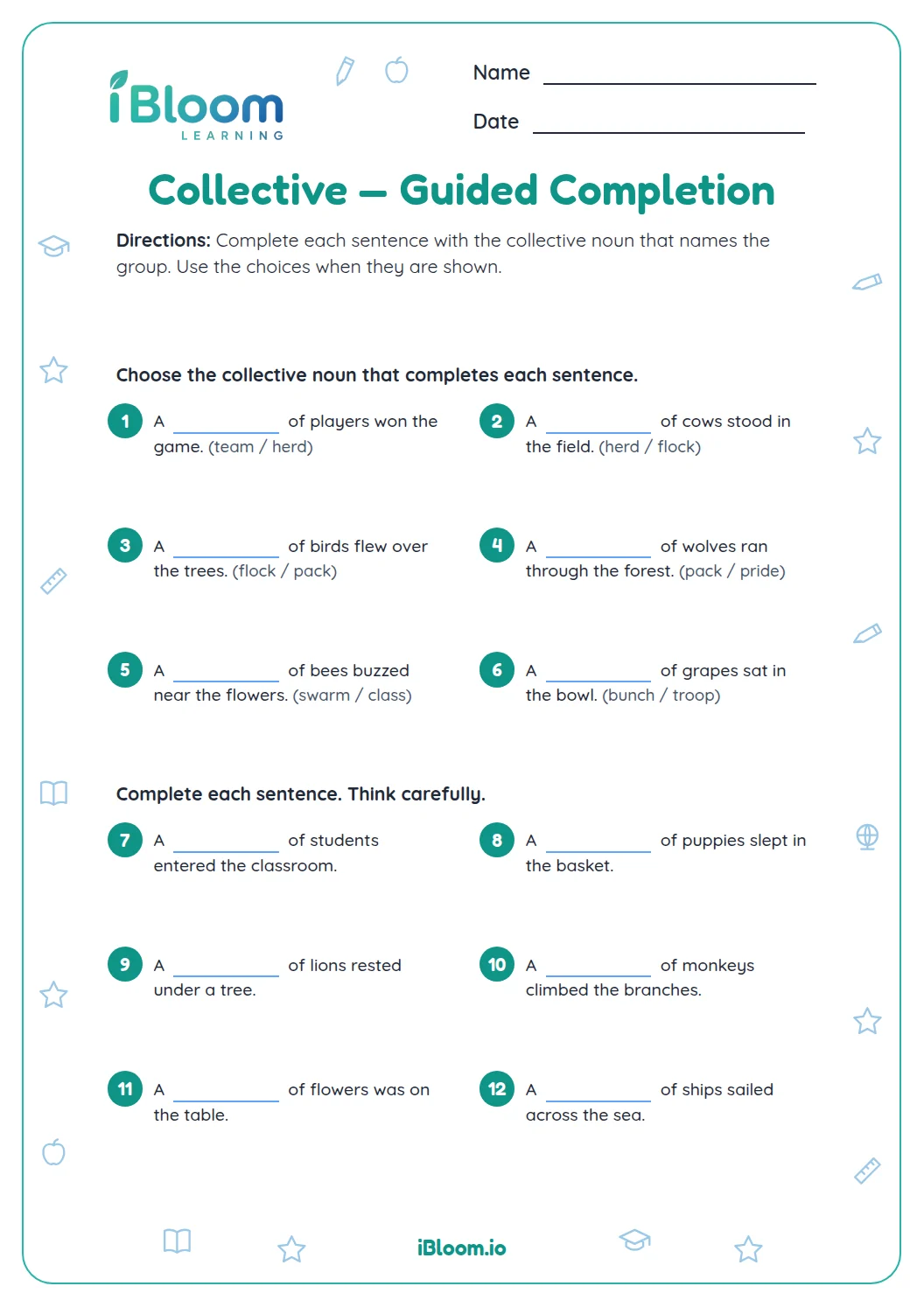
The first part asks learners to correct group words that do not fit, such as changing flock of cows to herd of cows. They then choose fitting nouns from context, practice singular verb agreement, and write sentences using pack and herd. The key includes sample sentences.
What grade is this worksheet for?
This printable is designed for Grade 2. Its short prompts use familiar groups such as bees, puppies, cattle, and classmates, then apply the same idea to verb agreement. An adult can read a prompt aloud if a learner needs support.
How many questions are included?
There are 14 questions across four parts. Learners answer four correction questions, four context questions, four verb choices, and two sentence-writing prompts. The worksheet and its separate answer key each use three pages. Review the key after each part to discuss how the context identifies the correct group word.
How should a learner choose the verb for a group noun?
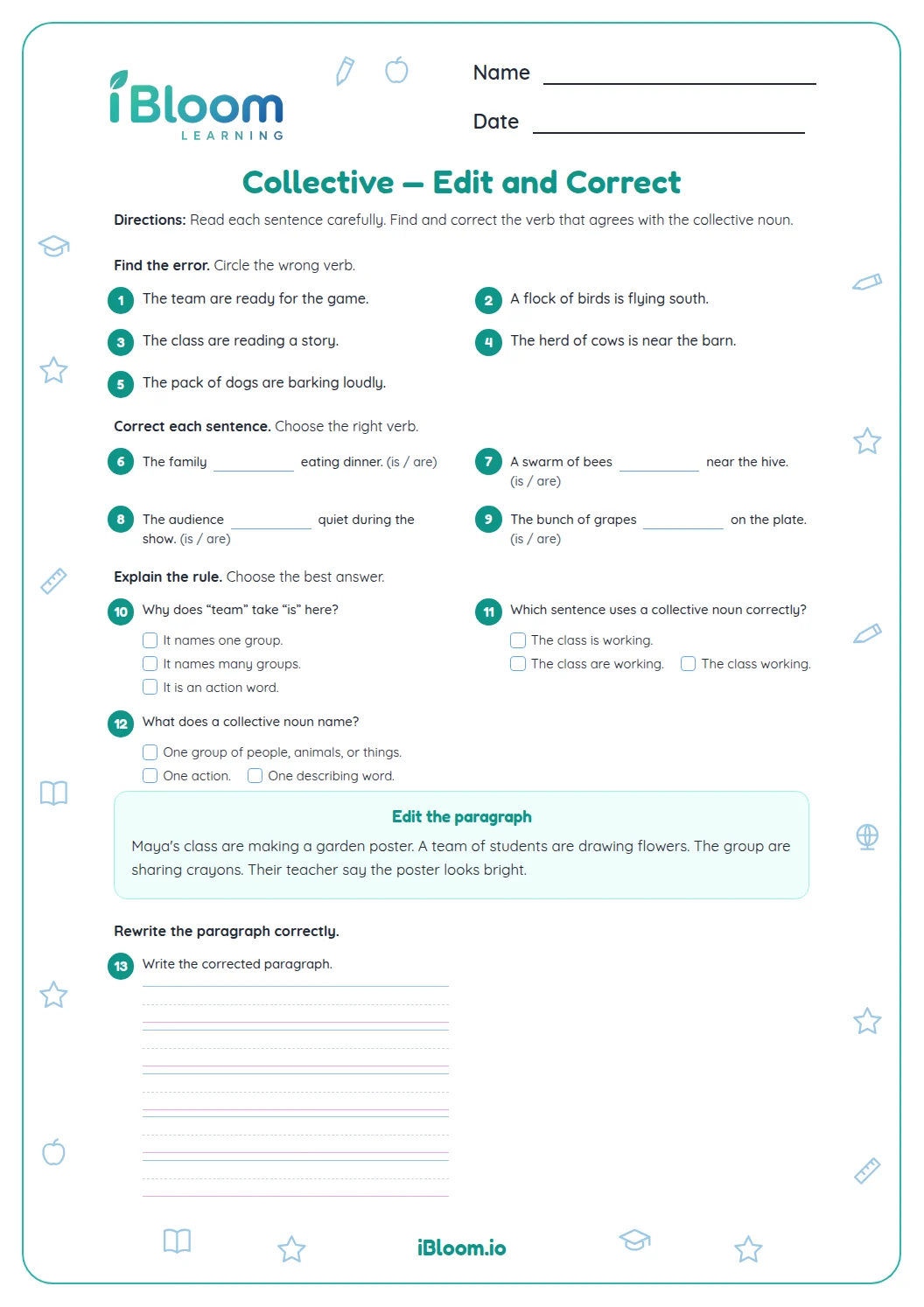
First find the noun naming the group, such as team or class. In these sentences, the group is treated as one unit, so choose a singular verb: “The team practices.” The nearby plural members do not change the subject. Ask the learner to explain the clue or agreement choice aloud.
What answers are acceptable for the final prompts?
The last two items ask learners to write a sentence using pack and herd as collective nouns. The key gives examples, but other clear sentences are acceptable when the noun names a group correctly and the verb fits the sentence.
How long does the worksheet take?
Plan for about 15 minutes, depending on how much time the learner spends writing the two original sentences. The multiple-choice items are brief; reviewing why each group noun or verb fits can add useful discussion time. Ask the learner to explain the clue or agreement choice aloud.