







About this worksheet
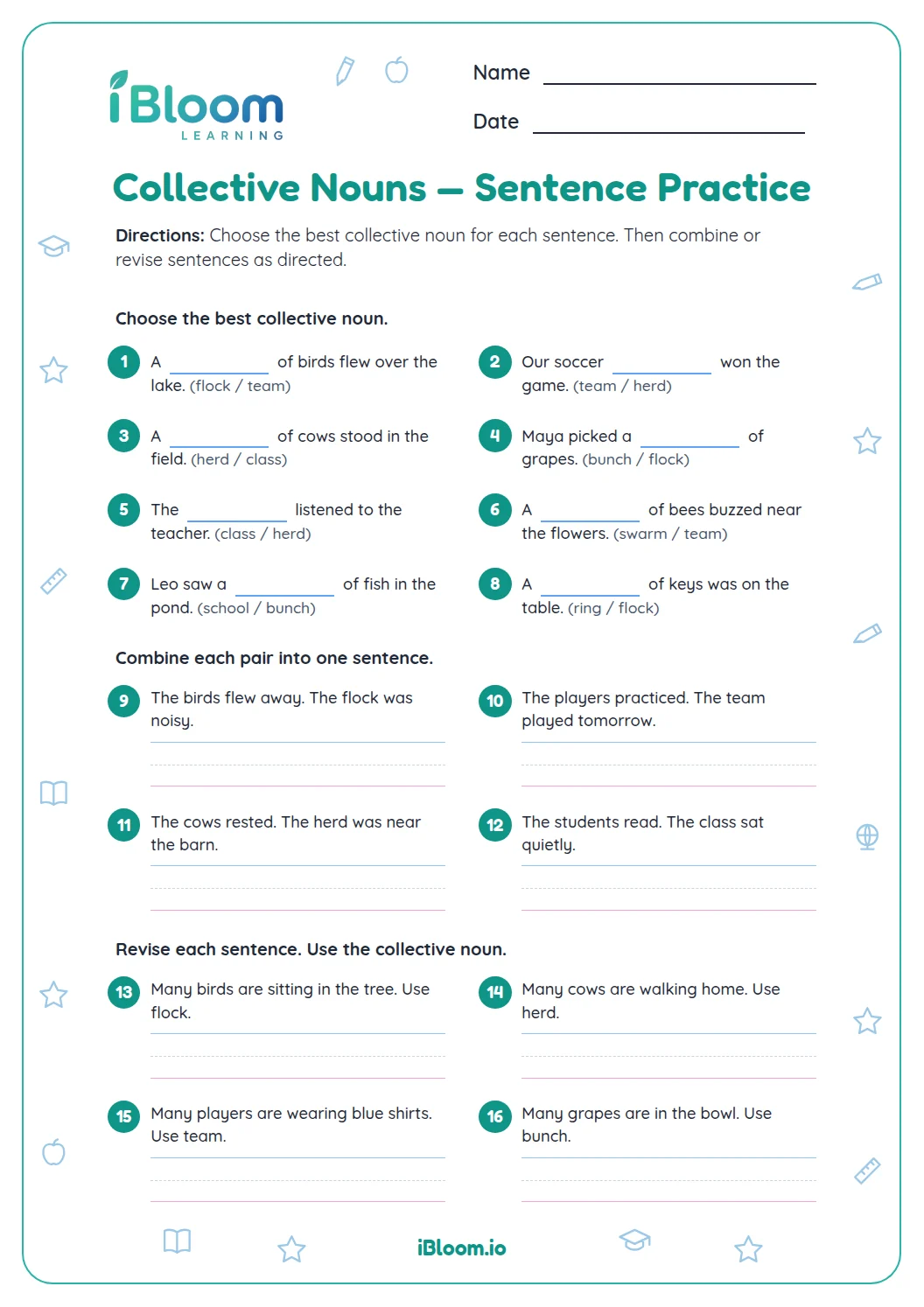
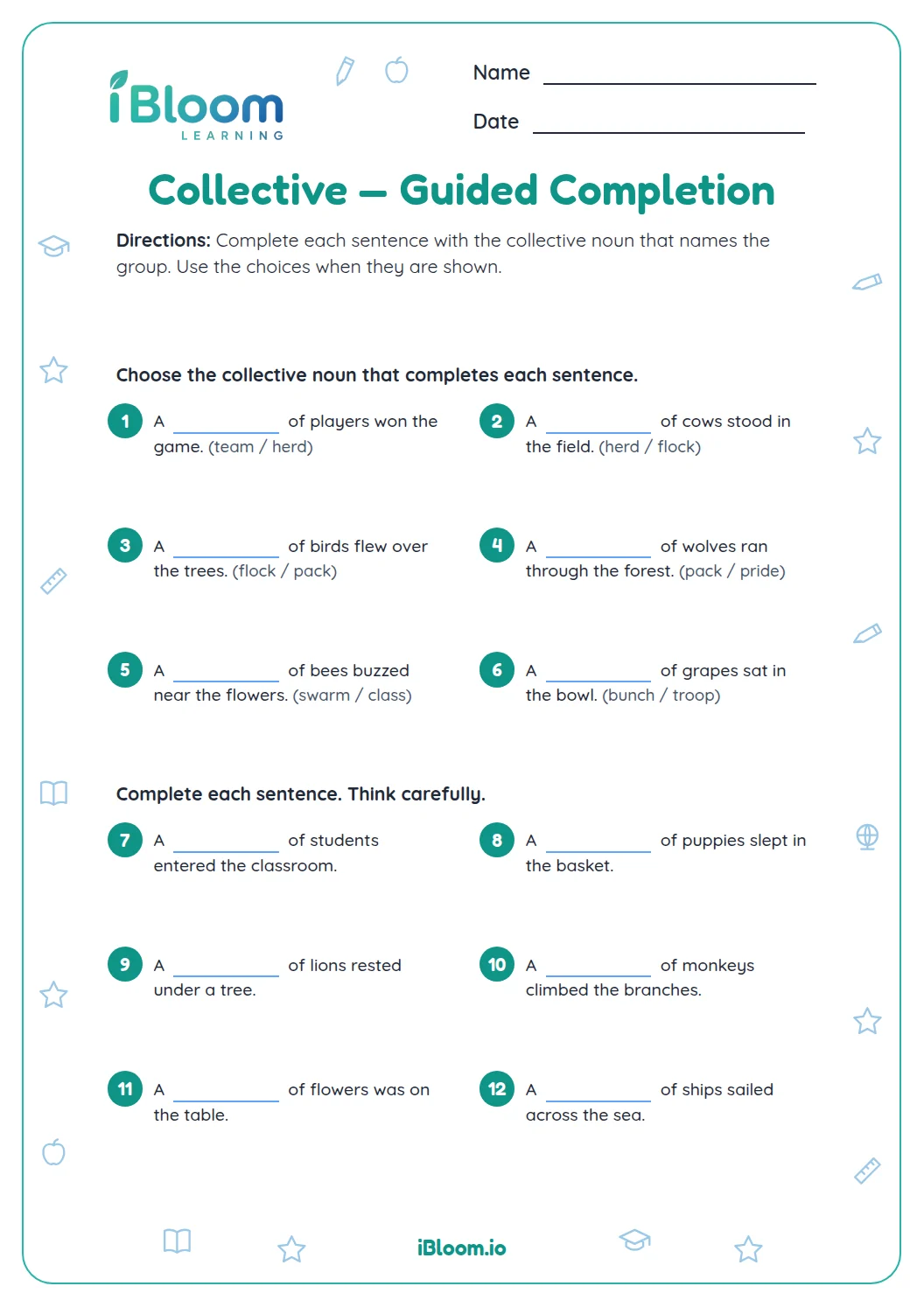
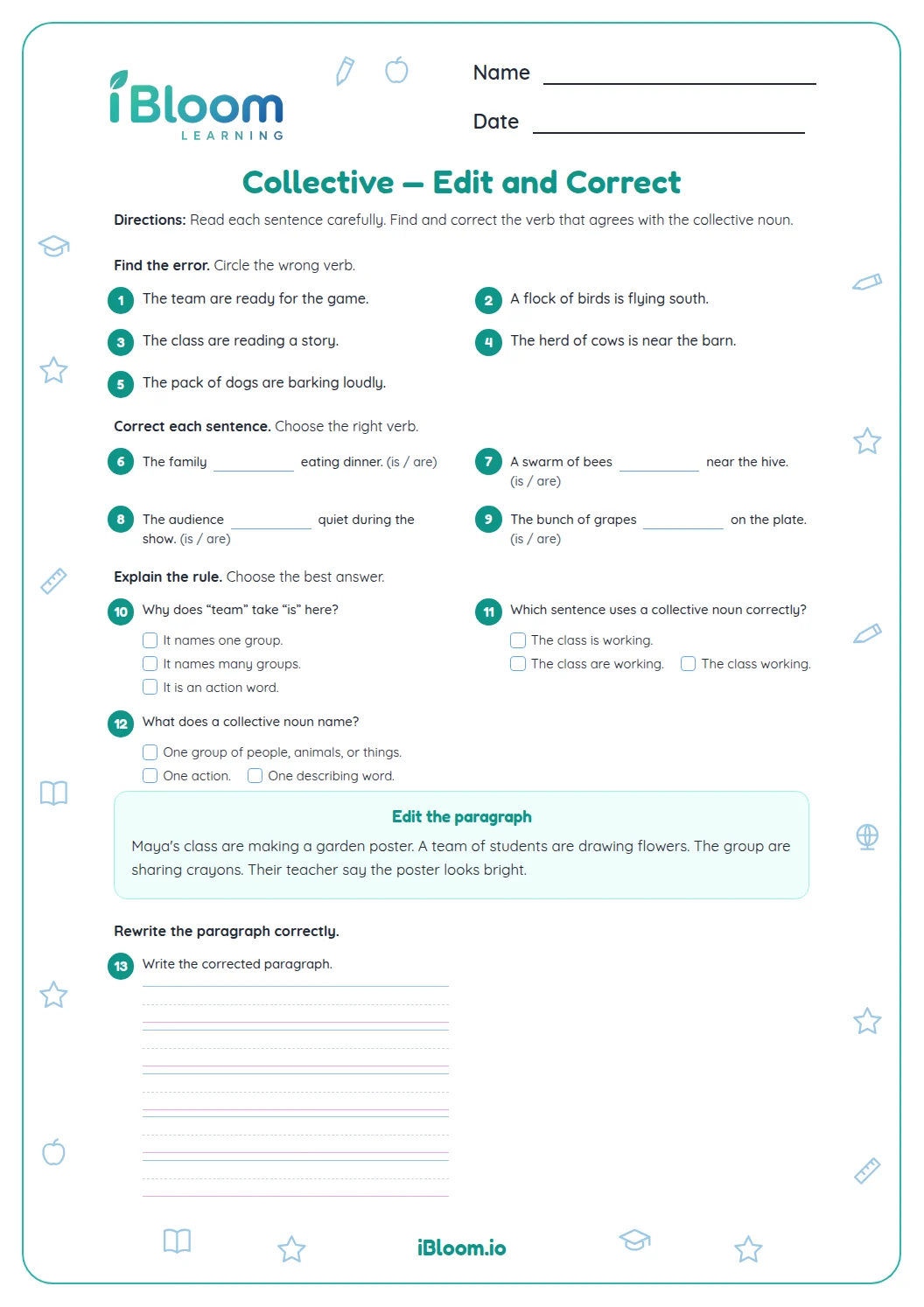
This free printable Grade 2 worksheet turns collective nouns into useful sentence-writing practice. Children complete six sentences with group words, build three sentences around supplied phrases, and write three original sentences using team, class, and bunch. These fourteen tasks practice CCSS L.2.1a, using collective nouns. The examples include a flock of birds, a herd of cows, a school of fish, and groups of people or things. Two final questions check whether a collective noun matches its group. Part A provides two choices for each blank; the later parts give children more control over what they write. The answer key includes model sentences for all six writing tasks.
Aligned to L.2.1a
What is a collective noun?
A collective noun names a group. Flock names a group of birds, and bunch names a group of things such as grapes. In a flock of birds, flock is the group word and birds names the members.
The worksheet uses familiar groups so children can focus on building sentences. Part A pairs each correct group word with one that does not fit the sentence, such as herd and school for cows.
How do children turn a group phrase into a sentence?
A phrase such as a flock of birds names a group but leaves the action unfinished. Ask children to tell what the group does. They can then add a place or another detail if their sentence remains clear.
- 1Given phrase: a flock of birds
- 2Add what happens: flies
- 3Add a place: over the pond
- 4Sample sentence: A flock of birds flies over the pond.
What makes an original answer correct?
In Part C, team must name a group of players, class a group of students, and bunch a group of grapes. Each response needs a complete thought with an opening capital and an end mark.
The old sheet moved from a word bank to open writing and a self-check. This version keeps the move from guided choices to sentence writing, then adds two quick group-meaning checks.
Move from group words to full sentences
- 1Say what the word group means and name one group your child knows.
- 2Complete the six blanks using the word pairs in parentheses.
- 3For Part B, say the supplied group phrase, then add what the group does.
- 4Write a complete sentence for each phrase, starting with a capital.
- 5For Part C, use each required word with the group meaning named in the prompt.
- 6Compare the writing with the samples for correct meaning and a complete thought.
Mistakes to notice and how to help
The mistake
Writing birds when asked for the collective noun in “a flock of birds.”
The fix
Birds names the members. Flock names the group.
The mistake
Writing only “a herd of cows” as a sentence.
The fix
Add what the herd does, such as “A herd of cows rests in the field.”
The mistake
Using class to mean a lesson when the prompt asks for a group of students.
The fix
Make the group meaning clear: “Our class lines up for lunch.”
Common Core alignment
Use group nouns to complete and write sentences.
On this sheet: Children write collective nouns in context and create sentences about groups.
Show the official wordingHide the official wording
Use collective nouns (e.g., group).
What to practice next
Make more practice
Further reading
Questions parents and teachers ask
Which collective nouns appear in the worksheet?
The worksheet uses flock, herd, team, bunch, school, and class. The first six sentences introduce these group words in context. The writing tasks and final checks reuse them so children can practice complete thoughts without having to learn a different group name for every single question on the page.
Why is school a group word for fish?
In “a school of fish,” school names a group of fish swimming together. The noun also has a familiar meaning connected with learning, so context matters. Question 5 includes fish and swimming to make the intended group meaning clear before children use the phrase in their own sentence.
Are the writing answers all different?
Children can write different correct sentences in Parts B and C. The given phrase or word must keep its group meaning, and the sentence must express a complete thought. The answer key supplies samples for checking. A sensible different action or setting can be accepted when those requirements are met.
How do I help a child who writes only a phrase?
Ask what the named group does, then help your child add that action. For “a herd of cows,” a child might say “rests in the field.” Put the pieces together, start with a capital, and finish with a period: “A herd of cows rests in the field.”
Can this sheet be used for independent writing?
Yes, children who know these group words can complete the choices, write their own sentences, and check two group meanings. If the vocabulary is new, discuss the six examples first. During checking, focus on the required collective noun, its group meaning, and whether the child has written a complete thought.