









About this worksheet
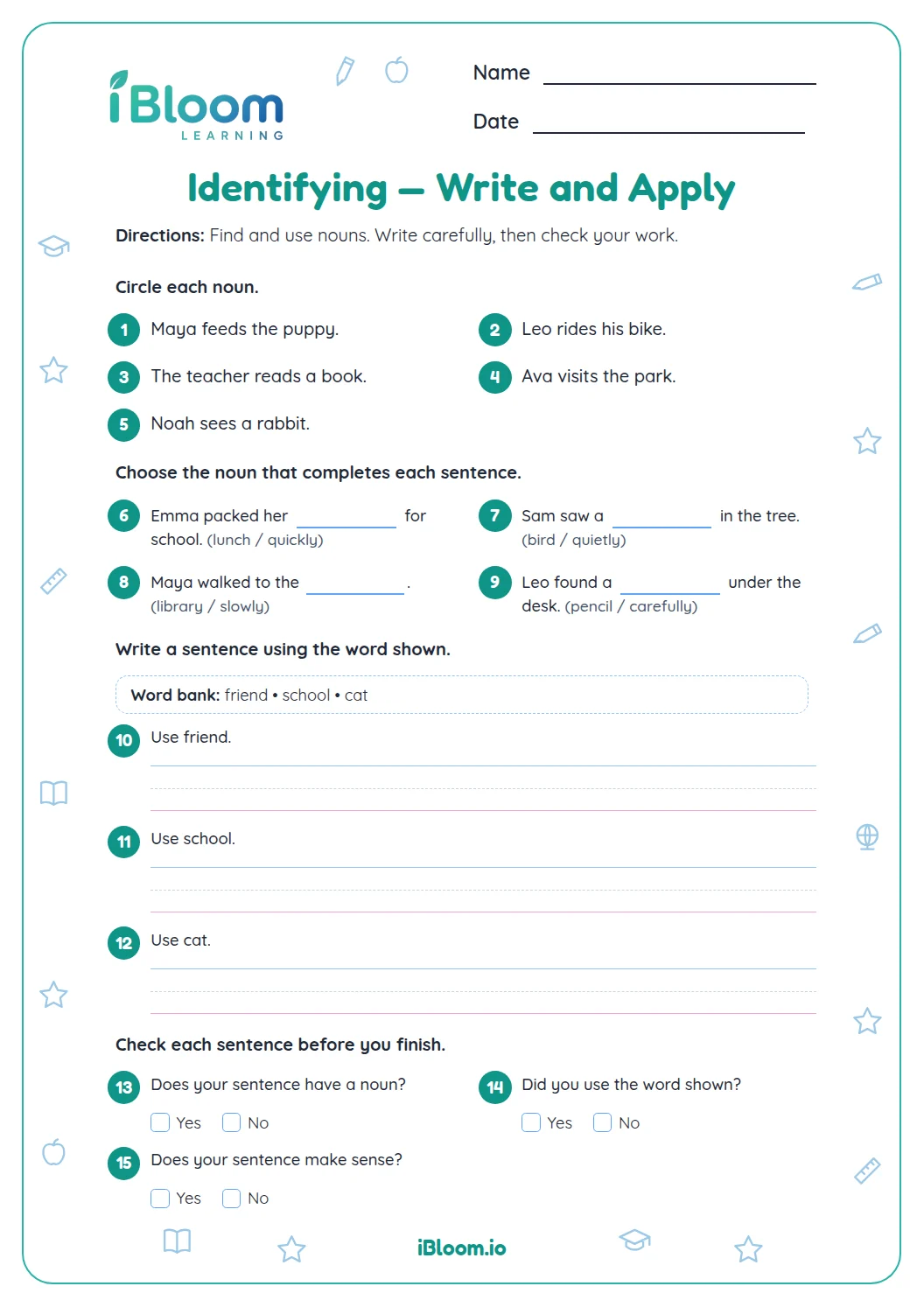
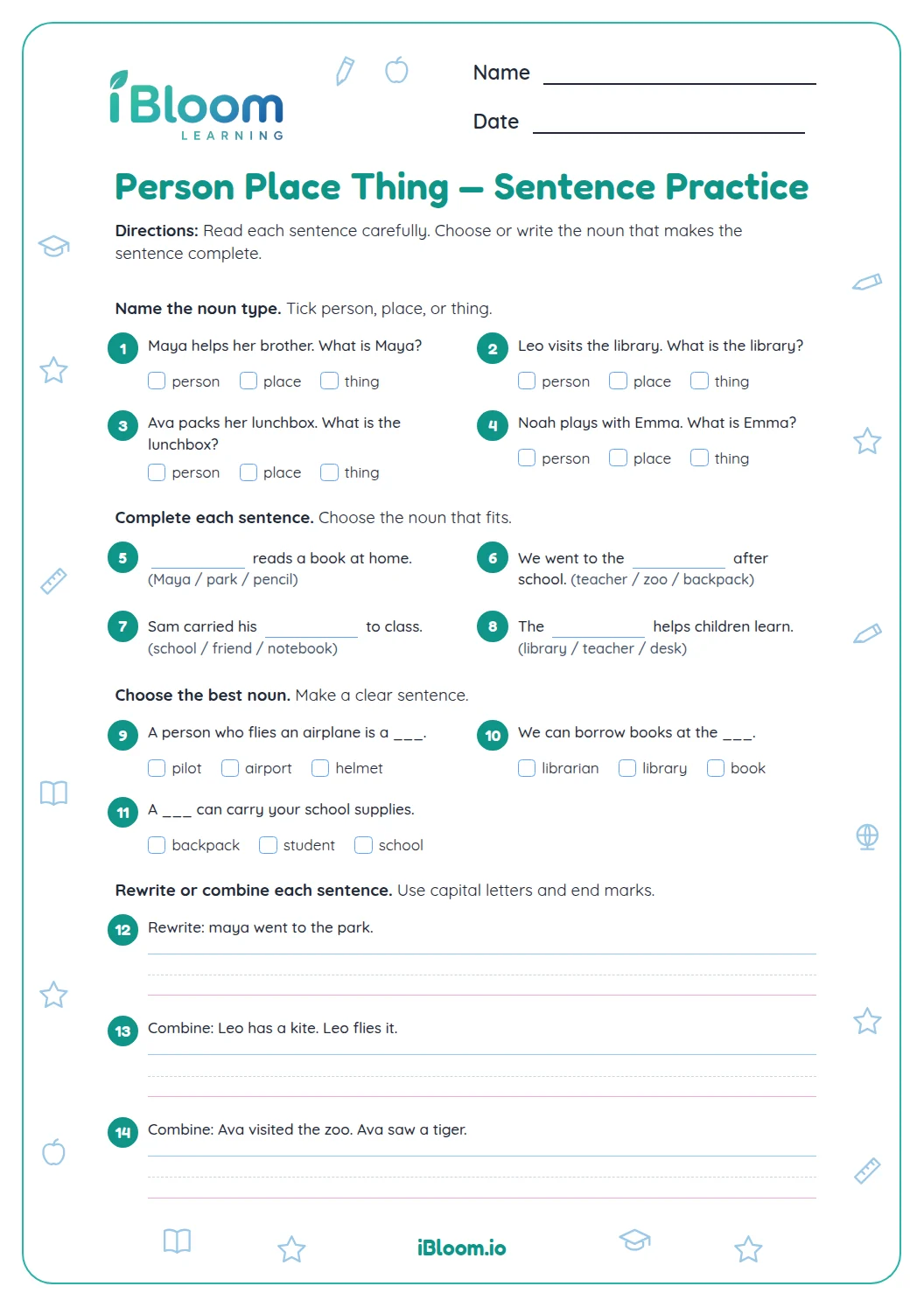
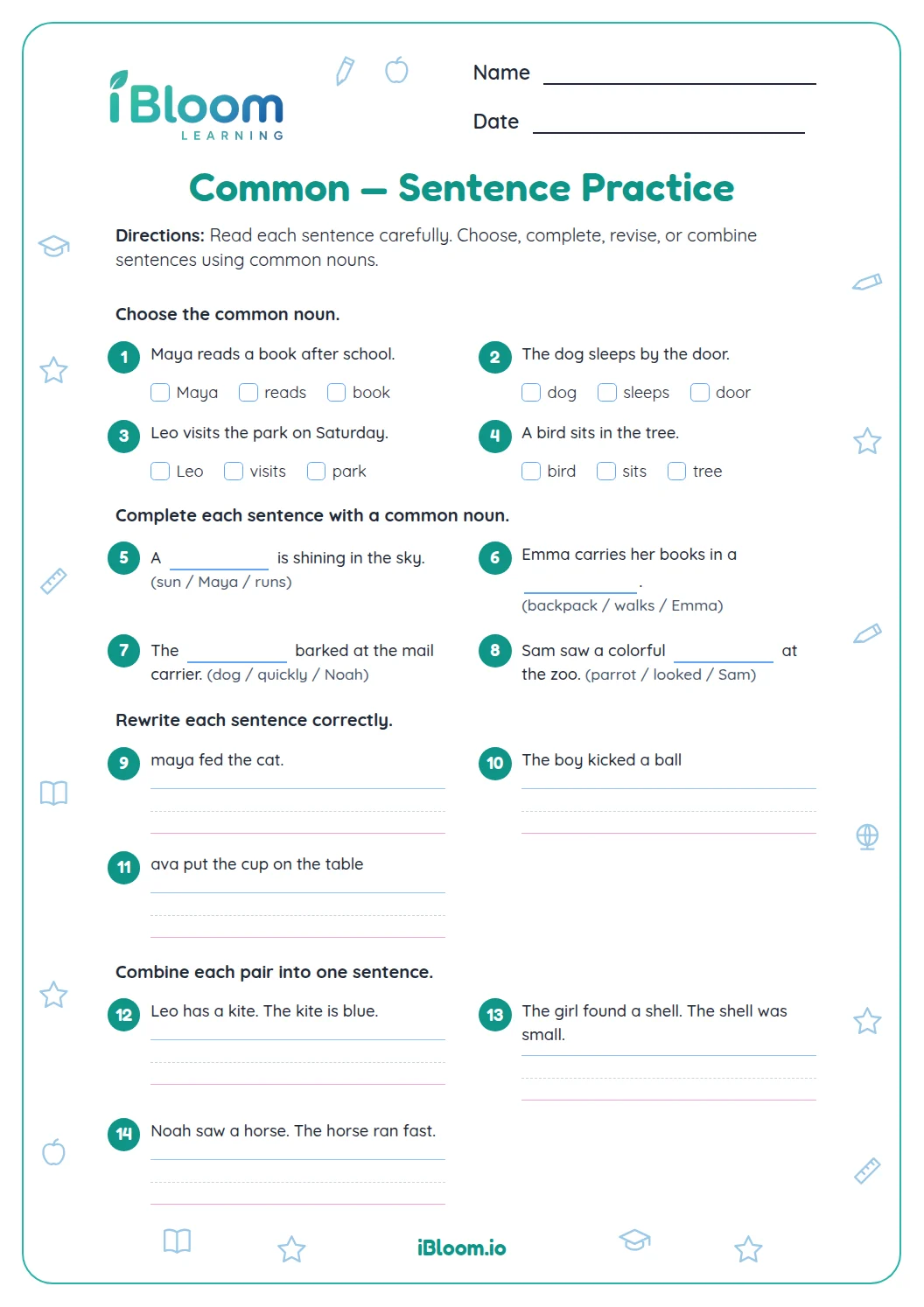
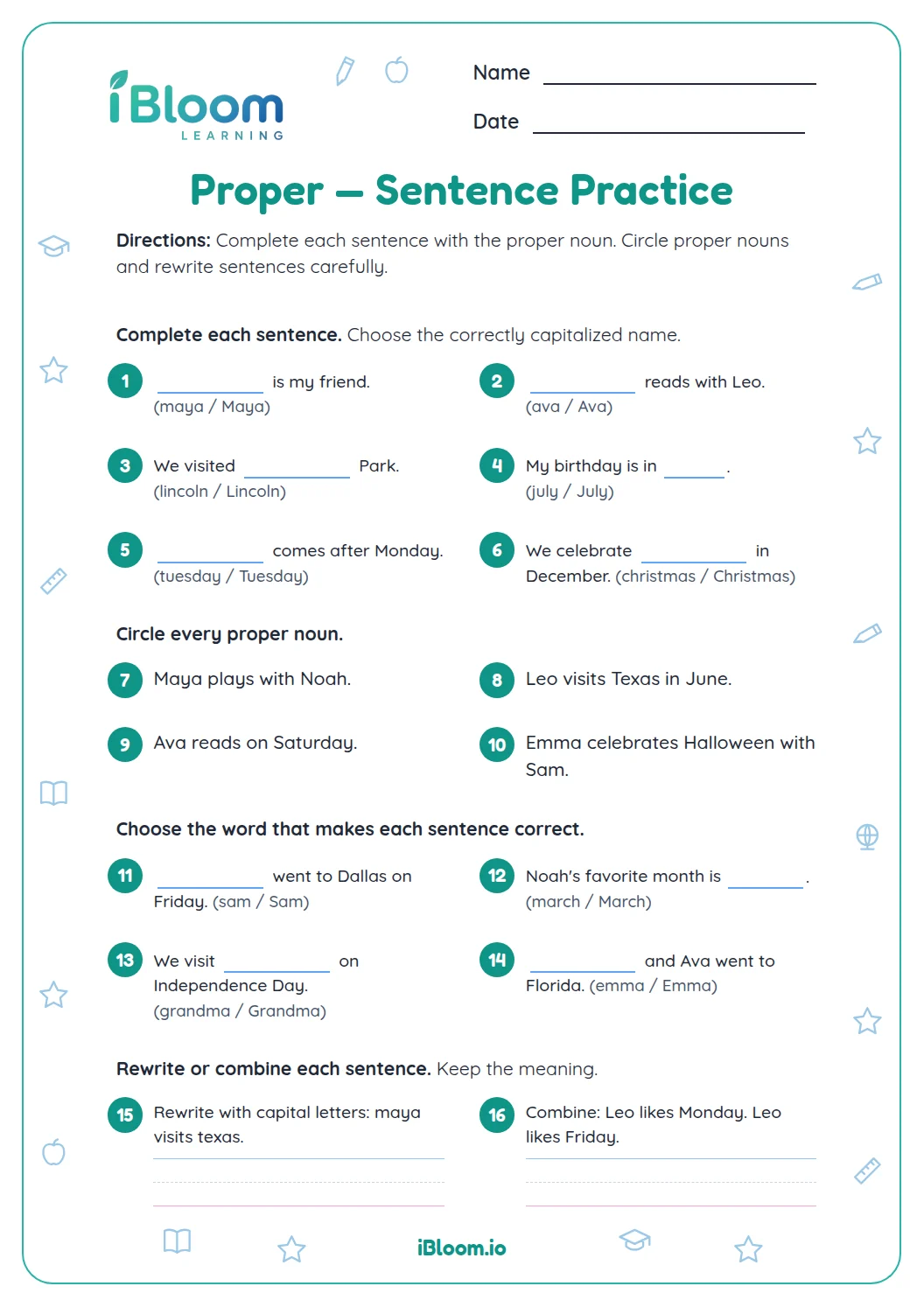
This free Grade 2 grammar worksheet moves from spotting nouns to correcting them in sentences. Students circle people, places and things, choose a noun in short sentences, and rewrite sentences with an incorrect plural or a place name that needs a capital letter. The answer key lists the noun choices and corrected sentences. The editing practice aligns with CCSS L.2.1.b for irregular plural nouns and L.2.2.a for capitalizing geographic names.
Aligned to L.2.1.b and L.2.2.a
How can a student spot a noun?
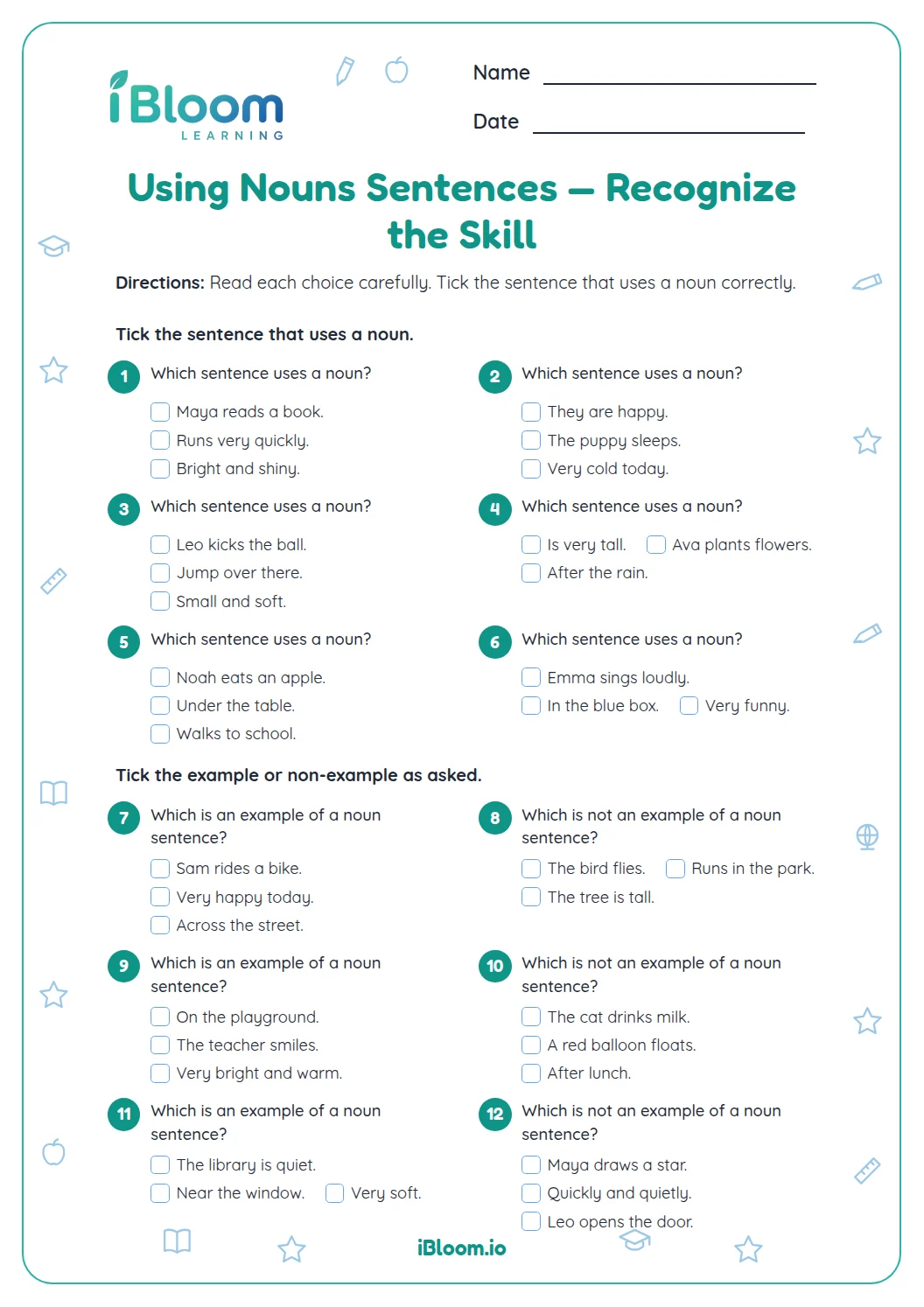
Ask whether a word names a person, place or thing. In Part A, students circle all the nouns in a short sentence. Some sentences include more than one noun, so read every word before finishing.
Question 2 says “Mia packed lunch for school.” Mia names a person, lunch names a thing and school names a place. All three are nouns.
- 1Question 2: Mia packed lunch for school.
- 2Nouns: Mia, lunch, school
How do person, place and thing clues help?
The question gives a useful way to check a word. A person can be a teacher, a place can be a park and a thing can be a bell or shell. Words that show an action, such as reads or rang, are not nouns in these sentences.
In question 8, bell is the thing that rang. The word rang tells what happened, so bell is the noun.
What should students edit in Part C?
Part C asks students to fix one noun error and rewrite the whole sentence. Some items use irregular plurals that change form, such as child to children and foot to feet. Other items need a capital letter for a geographic name.
Question 12 changes mouses to mice. The sentence already starts with a capital and ends with a period, so the noun form is the edit to make.
How to use this worksheet
- 1Read the sentence once for its full meaning.
- 2In Parts A and B, ask whether a word names a person, place or thing.
- 3Circle every noun when a sentence has more than one.
- 4In Part C, find the noun that needs a form or capitalization correction.
- 5Rewrite the whole sentence and compare it with the answer key.
Common mistakes and quick fixes
The mistake
Circling an action word such as hops.
The fix
Ask whether the word names someone or something, or tells what happens; hops is an action.
The mistake
Writing mouses as the plural of mouse.
The fix
Mouse has an irregular plural: mice. Say both forms aloud, then reread the sentence.
The mistake
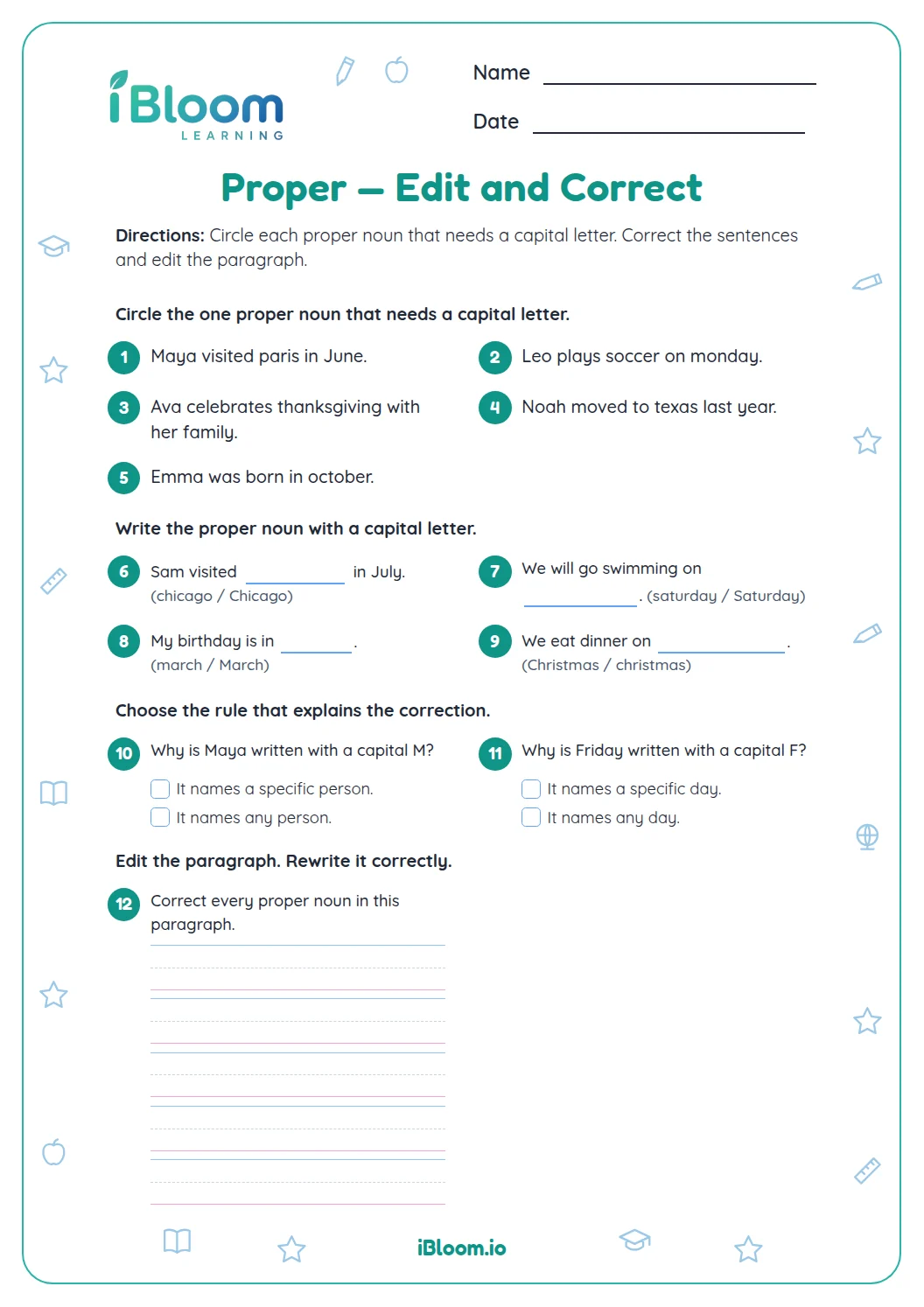
Leaving texas lowercase because it is inside a sentence.
The fix
Geographic names begin with capital letters wherever they appear: Texas and New York.
Common Core alignment
The editing items practice irregular plural nouns and capitalization of place names.
Correct common irregular plural nouns such as children, mice and feet.
On this sheet: Part C edits sentences by replacing incorrect irregular plural noun forms.
Show the official wordingHide the official wording
Form and use frequently occurring irregular plural nouns (e.g., feet, children, teeth, mice, fish).
Capitalize geographic names when editing sentences.
On this sheet: The correction items capitalize place names such as Texas and New York.
Show the official wordingHide the official wording
Capitalize holidays, product names, and geographic names.
What to practice next
Make more practice
Further reading
Questions parents and teachers ask
What is a noun?
A noun names a person, place or thing. Teacher names a person, park names a place and bell names a thing. Questions 1–10 ask students to find nouns in sentences; the answer key shows every noun to circle and the correct multiple-choice response.
Why does Part A ask students to circle more than one word?
A sentence can have several nouns. In “Mia packed lunch for school,” Mia is a person, lunch is a thing and school is a place. Students circle all the naming words, then check the answer key to see whether they found each one.
What makes children and mice irregular plurals?
Their plural forms do not simply add s or es to the singular. Child becomes children, and mouse becomes mice. Part C gives students practice correcting these forms in full sentences, and the key provides a complete corrected sentence. Saying the singular and plural together can help students hear the change.
Why is Texas capitalized in the sentence?
Texas is a geographic name, so it begins with a capital letter even when it appears in the middle of a sentence. Part C also includes New York. The answer key shows the capitalized place name in the sentence students rewrite.
Should students rewrite the entire sentence in Part C?
Yes. Rewriting the whole sentence helps students place the corrected noun in context and keep the remaining words in order. Each item has one noun form or capitalization change. The answer key shows a corrected version with standard sentence punctuation.