









About this worksheet
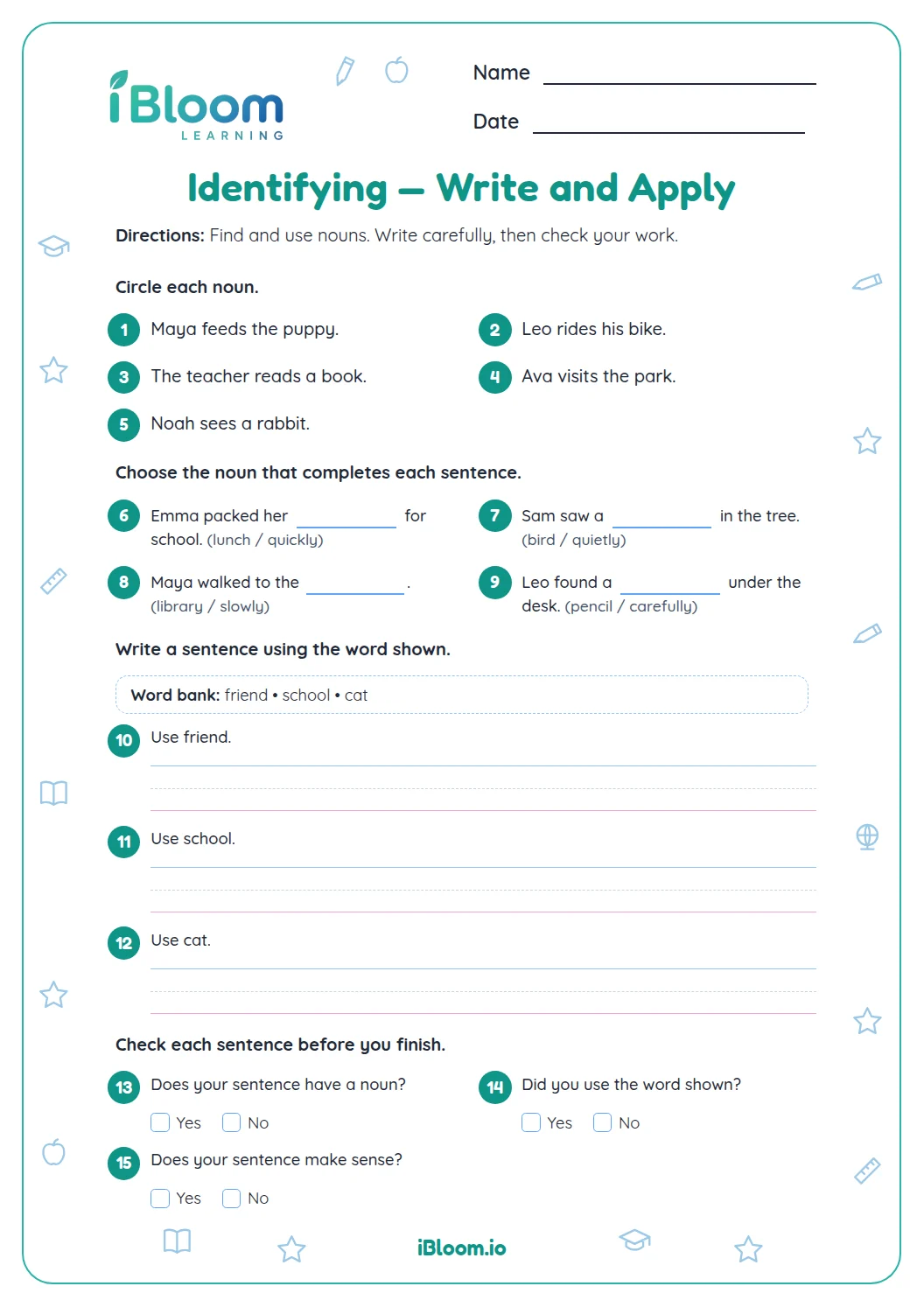
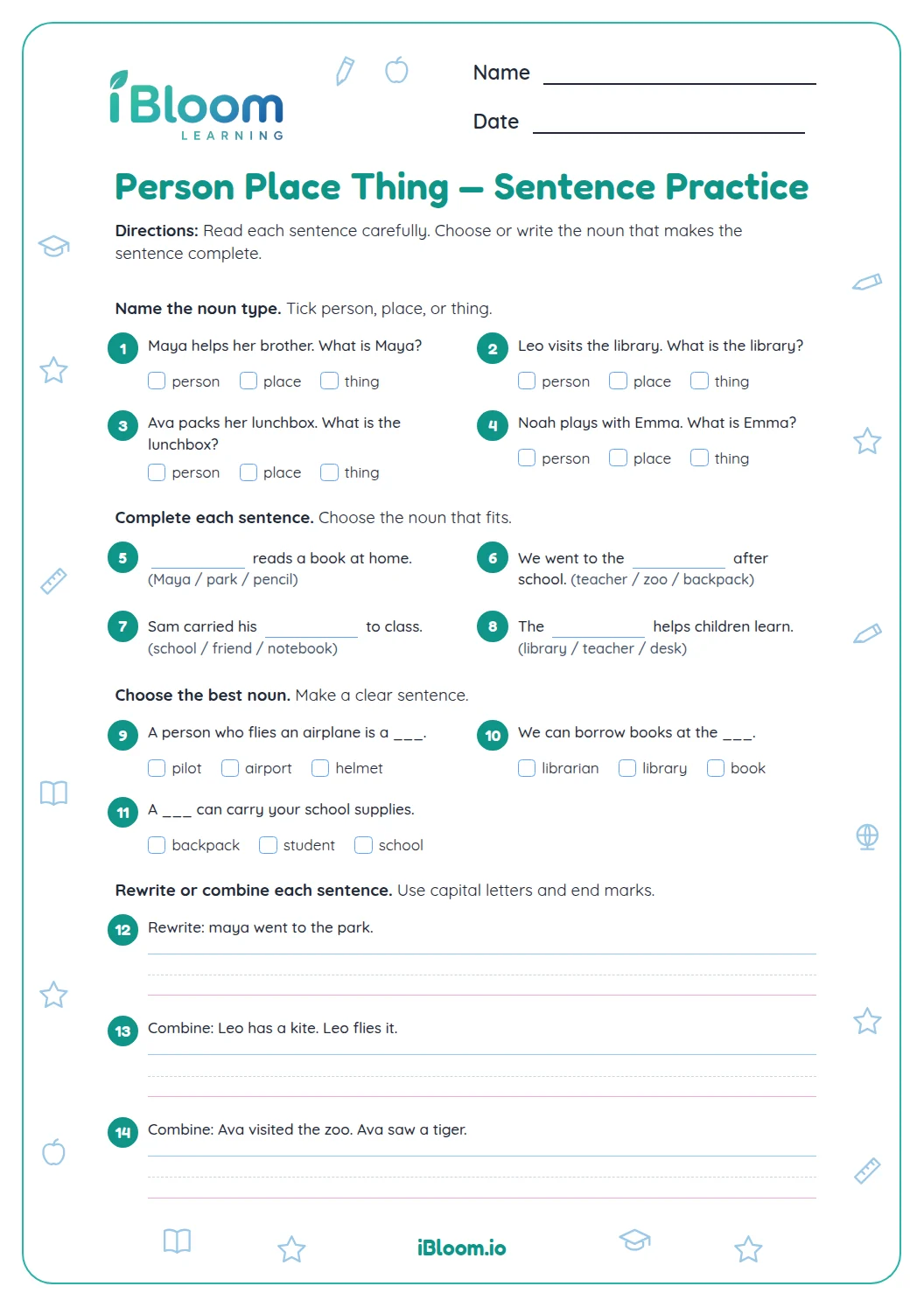
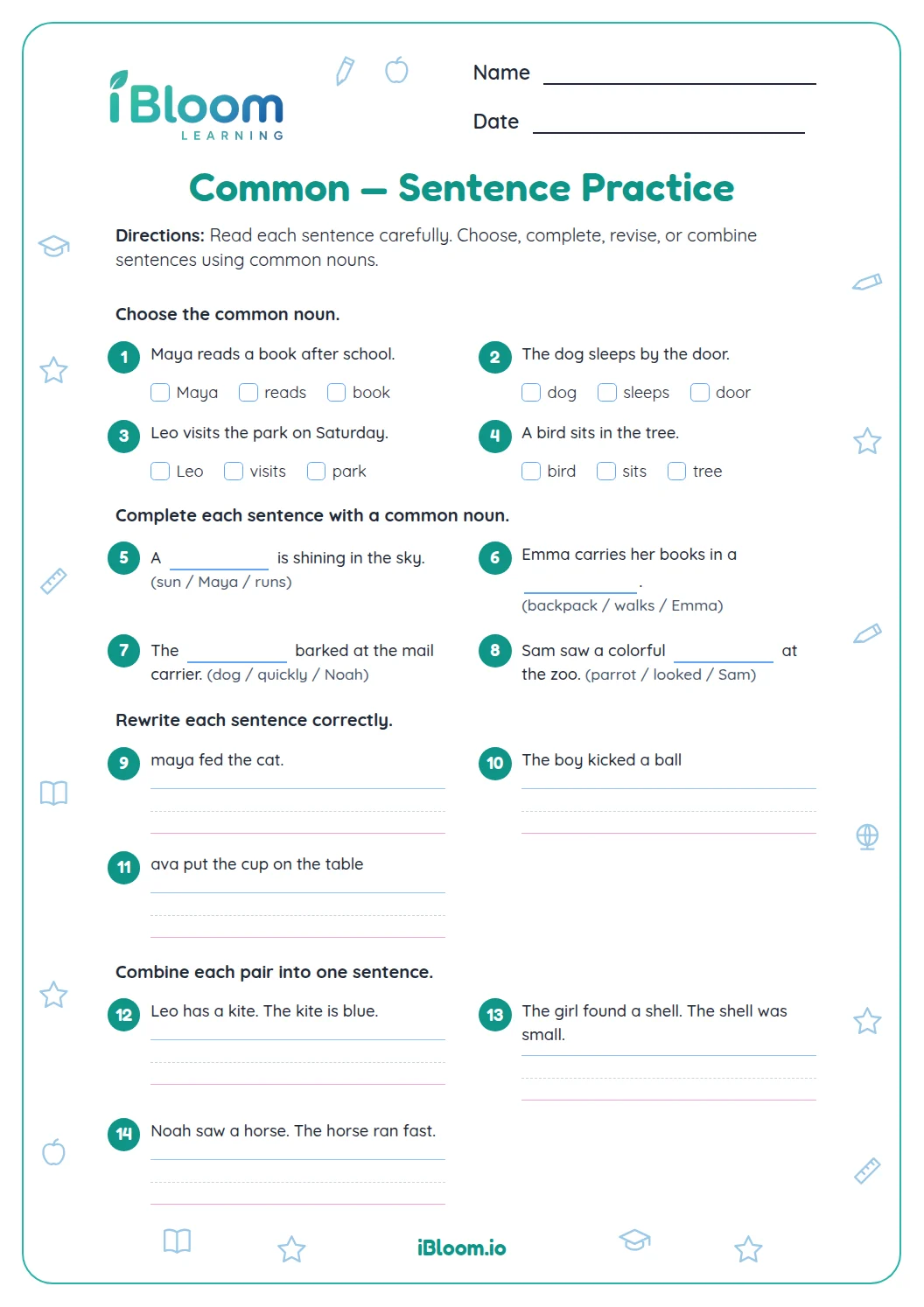
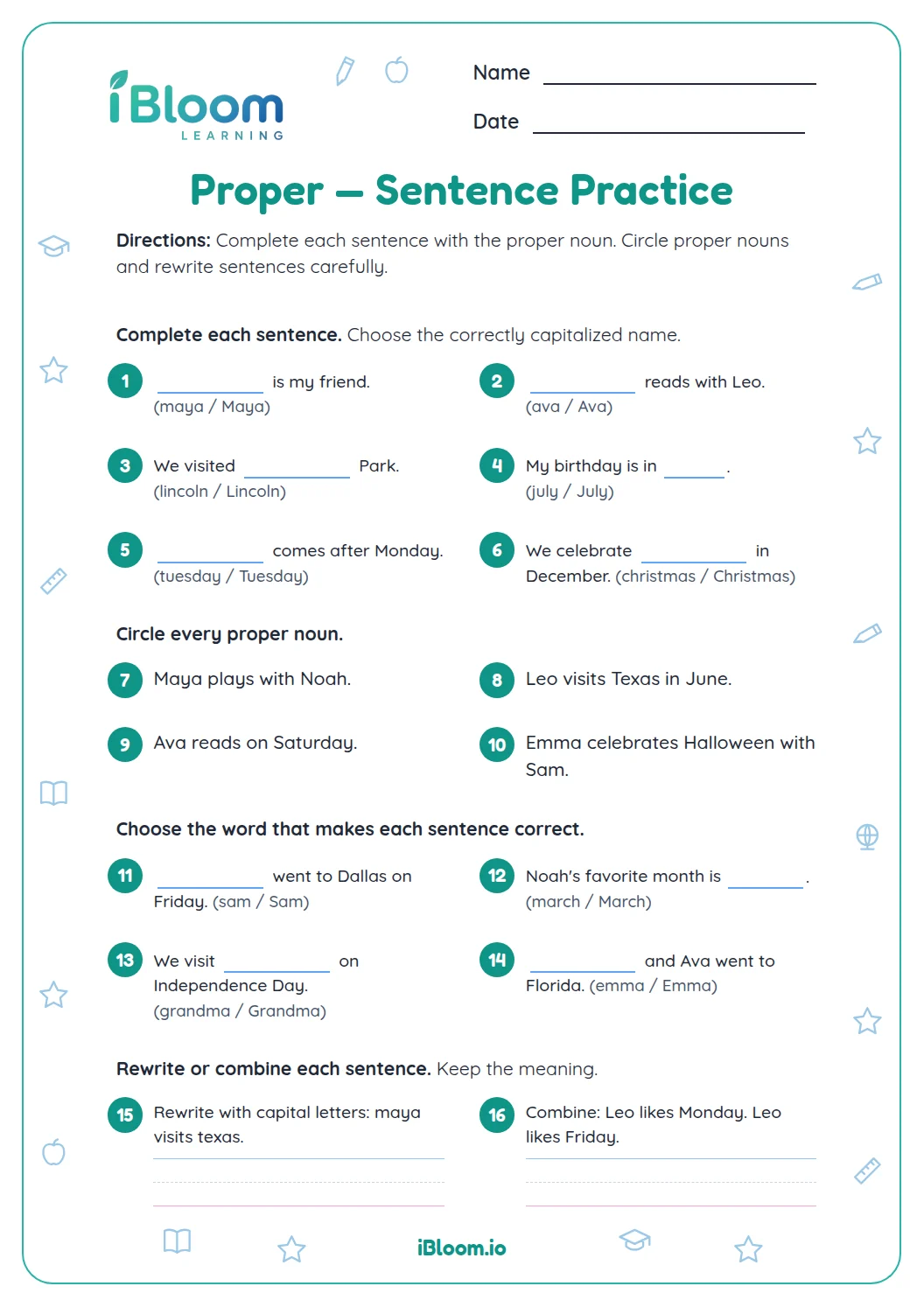
This Grade 2 printable gives children three ways to identify nouns in sentences. They circle every noun in four short sentences, choose a noun from six word choices, and write one noun from six more sentences. The examples include people, places, animals, and things. An answer key lists the target words, with all nouns shown for the circle section so families can check each sentence together.
Aligned to L.2.1
What noun practice is included?
Part A asks children to circle every noun in four sentences. Question 1 names Maya, a basket, and a school. Part B completes four sentences with a noun, and Part C asks children to write every noun they find in six short sentences.
How can a child spot a noun?
Ask who or what the sentence names, then look for a person, place, animal, or thing. In “Maya carried a basket to school,” Maya is a person, basket is a thing, and school is a place. Words such as carried tell an action instead.
How should the answer key be used?
Part A’s key lists every noun to circle. Part B has one fitting noun for each blank. Part C lists all nouns in each sentence; accept the same words even if a child writes them in a different order.
How to use this worksheet
- 1Read each sentence once for meaning.
- 2In Part A, circle every word that names a person, place, animal, or thing.
- 3In Part B, fill each blank with a noun that completes the sentence.
- 4In Part C, write every noun in the sentence, using commas between words.
- 5Reread each response and check that the word names someone or something.
- 6Compare each noun list with the answer key and add any word you missed.
Common mistakes and quick fixes
The mistake
Circling an action word such as “carried” in question 1.
The fix
Ask whether the word names someone or something. Maya, basket, and school are nouns; carried tells an action.
The mistake
Finding only one noun when a sentence has more, as in question 1.
The fix
Reread the sentence and ask “Who?” and “What?” Maya, basket, and school all name people or things.
The mistake
Leaving a noun out of the final short-answer list.
The fix
Reread the whole sentence and check each person, place, animal, or thing against the answer key.
Common Core alignment
Students identify nouns in sentences and use the words they find in short written responses, practicing Grade 2 grammar and usage.
Use standard English grammar and usage when writing or speaking.
On this sheet: Students identify nouns while reading and writing complete sentences.
Show the official wordingHide the official wording
Demonstrate command of the conventions of standard English grammar and usage when writing or speaking.
What to practice next
Make more practice
Further reading
Questions parents and teachers ask
What is a noun?
A noun names a person, place, animal, or thing. In question 1, Maya names a person, basket names a thing, and school names a place. Ask “Who?” or “What?” the sentence names, then check that the selected word is not just an action.
Does Part A ask children to circle every noun?
Yes. Each Part A sentence may include more than one noun. The key lists all expected words, such as Maya, basket, and school in question 1. Children should reread the whole sentence so they do not stop after finding the first noun.
Can my child put the nouns in a different order?
Yes. For the last six questions, the key lists every noun in the sentence, but the order does not matter. A child can write “lunch, apples, Leo” for question 12 and still have all three nouns. Check that no named person or thing was left out.
How is a noun different from a verb?
A noun names someone or something; a verb tells what happens or what someone does. In question 1, Maya, basket, and school are nouns, while carried is the action. Asking “Who or what?” versus “What happened?” can help distinguish them.
Why does the worksheet include lists of nouns?
The list questions ask children to separate nouns from actions and other words in a sentence. For example, “cat, sofa” names two things, while “slept, on” does not name a person, place, animal, or thing. The key shows every noun to select.
How long will this noun worksheet take?
Plan for about 15 minutes. The circling section takes careful rereading because each sentence can contain several nouns. The later questions move quickly, then the answer key can help you talk through any word that was mistaken for a noun.