

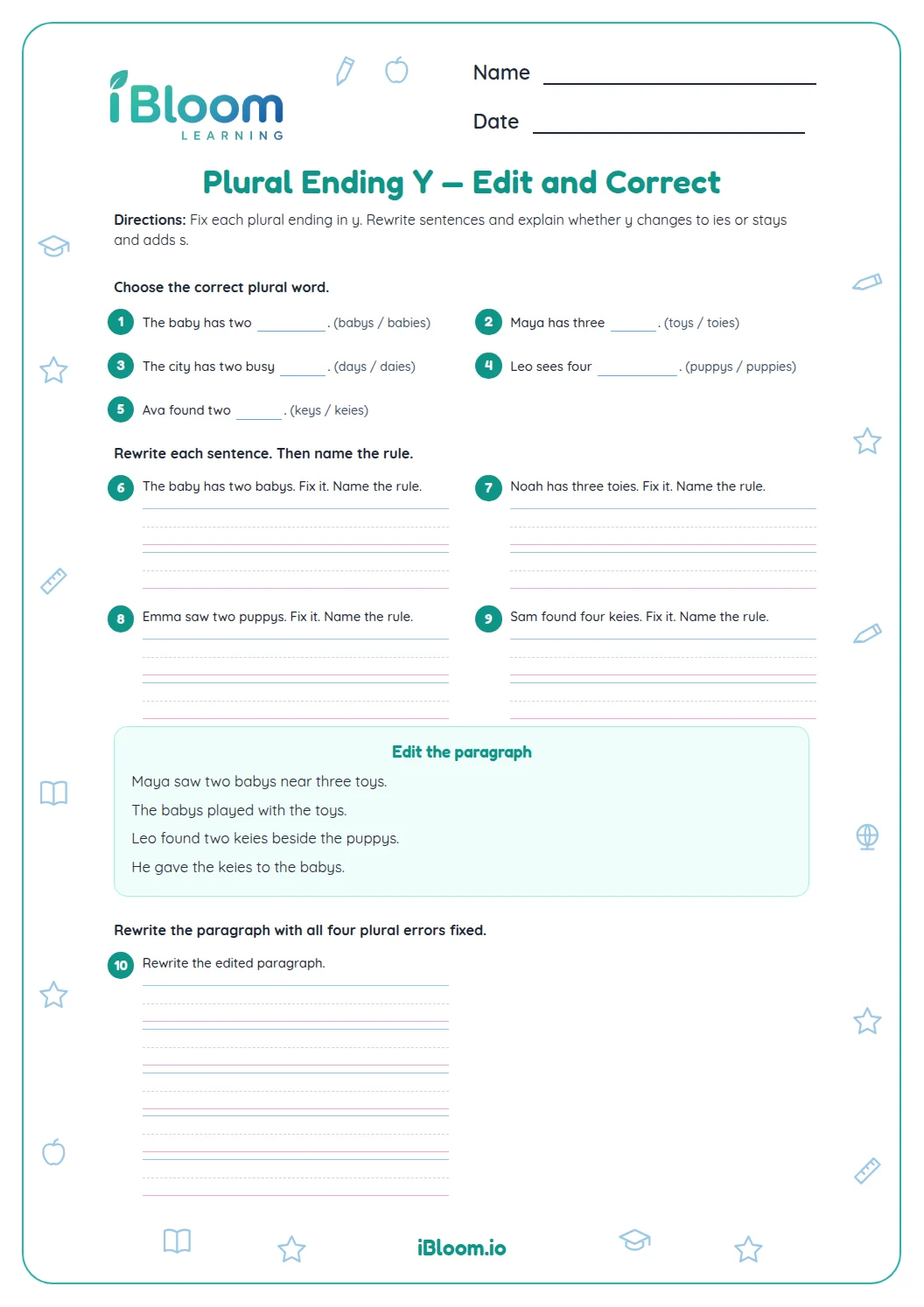
About this worksheet
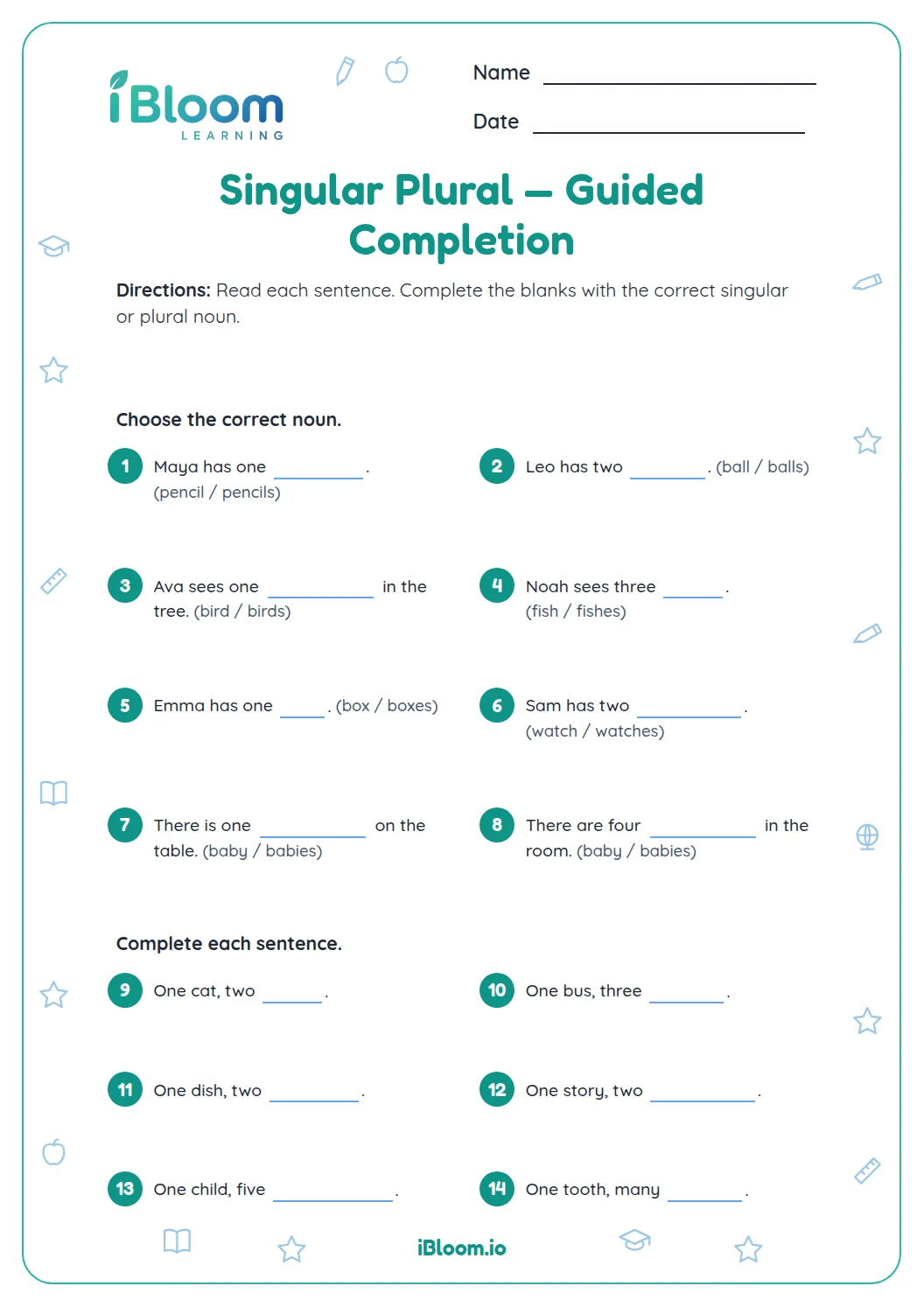
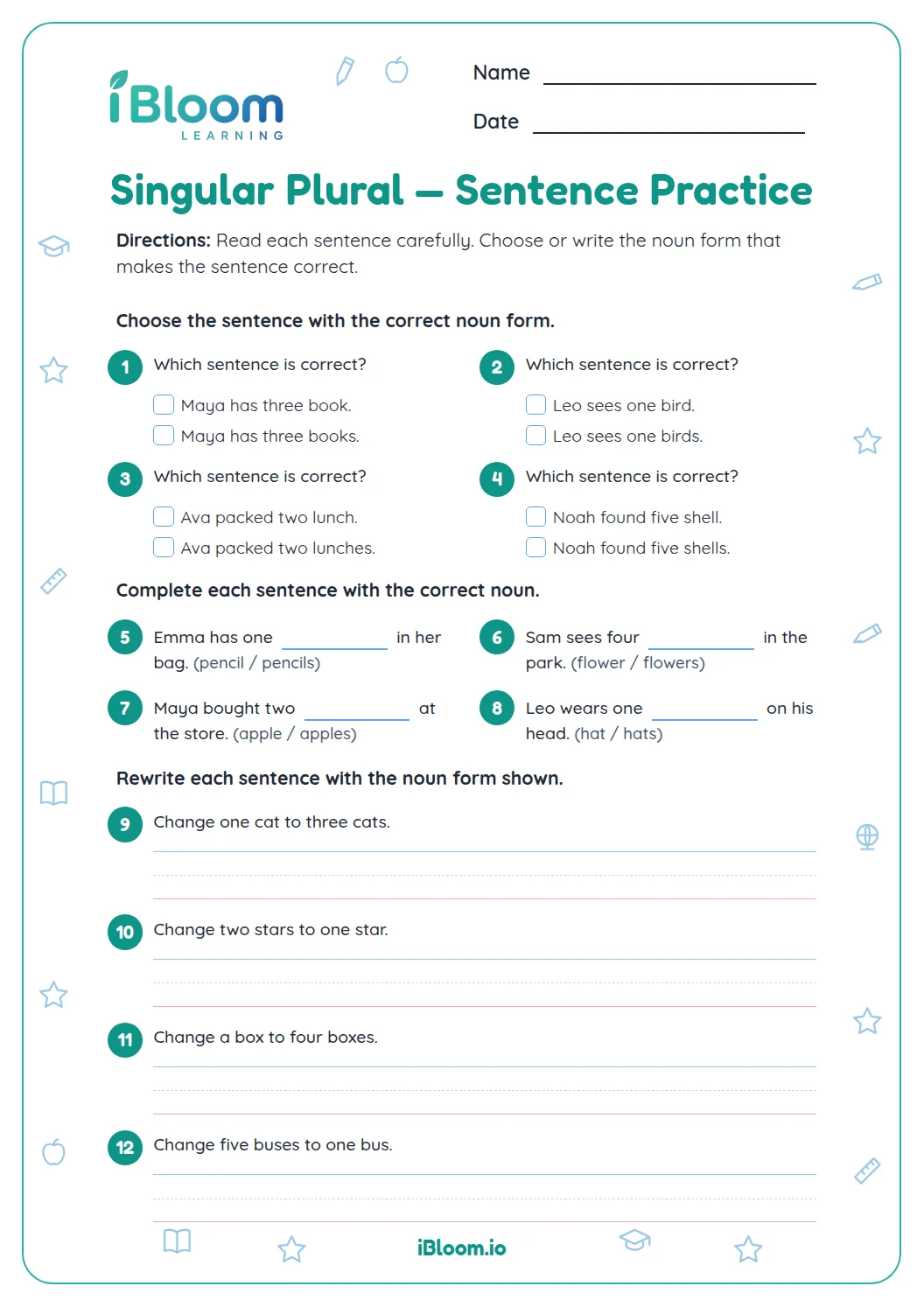
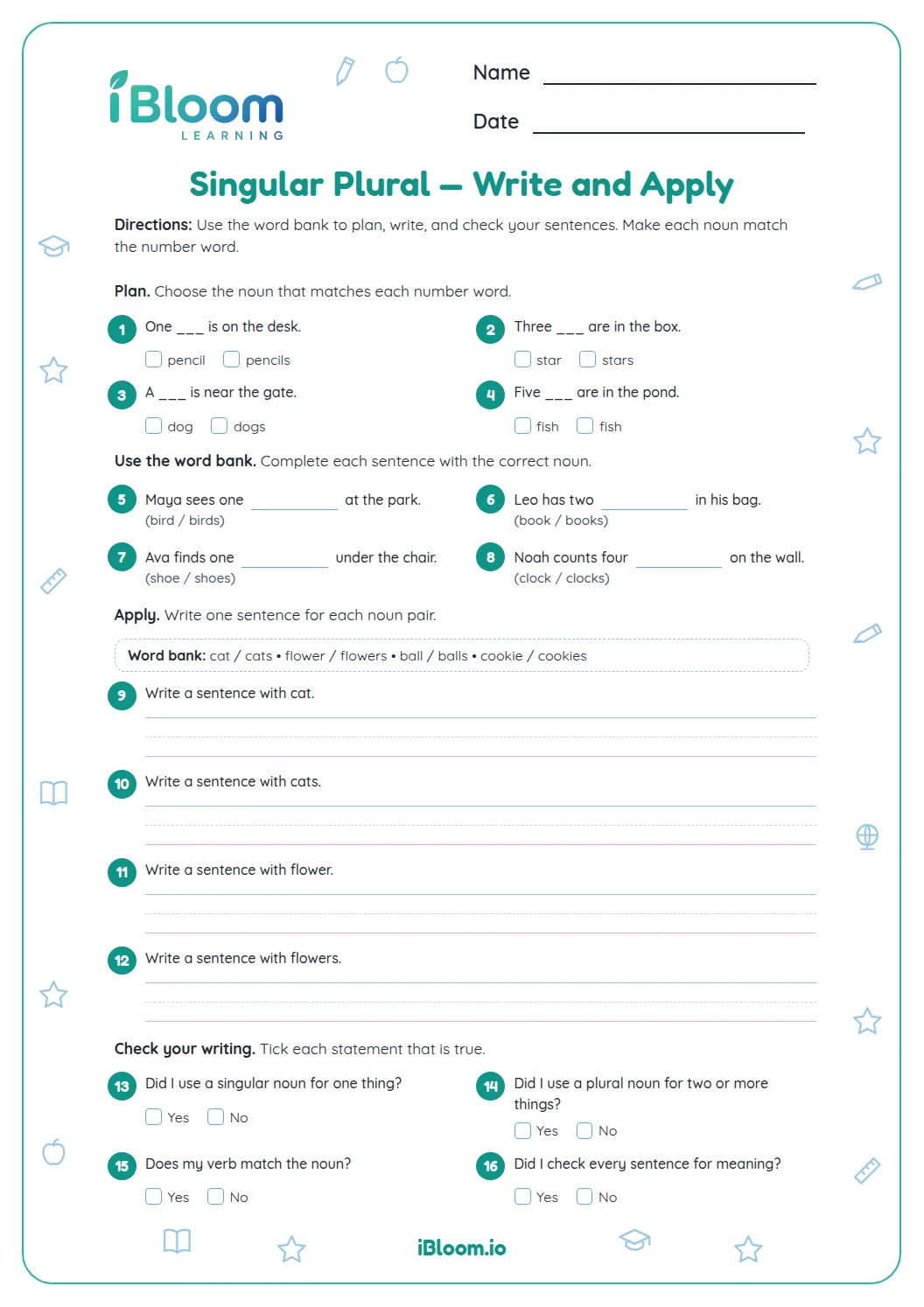
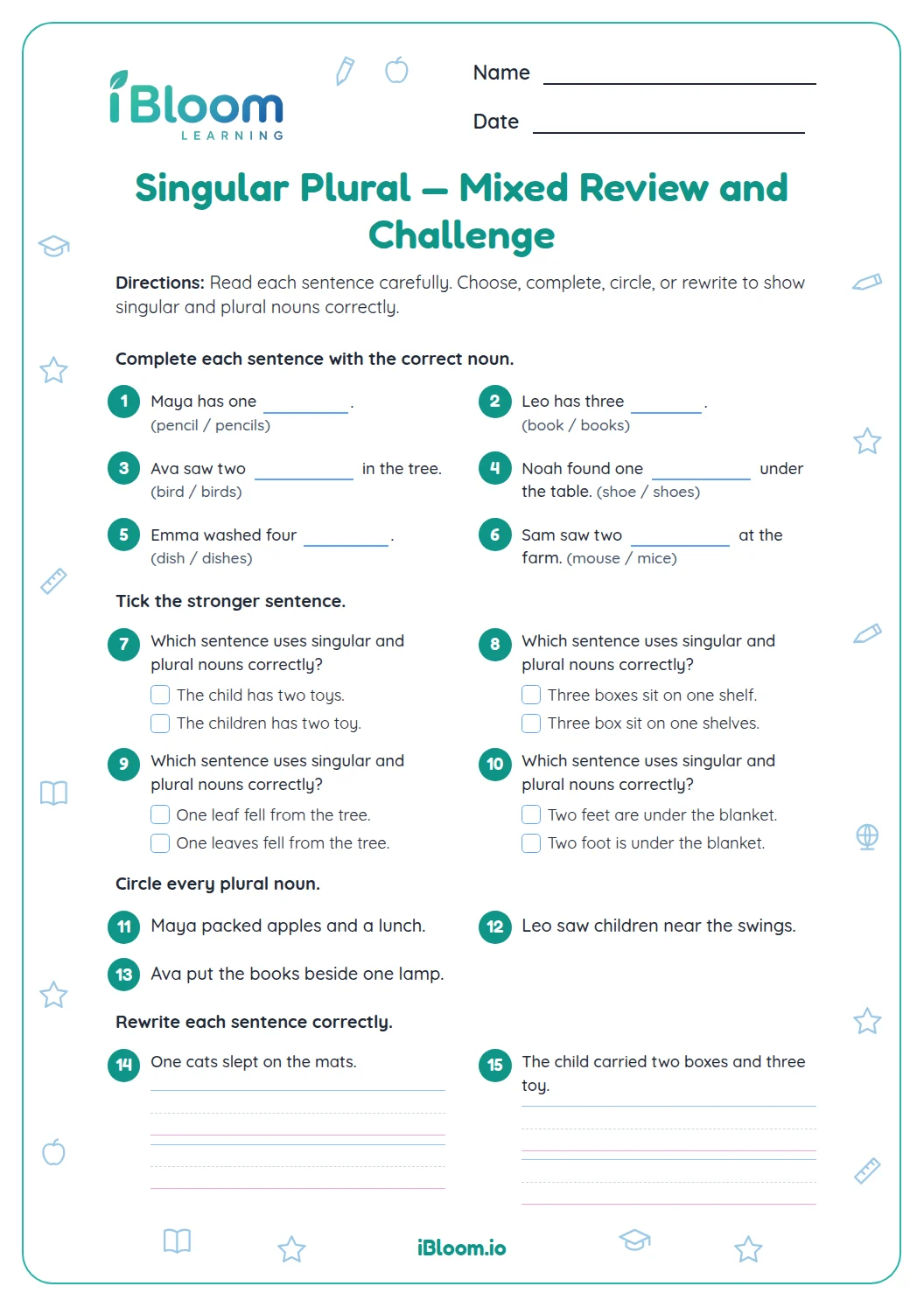
Learners edit just the noun in each sentence. The first group practices regular plural endings; the second corrects singular nouns, including common irregular pairs.
Aligned to L.2.2.D
What does this editing page cover?
Questions 1–4 ask learners to circle the noun whose form conflicts with the quantity clue. Questions 5–10 check singular and plural rules; questions 11–14 ask for a corrected noun, including common irregular forms.
- Eight plural noun edits
- Eight singular noun edits
- Regular and common irregular noun forms
A helpful way to think it through
For q4, Two tells us there is more than one puppy. Circle puppy as the noun to fix; its plural form is puppies.
How does the editing practice work?
The first four items display sentences as separate word tiles and ask learners to circle the noun that needs a number change. The next six questions check singular and plural rules. The last four ask for a corrected noun, including forms such as goose and child.
Make editing focused
- 1Have the learner underline the quantity clue first.
- 2Read the noun aloud with the clue: “three fox” sounds unfinished, so change the noun to foxes.
- 3In Part B, remember that irregular forms may change the whole word: geese becomes goose.
- 4Ask the learner to reread the original sentence with the corrected noun.
Common mix-ups
The mistake
Adding only s to nouns that need -es, such as foxs.
The fix
For nouns ending in x or ch, use -es: foxes, lunches.
The mistake
Changing y to ies after a vowel, such as changing donkey to donkies.
The fix
When a vowel comes before y, add s: donkeys.
The mistake
Treating an irregular noun like a regular noun, such as gooses.
The fix
Learn common pairs together: one goose, two geese.
Common Core alignment
The sentence edits practice Grade 2 conventions for forming and using frequently occurring irregular plural nouns, alongside regular plural patterns.
Generalize spelling patterns when writing words.
On this sheet: Part A applies spelling patterns when changing nouns to plural; irregular forms are included as related noun practice.
Show the official wordingHide the official wording
Generalize learned spelling patterns when writing words (e.g., cage → badge; boy → boil).
What to practice next
Questions parents and teachers ask
What should a learner change in each editing sentence?
The learner should change only the noun named by the prompt. First find the quantity clue, such as one, two, or three. Then check that the noun form matches that clue and reread the sentence to make sure the correction sounds right.
Do plural nouns always add s?
No. Many nouns add s, while nouns ending in sounds such as x or sh often add es. Some nouns ending in consonant plus y change to ies, and irregular nouns change in other ways. The worksheet offers examples of each pattern.
What grade is this noun editing worksheet for?
This page is designed for Grade 2 practice with singular and plural nouns. It includes regular spelling patterns and common irregular forms such as child and children. Children also practice spotting a noun that does not match a quantity clue.
Is an answer key included?
Yes. The answer key identifies the noun to circle, gives the correct rule choices, and lists each corrected noun form for the editing sentences. Use it after the learner has tried all three parts independently. The learner can also explain which clue showed the noun should be singular or plural.
How many items does the worksheet have?
There are 14 items in three parts: four noun-identification edits, six rule questions, and four corrected-noun responses. The key identifies the noun to circle, marks each rule choice, and supplies the corrected forms for the written responses. Review all three parts before checking.
What is one common irregular plural?
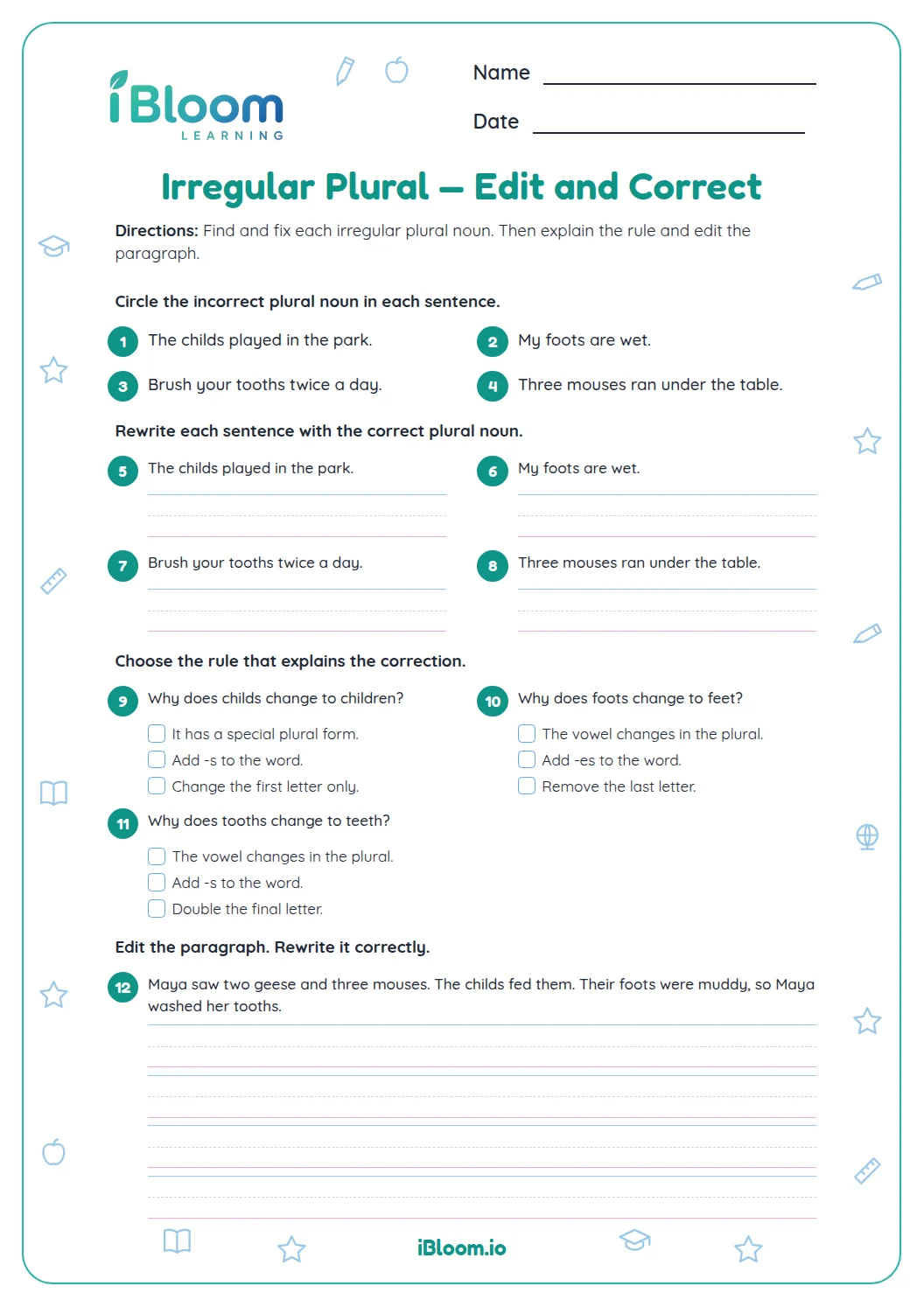
Children is the plural of child, and mice is the plural of mouse. These forms change more than a final s, so learners should read the quantity clue and use the familiar word form that matches it. Read each corrected sentence aloud to check it.