




About this worksheet
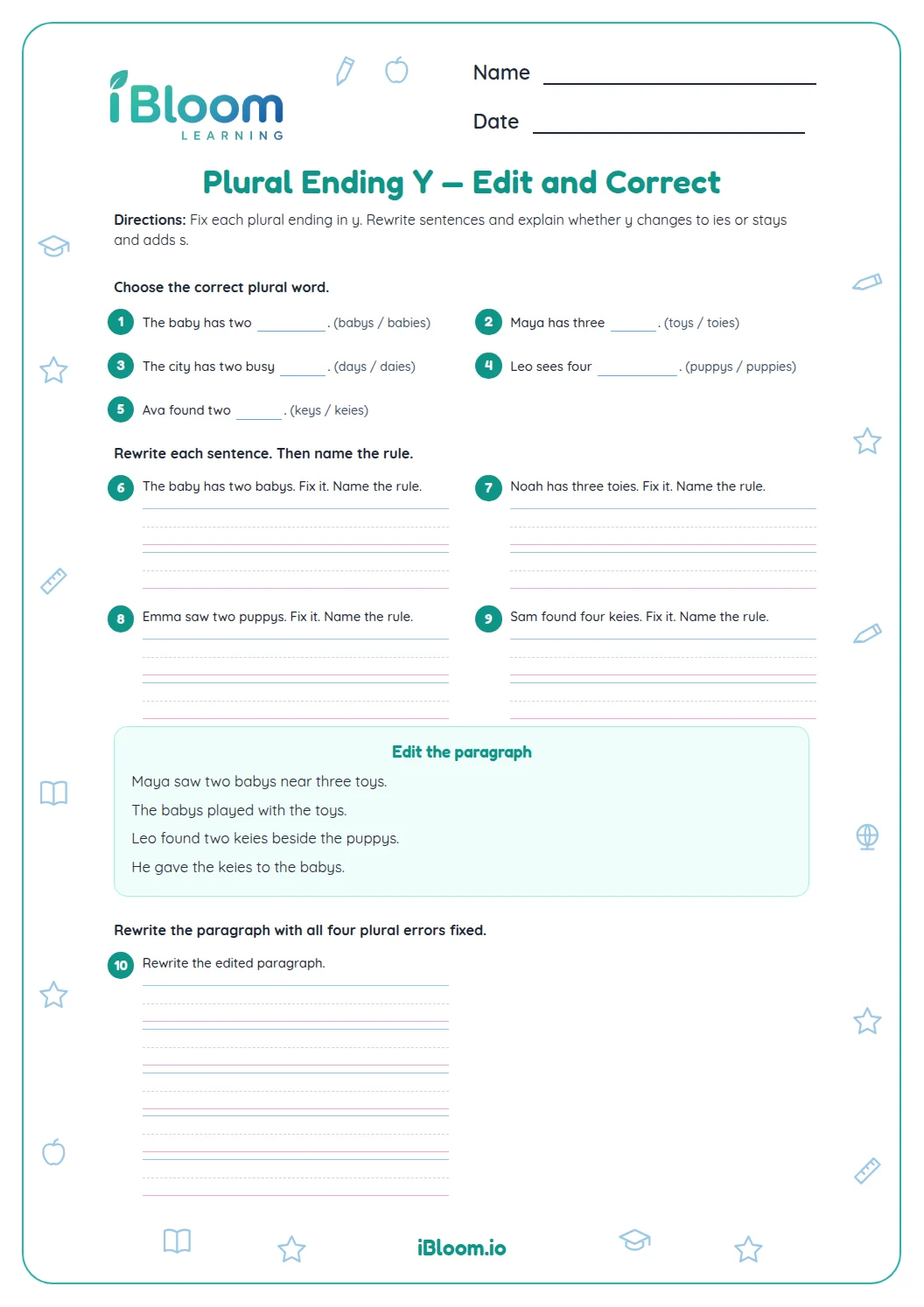
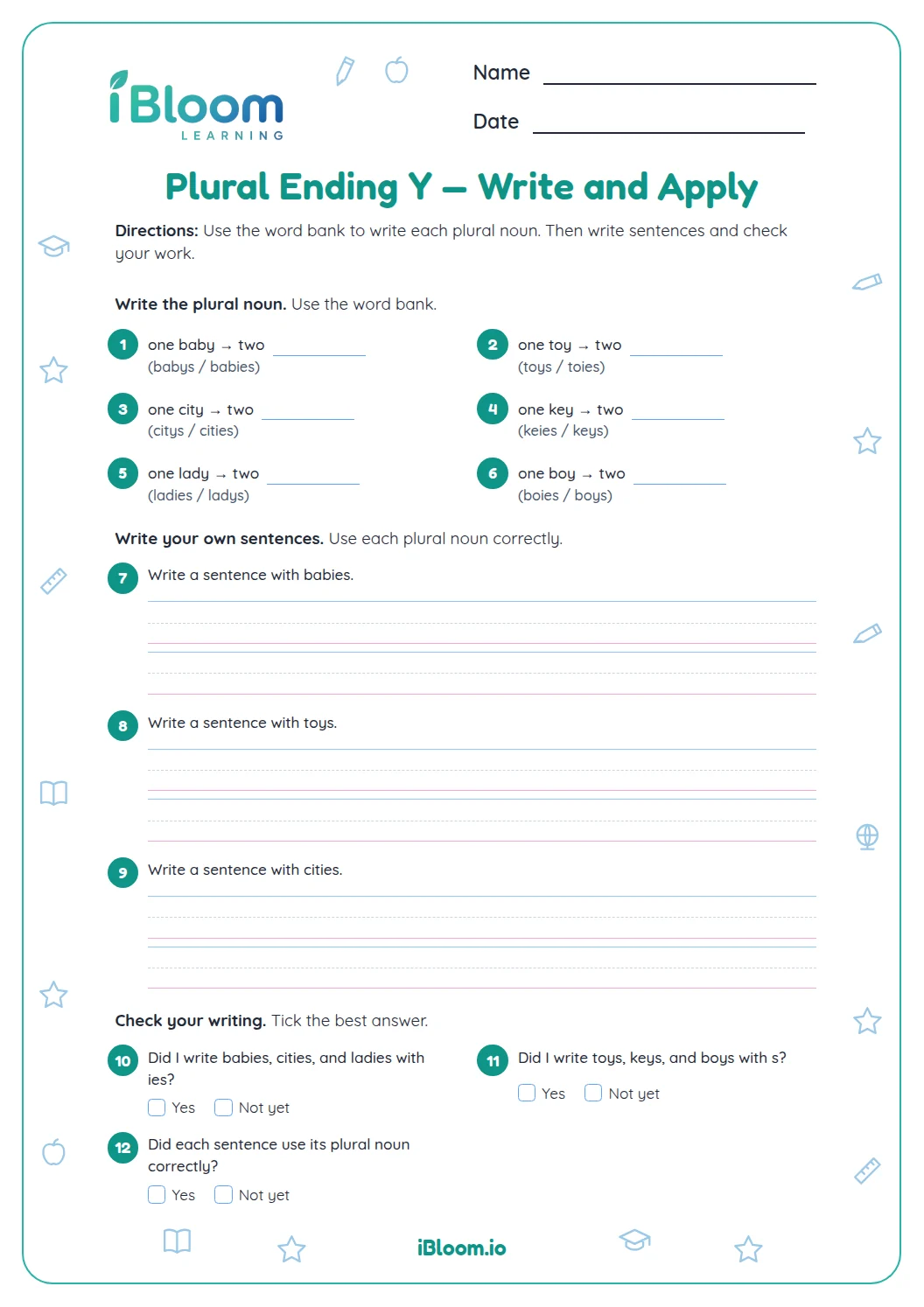
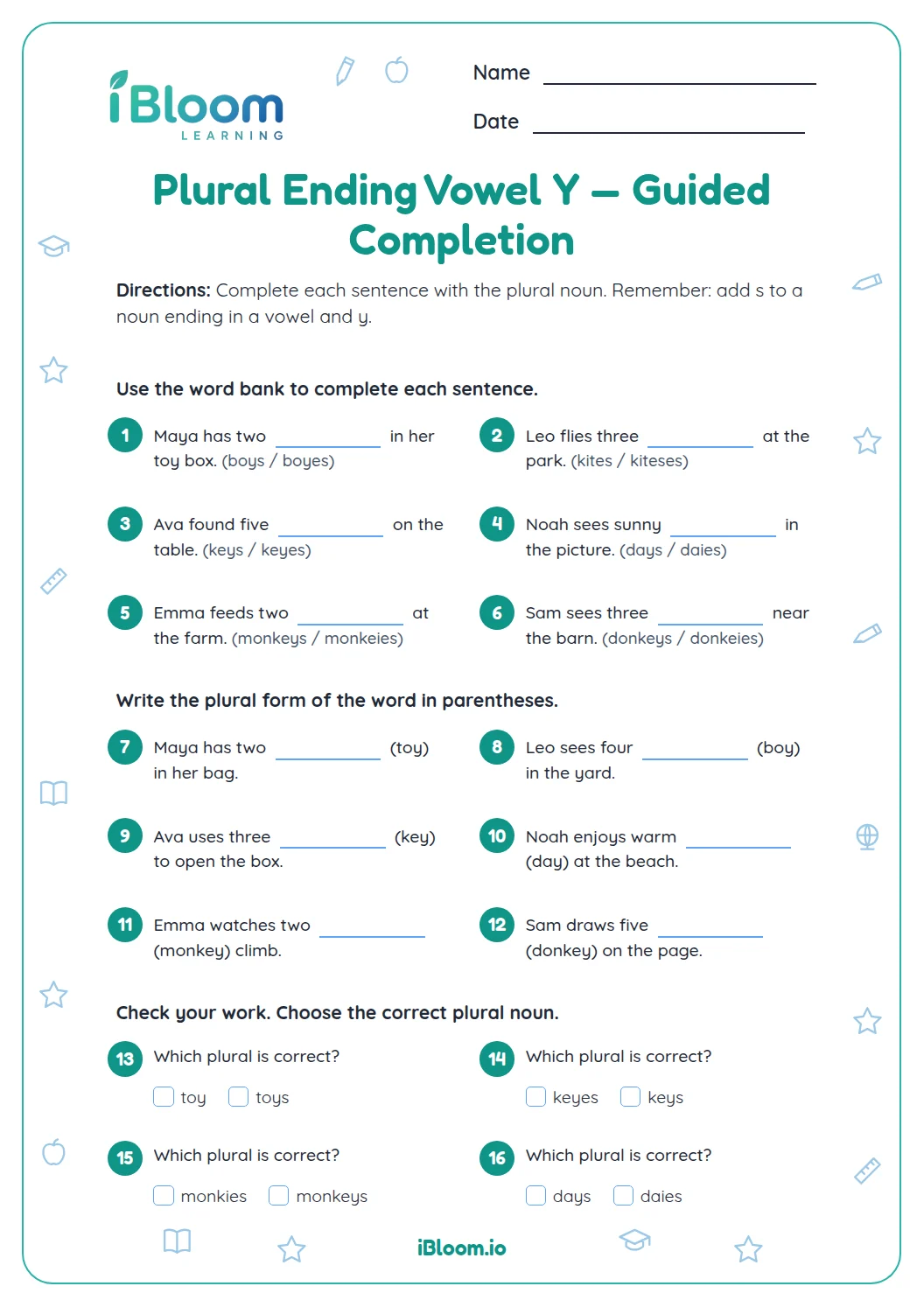
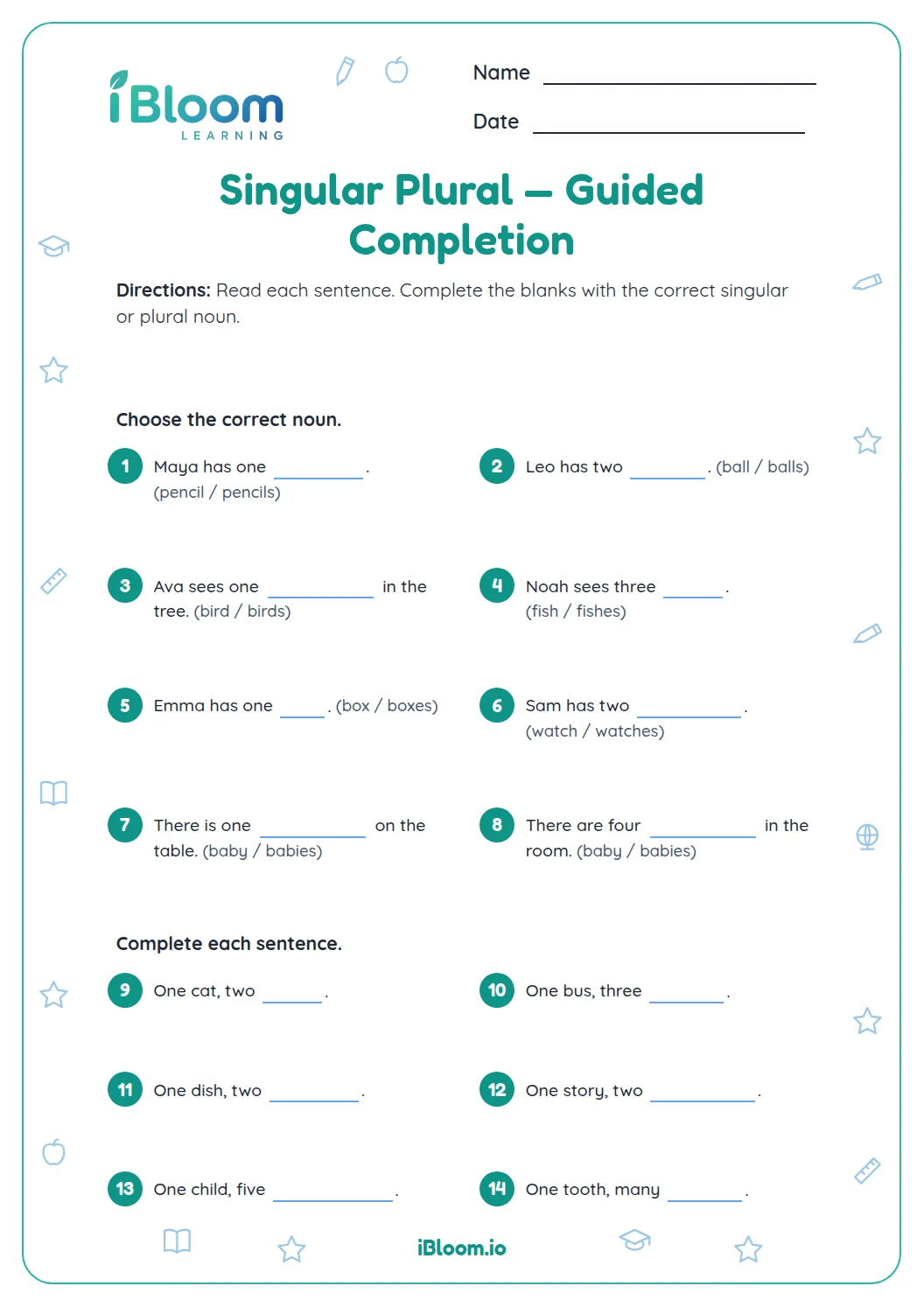
This free printable gives Grade 2 students 15 questions about plural nouns ending in y. They change consonant + y to ies, keep vowel + y and add s, choose correct spellings, complete sentence blanks, and write one sentence. The practice spans four parts on two pages with a separate two-page answer key.
When does y change to ies?
For many nouns ending in a consonant + y, change y to i and add es: puppy becomes puppies. This worksheet practices the spelling in isolated words and simple sentences.
What happens after a vowel and y?
When a vowel comes before y, keep the y and add s: toy becomes toys and key becomes keys. Check the letter immediately before y before making the plural.
How can you check a plural spelling?
Say the singular word, find the letter before y, then choose the ending. Cherry ends in consonant + y, so its plural is cherries. Toy has a vowel before y, so it becomes toys.
How to use this worksheet
- 1Read the singular noun carefully.
- 2Look at the letter right before the final y.
- 3Change consonant + y to ies.
- 4Keep vowel + y and add s.
- 5Read the completed sentence to check the plural fits.
Common mistakes and quick fixes
The mistake
Adding only s to a noun such as puppy.
The fix
Change consonant + y to ies: puppy becomes puppies.
The mistake
Changing toy to toies even though a vowel comes before y.
The fix
Keep the y and add s after a vowel: toy becomes toys.
The mistake
Adding ies to a noun that does not end in y.
The fix
Use this rule only for nouns ending in y; other nouns may form plurals differently.
What to practice next
Make more practice
Questions parents and teachers ask
How do you make a plural noun that ends in consonant plus y?
For many nouns with a consonant right before the final y, change y to i and add es: puppy becomes puppies. This sheet practices the pattern with words such as city, berry, party, and story. Students compare both spelling patterns throughout the practice.
What happens when a vowel comes before the final y?
Keep the y and add s when a vowel comes before it. For example, toy becomes toys and key becomes keys. Students compare these forms with consonant-plus-y words in the spelling choices and sentence completions. Check the exact letter before y before choosing an ending.
How many questions are included?
There are 15 questions on two worksheet pages, in four parts: changing y to ies, choosing the correct spelling, completing sentences with plural nouns, and writing a sentence. A separate two-page answer key includes a sample for the open response.
Is “babies” spelled with ies?
Yes. Baby ends in consonant plus y, so change y to i and add es: babies. The same pattern applies to family and cherry, which become families and cherries. This supports careful, independent practice with the specific skill on this printable.
How can students check the spelling rule?
Have them look at the letter immediately before the final y. A consonant signals the change to ies; a vowel signals that they should keep y and add s. Then reread the completed sentence to check that the plural makes sense.