




About this worksheet
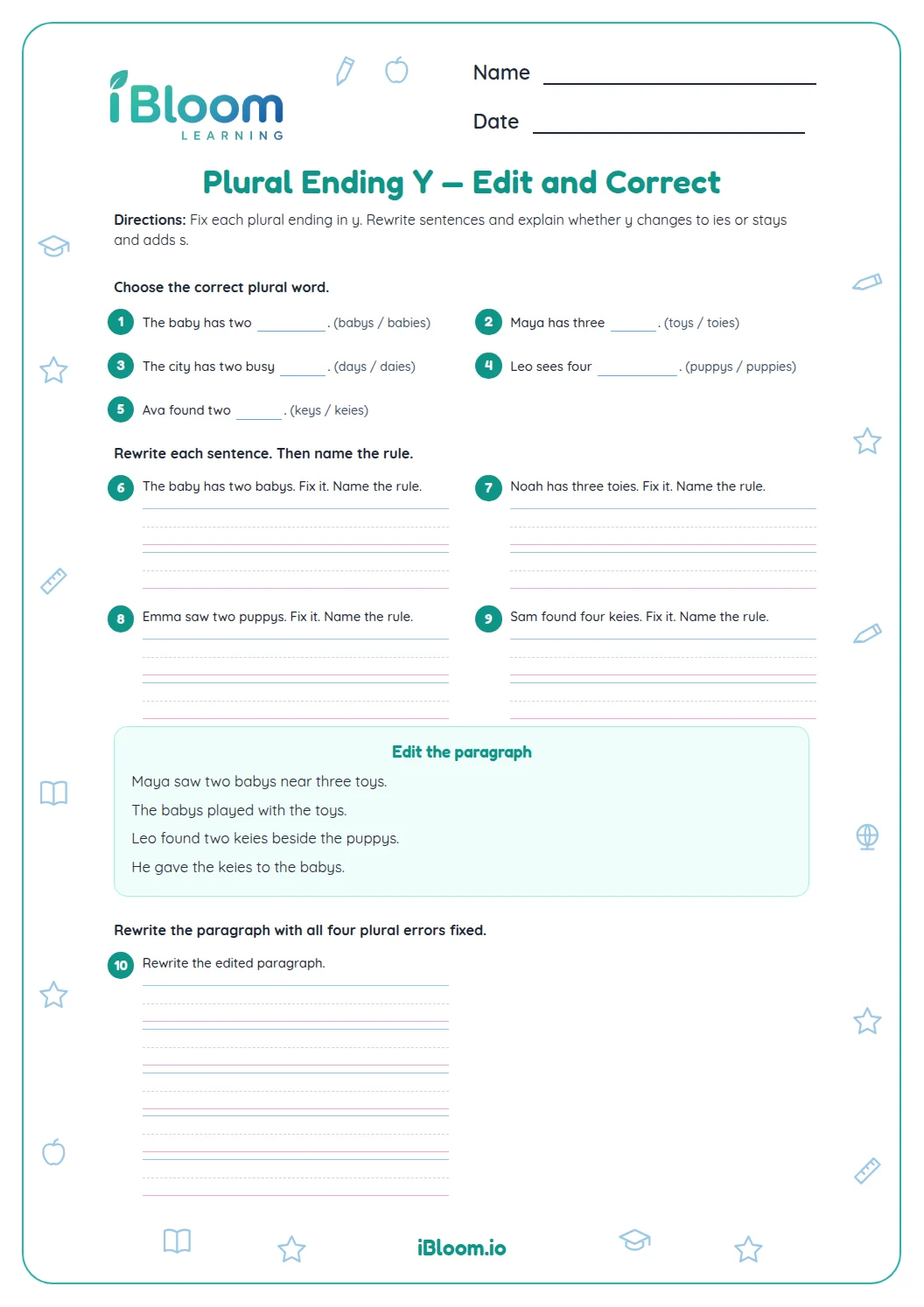
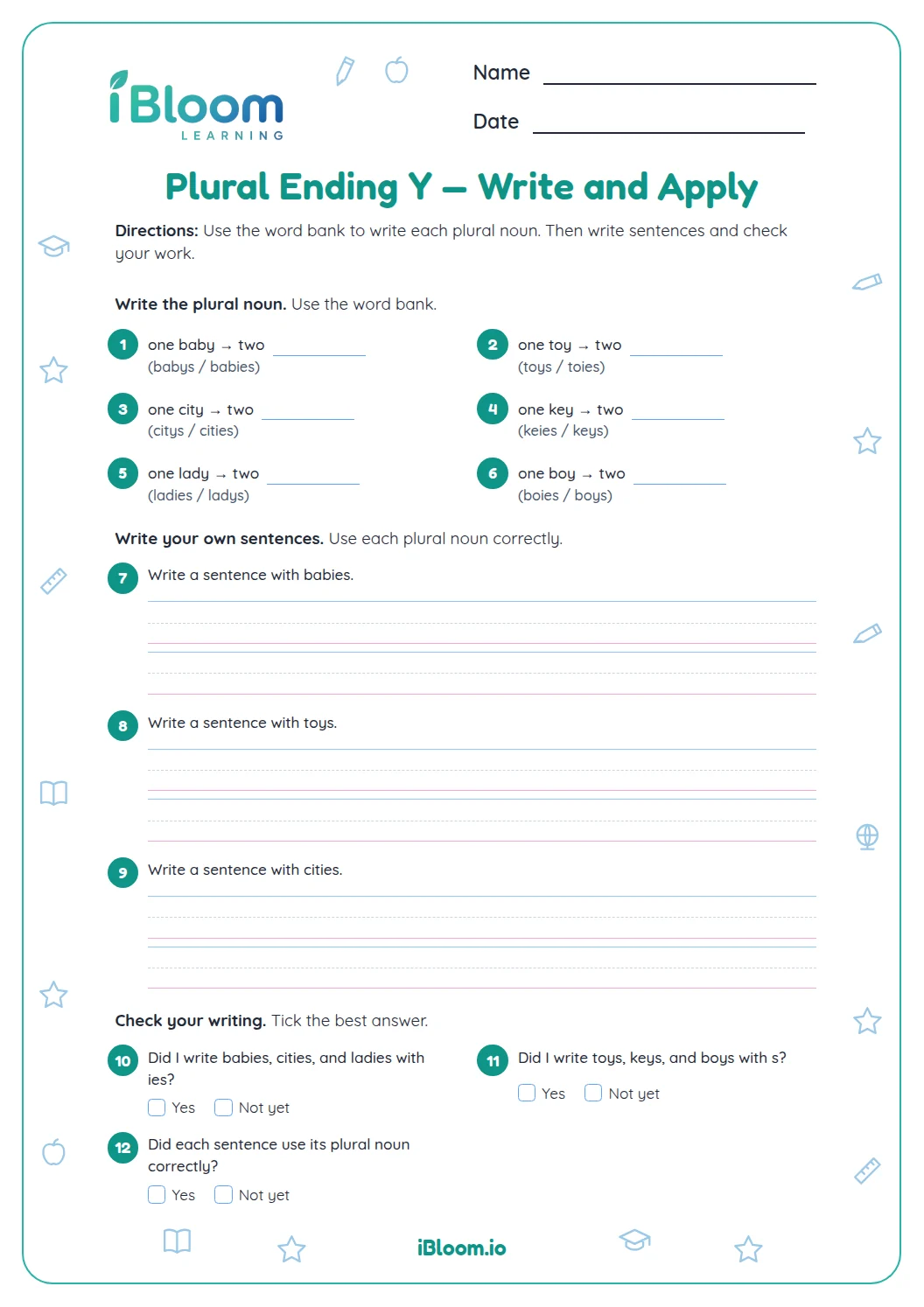
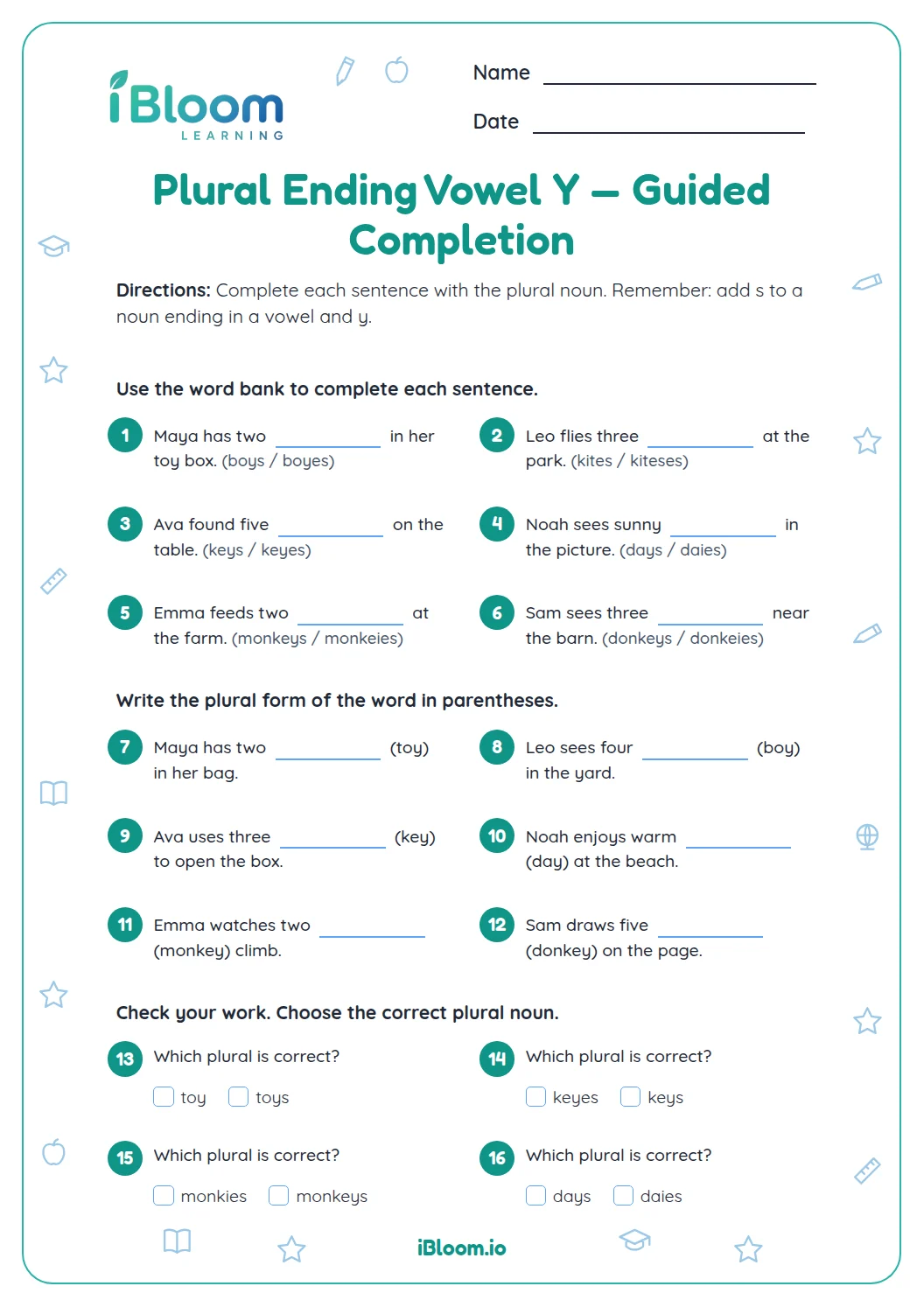
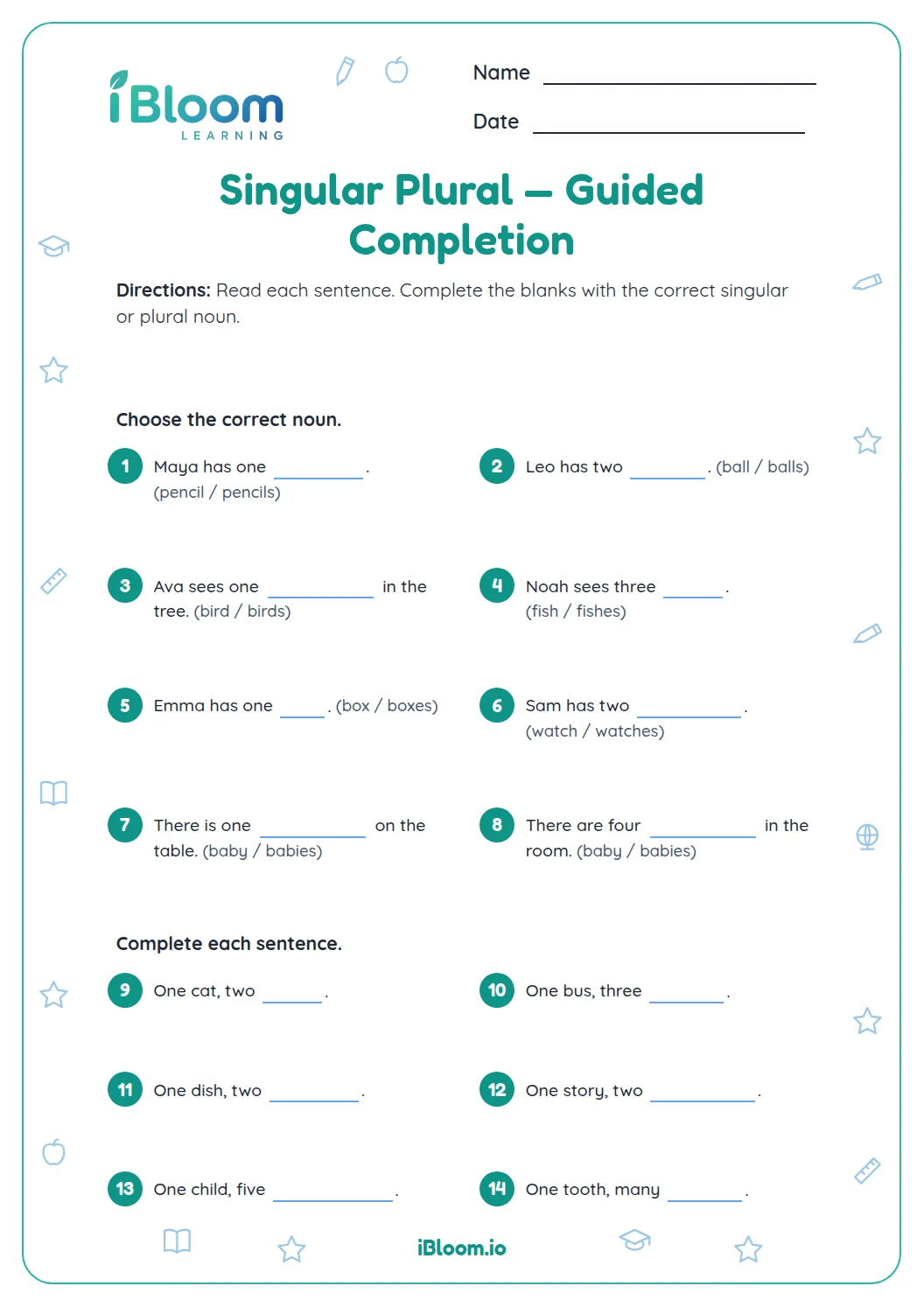
This Grade 2 worksheet reviews two ways to make plurals from nouns ending in y. Children choose correct spellings, complete short sentences, and edit plural nouns in context. Part A and Part B include both consonant + y and vowel + y words, and Part C asks students to apply the pattern while proofreading. An answer key is included.
Aligned to L.2.2d
What does the mixed review include?
Part A compares plural spellings for six nouns. Part B completes six short sentences with a plural noun. Part C edits four sentences by correcting the plural noun named in the prompt. Both patterns appear: consonant + y changes to ies, while vowel + y adds s.
- Part A: 6 multiple-choice spellings
- Part B: 6 plural fill-ins
- Part C: 4 editing answers
When does y change to ies?
Look at the letter just before y. When a consonant comes before y, change y to i and add es: baby becomes babies. When a vowel comes before y, keep the y and add s: toy becomes toys.
- 1One puppy becomes two ___.
- 2The letter before y is p, a consonant.
- 3Change y to i and add es: puppies.
How can you check a plural in a sentence?
Find the singular noun and inspect the letter before its final y. Then apply the matching pattern and reread the sentence. This helps catch forms such as babys, which keeps the y after a consonant, and toies, which changes y after a vowel.
How to use this worksheet
- 1Read the singular noun and notice the letter before y.
- 2Choose the plural spelling in Part A.
- 3Complete each Part B sentence with the plural form.
- 4In Part C, write the corrected plural noun only.
- 5Use the answer key to check whether y changed or stayed.
Common mistakes and quick fixes
The mistake
Changing y in every noun, including toy.
The fix
Check the letter before y; the vowel o means toy becomes toys.
The mistake
Adding only s after a consonant, as in babys.
The fix
For a consonant before y, change y to i and add es.
The mistake
Changing the singular noun when the word has a vowel before y.
The fix
Keep the y in words like key and day, then add s.
Common Core alignment
This practice connects the worksheet tasks to the listed Common Core skill.
Apply learned spelling patterns when forming plural nouns ending in y.
On this sheet: Parts A–C apply the spelling pattern for consonant+y and vowel+y plurals.
Show the official wordingHide the official wording
Generalize learned spelling patterns when writing words (e.g., cage → badge; boy → boil).
What to practice next
Make more practice
Further reading
Questions parents and teachers ask
What is the plural rule for nouns ending in y?
Look at the letter before the y. If it is a consonant, change y to i and add es, as in baby to babies. If it is a vowel, keep the y and add s, as in toy to toys. The worksheet practices both patterns in choices, sentences, and editing.
How many questions are on the worksheet?
There are 16 questions in three parts: six multiple-choice spellings, six sentence fill-ins, and four editing items. The answer key lists each plural form. The worksheet spans two practice pages, followed by a separate answer-key page for checking.
Why is the plural of toy “toys”?
The letter before y in toy is o, a vowel. For a vowel + y ending, keep the y and add s. That gives toys. This differs from puppy: p is a consonant, so change y to i and add es to make puppies.
What does Part C ask students to write?
Part C asks students to write only the corrected plural noun from each sentence. For example, “The babys are playing” needs babies. The prompt names the correction task, and the answer key gives the target form so learners can check the spelling pattern.
How can I help a child remember the pattern?
Ask the child to point to the letter right before y and name it as a vowel or consonant. Then say the rule out loud: consonant plus y changes to ies; vowel plus y keeps y and adds s. Try one example of each before checking the worksheet answers.