


About this worksheet
Most nouns add s or es to become plural, but some change in other ways. Child becomes children, tooth becomes teeth, and mouse becomes mice. A few nouns, such as deer, keep the same form. This worksheet asks students to complete sentences, correct an error, and use irregular plurals in their own writing.
Aligned to L.2.1.b
What makes a plural noun irregular?
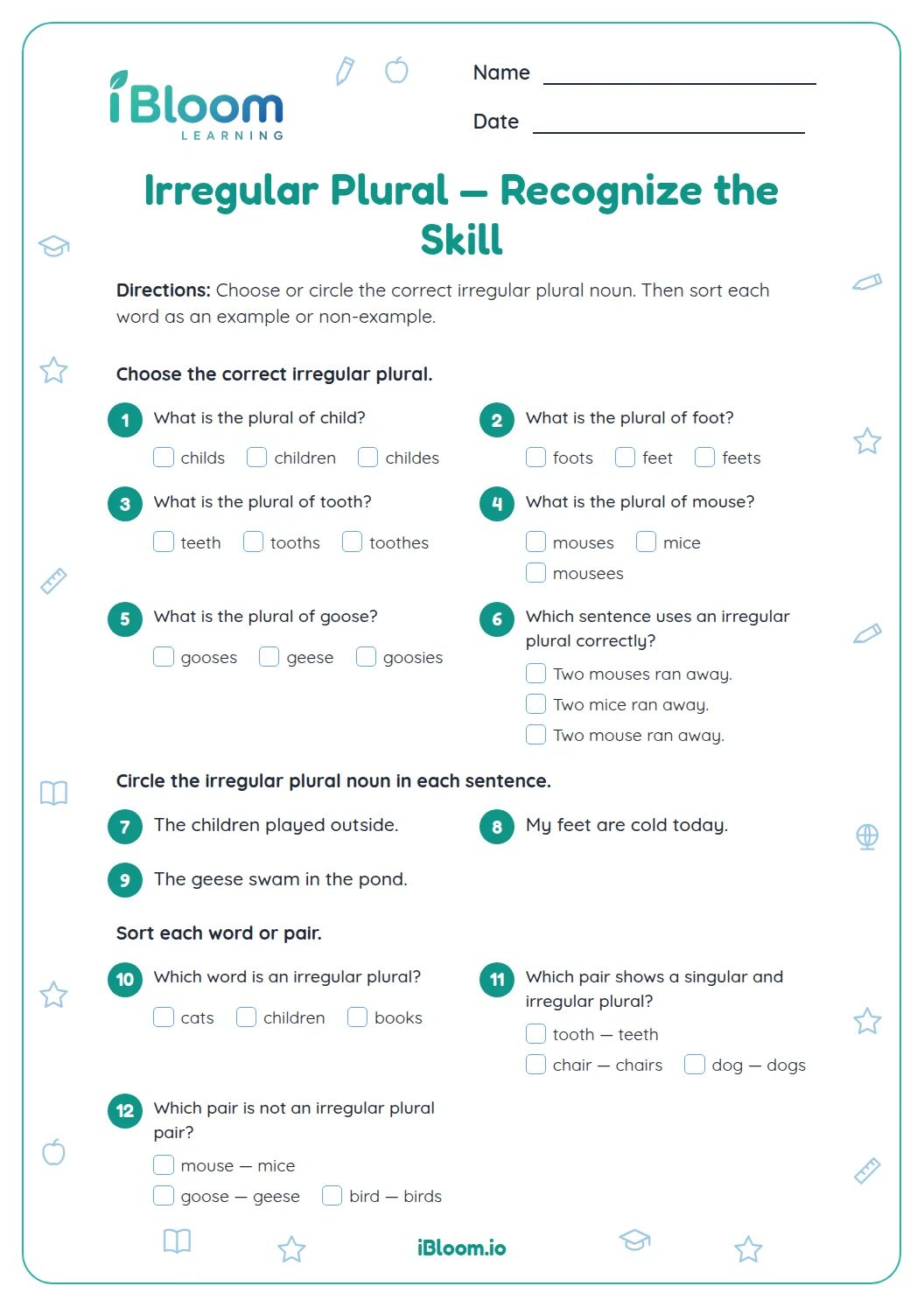
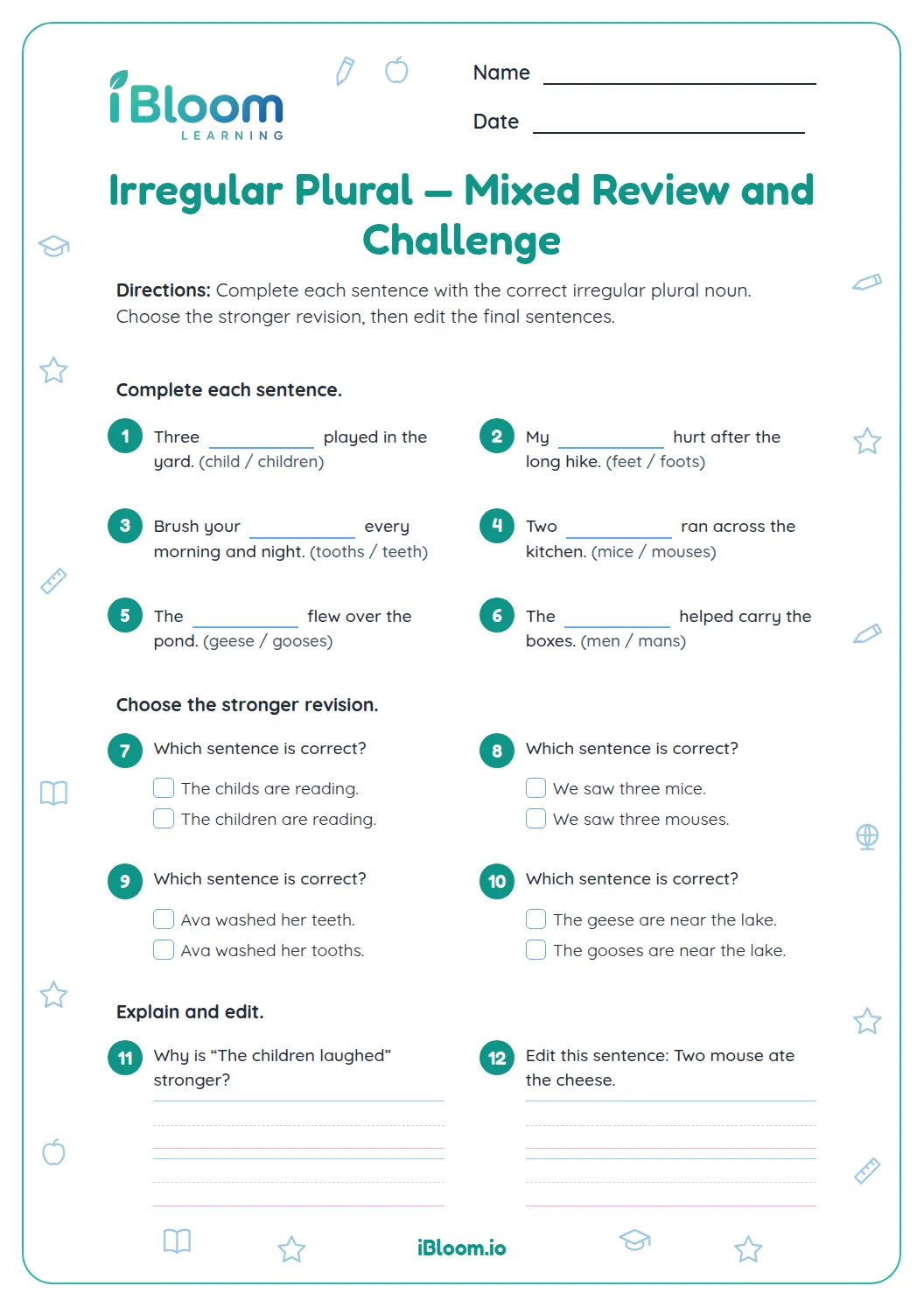
Many nouns add -s or -es, but common irregular nouns change form. Child becomes children, tooth becomes teeth, and mouse becomes mice. These forms must be learned and used as whole words.
- 1One child, two children.
- 2The plural changes form; it is not “childs.”
How do the sentences use irregular plurals?
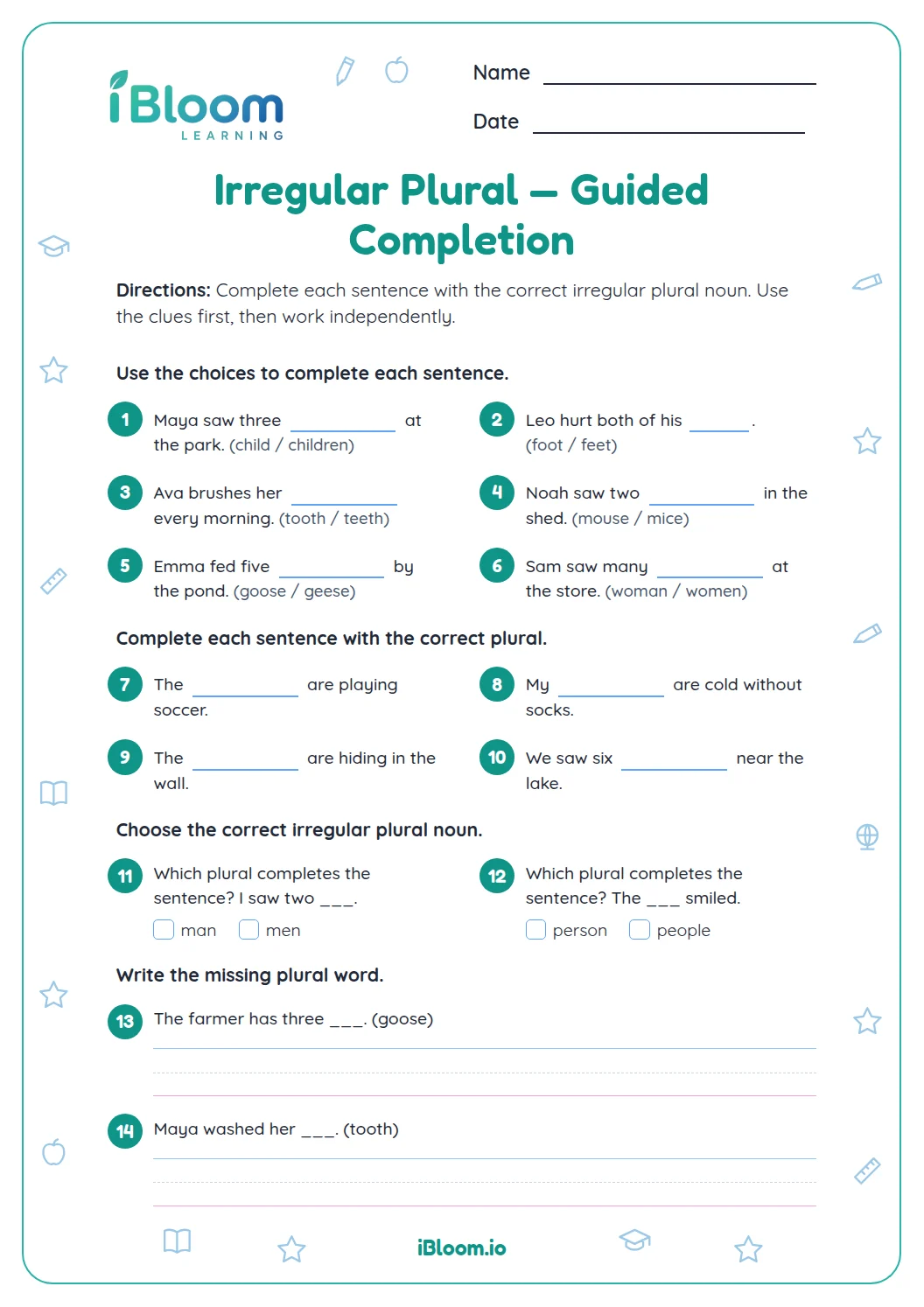
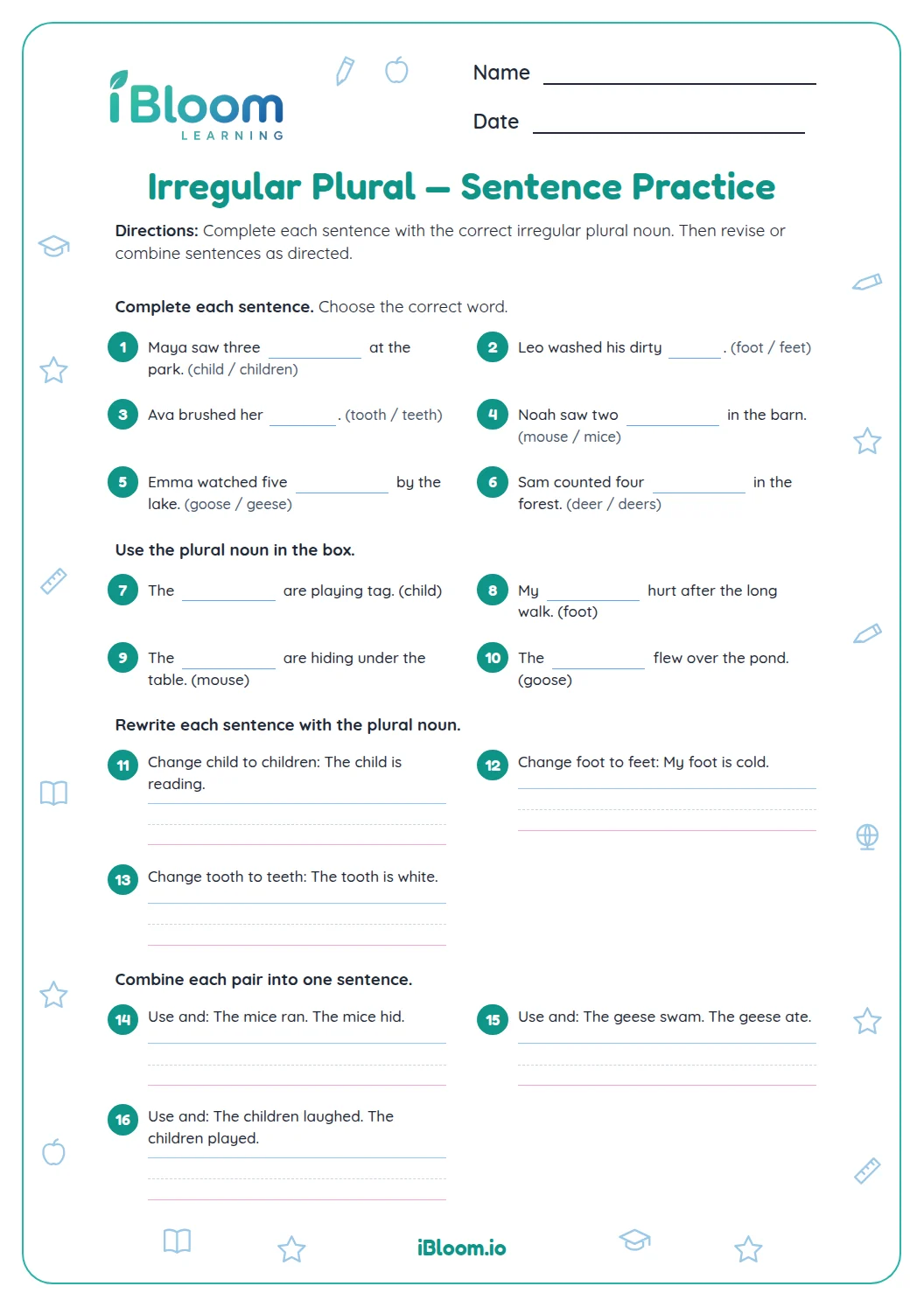
Questions 7–14 place the noun in a sentence, including goose/geese, woman/women, and deer/deer. Reading the full sentence helps students check that the plural fits its meaning.
How can students check the final sentence?
In question 15, change both man and woman to men and women. Reread the sentence to make sure both nouns are plural and the sentence still reads naturally.
How to use this worksheet
- 1Read the noun in its singular form.
- 2Recall the irregular plural rather than adding -s automatically.
- 3Read the whole sentence with the plural inserted.
- 4Check that any verb or other sentence wording still agrees.
- 5Rewrite the final sentence with both nouns plural.
Common mistakes and quick fixes
The mistake
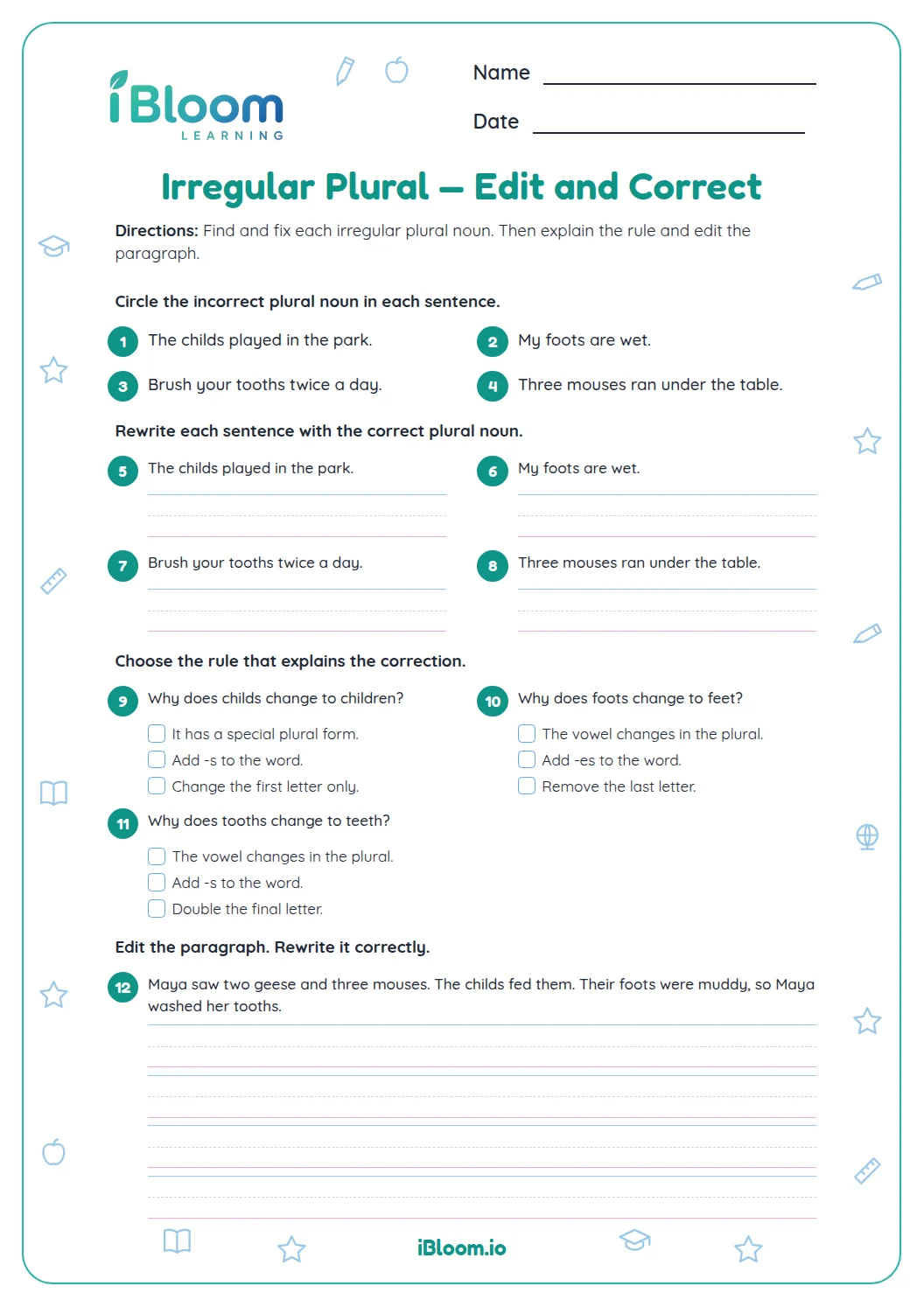
Writing “childs.”
The fix
Use the irregular plural children.
The mistake
Writing “mouses” for more than one mouse.
The fix
Use mice in the sentence.
The mistake
Changing only one noun in the last sentence.
The fix
Change both man and woman to men and women.
Curriculum alignment
Students form and use frequently occurring irregular plural nouns in sentences.
Form and use common irregular plural nouns in sentence contexts.
On this sheet:
Show the official wordingHide the official wording
Form and use frequently occurring irregular plural nouns (e.g., feet, children, teeth, mice, fish).
What to practice next
Further reading
Questions parents and teachers ask
What is an irregular plural noun?
An irregular plural noun does not follow the usual pattern of adding -s or -es. Child becomes children, tooth becomes teeth, and mouse becomes mice. This sheet gives students practice choosing, completing, and using common forms in sentences, where the surrounding words help show whether one or more is meant.
What is the plural of child?
The plural of child is children. For example, “One child played” becomes “Two children played.” Students use children in sentence completion and in their own sentence, so they can see the same form in more than one context. Students see these forms in short, complete sentences.
Does deer change in the plural?
No. Deer can name one or more animals: “one deer” and “three deer.” The worksheet includes this unchanged form alongside words such as geese and mice, which change spelling. Reading the quantity and the whole sentence helps students choose the right form.
How can students remember irregular plurals?
Practice each singular and plural pair aloud, then use the plural in a complete sentence. Grouping familiar pairs such as child/children, foot/feet, and tooth/teeth gives students a way to compare forms. The worksheet revisits common words in short, readable contexts.
What does the final question ask?
The last question asks students to rewrite “A man and a woman waved” with both nouns plural. The nouns change to men and women, while waved stays the same. A sample answer is “Men and women waved.” Students can reread it to confirm both plural forms fit.