
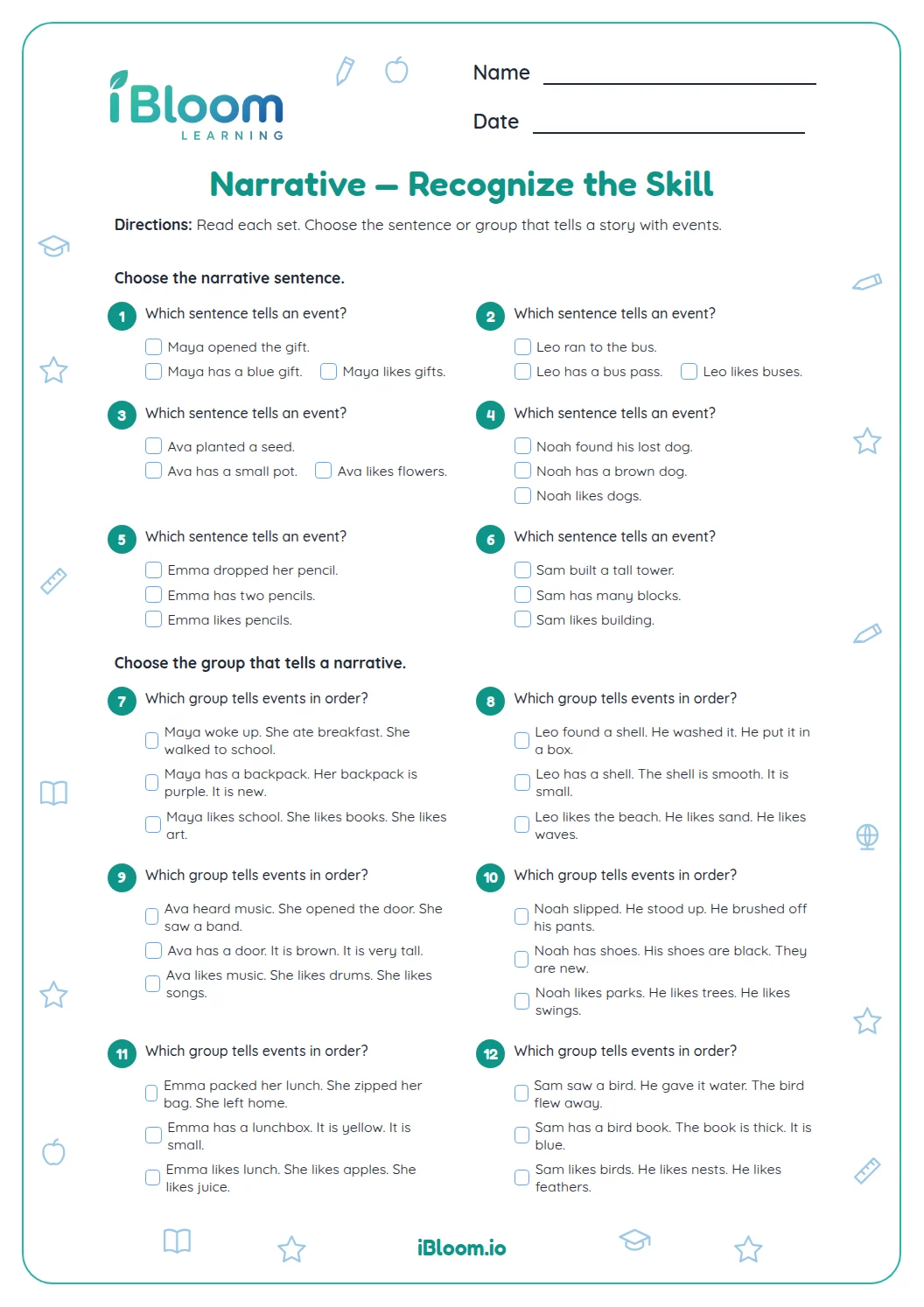
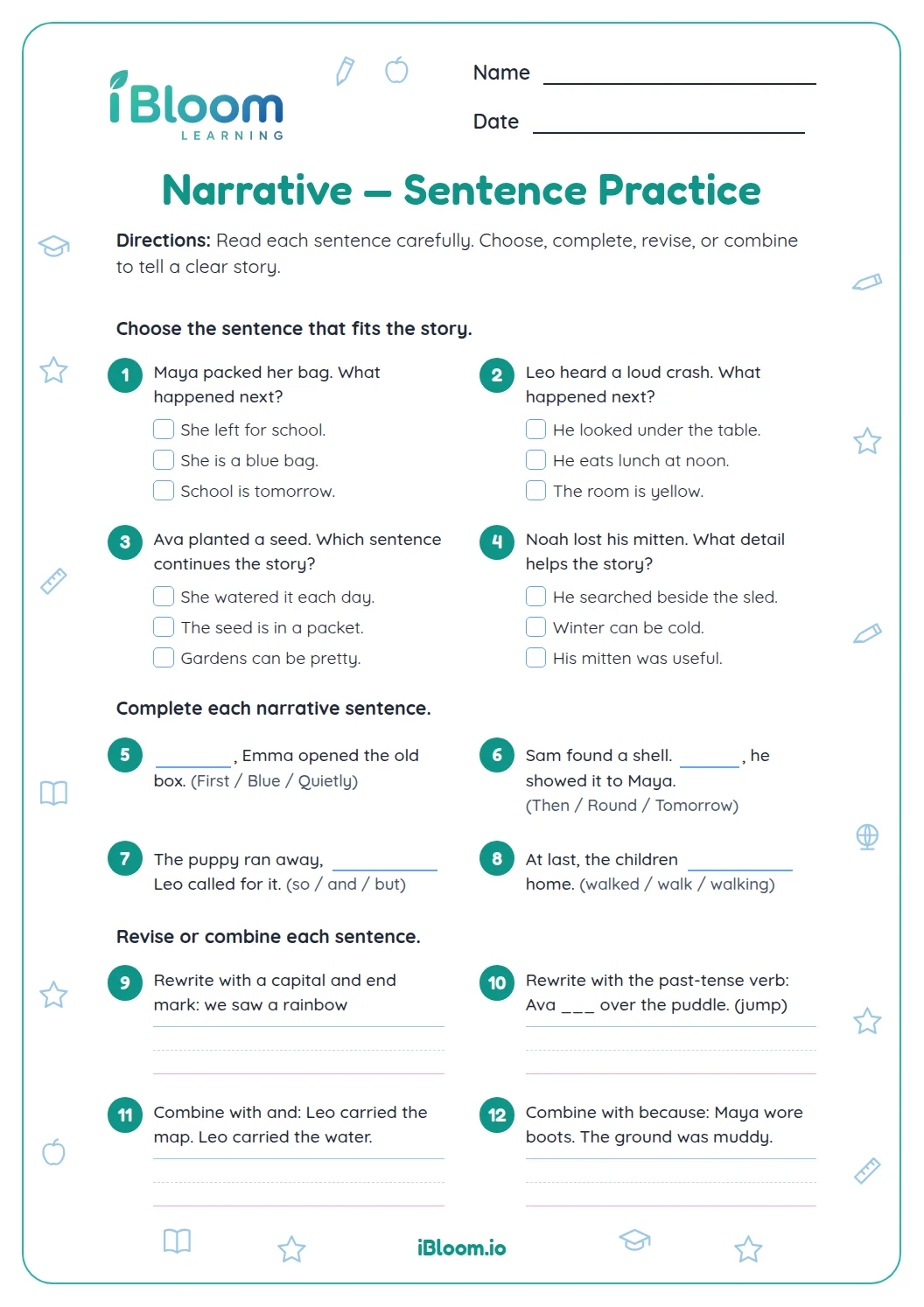

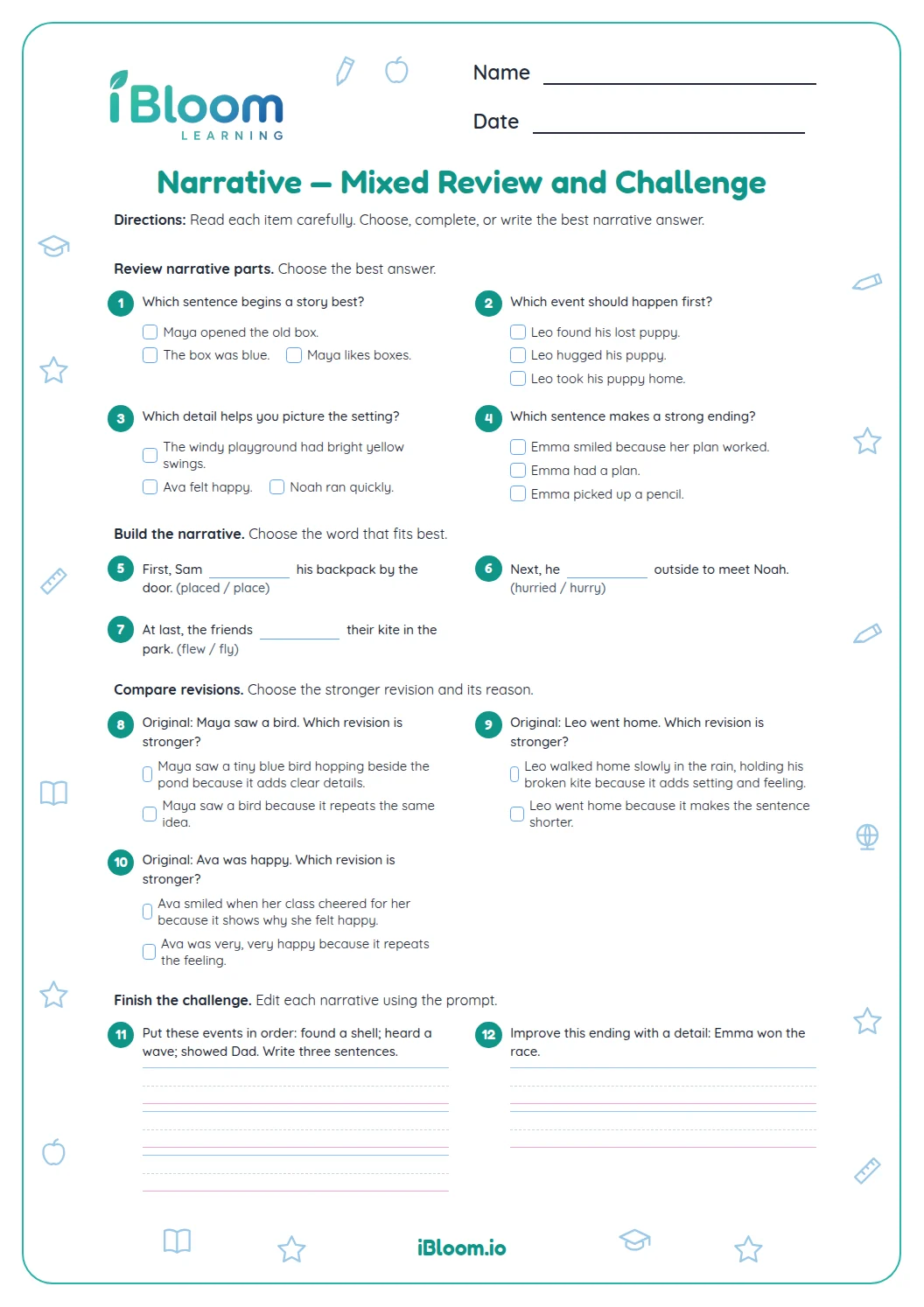
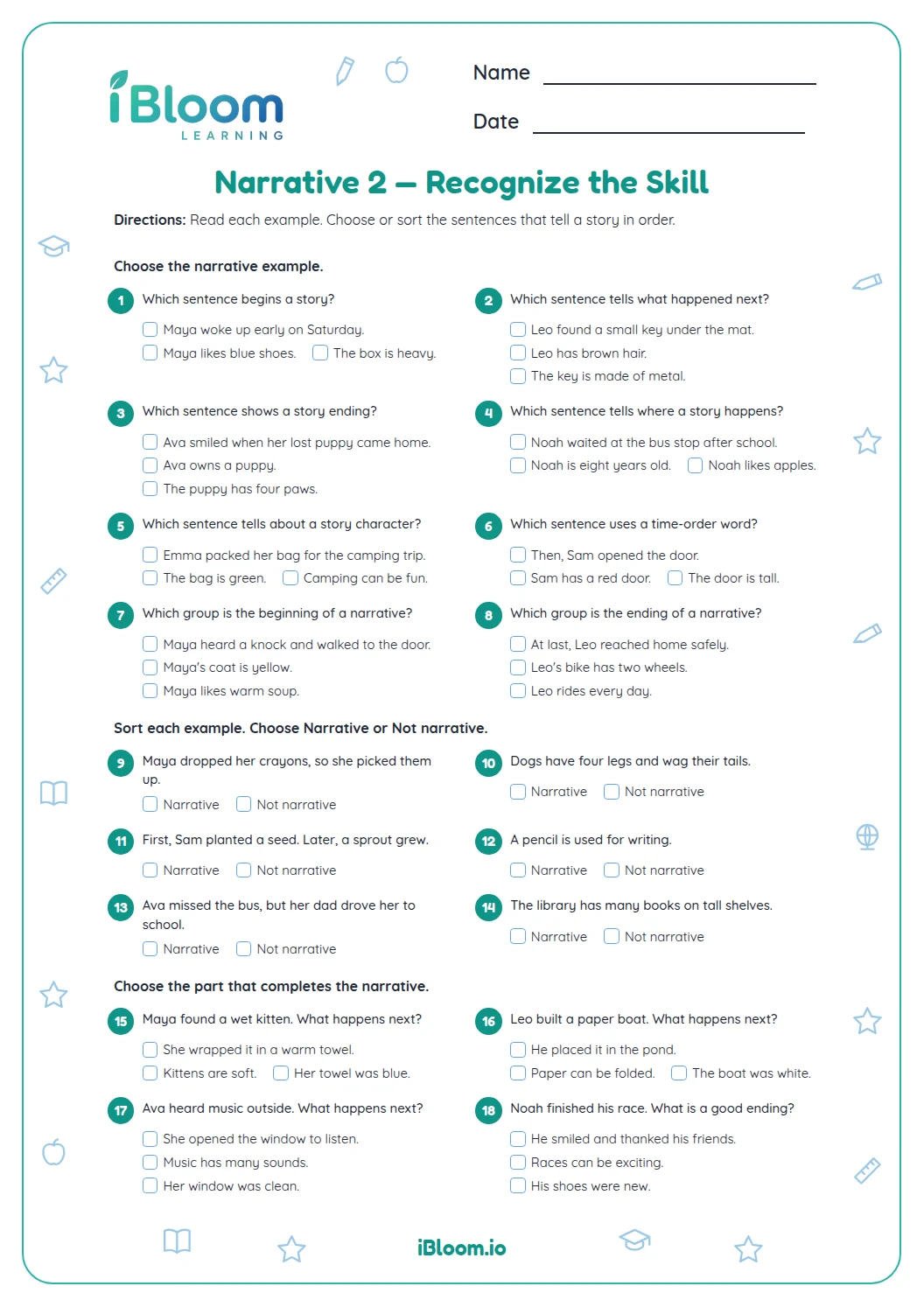


About this worksheet
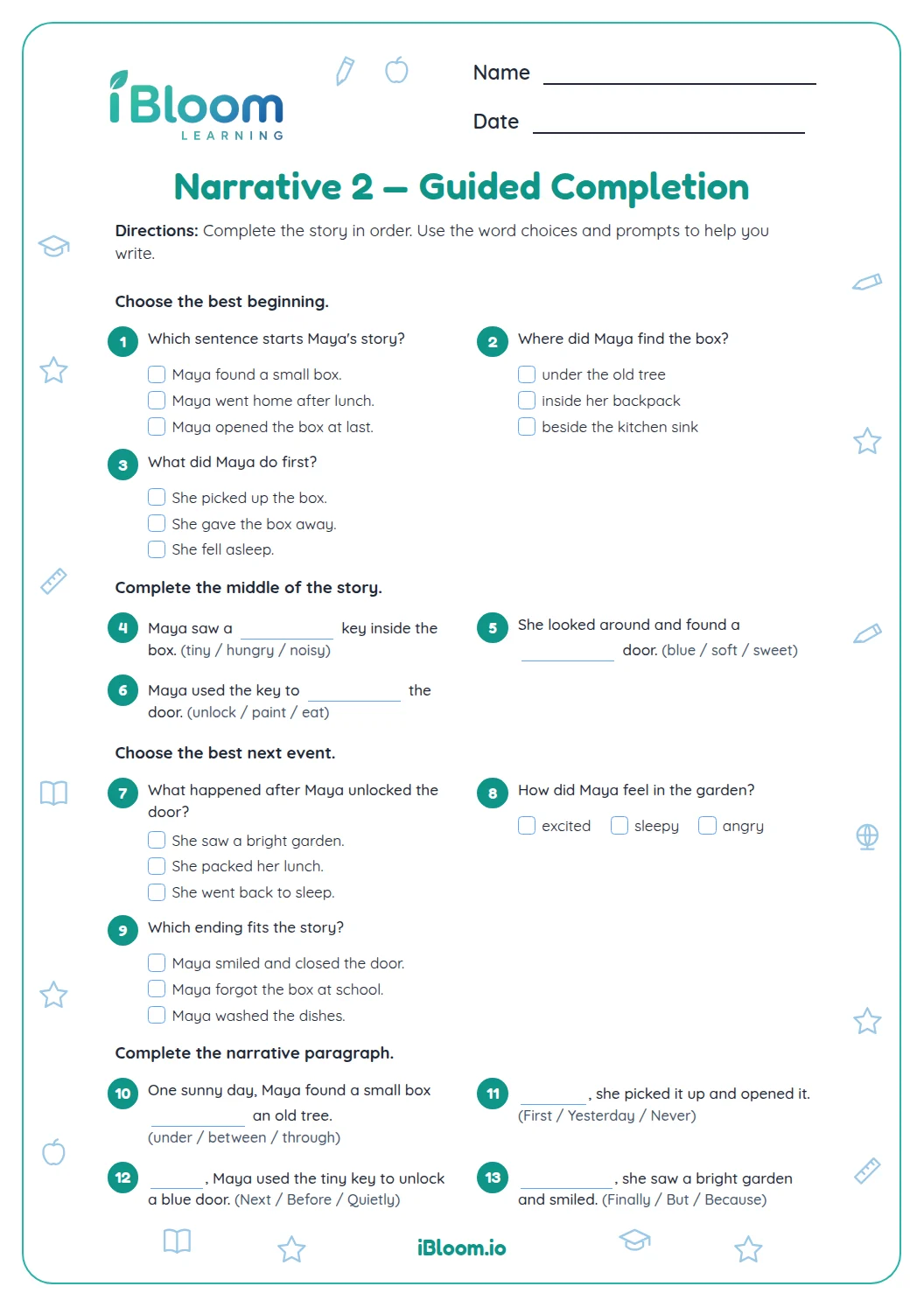
This Grade 2 narrative worksheet uses a short original story about Mia and her kite. Children choose sentences that fit the beginning, middle, feelings, and ending; complete six guided sentences; and add two of their own sentences. The prompts focus on event order, action and feeling details, and a clear close, in line with Common Core W.2.3. The passage and answer key give an adult a shared example for talking through narrative structure.
Aligned to W.2.3
How can you tell what happens first, next, and last?
Look for time words and actions. Mia finds the kite, takes it outside, runs to the field, and watches it rise. Those actions form a sequence.
- 1First, Mia took the kite from the bag.
- 2Next, she ran to the field.
- 3The time word helps signal event order.
Which details help a reader picture the event?
Action words show what a character does; feeling words tell how the character feels. In the passage, the kite rises and Mia feels proud. Those details make the moment easier to imagine.
How can a narrative feel finished?
A closing sentence shows what happens at the end or how the character responds. The final prompts invite a sentence that finishes Mia’s kite adventure.
How to use this worksheet
- 1Read the passage once to follow the whole event.
- 2Choose the sentence that belongs at each story moment.
- 3Fill each blank with a word that makes a complete sentence.
- 4Write an action Mia could do after the kite rises.
- 5Finish with a closing sentence that signals the story is done.
Common mistakes and quick fixes
The mistake
Putting the ending before the kite rises.
The fix
Retell the events with first, next, and at the end.
The mistake
Writing a feeling as an action.
The fix
Use an action verb for what Mia does and a feeling word for how she feels.
The mistake
Ending with a new event that does not finish the story.
The fix
Choose a final sentence that shows Mia is done for the day.
Common Core alignment
This page practices the parts of a short narrative with an event sequence and closure.
Recount events in order, add details, and give a narrative a sense of closure.
On this sheet: Children order events, supply missing narrative words, add an action sentence, and write a closing sentence.
Show the official wordingHide the official wording
Write narratives in which they recount a well-elaborated event or short sequence of events, include details to describe actions, thoughts, and feelings, use temporal words to signal event order, and provide a sense of closure.
What to practice next
Further reading
Questions parents and teachers ask
What is guided completion in narrative writing?
Guided completion gives children a story context and prompts to finish sentences or add details. Here, they follow Mia’s kite story, complete missing words, and write an action sentence and a closing sentence of their own. An adult can reread the passage with the child to check the detail.
What narrative skills does the worksheet practice?
Children identify the beginning, sequence actions, notice a feeling, and supply words that make the story clear. The last two questions ask them to add an event detail and a closing sentence. An adult can reread the passage with the child to check the detail.
Can answers vary on the last two questions?
Yes. The key gives sample sentences for the two open responses. Another complete sentence is appropriate when it fits the events in Mia’s story and helps the narrative continue or end. An adult can reread the passage with the child to check the detail.
Is there an original story passage?
Yes. The passage follows Mia as she finds a kite, takes it to a field, watches it rise, and carries it home when the sky turns gray. The questions use those same events and details. An adult can reread the passage with the child to check the detail.
How many questions and pages are included?
There are 14 questions in the worksheet, followed by a separate answer key. The passage makes this a three-page printable set, and the key includes sample responses for the open-ended writing. An adult can reread the passage with the child to check the detail.