



About this worksheet
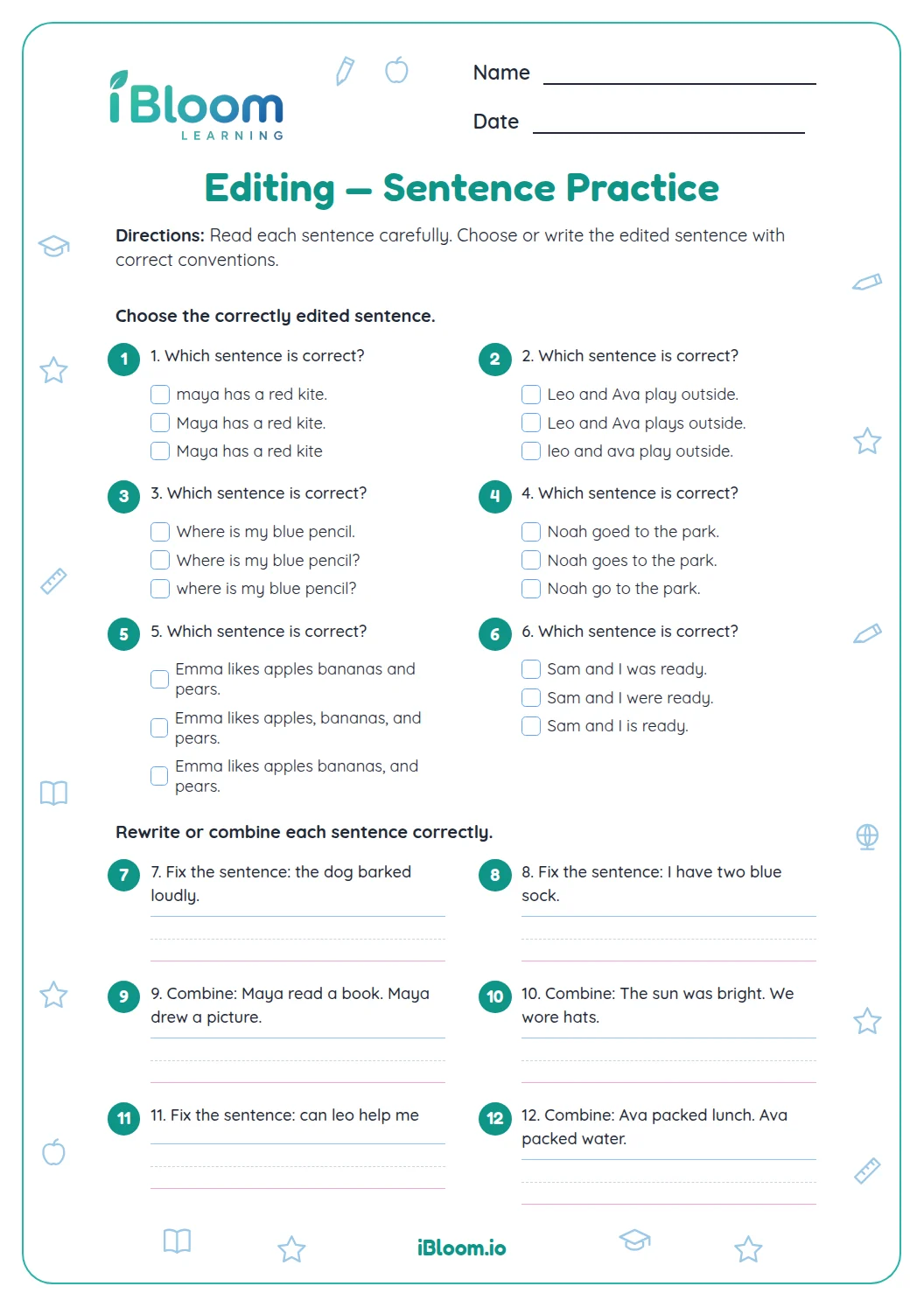
This Grade 2 worksheet uses short narrative sentences to practice editing. Students first identify a complete sentence or choose a correction, then add missing capitals or end marks. The 15 questions appear in two parts, with a separate answer key to check the expected edits.
Aligned to L.2.2
What does this editing worksheet cover?
Part A asks students to choose a complete sentence or an editing correction. Part B has ten blanks for missing capital letters or end marks in narrative sentences and dialogue.
- Part A: choose a complete sentence or needed edit (5 questions)
- Part B: add a capital letter or end mark (10 questions)
How can a child check a sentence?
Read the words aloud and ask whether they tell a complete thought. Then check the first letter and the ending mark. If the sentence asks something, use a question mark; if it tells something, use a period. Dialogue punctuation belongs inside the quotation marks.
- 1Can you help me___
- 2The sentence asks a question, so add a question mark.
How can this practice support narrative writing?
A story is easier to follow when each sentence is complete and its punctuation helps the reader hear the words. After checking the worksheet, ask the child to reread one paragraph from a story they wrote and look for the same clues.
How to use this worksheet
- 1Read the directions for the part before starting it.
- 2Work through the questions in order and say what clue helped you decide.
- 3Use the separate answer key to check each response.
- 4For any missed question, explain the corrected answer in your own words.
Common mix-ups
The mistake
Forgetting to capitalize the first word.
The fix
Check the very first letter after the sentence begins; names such as Grandma also need capitals.
The mistake
Using a period after a question.
The fix
Ask whether the sentence is asking for information. If it is, end it with a question mark.
The mistake
Fixing one error but missing another.
The fix
Read the whole corrected sentence again and check its beginning and ending.
Curriculum alignment
This worksheet practices the skill named in the standard below. State and district pacing can vary.
Demonstrate command of capitalization, punctuation, and spelling when writing.
On this sheet: Students edit narrative sentences by applying capitalization and punctuation conventions.
Show the official wordingHide the official wording
Demonstrate command of the conventions of standard English capitalization, punctuation, and spelling when writing.
What to practice next
Make more practice
Further reading
Questions parents and teachers ask
How many questions are on the worksheet?
There are 15 questions in two parts on two practice pages. Part A has five sentence and editing choices, and Part B has ten blanks for capitals or end marks. A separate answer key follows the worksheet so you can review the corrections together.
What editing skills does it cover?
Students identify complete sentences and practice capitals and end punctuation in short narrative examples. The prompts include names, statements, questions, and dialogue. Each item asks for one choice or one missing word or mark, so families can review a single editing decision at a time.
How should my child check a sentence?
Read it once for a complete thought, then check the first word and the ending mark. For a question, use a question mark. In the dialogue item, put the question or exclamation mark inside the quotation marks before rereading the whole line.
Can a child complete it independently?
A child can try each part independently after an adult reads the directions. The short prompts make it possible to check one editing clue at a time. If an answer is missed, ask the child to reread the sentence and point to the clue that shows the needed edit.
When should we use the answer key?
Use the separate key after a part or after all 15 questions. Compare the selected edit or missing mark with the key, then reread the corrected sentence aloud. The goal is to notice how the correction makes the narrative sentence clear and complete.