






About this worksheet
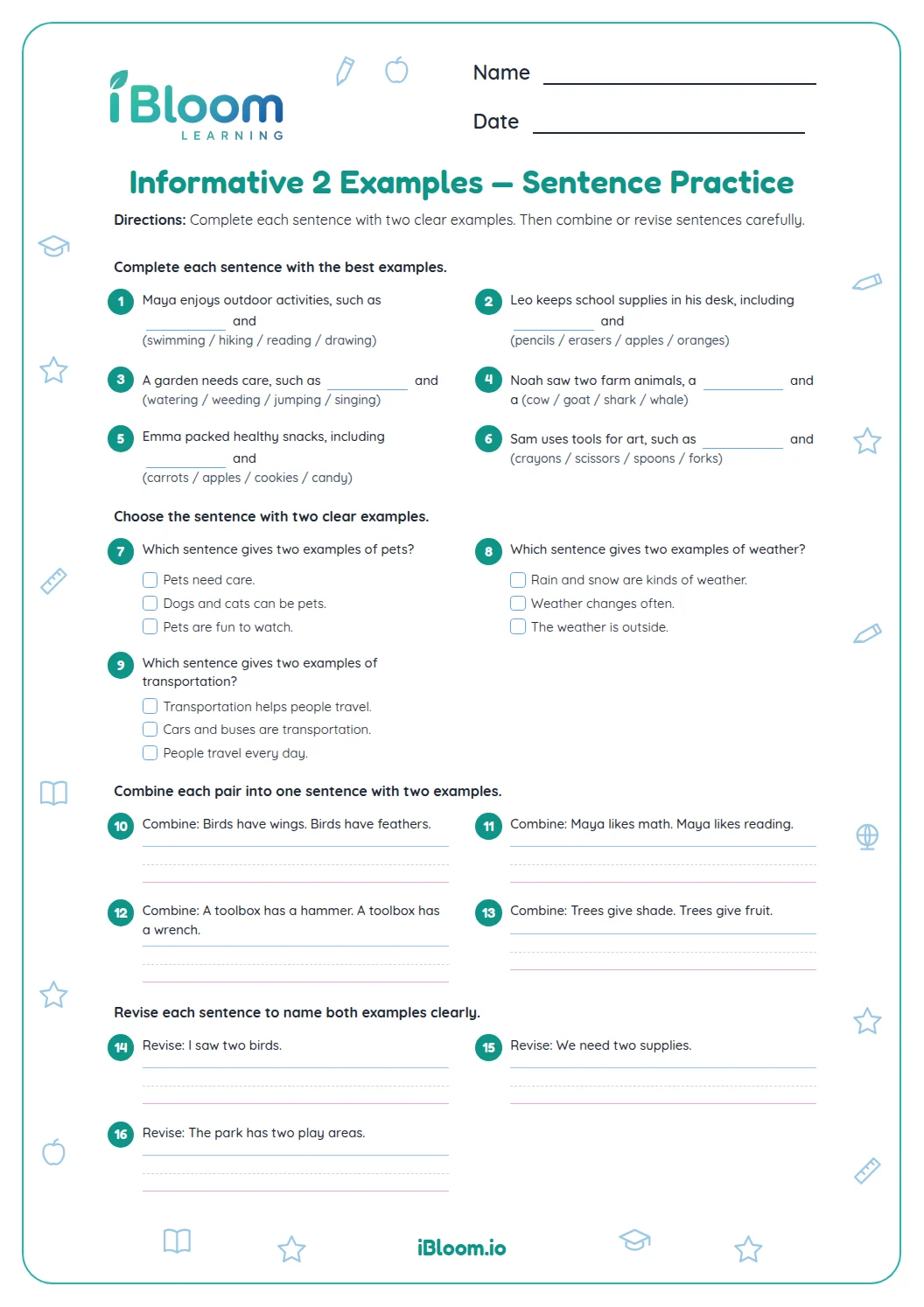
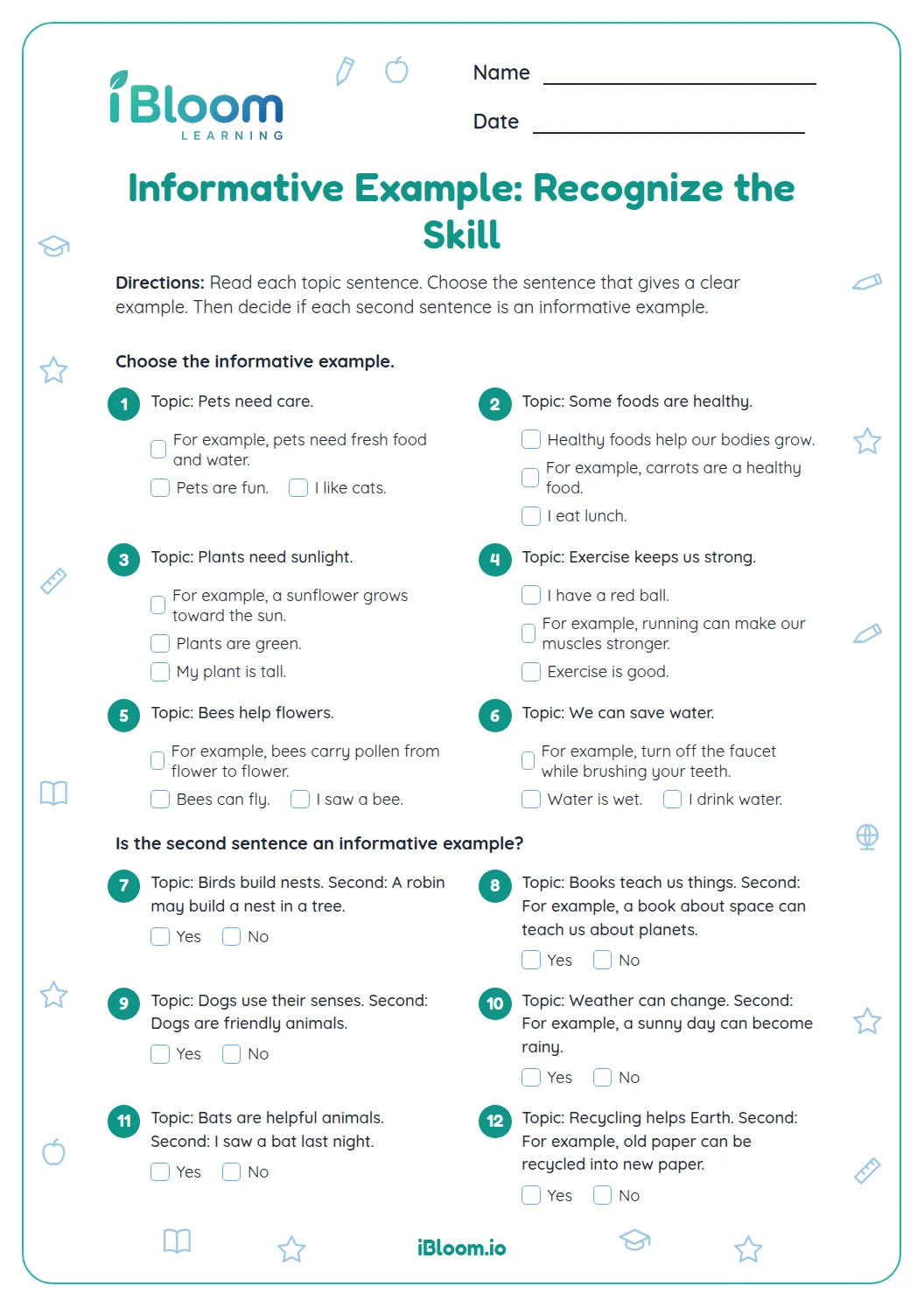
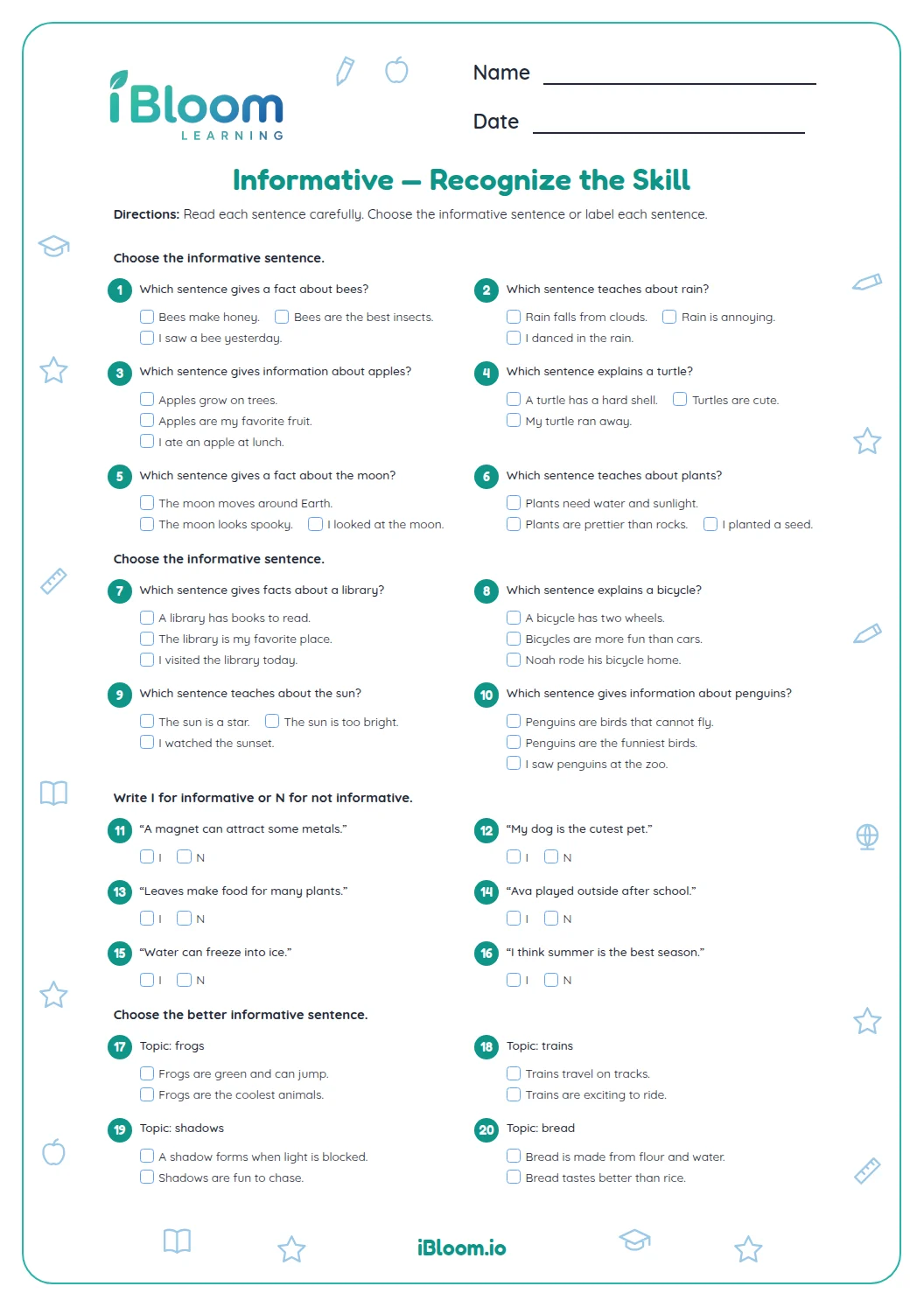
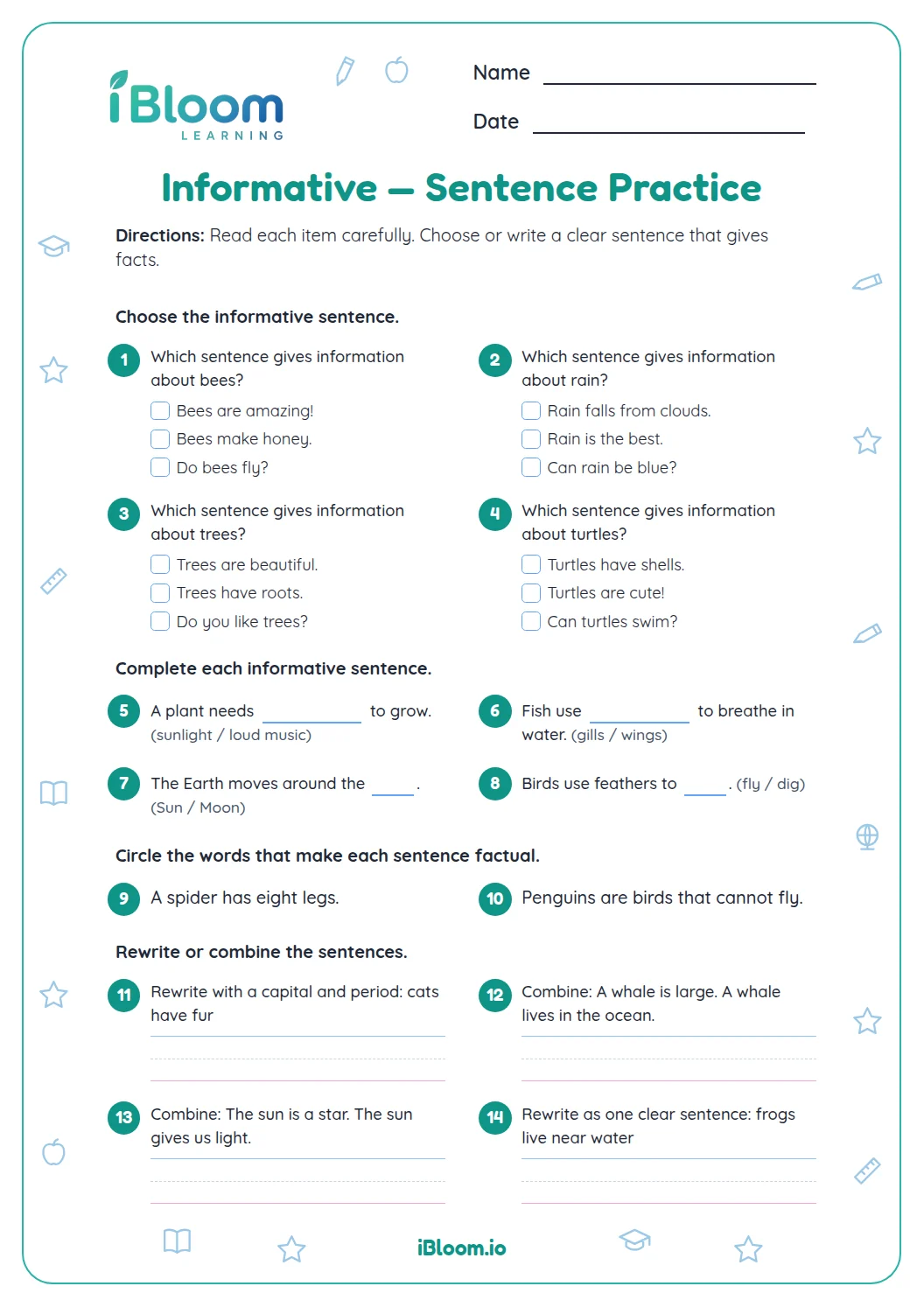
This free Grade 2 worksheet uses two short informative paragraphs to show how a topic can be supported by two examples. Children answer 10 multiple-choice questions about what each model explains, the jobs its sentences do, and which new examples belong. The paper model explains ways to reuse paper; the classroom model explains ways to care for a room. Identifying each model’s purpose practices CCSS RI.2.6. A separate answer key covers all 10 choices.
Aligned to RI.2.6
What do the two model paragraphs show?
Each model has four sentences: a topic sentence, two examples, and a closing sentence. Reusing Paper explains two uses for old paper. Classroom Jobs explains two ways students help care for their room.
The models appear in Part A. Part B asks what they explain, Part C names sentence jobs, and Part D asks which pairs of examples fit or do not fit a topic.
How do two examples support a topic?
An example gives a specific way the general topic works. Writing on the blank backs of used sheets explains one way to reuse paper. Rolling old paper into beads explains another. Each example gives the reader different information about the same topic.
- 1Topic: We can reuse paper in different ways.
- 2Example 1: Write lists on the blank backs of used sheets.
- 3Example 2: Roll strips of old paper into beads.
- 4Closing: These ideas give used paper another job.
How is the closing different from another example?
A closing brings the paragraph back to its main idea. “These ideas give used paper another job” points back to both examples without adding a third craft. Children can look at what a sentence does, as well as where it appears.
After checking the choices, ask your child to say a new four-sentence paragraph about classroom jobs. Use the two new jobs in question 8 and finish with a sentence that connects them.
How to use this worksheet
- 1Read Reusing Paper aloud and identify its topic.
- 2Point to its two examples and explain how each fits.
- 3Read Classroom Jobs and let the child find its ending.
- 4Complete Parts B and C, returning to the models as needed.
- 5For Part D, notice whether the question asks for a pair that fits or does NOT fit.
Mistakes to check together
The mistake
Calling the paper necklace the topic of the whole paragraph.
The fix
Ask which idea includes both list writing and bead making: reusing paper.
The mistake
Treating the closing as a third example.
The fix
Look for a specific new action; the closing sums up the two actions already given.
The mistake
Choosing a pair because only one example fits.
The fix
Read both halves of each pair and connect each to the topic.
Common Core alignment
Identify what each informative paragraph aims to explain.
On this sheet: Questions 1 and 2 ask what the paper-reuse and classroom-care models explain.
Show the official wordingHide the official wording
Identify the main purpose of a text, including what the author wants to answer, explain, or describe.
What to practice next
Make more practice
Further reading
Questions parents and teachers ask
Why are there two examples in each paragraph?
Two examples show two specific ways the topic works. In Reusing Paper, a used sheet can become a place for lists or material for beads. Ask your child to explain both connections. This makes the paragraph’s organization visible before the child tries arranging examples in their own writing.
Does my child need to write a whole paragraph?
The printed tasks ask children to choose answers about the model paragraphs. They identify topics, examples, and endings, then select new example pairs. Afterward, you can invite your child to say or write a paragraph using the classroom jobs from question 8 as two supporting examples.
Can I read the models aloud?
Yes, you can read both models aloud while your child follows the sentences. Pause after each paragraph and ask what it teaches. Then reread a sentence when a question names it. This keeps the activity centered on paragraph structure while providing help with any unfamiliar words.
How can we tell a topic from an example?
The topic names the broad idea, while an example gives one specific way it works. Caring for a classroom includes many possible jobs; putting books on a shelf is one job. Have your child use that broad-to-specific relationship when deciding how to label the sentences in Part C.
What should we check in the last four questions?
Read whether each question asks for examples that fit or do not fit the topic. Questions 7 and 8 ask for fitting pairs; questions 9 and 10 ask for unrelated pairs. Check both examples in each choice, then explain how they connect to the named topic.