
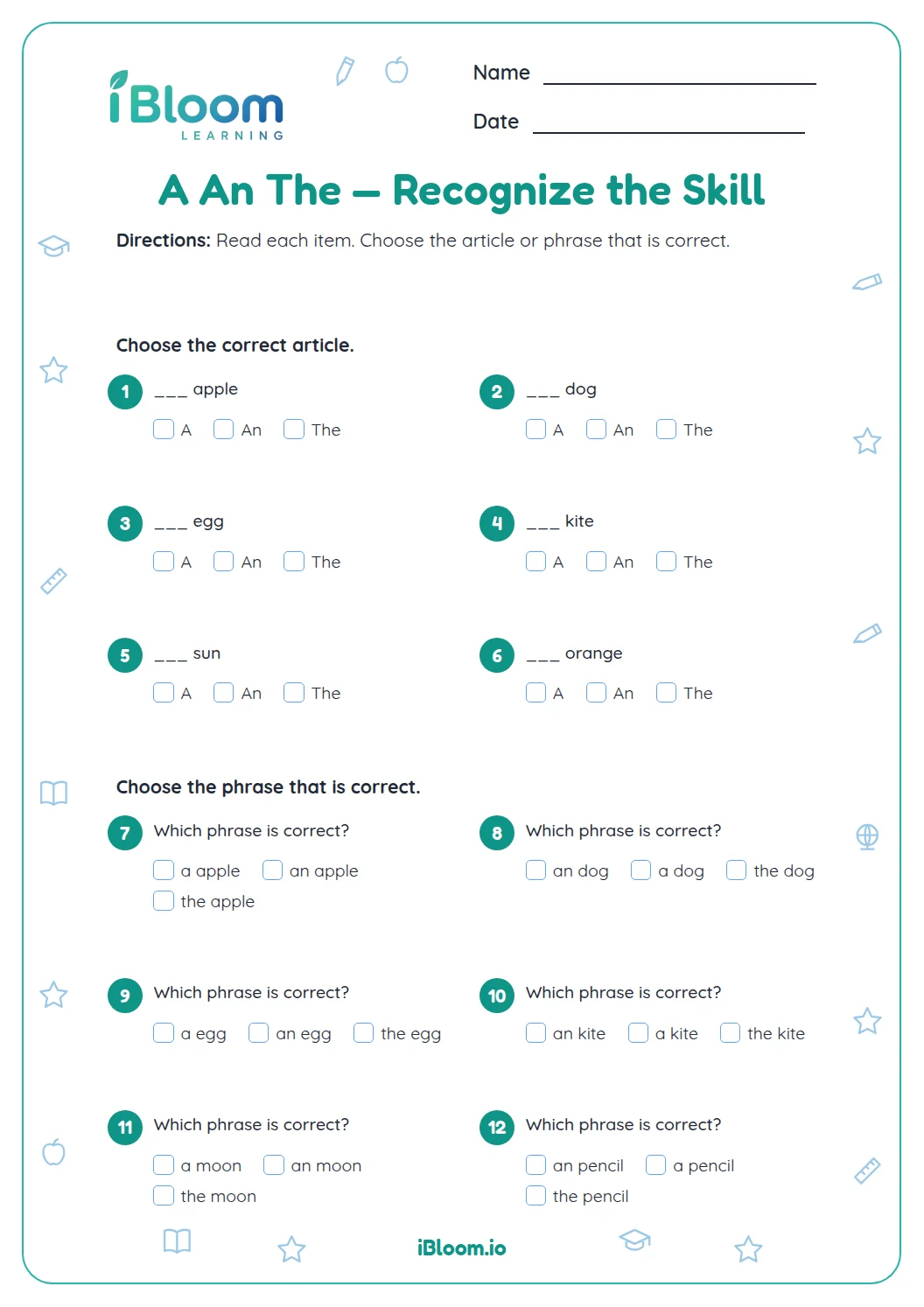
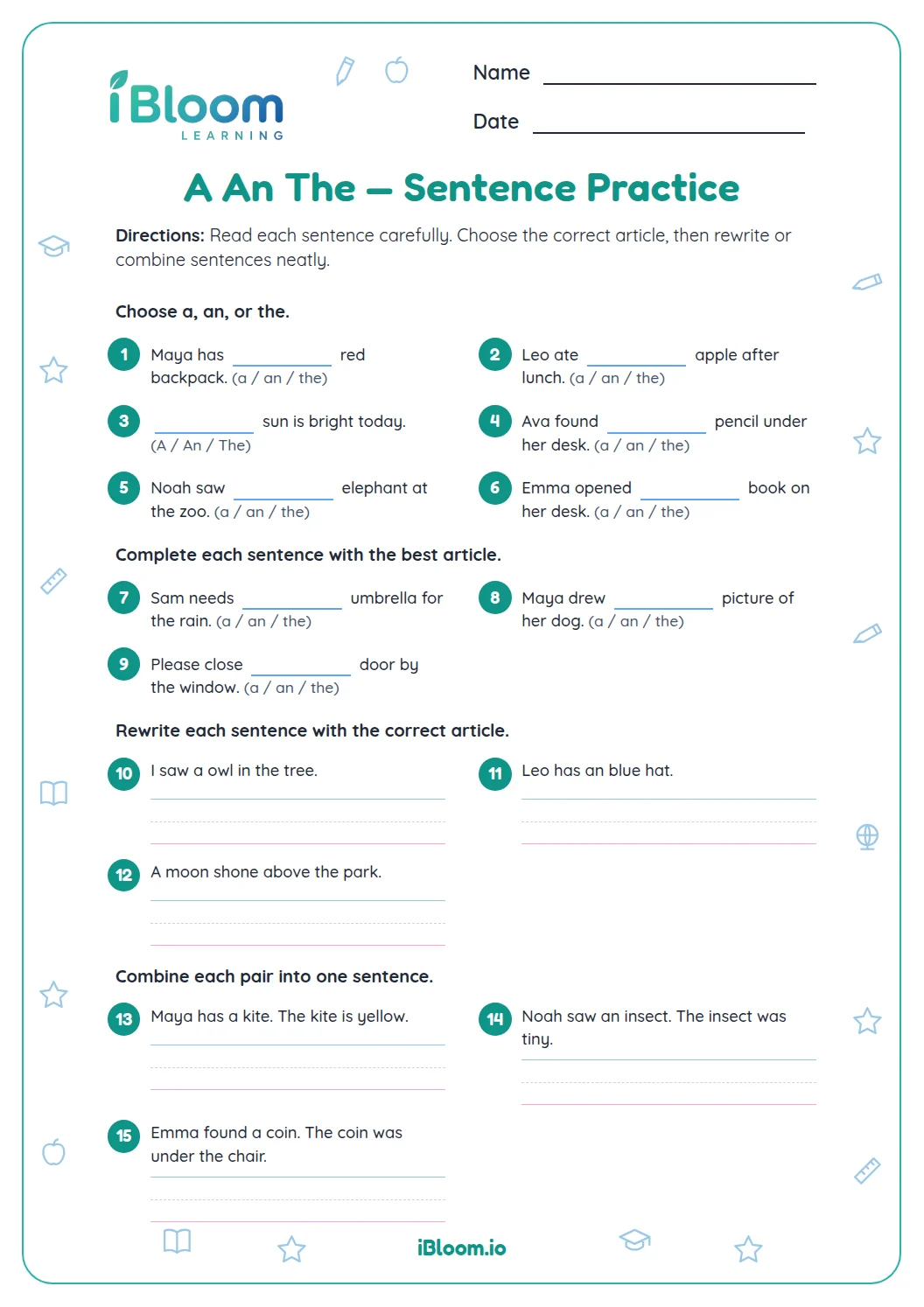
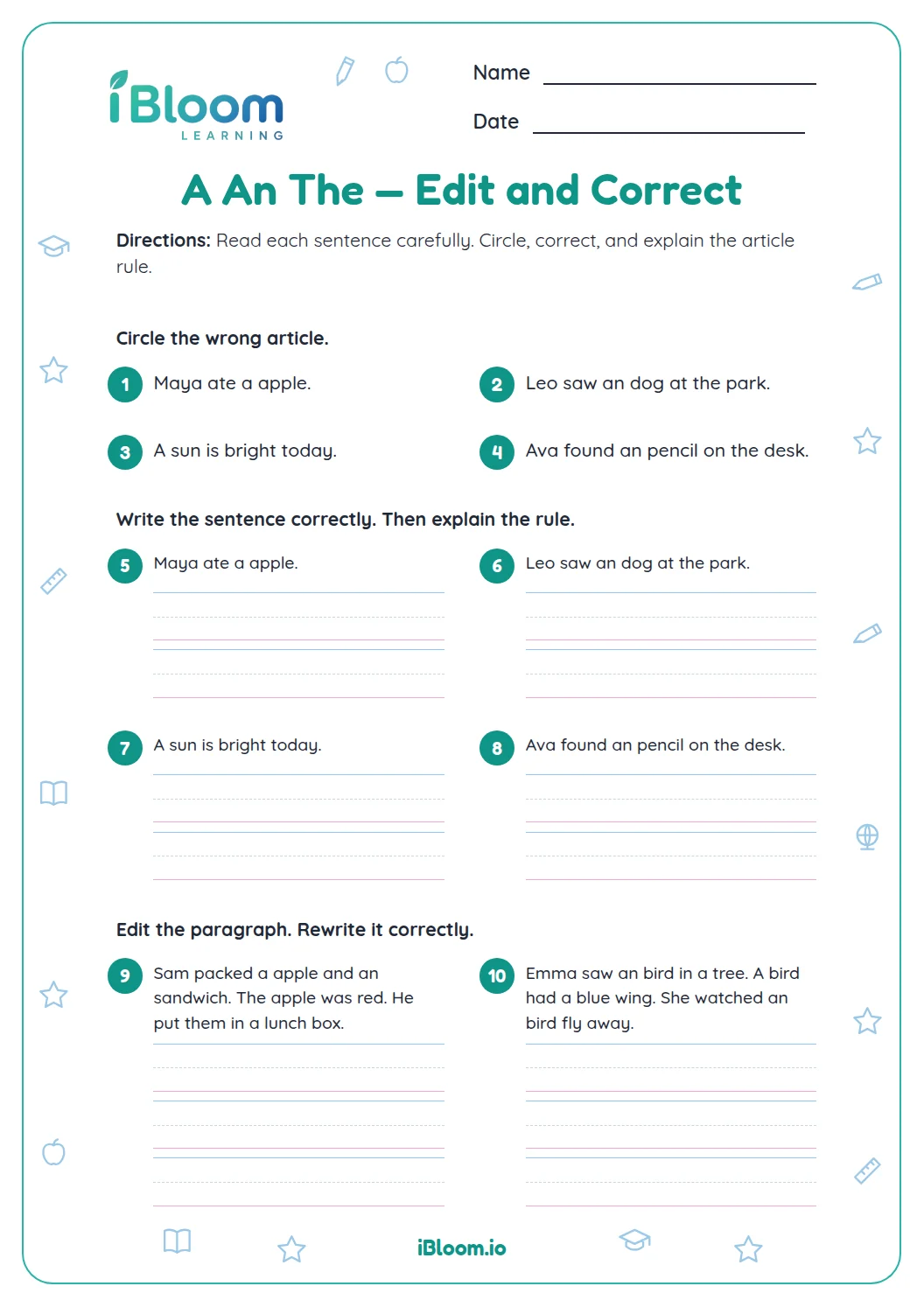
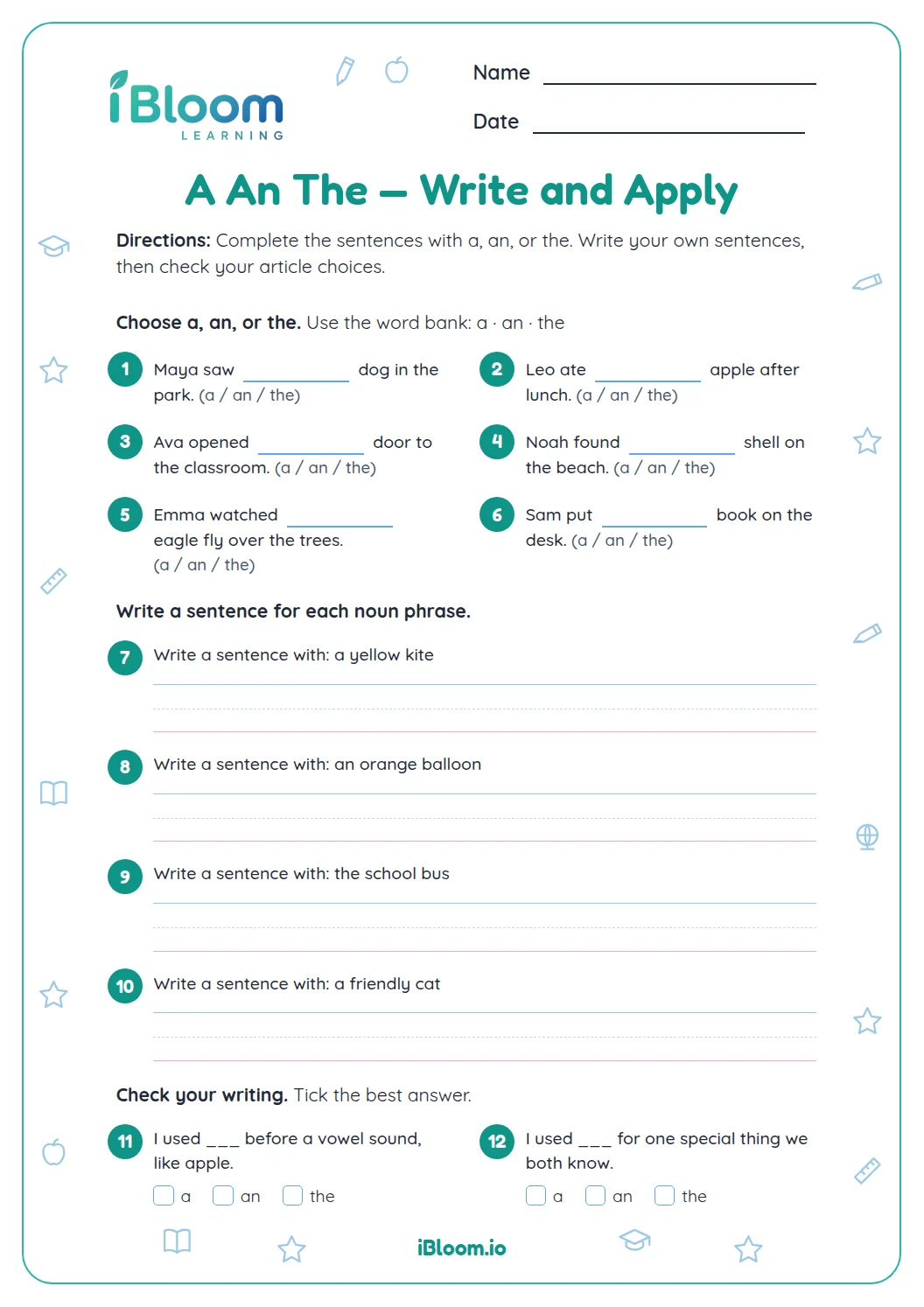
About this worksheet
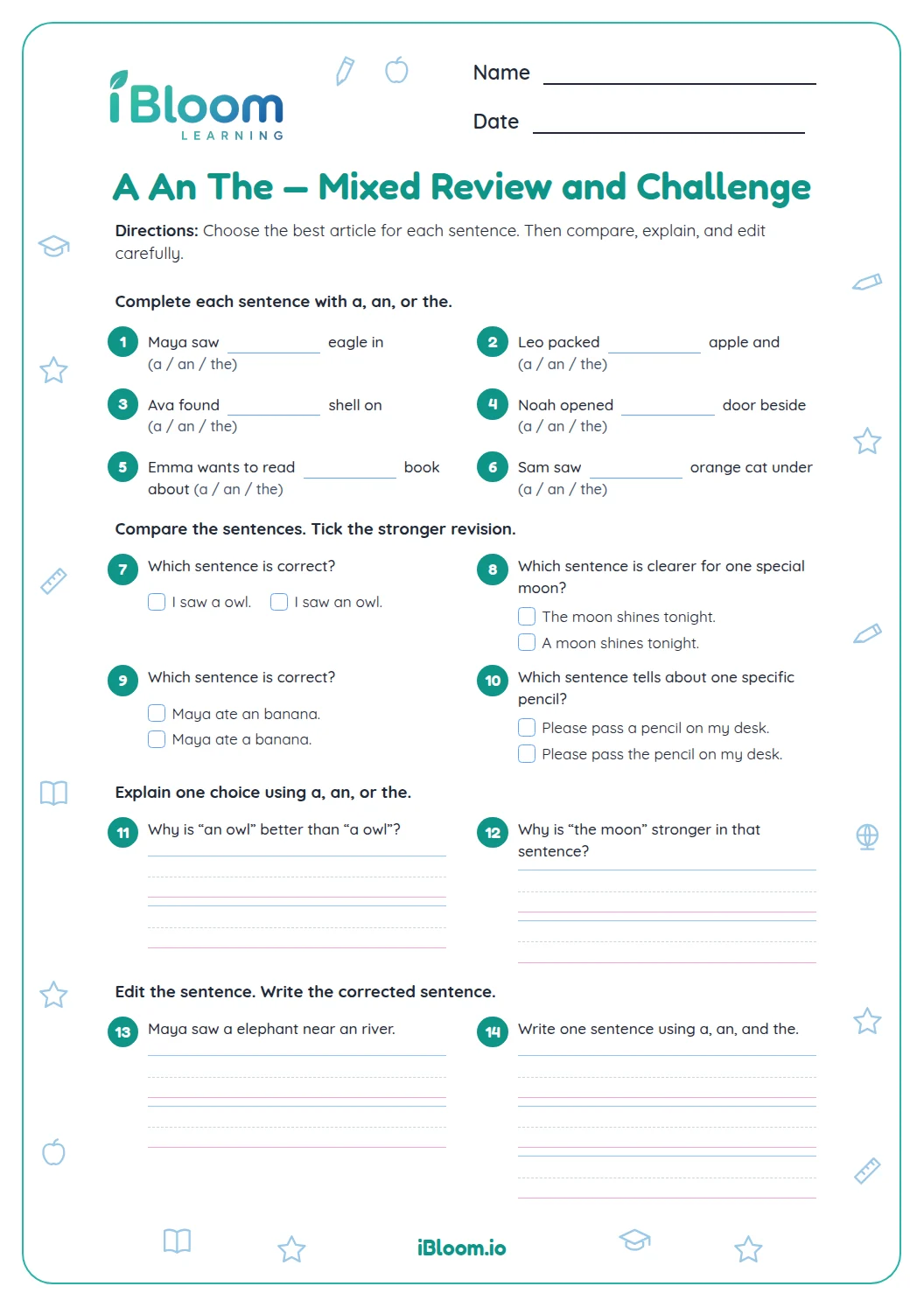
This free Grade 2 worksheet gives 16 guided completions with a, an and the. Students begin with familiar nouns, listen for the first sound when choosing between a and an, and use sentence context to select the for a particular noun. The key lists the intended article for each sentence. The page practices CCSS L.1.1.h.
Aligned to L.1.1.h
How do a, an and the work?
Articles come before nouns. Choose a or an by the first sound of the next word: a red ball, an apple. Use the when the sentence points to a particular noun, such as the ball Maya already received.
How can you choose between a and an?
Listen to the first sound, not just the first letter. “An owl” begins with a vowel sound, while “a shiny shell” begins with a consonant sound. The worksheet uses familiar words so students can read each phrase aloud.
When does a sentence need the?
Use the when the reader can identify the particular thing. In “Emma found a shell. She put the shell in her bucket,” the second sentence refers to the shell already introduced.
How does context guide the choice?
Question 11 first introduces “a shiny shell.” The next sentence refers to that same shell, so the blank takes the: “She put the shell in her bucket.”
Complete the sentences
- 1Read the full sentence before choosing.
- 2For a or an, listen to the first sound in the next word.
- 3For the, check whether the sentence points to a particular noun.
- 4Read the completed sentence aloud.
- 5Use the answer key to check the intended article.
Common Core alignment
This page practices choosing articles before nouns in complete sentences.
Use determiners, including articles.
On this sheet: Students choose a, an and the before nouns, using sound and sentence meaning.
Show the official wordingHide the official wording
Use determiners (e.g., articles, demonstratives).
What to practice next
Further reading
Questions parents and teachers ask
How do I choose between a and an?
Listen to the first sound of the next word. Use an before a vowel sound, as in an apple, and a before a consonant sound, as in a red ball. For example, point to a sentence and explain how its noun clues the article choice.
When should I use the?
Use the when a reader can identify a particular person, place or thing. After introducing a shell, a sentence can refer to the same object as the shell. Context makes the intended choice clear. For example, point to a sentence and explain how its noun clues the article choice.
Why does the worksheet include repeated nouns?
A sentence may first introduce a noun with a or an, then refer to that same noun with the. The shell sentences let students use that context to choose the article. For example, point to a sentence and explain how its noun clues the article choice.
What should a student do if more than one article sounds possible?
Read the surrounding words and look for context. This worksheet gives a specific clue before each intended the choice, such as a noun introduced in the previous sentence. For example, point to a sentence and explain how its noun clues the article choice.
How long does this worksheet take?
About 15 minutes is a useful estimate for 16 sentence completions. Students can spend extra time reading each finished sentence aloud and explaining the article choice with the clue in the sentence. For example, point to a sentence and explain how its noun clues the article choice.