
About this worksheet
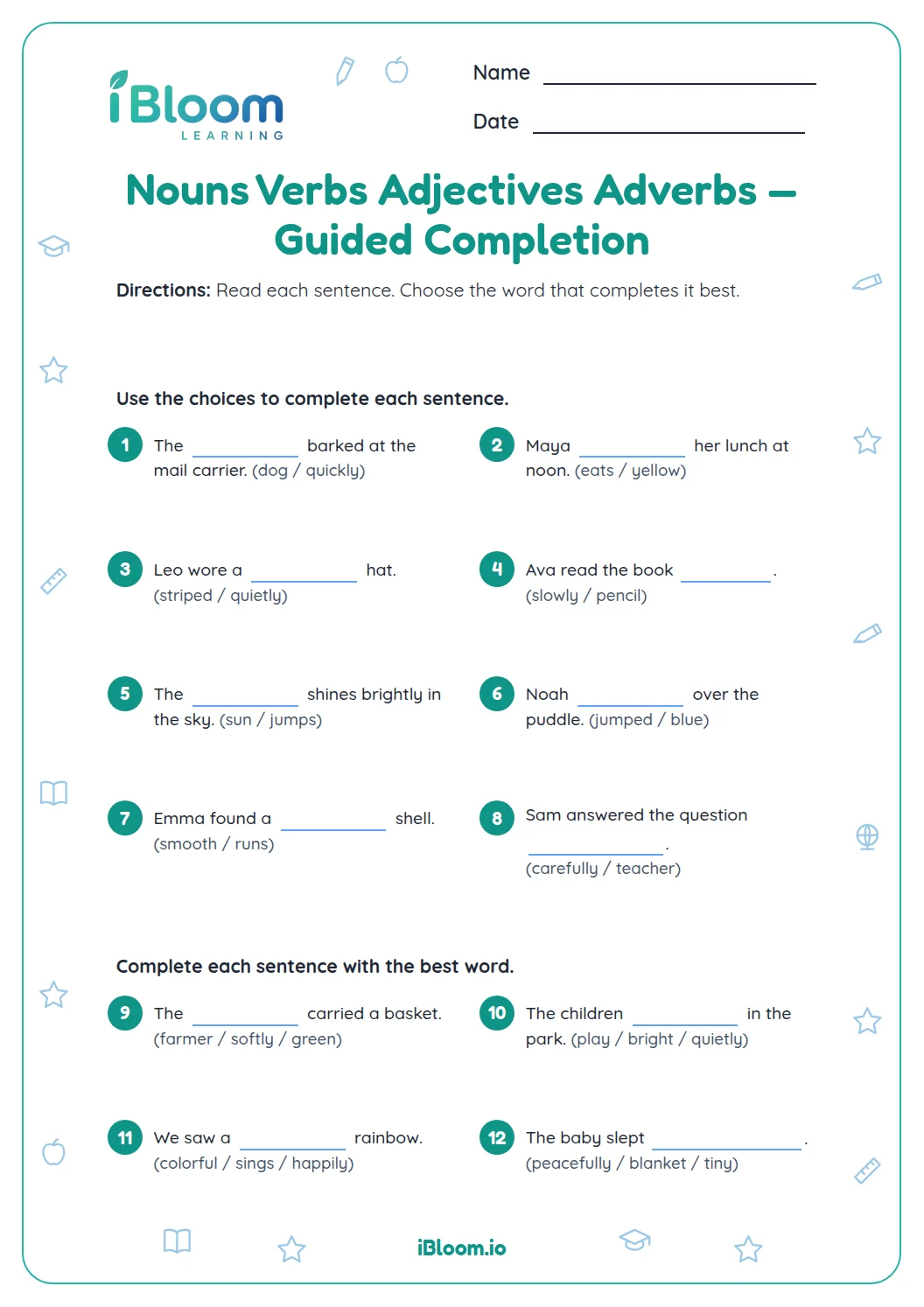
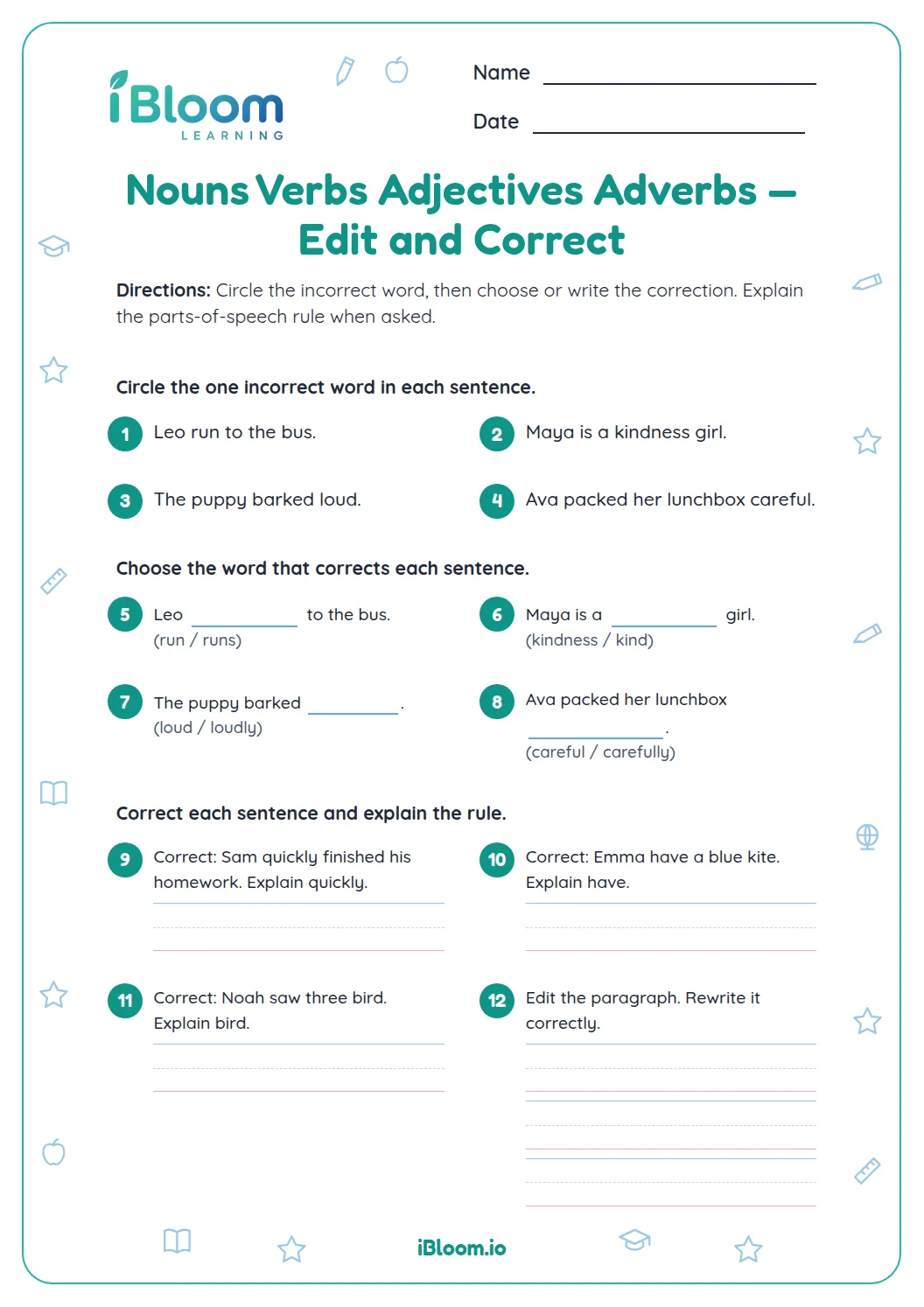
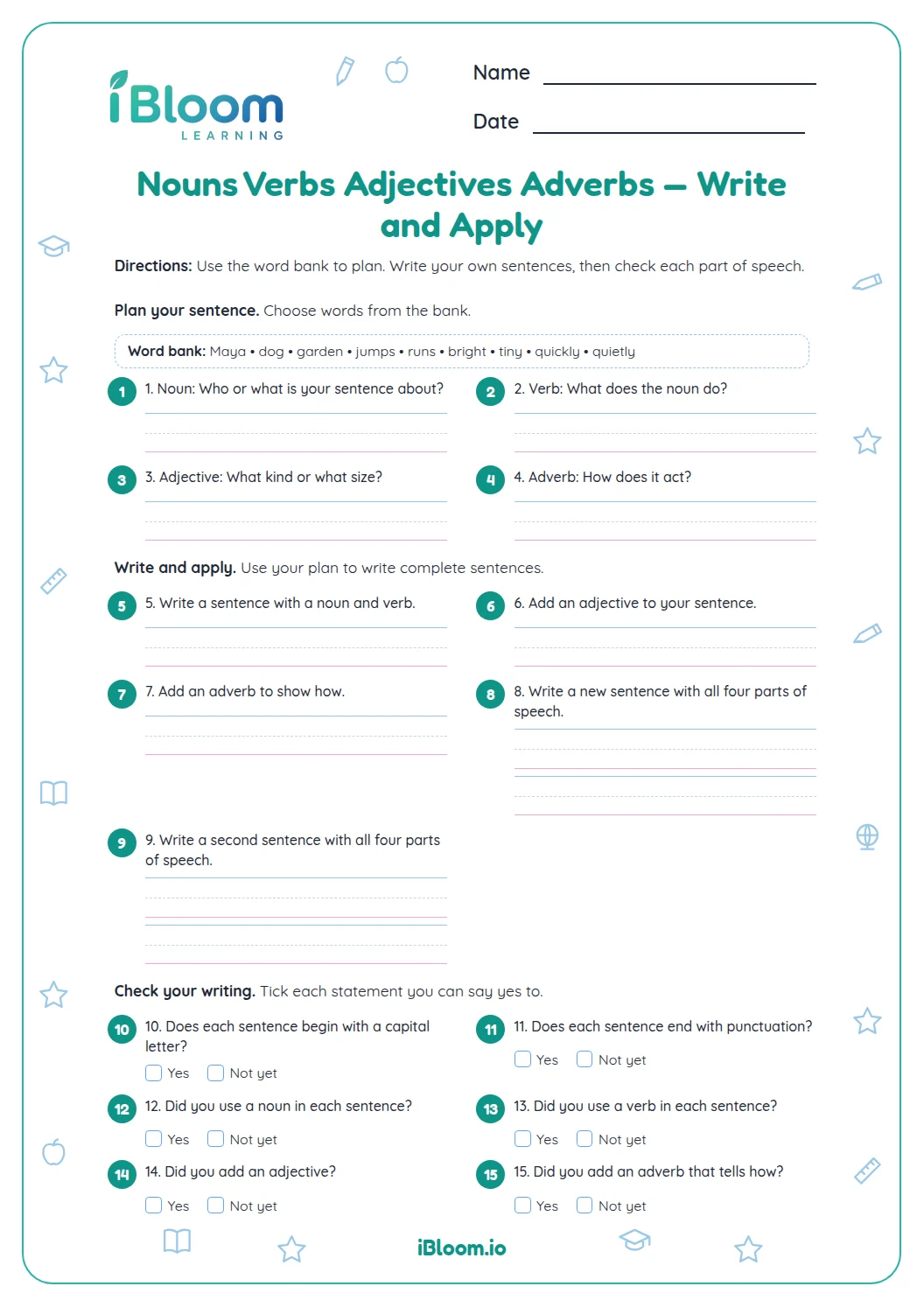
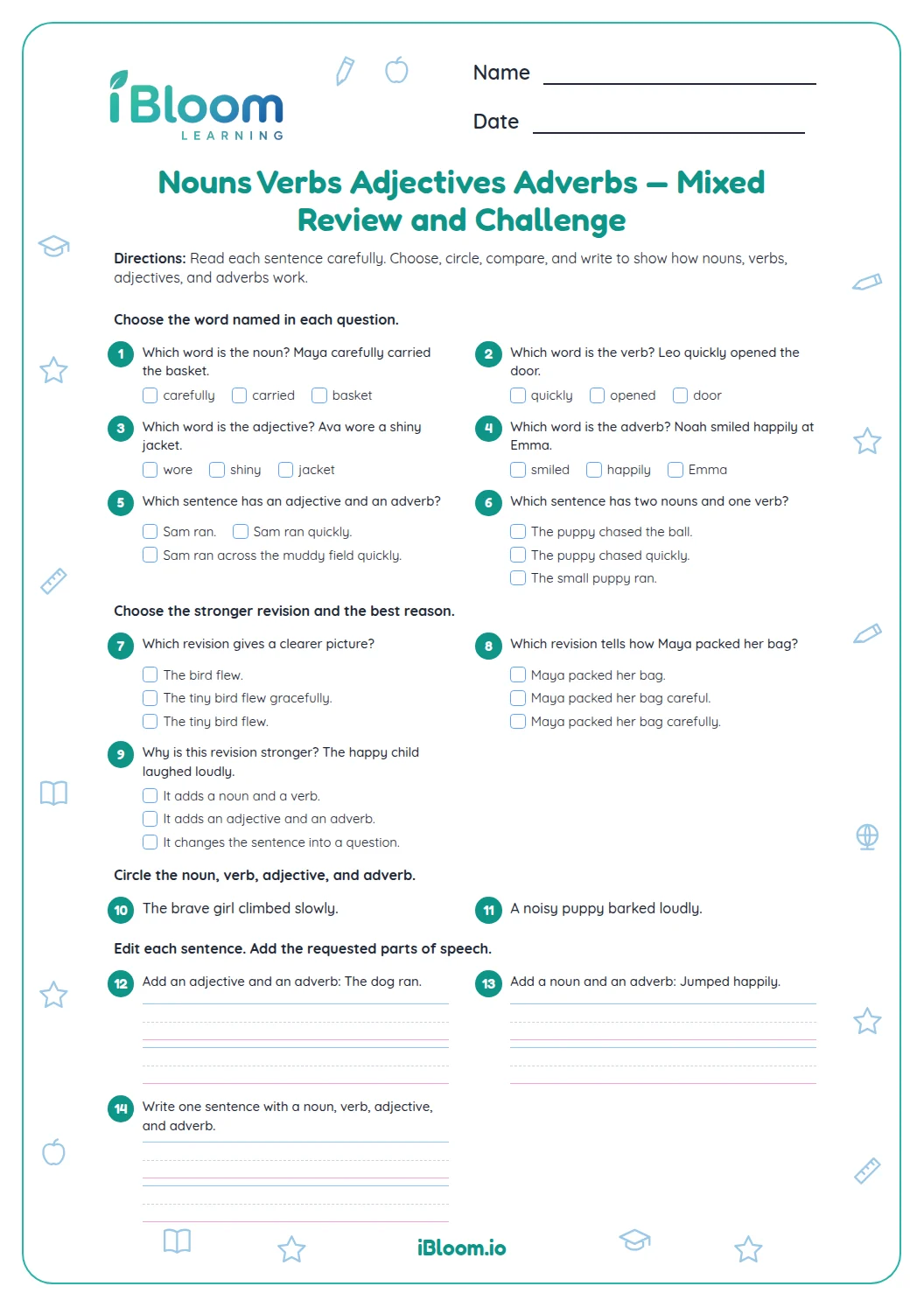
This Grade 2 printable gives children practice with nouns, verbs, adjectives, and adverbs. In Part A, they complete short sentences with nouns and verbs. In Part B, they build adjectives and adverbs from base words and use them in context. The 16 fill-in questions come with a separate answer key.
Aligned to L.2.1e
What word jobs do the two parts practice?
The 16 fill-in items are grouped into two parts. Part A completes sentences with nouns and verbs; Part B forms adjectives and adverbs from base words and uses them in context.
- Part A includes four noun and four verb questions.
- Part B includes four adjective and four adverb questions.
How can a reader spot a noun or verb?
A noun names a person, place, animal, or thing. A verb tells what someone or something does. In “Sam carried a box,” Sam and box are nouns; carried is the action verb.
How can children build adjectives and adverbs?
Some adjectives and adverbs can be built from related words. Add -y to sun to form sunny, which describes a day. Add -ly to careful to form carefully, which tells how Lena walked.
- 1Make an adverb from careful: Lena walked ___.
- 2Careful + -ly gives carefully, which tells how Lena walked.
How to work through the page
- 1Read the part heading and name the word job it asks you to find.
- 2Read the whole sentence before looking at the choices.
- 3Locate the person, animal, thing, or action first.
- 4For adjectives and adverbs, ask what the word describes or how an action happens.
- 5Choose one word and read the sentence again to check it.
- 6Use the separate key to review any missed word.
Common mix-ups and fixes
The mistake
Choosing puppy as the action in “A puppy naps.”
The fix
Ask what the puppy does. Naps is the action; puppy names the animal.
The mistake
Calling tiny a noun in “The tiny frog jumps.”
The fix
Frog names the animal, while tiny describes what kind of frog.
The mistake
Choosing careful instead of carefully for how Lena walked.
The fix
Ask which word tells how she walked. Carefully modifies the action walked.
Curriculum alignment
This worksheet gives focused practice with a skill in the Common Core State Standards.
Choose adjectives and adverbs by what each word describes in a sentence.
On this sheet: Parts C and D ask children to identify adjectives describing nouns and adverbs describing actions.
Show the official wordingHide the official wording
Use adjectives and adverbs, and choose between them depending on what is to be modified.
What to practice next
Make more practice
Further reading
Questions parents and teachers ask
What is a noun in this worksheet?
A noun names a person, place, animal, or thing. In “Mia opened the gate,” Mia names a person and gate names a thing. The question identifies which kind of noun to find, so the learner can use the sentence and the choices together.
How can a child find the verb?
Ask what the person or animal does in the sentence. In “The rabbit hops,” hops tells the action. The four Part B questions use clear action verbs so children can distinguish them from the nouns that name who or what acts.
What does an adjective describe?
An adjective describes a noun. In “The tiny frog jumps,” tiny tells what kind of frog. Part C names the noun in each question so children can focus on the describing word and read the sentence for meaning.
What does an adverb tell?
The printable contains 16 fill-in questions in two parts. Part A has four noun and four verb questions; Part B has four adjective and four adverb questions. Children write the target word in each blank, then use the separate key to check their responses.
How many questions and parts are included?
There are 16 fill-in questions in two parts, with eight questions in each part. Children complete nouns and verbs first, then adjectives and adverbs. The separate answer key lists each target word so a parent or teacher can review a response together.