




About this worksheet
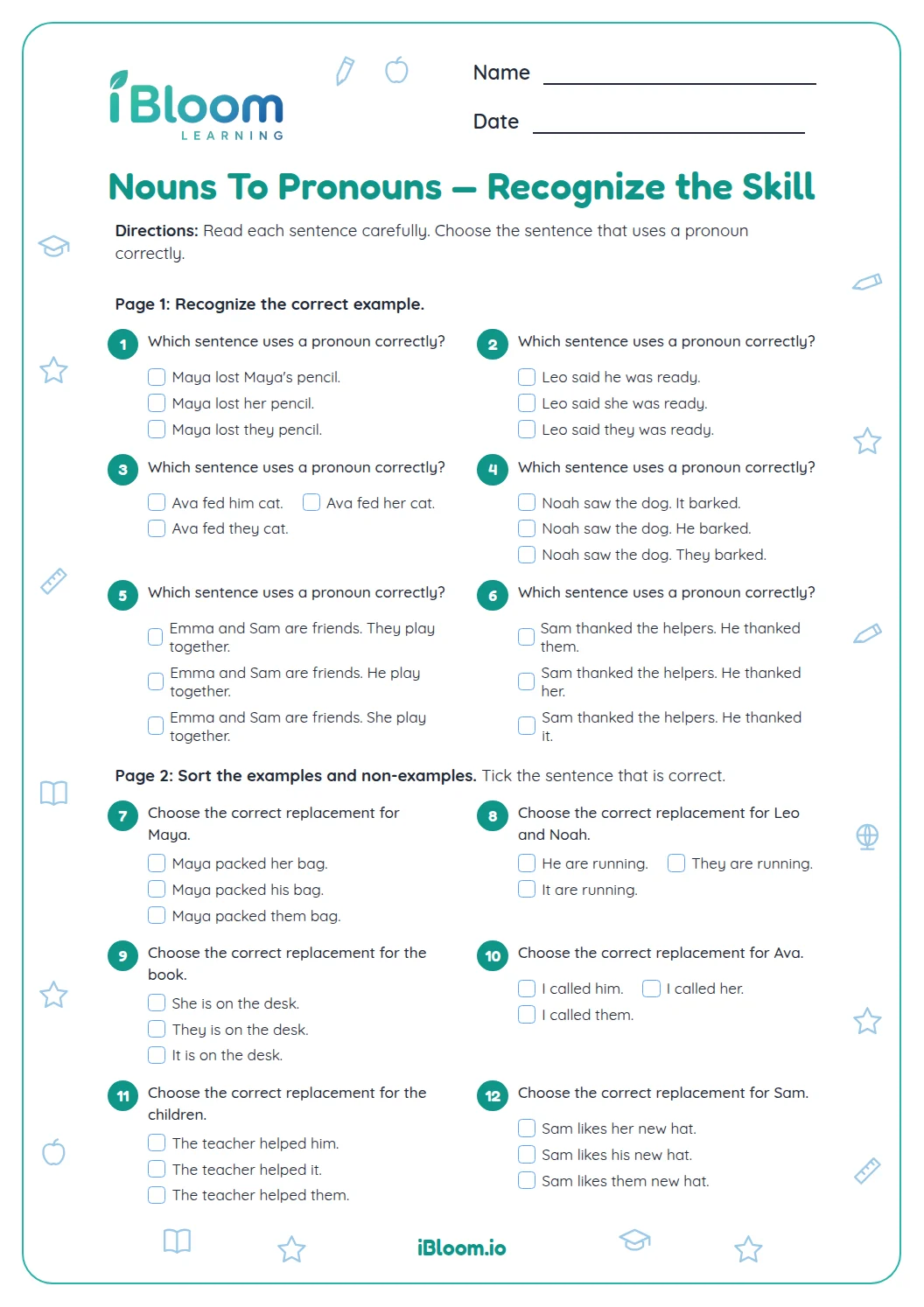
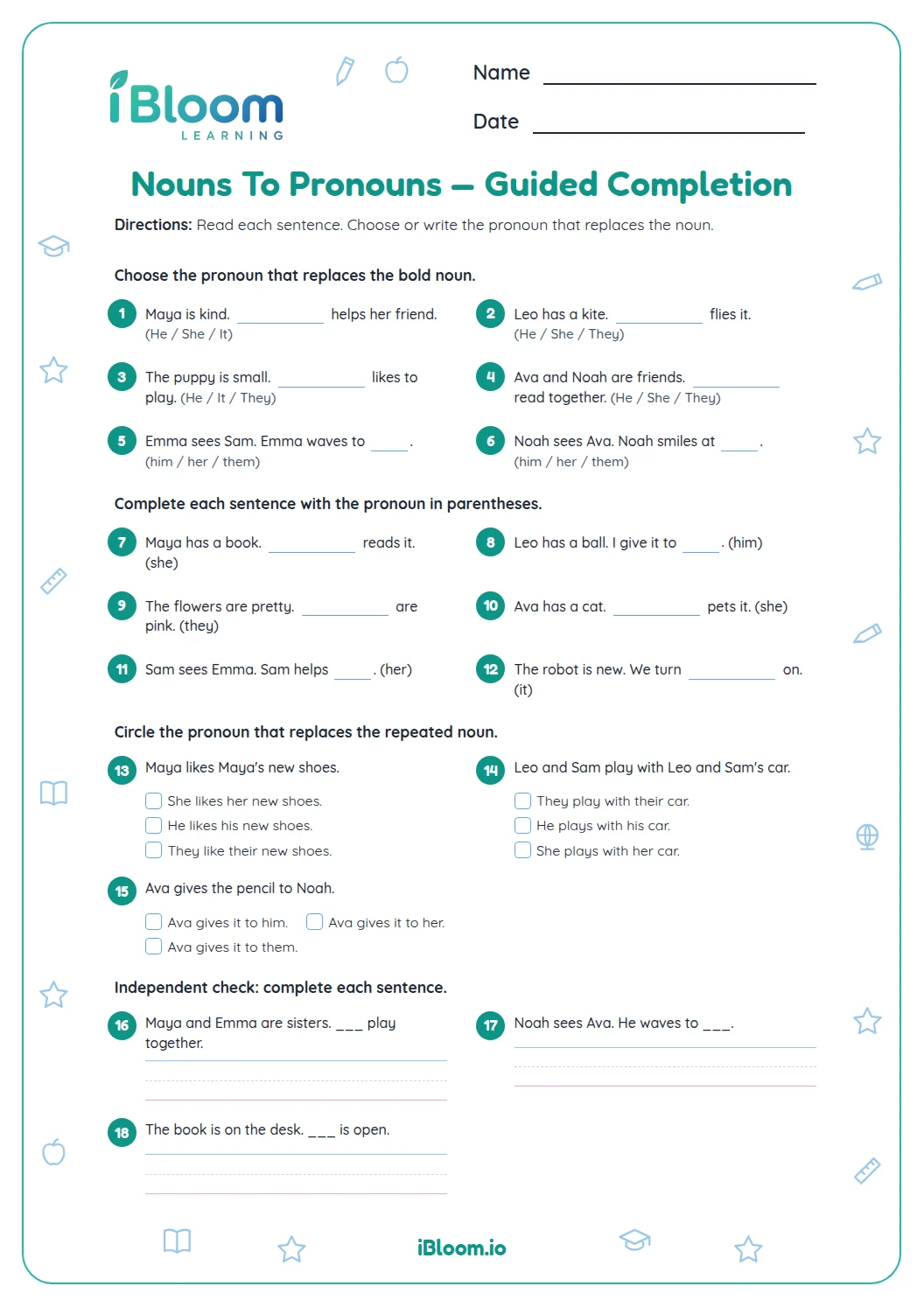
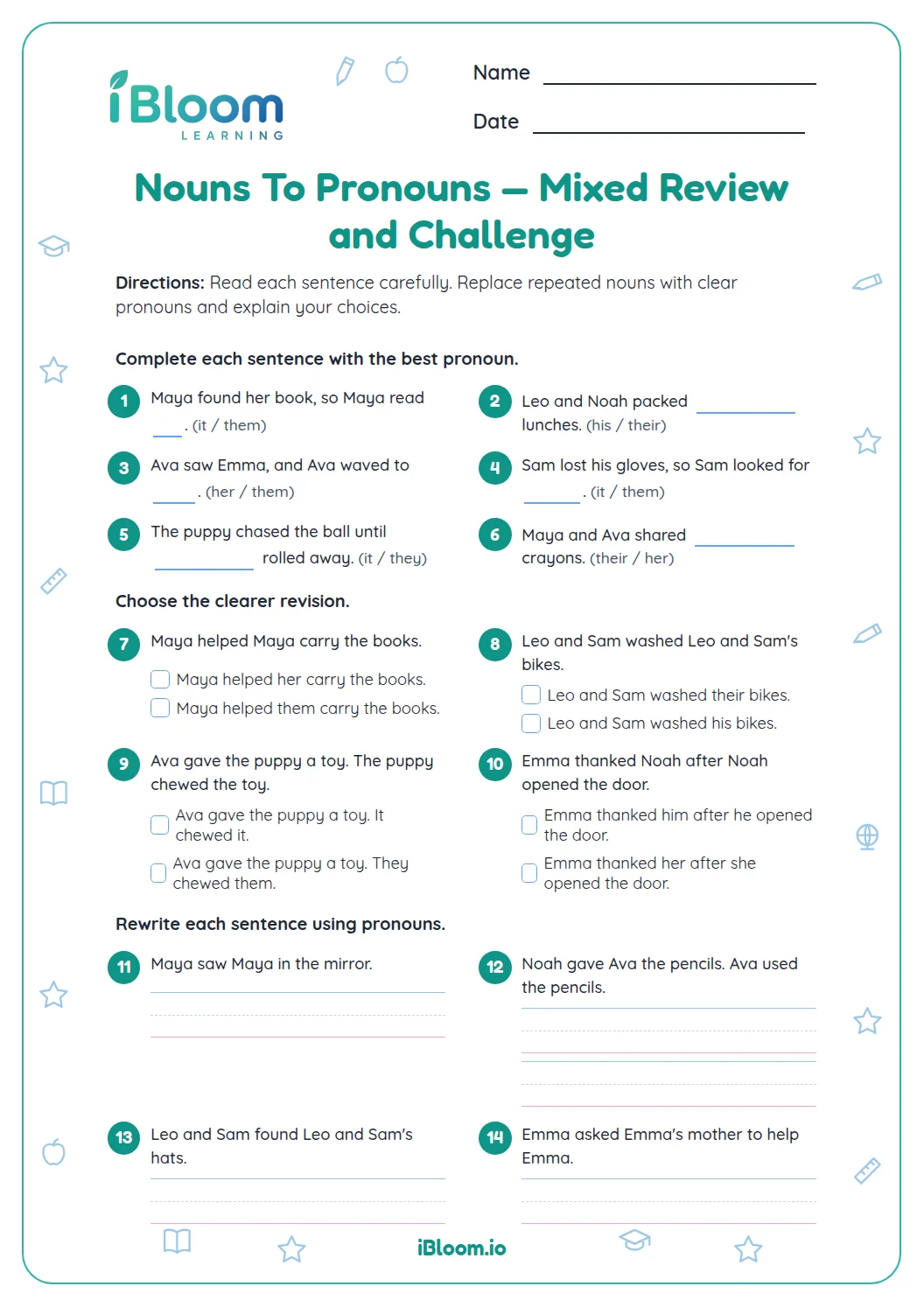
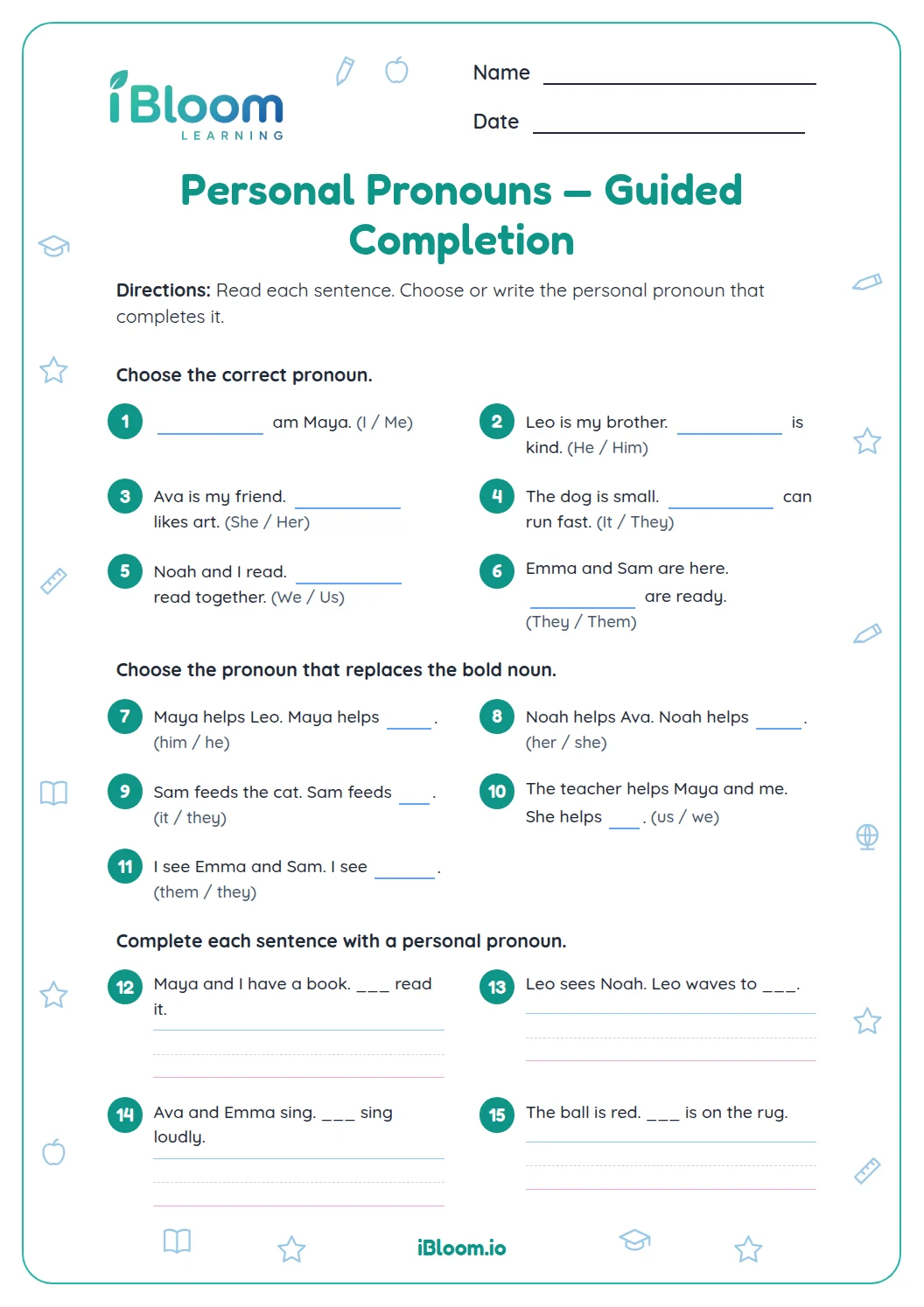
This free Grade 2 printable helps students replace named people, groups, animals, and things with subject pronouns. Sixteen sentence prompts practice he, she, it, they, I, we, and you. Students write a pronoun that fits each sentence, then check their work with the separate answer key.
What will students practice?
Each sentence names the subject before a blank, so students can match the pronoun to the noun or nouns. The 16 prompts include singular and plural subjects, as well as first- and second-person examples.
Students should reread each completed sentence to confirm that its pronoun refers to the intended noun.
How can students work through an example?
Find the noun the blank replaces, then choose a pronoun that agrees with it. A first-person pronoun such as we includes the speaker.
- 1Maya has a kite. ___ flies it.
- 2Key: She
How should students use the answer key?
Check the answer by reading the full sentence with the pronoun in place. If a sentence names more than one person, decide whether the speaker is included before choosing we, you, or they.
What can students practice next?
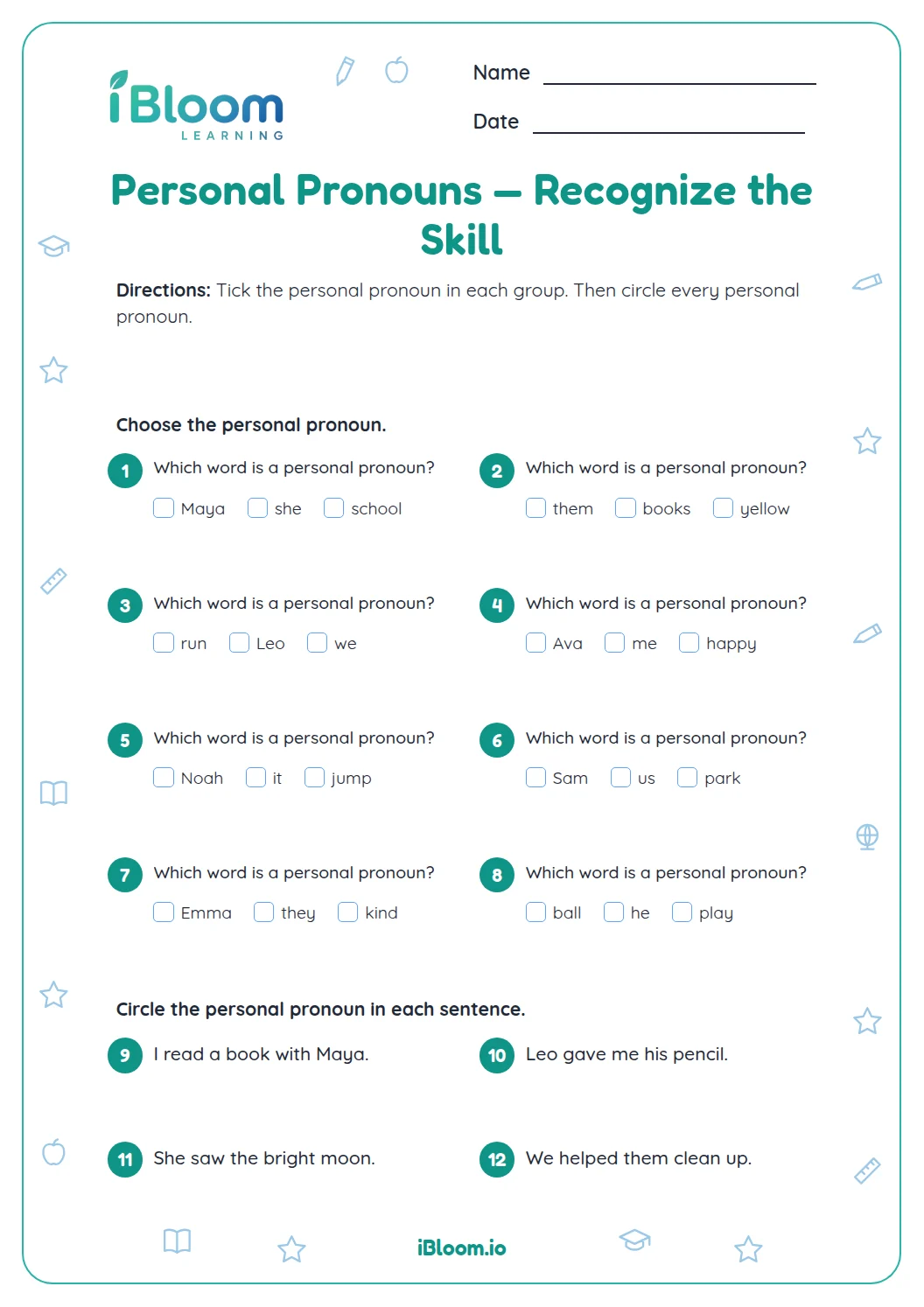
The personal pronouns page reviews the same subject forms before students move on to pronouns such as me or reflexive pronouns.
How to use this worksheet
- 1Read the whole sentence.
- 2Find the person, group, animal, or thing the blank replaces.
- 3Check whether the subject is one or more than one.
- 4Choose a pronoun that matches the subject and point of view.
- 5Reread the sentence and compare with the answer key.
Common mistakes and quick fixes
The mistake
Using it for people.
The fix
Use he or she for one person and they for a group.
The mistake
Using they for a single object.
The fix
Check whether the noun names one thing or several things.
The mistake
Choosing we when the speaker is not included.
The fix
Use we only when the sentence includes the person speaking.
What to practice next
Questions parents and teachers ask
What does this worksheet teach about pronouns?
The 16 sentence prompts ask students to replace a named person, group, animal, or thing with a subject pronoun. The prompts include I, we, you, he, she, it, and they; a separate key lists a fitting answer for each.
Why use a pronoun instead of repeating a noun?
A pronoun can stand in for a noun that has already been named. In “Maya has a kite. She flies it,” she refers to Maya and it refers to the kite. Students practice matching each pronoun to its noun in the sentence.
How many questions and pages are included?
There are 16 questions on two worksheet pages, with a separate answer key. Students write a pronoun for each blank, moving from single nouns to groups and first- or second-person pronouns. The worksheet has two sections, with single nouns first and group subjects in the next section.
Why does “Sam and I” become “we”?
We includes the speaker and at least one other person. In the prompt “Sam and I can help,” the sentence includes the person speaking, so “We can carry the books” correctly replaces both names. Because the speaker is one of the helpers, the pronoun includes both people. “They” would leave the speaker out.
How should I check a student’s pronoun choice?
Have the student point to the noun or nouns the pronoun replaces, then reread the sentence with the pronoun in place. The answer should make sense and agree in number and person with the named subject. For example, ask “Who does this pronoun mean?” A pronoun that refers to a different person or thing changes the sentence meaning.