
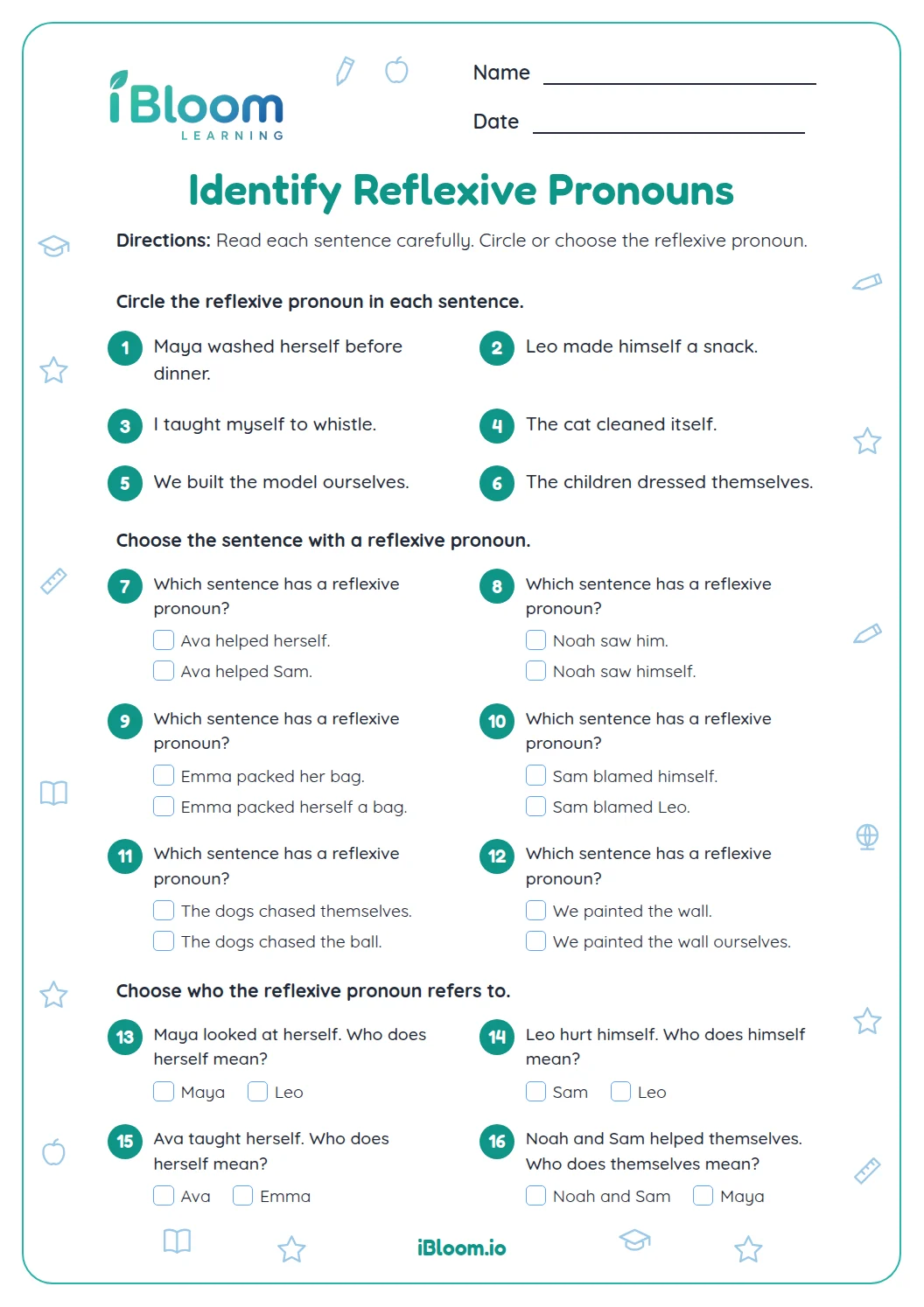
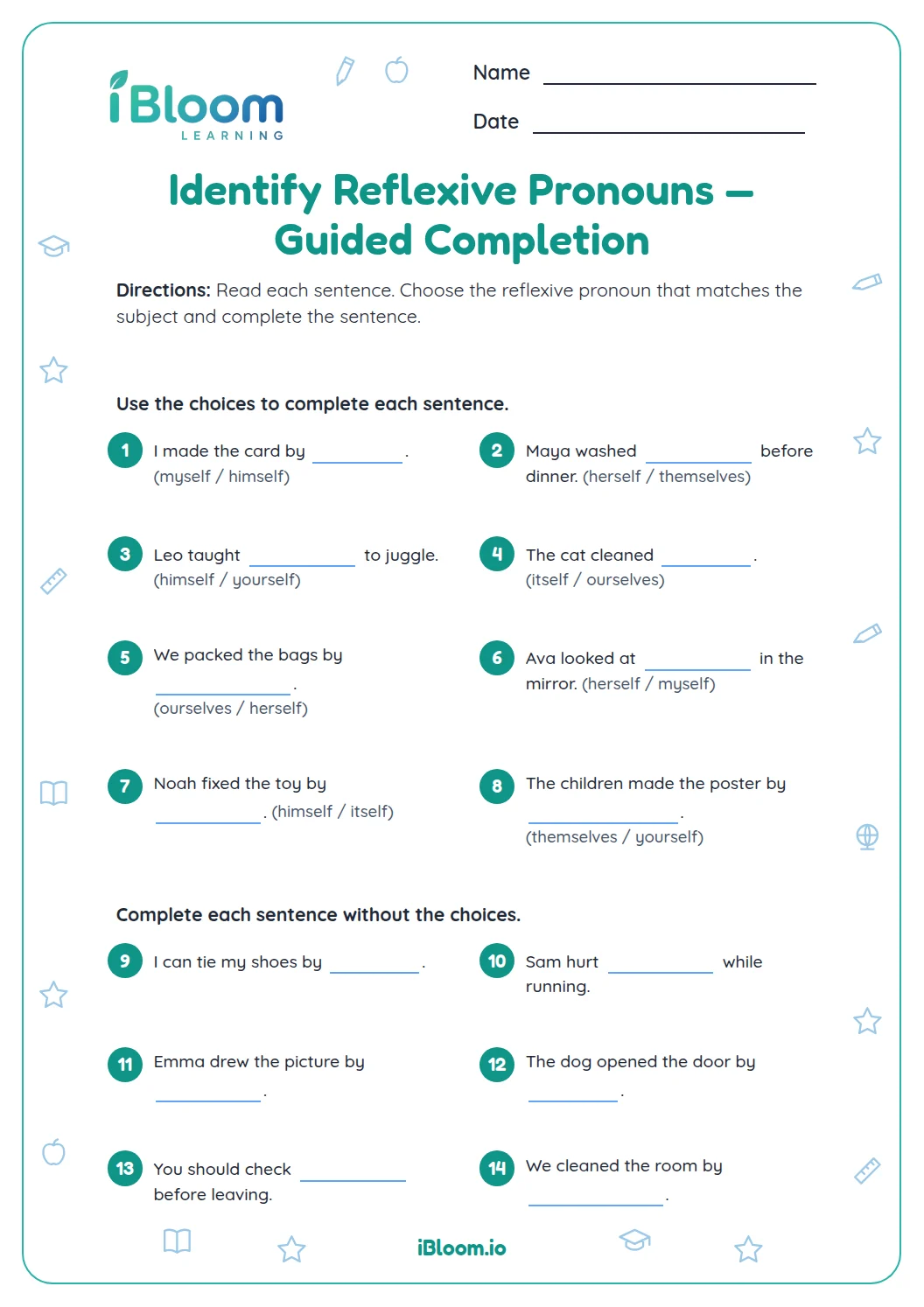
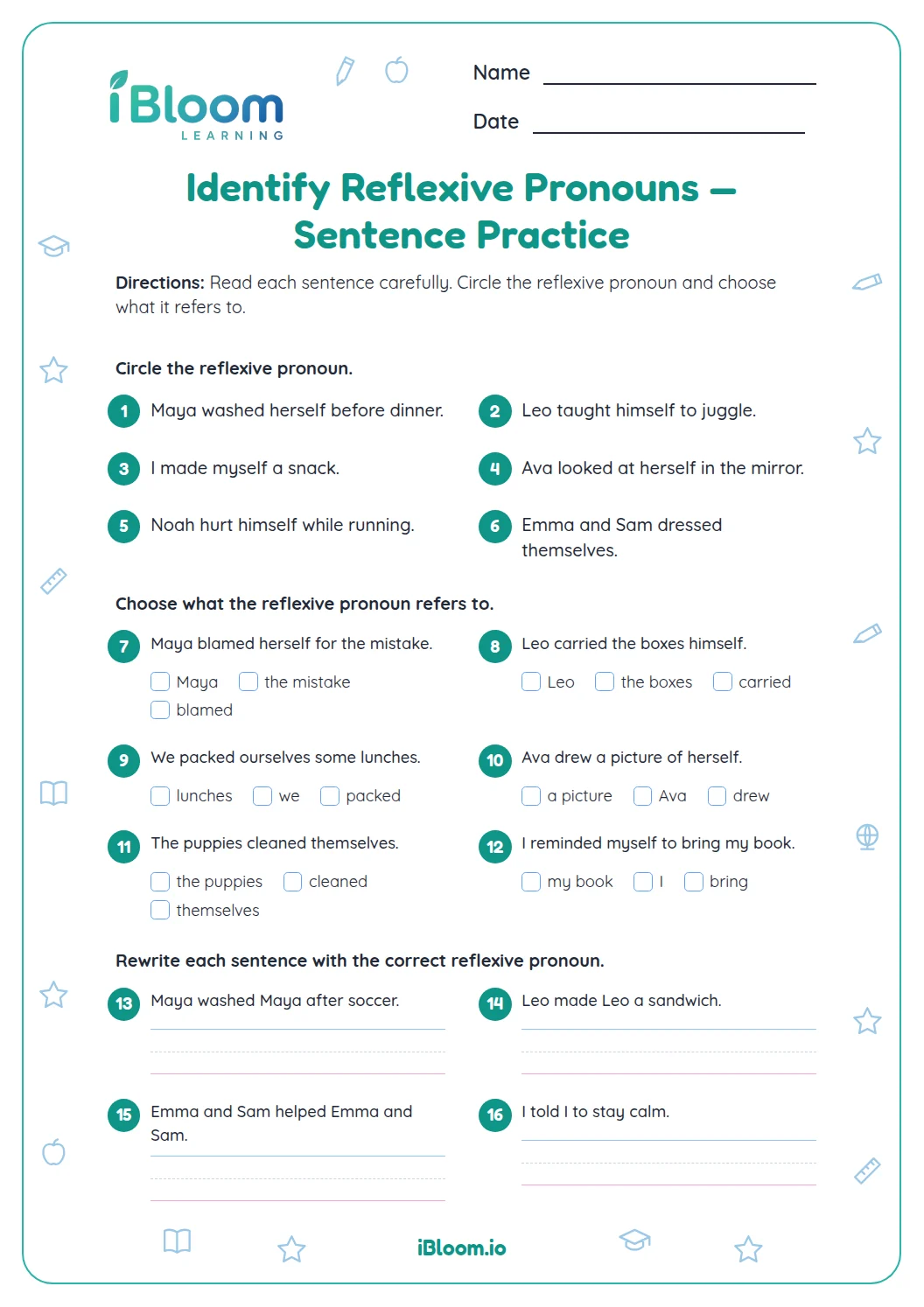
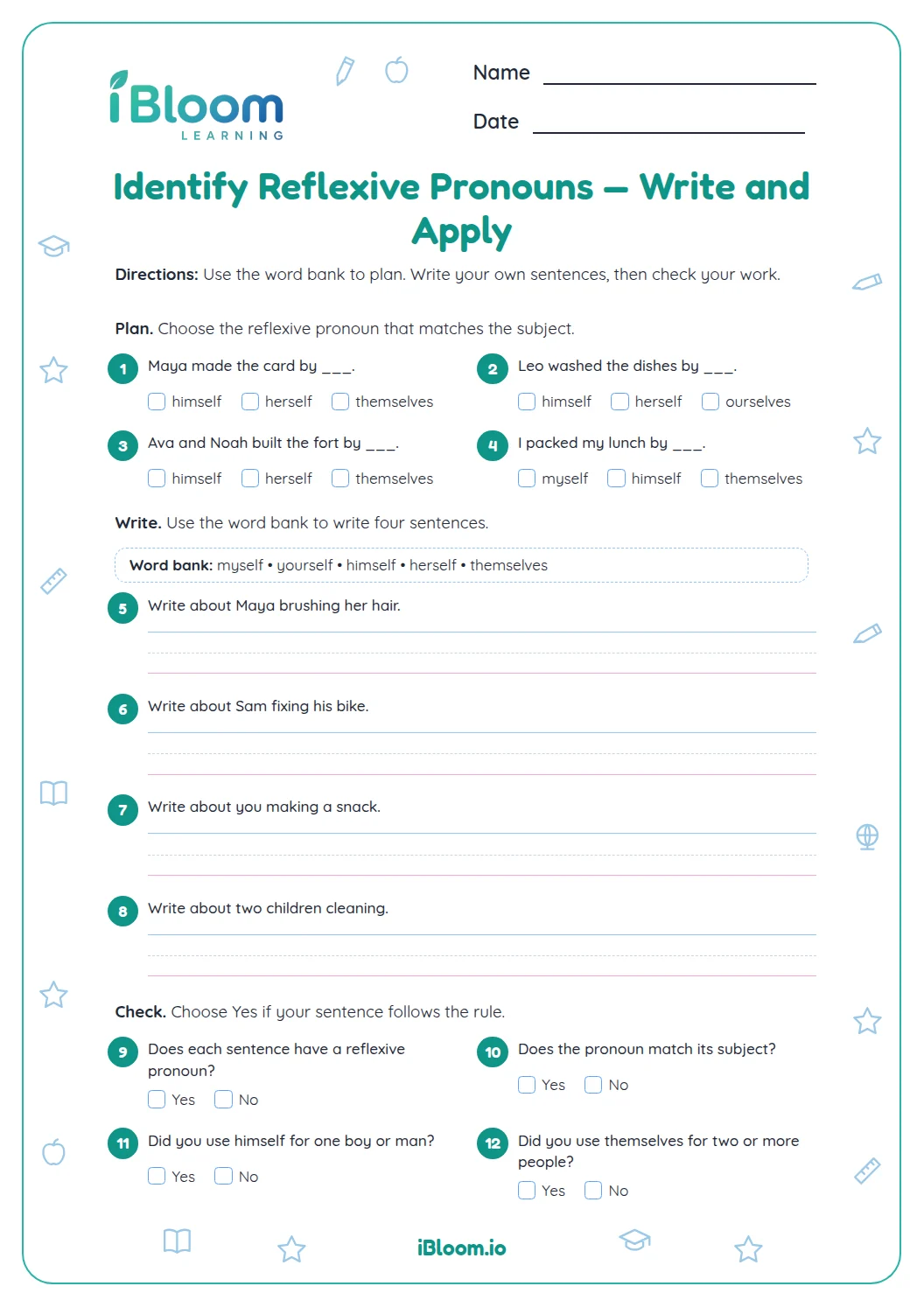




About this worksheet
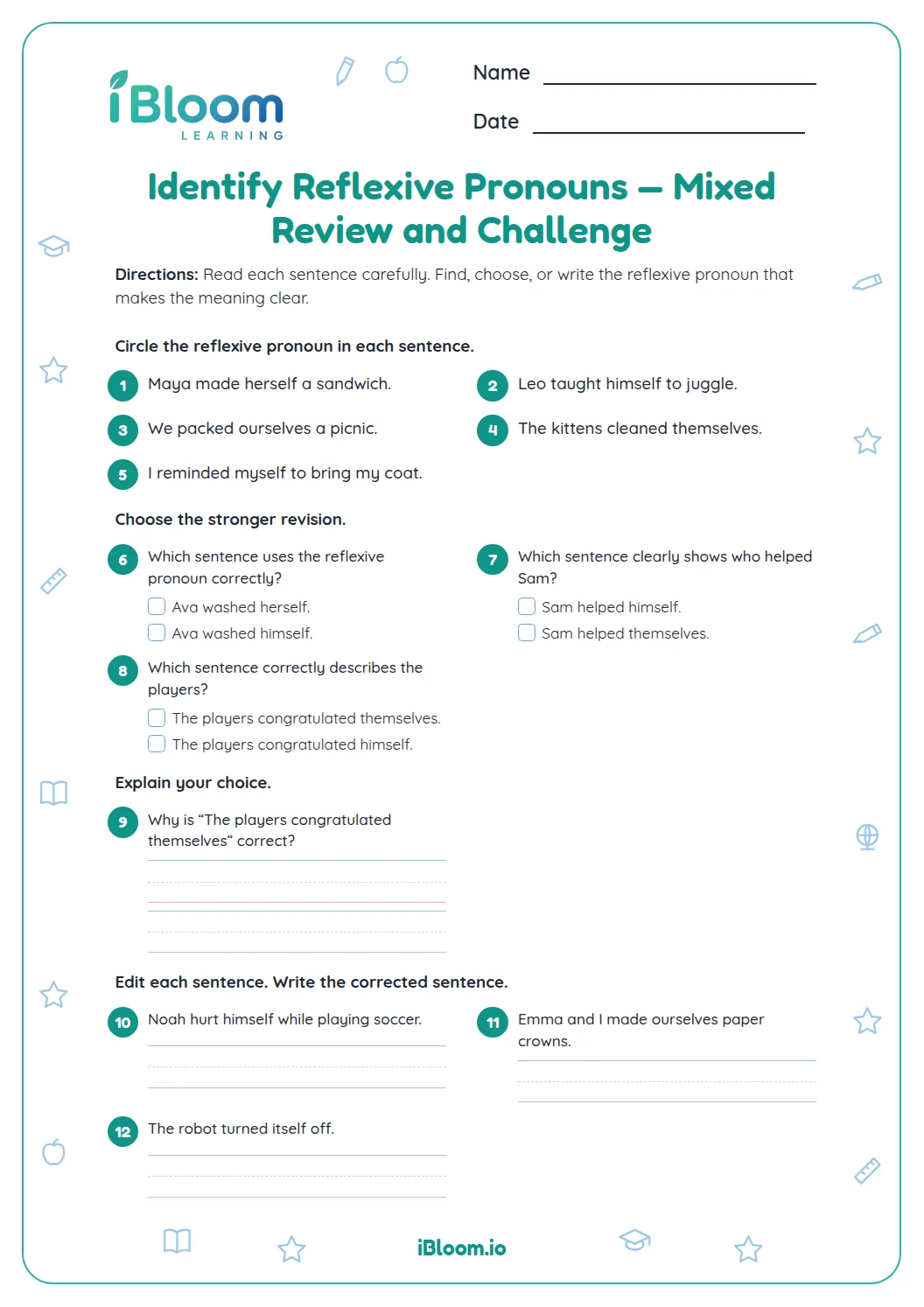
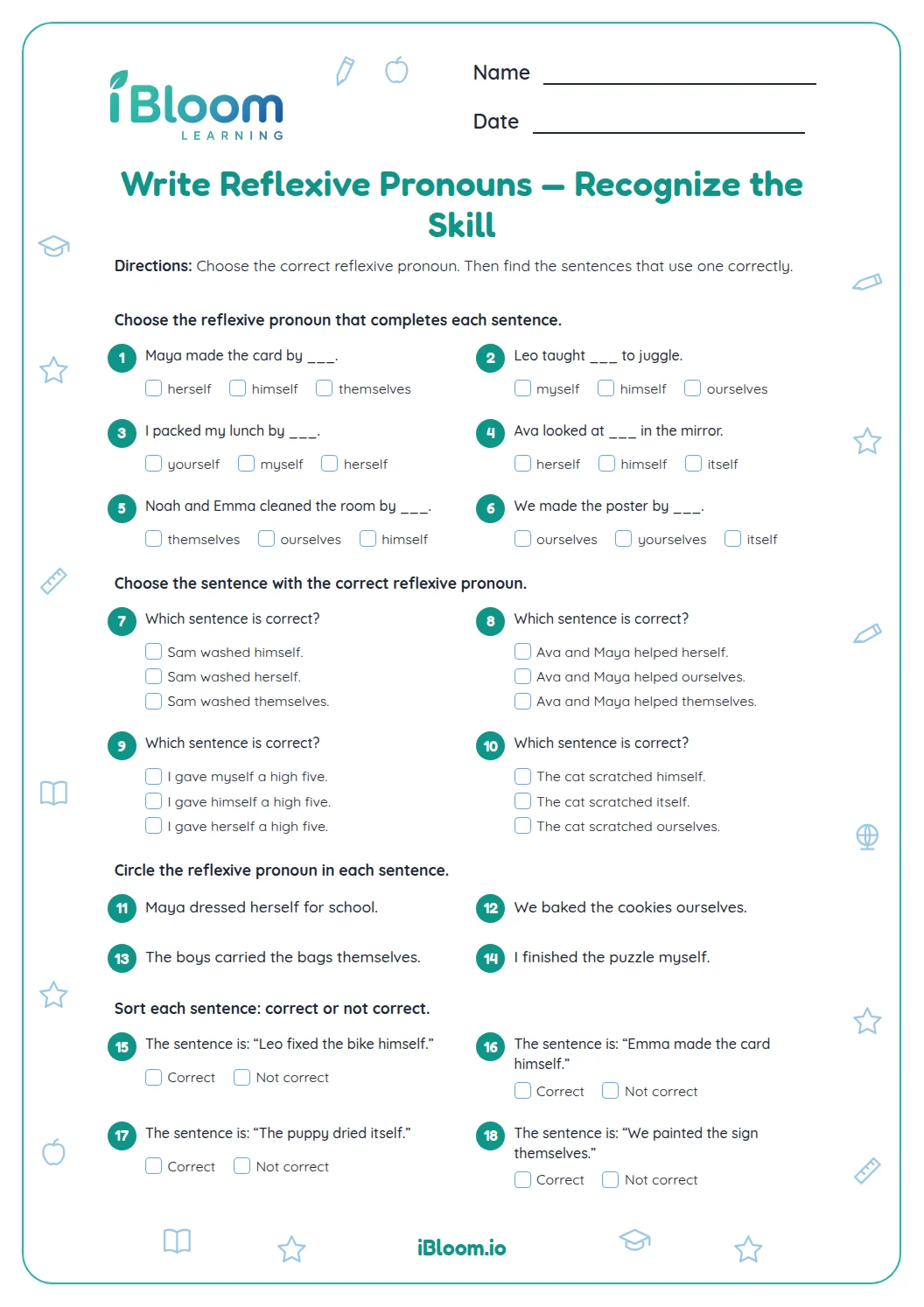
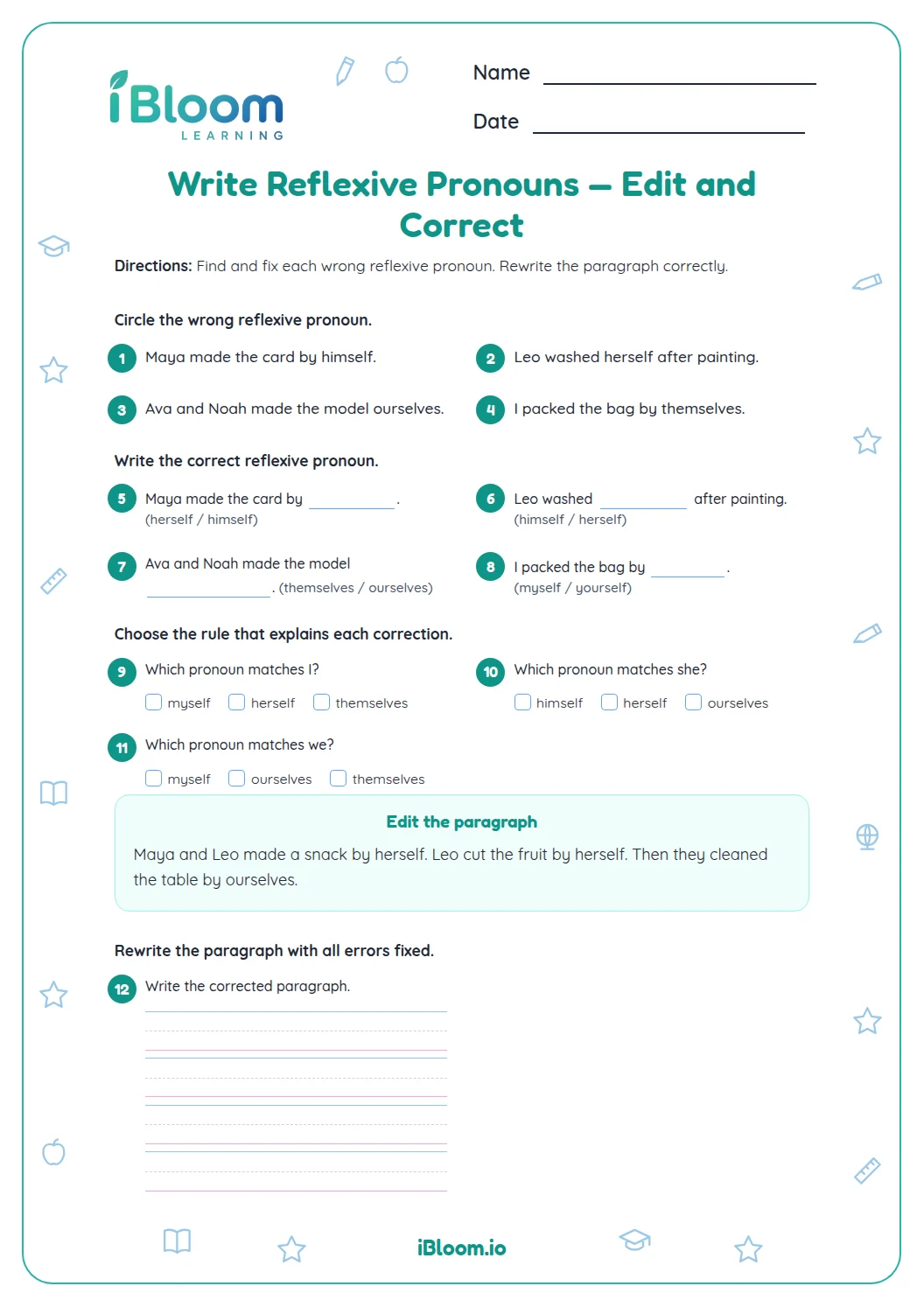
This free Grade 2 worksheet helps children identify and correct reflexive pronouns. Learners choose a form that matches the subject, repair sentences with an agreement error, and apply the pattern in four written responses. The examples use people, a puppy and a bicycle to make person and number visible in each sentence. A separate answer key gives the choices and sample writing responses.
How do reflexive pronouns match a subject?
A reflexive pronoun points back to the subject. Use herself with Maya in “Maya made herself a snack,” because Maya is one person and the action is for Maya.
- 1Maya made herself a snack.
- 2Subject: Maya, one person.
- 3Pronoun: herself.
How can a child edit an agreement error?
Find the subject first, then check the person and number of the reflexive pronoun. A plural subject such as the girls needs a plural form such as themselves.
- Part A chooses a pronoun that agrees with its subject.
- Part B replaces an incorrect pronoun.
- Part C applies the pattern in writing.
What changes in the writing part?
The last four items ask children to use reflexive pronouns in complete sentences. The key gives a sample for each prompt; accept another complete sentence when the pronoun clearly points back to its subject.
- Part A selects a matching pronoun.
- Part B edits a mismatch.
- Part C applies the pattern in writing.
How to use this worksheet
- 1Read the whole sentence and name its subject.
- 2Choose a reflexive pronoun that points back to that subject.
- 3In an editing item, replace the mismatched pronoun and reread the sentence.
- 4Write a complete sentence for each of the last four items.
- 5Compare each choice with the answer key; check that written pronouns match their subjects.
Common mistakes and quick fixes
The mistake
Using a singular form with a plural subject, as in “the girls … himself.”
The fix
Name the group first, then use a plural form such as themselves.
The mistake
Choosing a pronoun based on the object instead of the subject.
The fix
Find who or what does the action; that subject determines the reflexive form.
The mistake
Writing a reflexive pronoun without a subject it points back to.
The fix
Reread the sentence and make sure the same person or thing appears as the subject.
What to practice next
Make more practice
Questions parents and teachers ask
What is a reflexive pronoun?
A reflexive pronoun points back to the subject in the same sentence. Examples on this page include myself, yourself, himself, herself, itself, ourselves and themselves. Ask the child to name the subject before choosing the matching form. Several items show how the pattern works in context.
How do I choose himself or themselves?
Check the subject’s person and number. Use himself for one male person, and themselves for a plural subject such as the girls or the twins. The editing section asks children to notice that difference in complete sentences. The worksheet provides examples with people and a thing.
What does “edit and correct” mean here?
Children read a sentence with a mismatched reflexive pronoun and choose a correction that agrees with its subject. They then write original sentences using the same relationship. The answer key gives the correct forms and sample responses. Children should reread the full sentence after making each change.
How many questions are on this worksheet?
There are 15 questions: 11 multiple-choice items and four written responses. The first part chooses matching pronouns, the next part corrects errors, and the final part applies the pattern in sentences. Each section keeps the focus on matching a pronoun to its subject.
Can answers differ on the writing questions?
Yes. The key provides one sample for each open response. Accept a different complete sentence when it uses the requested reflexive pronoun correctly and makes clear which subject the pronoun points back to. The sample is a guide, not the only acceptable sentence.