





About this worksheet
The subject tells who acts. Children use that clue to choose forms such as myself, herself, itself, ourselves, and themselves.
Aligned to L.2.1.C
What does guided completion practice?
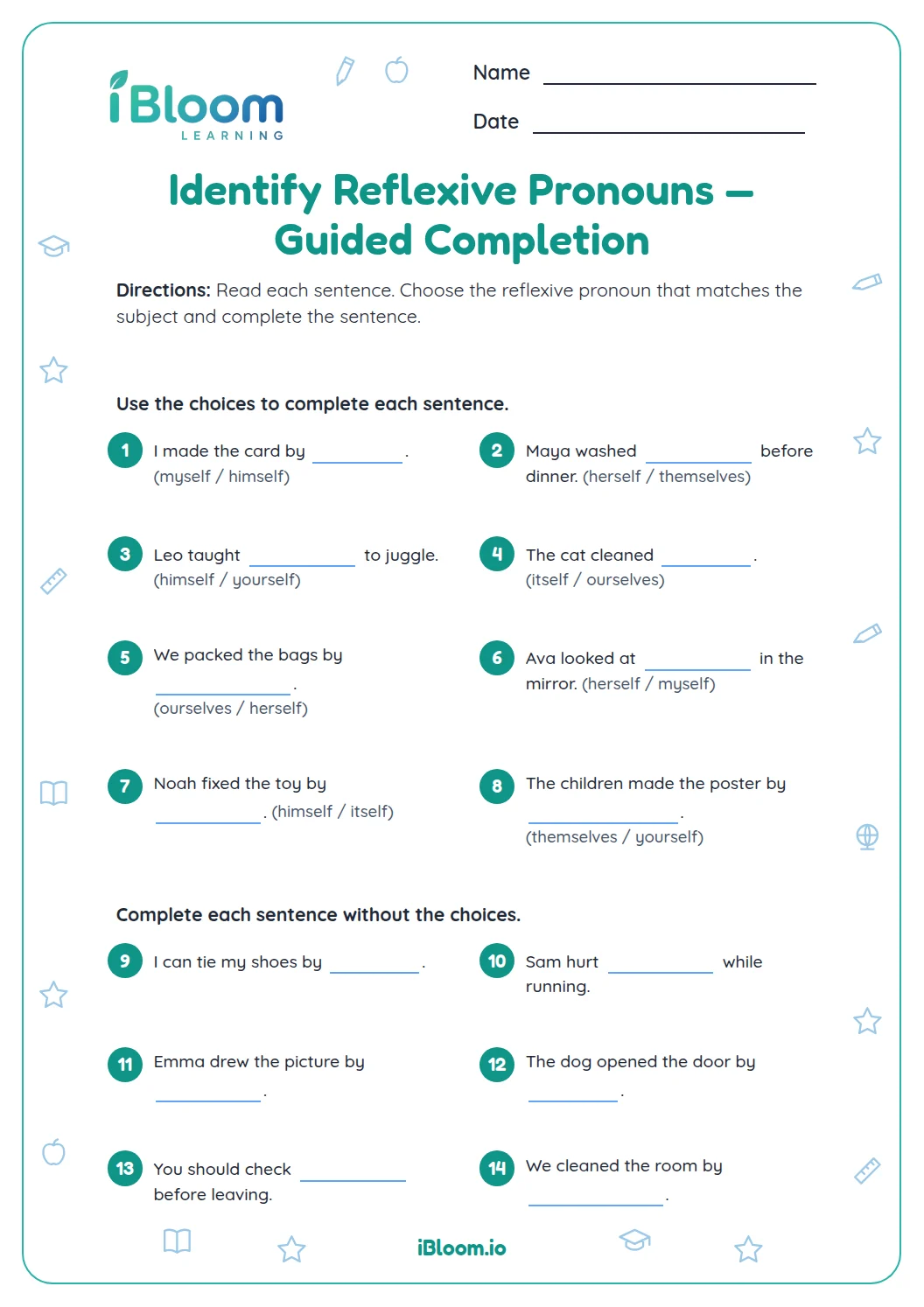
Questions 1–8 offer three choices for matching a reflexive pronoun to its subject. Questions 9–14 remove the choices, so learners write the matching form independently.
- Practice all common reflexive forms
- Match singular and plural subjects
- Use the sentence meaning to confirm the ending
A helpful way to think it through
For q6, the subject We includes the speaker and others, so the matching reflexive pronoun is ourselves.
What changes between the two parts?
Part A supplies three choices for each blank, so learners can compare forms while reading the subject. Part B removes the choices. The learner must identify who acts and write the reflexive pronoun that matches that subject.
Guide the pronoun choice
- 1Read the subject aloud and name the person or group.
- 2Ask whether the subject is one person, several people, or an animal/object.
- 3In Part B, read the whole sentence before filling in the blank.
- 4Check the key and ask the learner to point from the pronoun back to its subject.
Common mix-ups
The mistake
Using himself for a girl or herself for a boy.
The fix
Match the pronoun to the person named in the subject.
The mistake
Using myself after we.
The fix
We points to a group that includes the speaker, so use ourselves.
The mistake
Using themselves for one animal.
The fix
A single animal named as it takes itself.
Common Core alignment
This worksheet supports Grade 2 grammar work with pronouns in sentences.
Use reflexive pronouns.
On this sheet: Learners complete sentences using pronoun forms that agree with the subject.
Show the official wordingHide the official wording
Use reflexive pronouns (e.g., myself, ourselves).
What to practice next
Questions parents and teachers ask
How should a child choose the right reflexive pronoun?
Find the subject first and ask who is doing the action. Then choose a form that matches: I uses myself, she uses herself, we uses ourselves, and they uses themselves. The sentence meaning can help confirm the choice before the learner writes it.
What does a reflexive pronoun do in a sentence?
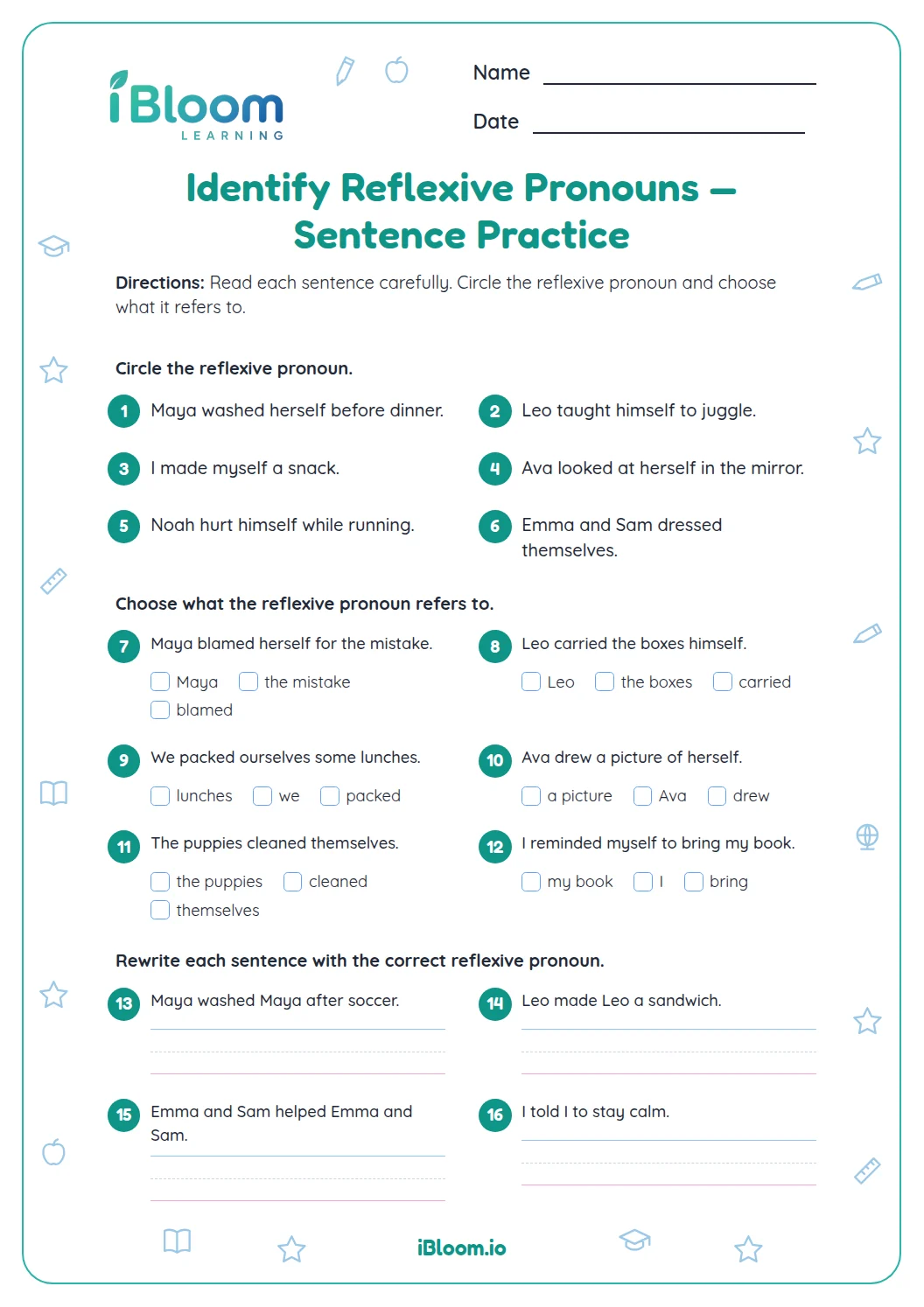
A reflexive pronoun points back to the subject in that same sentence. In “Maya washed herself,” the pronoun herself points back to Maya, who is doing the washing. The subject and reflexive pronoun refer to the same person or group.
What grade is this guided completion page for?
This worksheet is written for Grade 2 learners practicing how reflexive pronoun forms match a sentence subject. It begins with choices, then gives independent blanks. This progression lets children use a word bank before relying on their own recall.
Does this worksheet include the answer key?
Yes. A separate answer key gives the matching reflexive pronoun for all fourteen sentences. Use it after practice to check the subject and explain why that form fits. The key follows the same question numbers as the worksheet.
How many sentences are included?
There are 14 sentence completions in two parts. The first eight have choices and the last six ask learners to write a reflexive pronoun independently. The answer key lists the matching form for each sentence so an adult can review the work.
Which reflexive pronoun matches “we”?
Use ourselves when the subject is we. The form includes the speaker and at least one other person. In “We packed our bags by ourselves,” the pronoun points back to the group named by we. Learners can say the subject aloud first.