



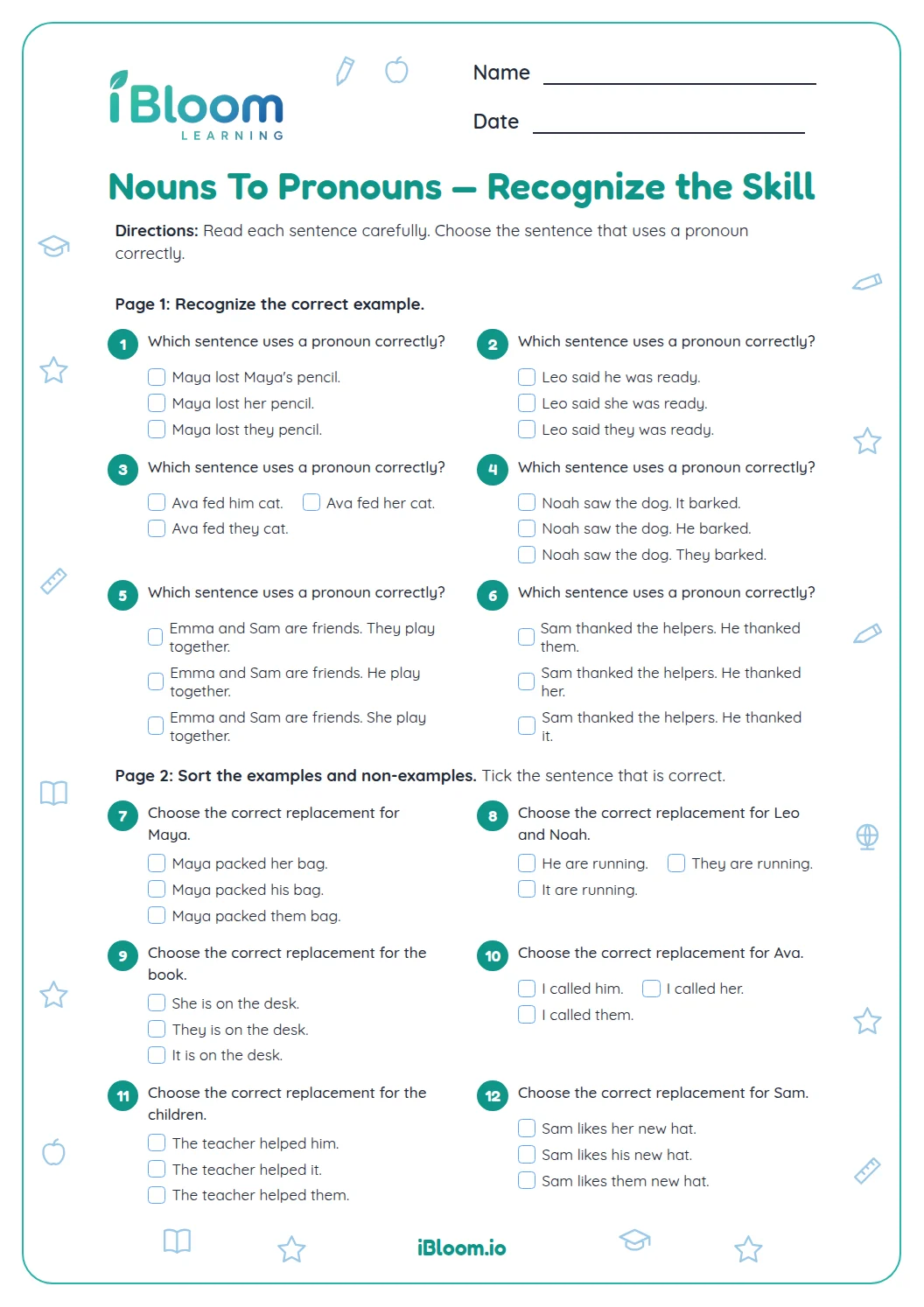
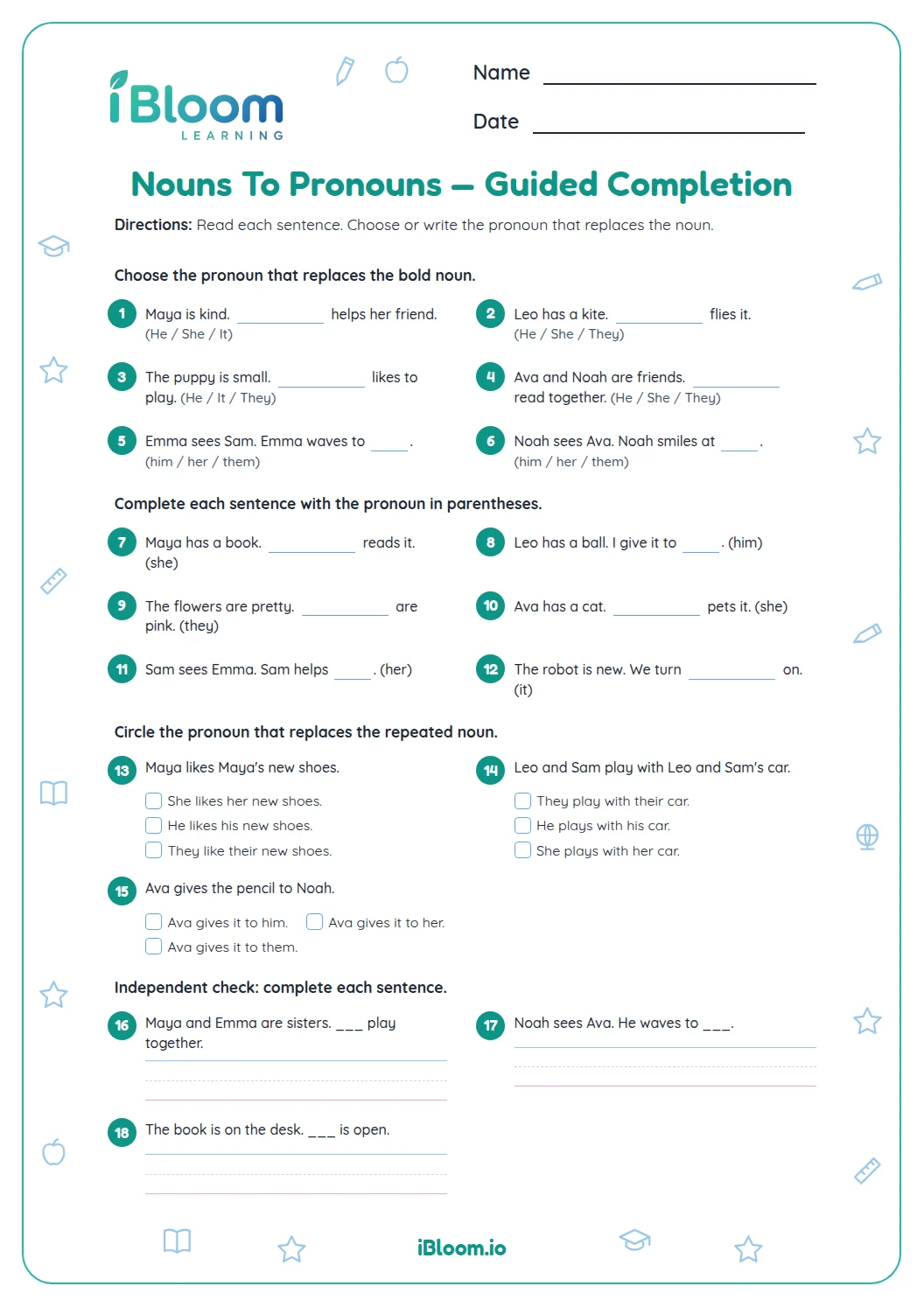


About this worksheet
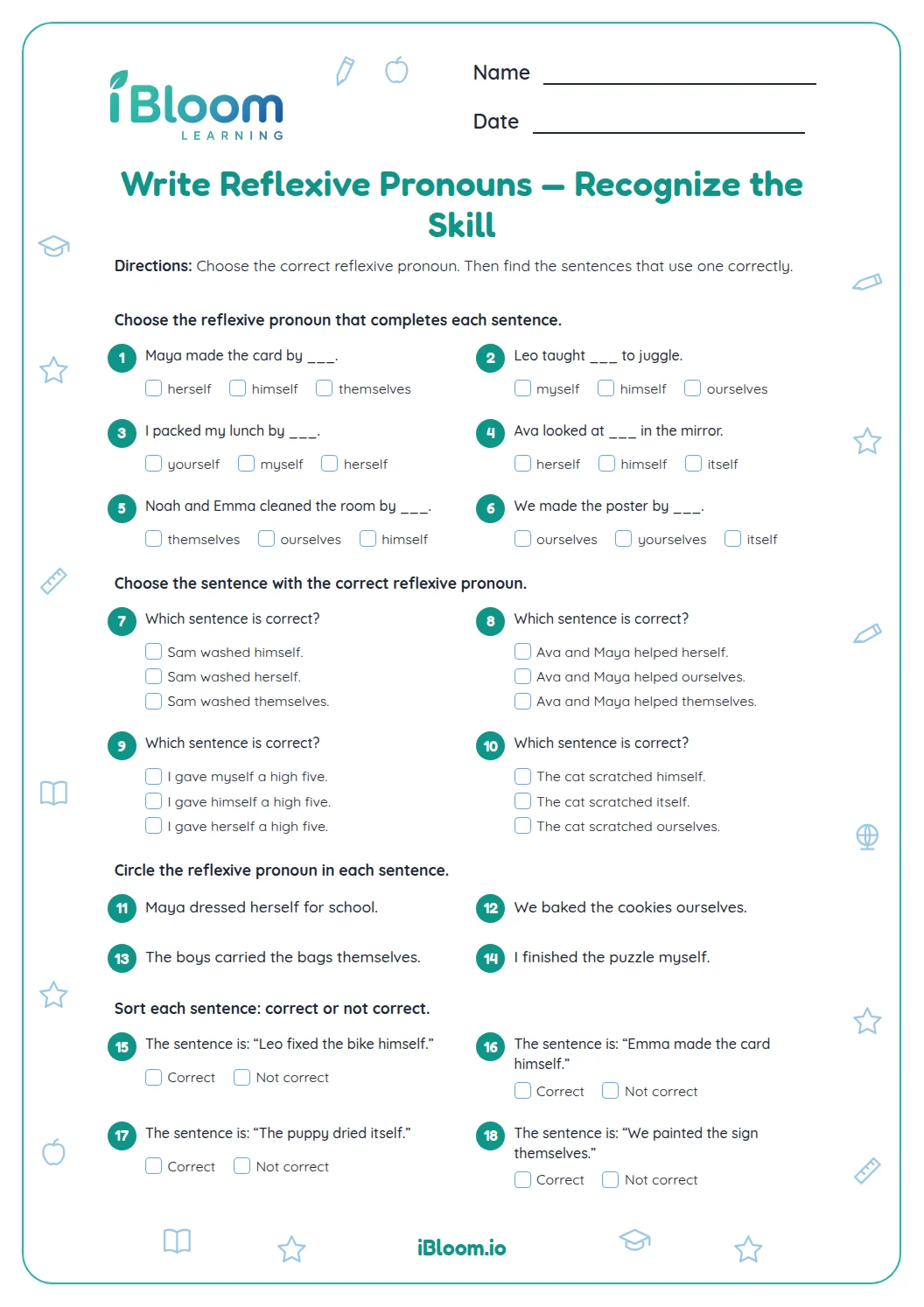
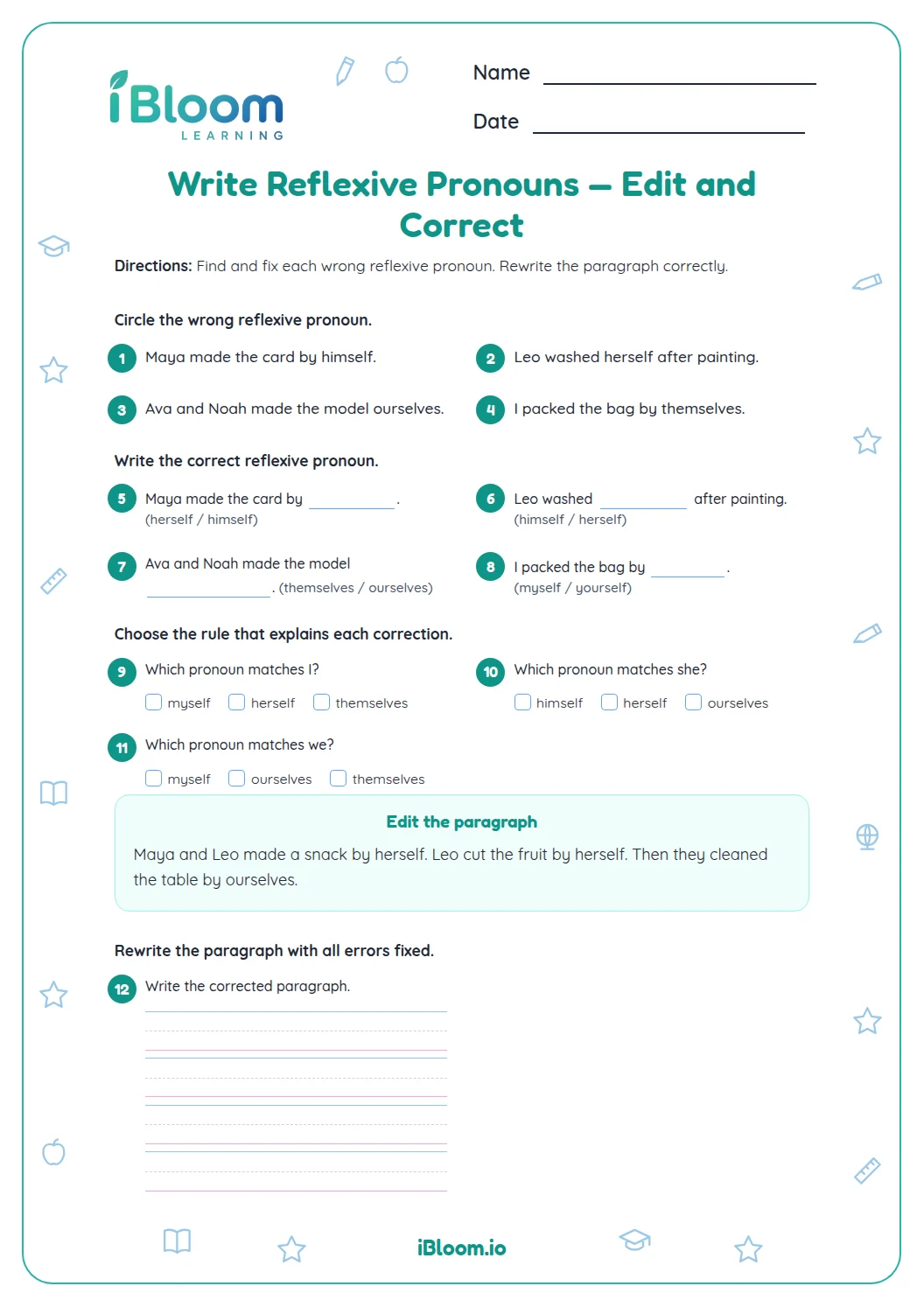
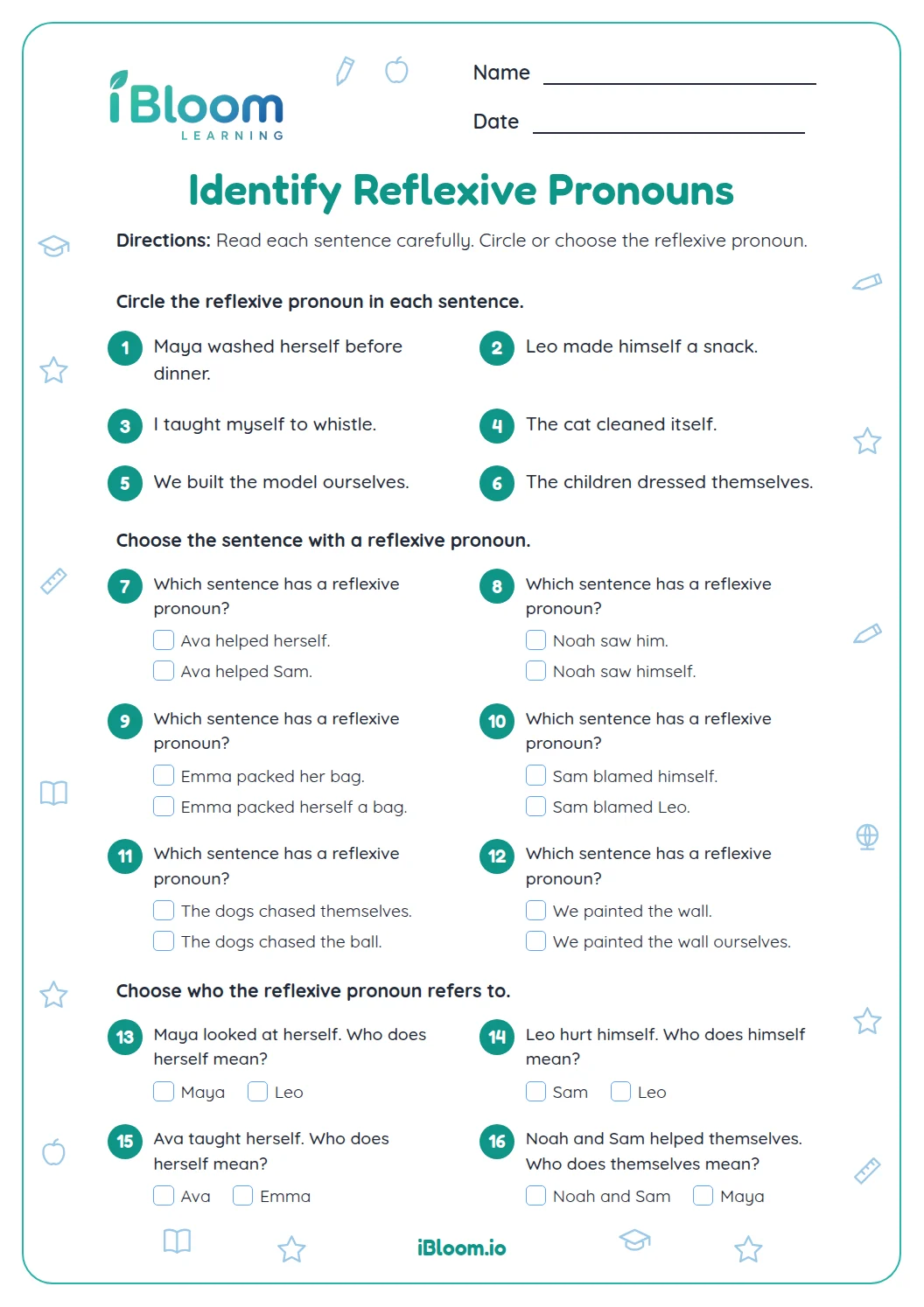
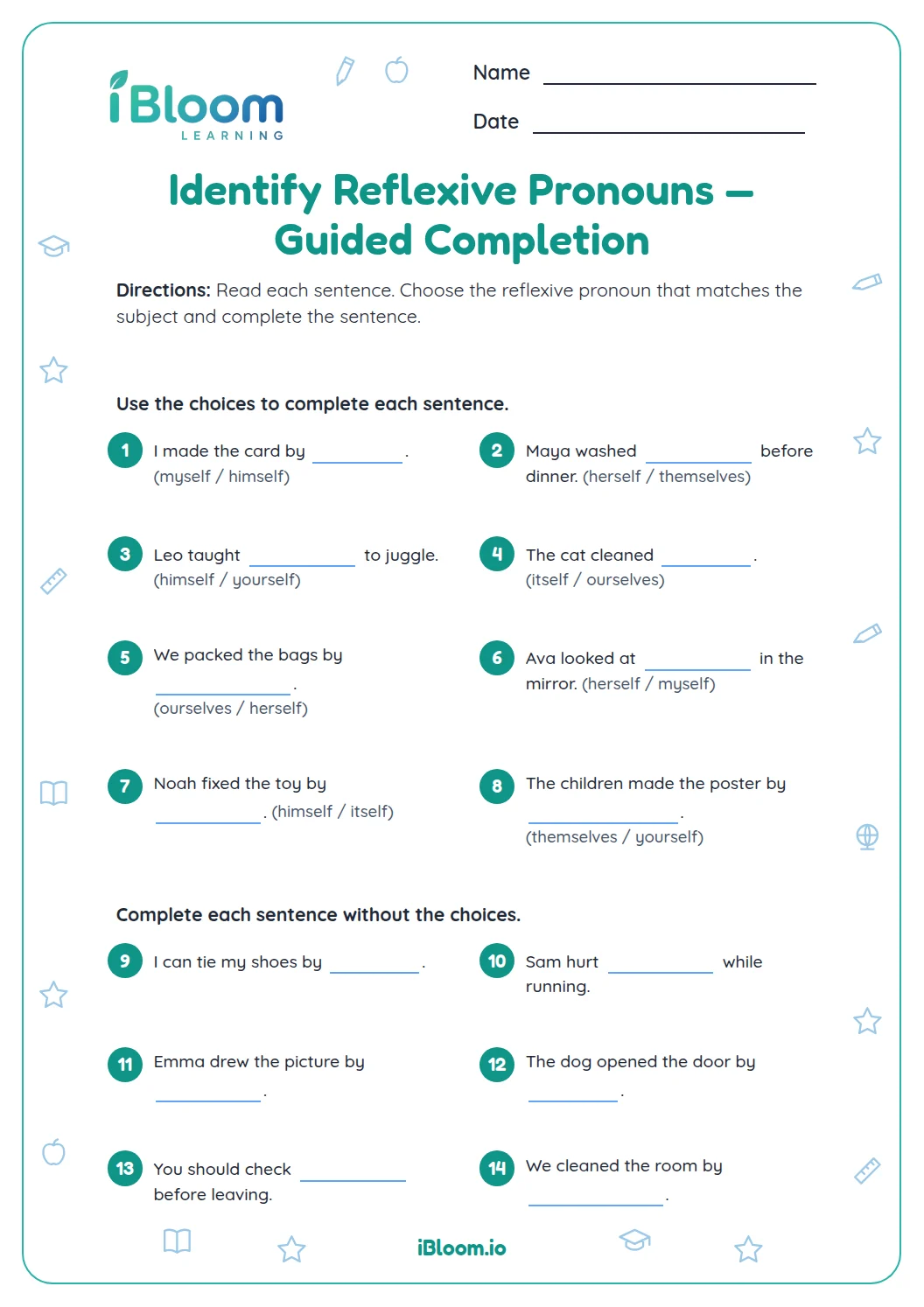
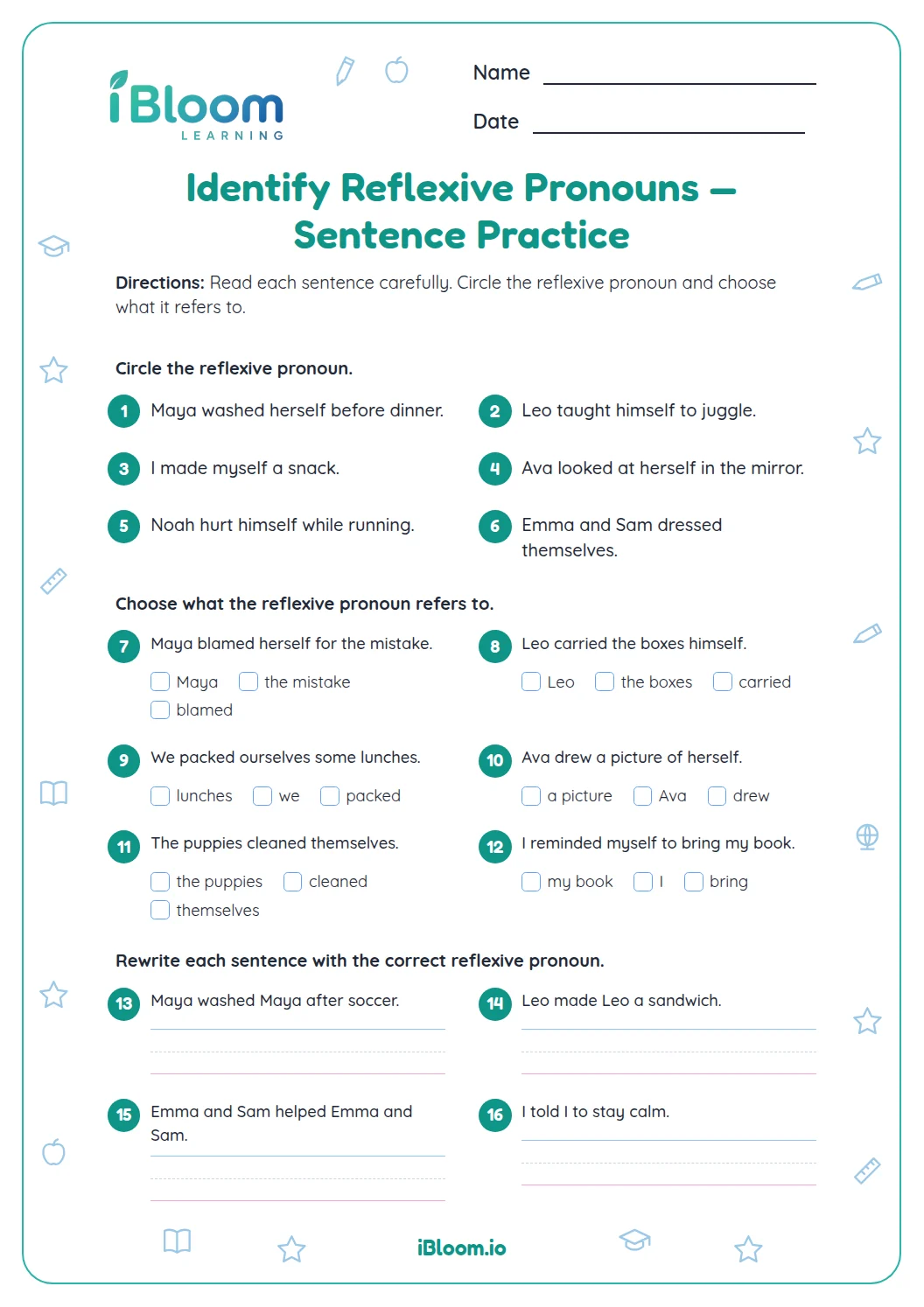
This Grade 2 worksheet practices reflexive pronouns such as myself, herself, ourselves, and themselves. Students first choose a pronoun that matches the sentence subject, then complete sentence blanks, write two original sentences, and check pronoun agreement in complete examples. The sequence moves from recognition to using the pronoun in context, like the earlier worksheet’s sentence-writing practice. A separate two-page answer key includes sample sentences for the open responses. The lesson aligns with Common Core L.2.1.c.
Aligned to L.2.1.c
How does the pronoun match the subject?
Find the person or people doing the action. Then choose the reflexive pronoun with the same point of view and number: I → myself, you → yourself, and we → ourselves.
- 1Ava and I cleaned the table by ___.
- 2Ava and I means we, so the answer is ourselves.
What should you check in a sentence blank?
Read the whole sentence before filling the blank. The subject may be a name, a group, or a pronoun such as I or we. Use that subject to decide whether the reflexive form ends in -self or -selves.
How can students use reflexive pronouns in writing?
Write a complete sentence and make sure the reflexive pronoun refers to its subject. “I packed my lunch by myself” uses myself to refer back to I. In the final choices, also check that singular team takes itself in the sentence.
- 1I packed my lunch by myself.
- 2I and myself refer to the same person.
How to use this worksheet
- 1Underline the subject in each sentence.
- 2Decide whether it names one person or more than one.
- 3Choose the matching reflexive form, such as herself or themselves.
- 4Read the completed sentence aloud to check who the pronoun refers to.
- 5For the writing items, use a complete sentence and reread for agreement.
Common mistakes and quick fixes
The mistake
Using himself with a girl’s name or herself with a boy’s name.
The fix
Match the reflexive form to the sentence subject.
The mistake
Using -selves with one subject, as in “I ... ourselves.”
The fix
Use -self for one person and -selves for more than one.
The mistake
Writing a reflexive pronoun that points to someone else.
The fix
Check that the pronoun refers back to the subject doing the action.
Common Core alignment
This worksheet practices the listed Common Core skill through its questions.
Use reflexive pronouns that match the sentence subject.
On this sheet: Children select and use reflexive pronouns in sentences.
Show the official wordingHide the official wording
Use reflexive pronouns (e.g., myself, ourselves ).
What to practice next
Make more practice
Further reading
Questions parents and teachers ask
What is a reflexive pronoun?
A reflexive pronoun refers back to the subject of the sentence. In “Maya made the card by herself,” herself points back to Maya. This worksheet asks students to choose matching forms, complete sentences, and write two examples of their own.
How many questions are included?
The worksheet has 16 questions: six multiple-choice matches, seven sentence completions, and three sentence checks. Students move from choosing a form to writing it in context. The answer key lists the matching pronoun for every item and supports checking after the page is complete.
When should a student use myself or ourselves?
Use myself when I is the subject, as in “I tied my shoes by myself.” Use ourselves when we is the subject, as in “We made the poster by ourselves.” The pronoun form changes with the subject’s person and number.
What is the difference between himself and themselves?
Himself refers back to one male person, as in “Leo packed his bag by himself.” Themselves refers back to a plural subject, as in “The children built the tower by themselves.” Find the subject first, then choose the matching form.
Are the written answers all the same?
No. Questions 12 and 13 ask students to create their own complete sentences, so the answer key gives a sample rather than the only acceptable wording. A response works when it uses a reflexive pronoun that refers back to the sentence subject and makes sense as a sentence.