




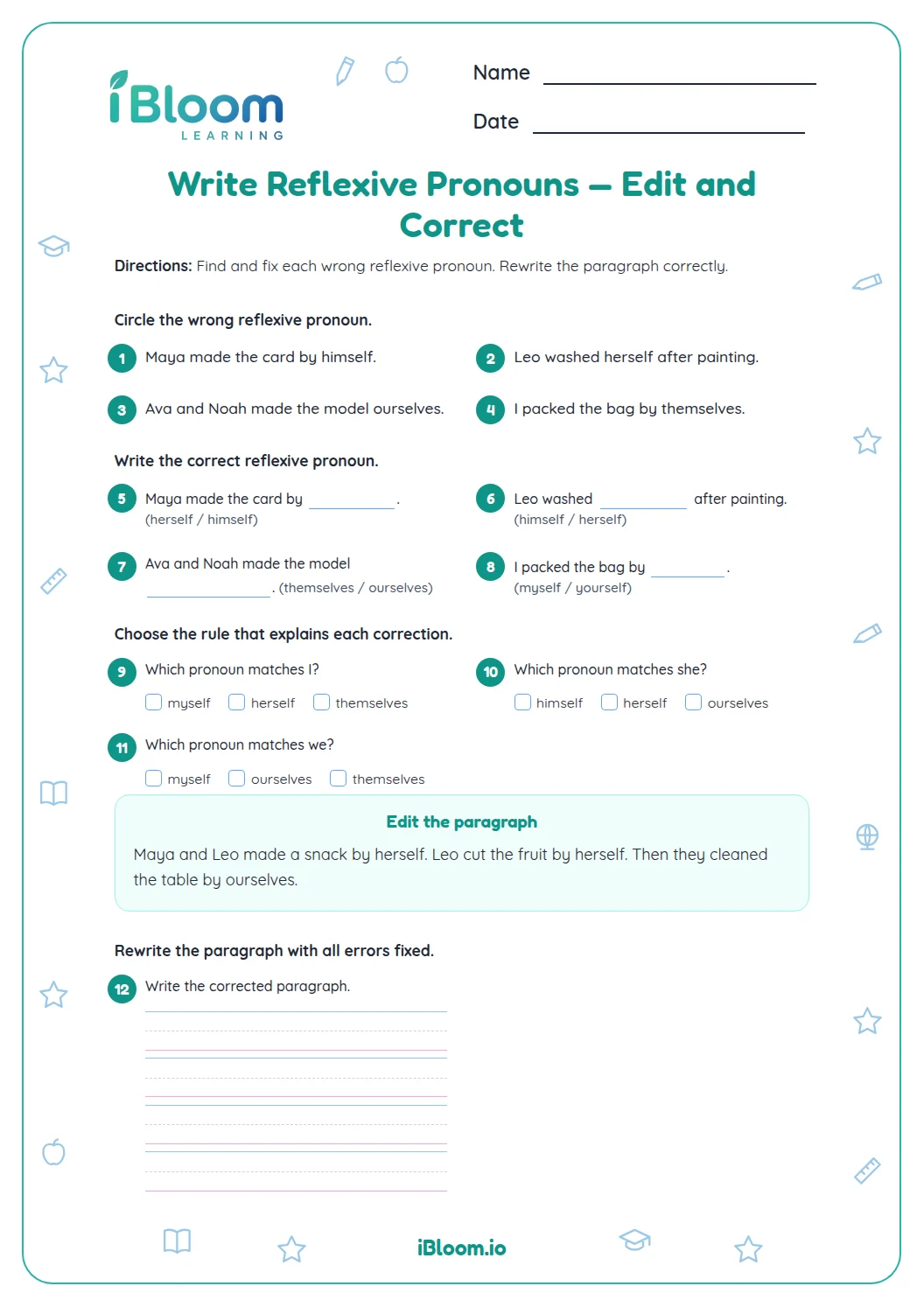
About this worksheet
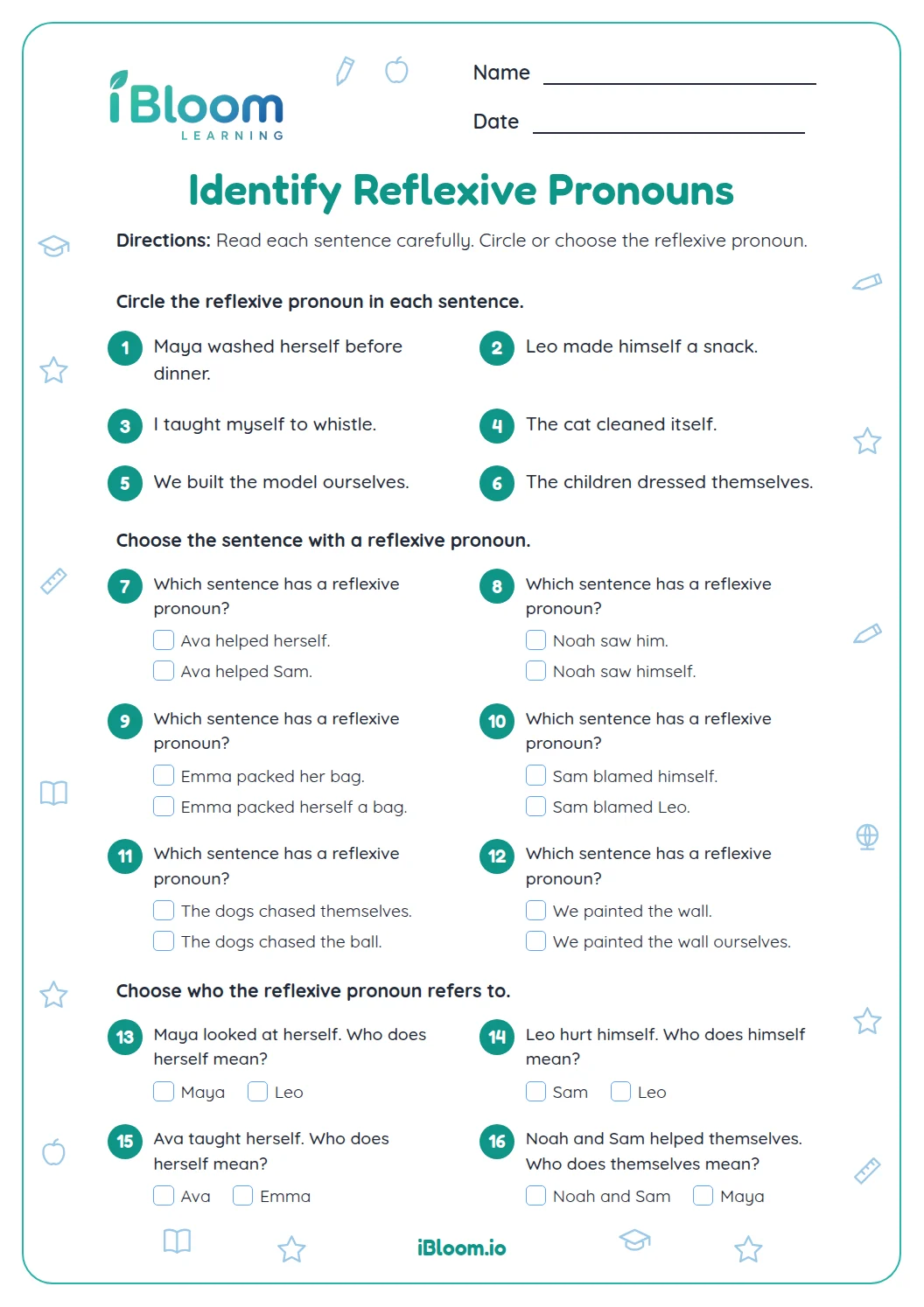
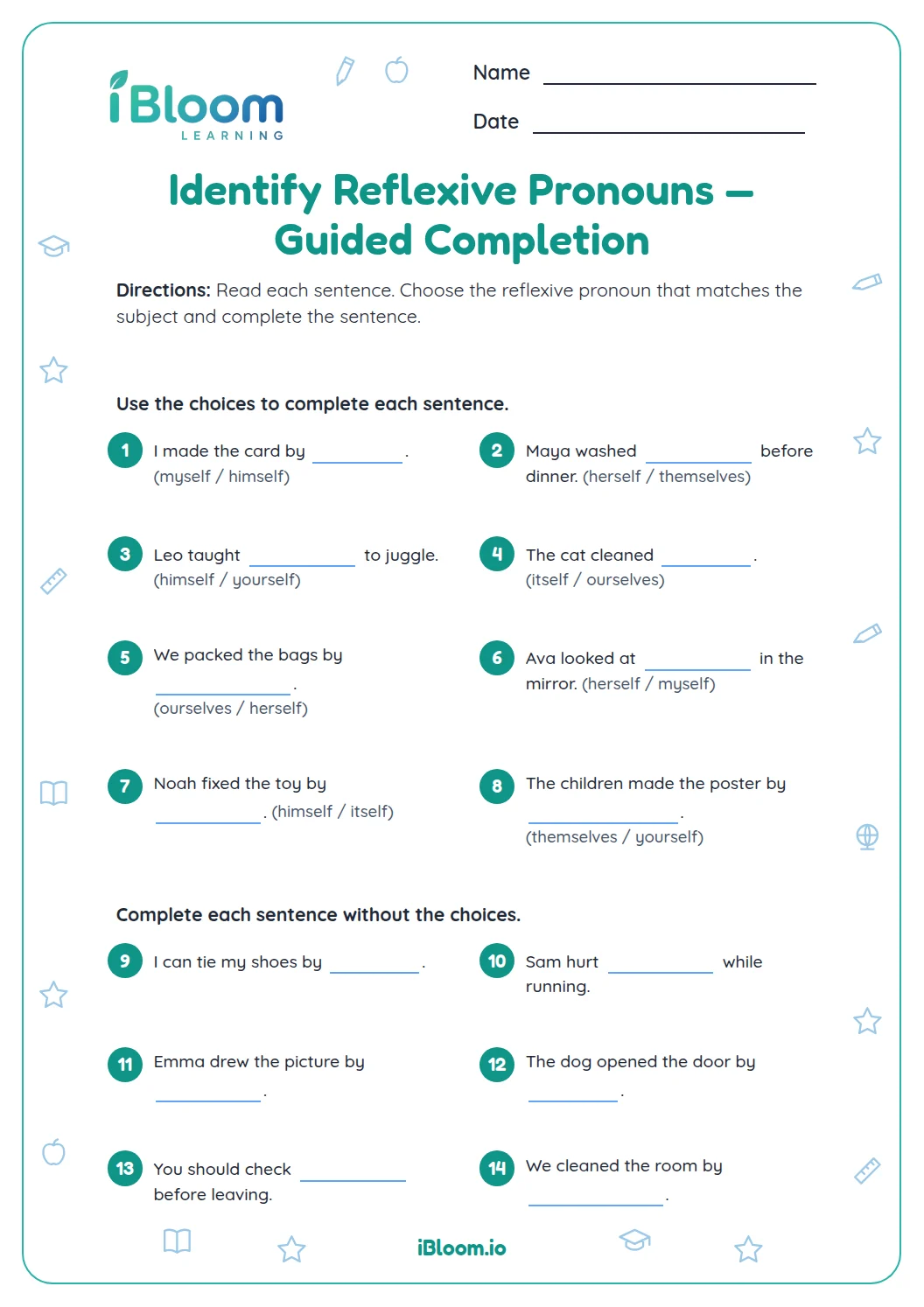
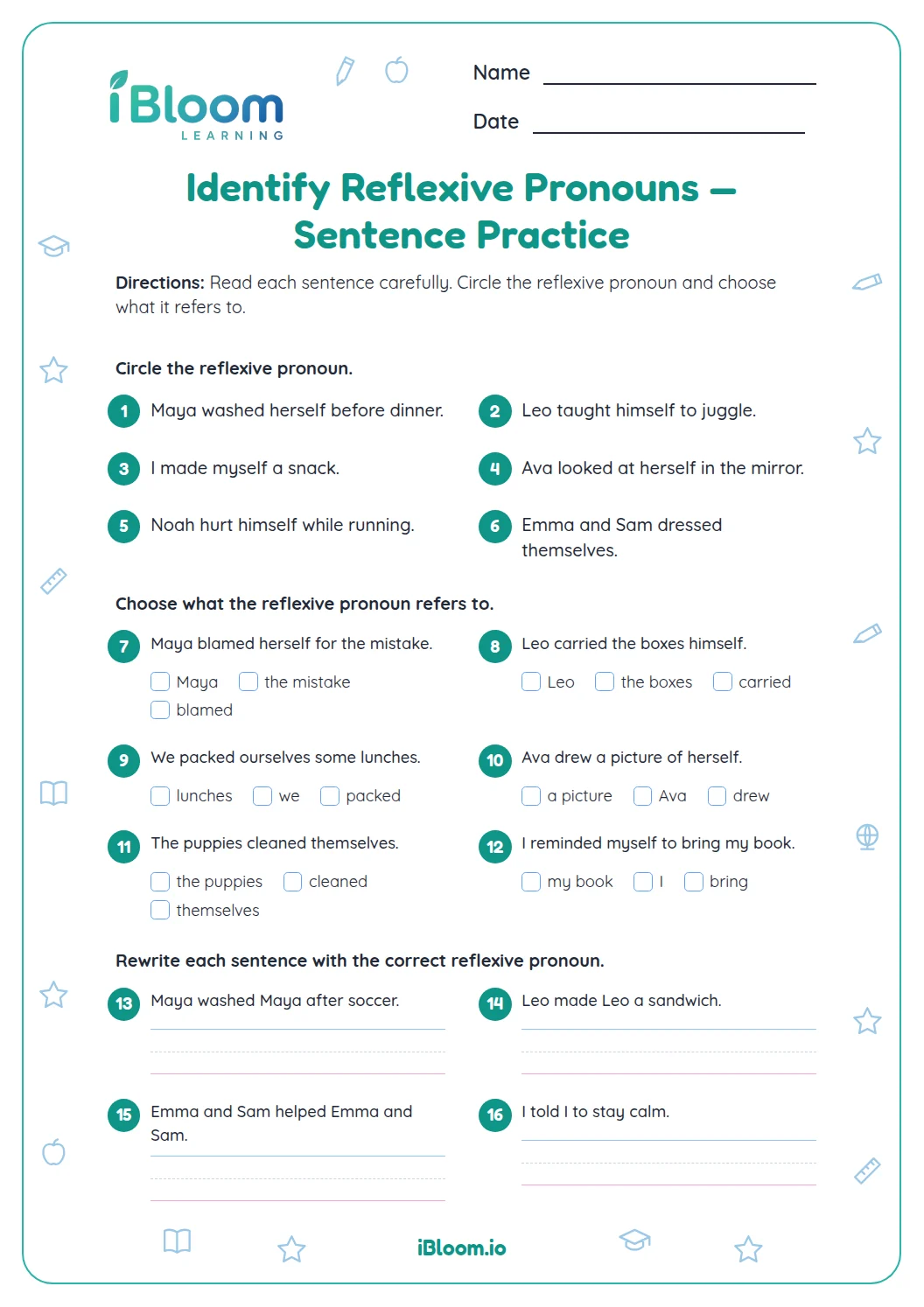
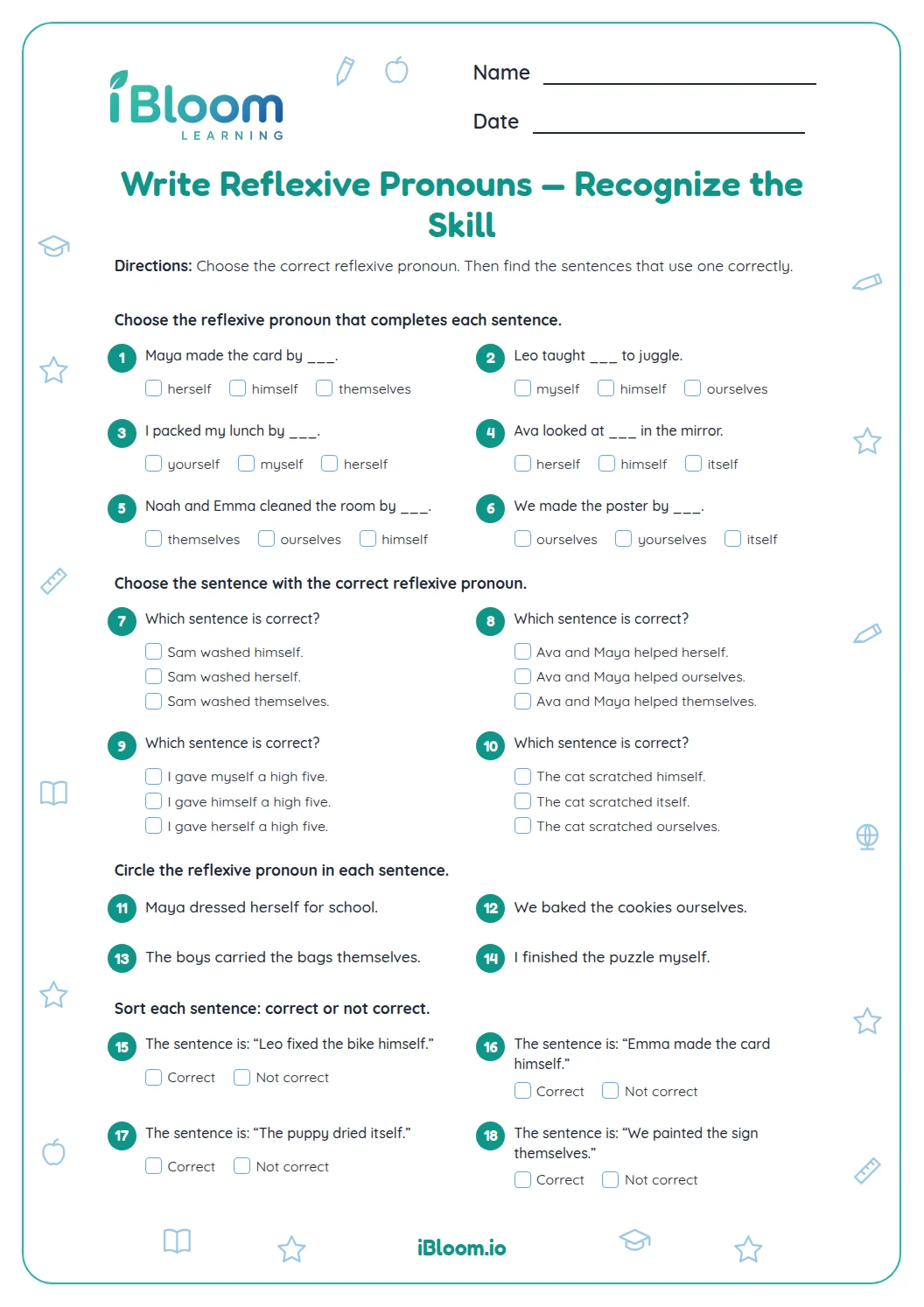
Sixteen guided items build from choosing a matching reflexive pronoun to completing and revising sentences. The printable includes a separate answer key and focused practice that moves from direct work to reasoning.
Aligned to L.2.1.c
A pronoun points back to the subject
A reflexive pronoun names the same person or thing as the subject. In “I packed my lunch myself,” myself refers back to I. The ending changes to match the subject.
- 1I → myself
- 2Mia → herself
- 3The puppies → themselves
Check who does the action
Read the subject first. Then select the matching pronoun: myself, yourself, himself, herself, itself, ourselves, or themselves. A plural subject such as the girls takes themselves.
What each part asks learners to do
Part A offers choices to establish the subject match. Part B removes the choices so learners retrieve the form. Part C checks usage in editing and original sentences.
- Part A: select a matching form
- Part B: supply the missing reflexive pronoun
- Part C: edit, select, and write
How to use this worksheet
- 1Find the subject before choosing or writing a pronoun.
- 2Decide whether the subject names one person, one thing, or a group.
- 3Match the pronoun form to that subject: herself, itself, ourselves, or themselves.
- 4Read the completed sentence aloud to check that the action returns to the subject.
- 5Use the separate key to compare answers; accept a clear original sentence for question 15.
Common mistakes and quick fixes
The mistake
Using a pronoun that does not match the subject, such as “Mia made it himself.”
The fix
Find who acts, then choose the matching form: himself, herself, or themselves.
The mistake
Using a reflexive pronoun when the sentence needs an object pronoun.
The fix
Check that the pronoun refers back to the subject doing the action.
The mistake
Using themselves with one person or itself with a person.
The fix
Match the pronoun form to the exact subject in the sentence.
Curriculum alignment
This worksheet practices the following Common Core skills.
Use reflexive pronouns such as myself and ourselves.
On this sheet: Sentence completion and editing practice supports grade-level grammar and usage.
Show the official wordingHide the official wording
Use reflexive pronouns (e.g., myself, ourselves).
What to practice next
Further reading
Questions parents and teachers ask
What makes a pronoun reflexive?
A reflexive pronoun refers back to the subject that performs the action. In “I packed my lunch myself,” myself refers back to I. This worksheet asks learners to match that form to the subject in each sentence.
Which reflexive pronouns are practiced?
The page practices myself, yourself, himself, herself, itself, ourselves, and themselves. Learners choose some forms and write others. The subject gives the clue: one girl takes herself, while a group of students takes themselves.
How can I help a learner choose the right form?
Ask who performs the action, then identify whether the subject is one person, one thing, or a group. Have the learner reread the sentence with the chosen pronoun. The completed sentence should make clear that the action returns to that subject.
What does guided completion include?
Part A has six multiple-choice sentences. Part B has five blanks to complete without a word bank. Part C asks learners to identify correct use, revise a sentence, and write an original example. The key provides a sample for the open response.
Why does “The bird built itself a nest” use itself?
The bird is the subject, and itself refers back to that subject. The sentence describes the bird building the nest for its own use. This item contrasts with pronouns used for a person or a group.
Can answers to the original sentence question vary?
Yes. For “Write a sentence using the reflexive pronoun herself,” any clear sentence that uses herself to refer back to a female subject is acceptable. The answer key gives one sample, “Nora taught herself a song,” rather than the only possible response.