
About this worksheet
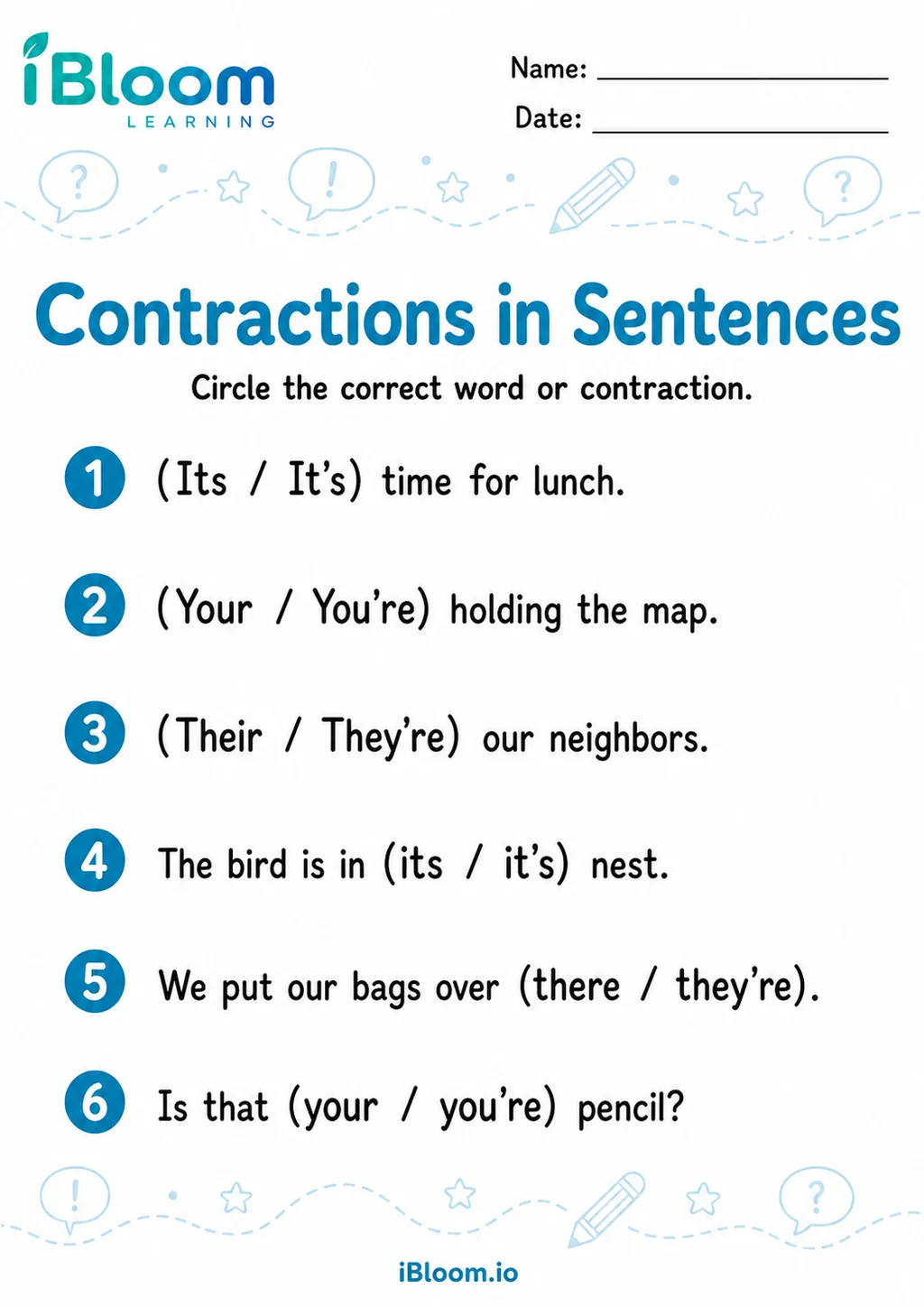
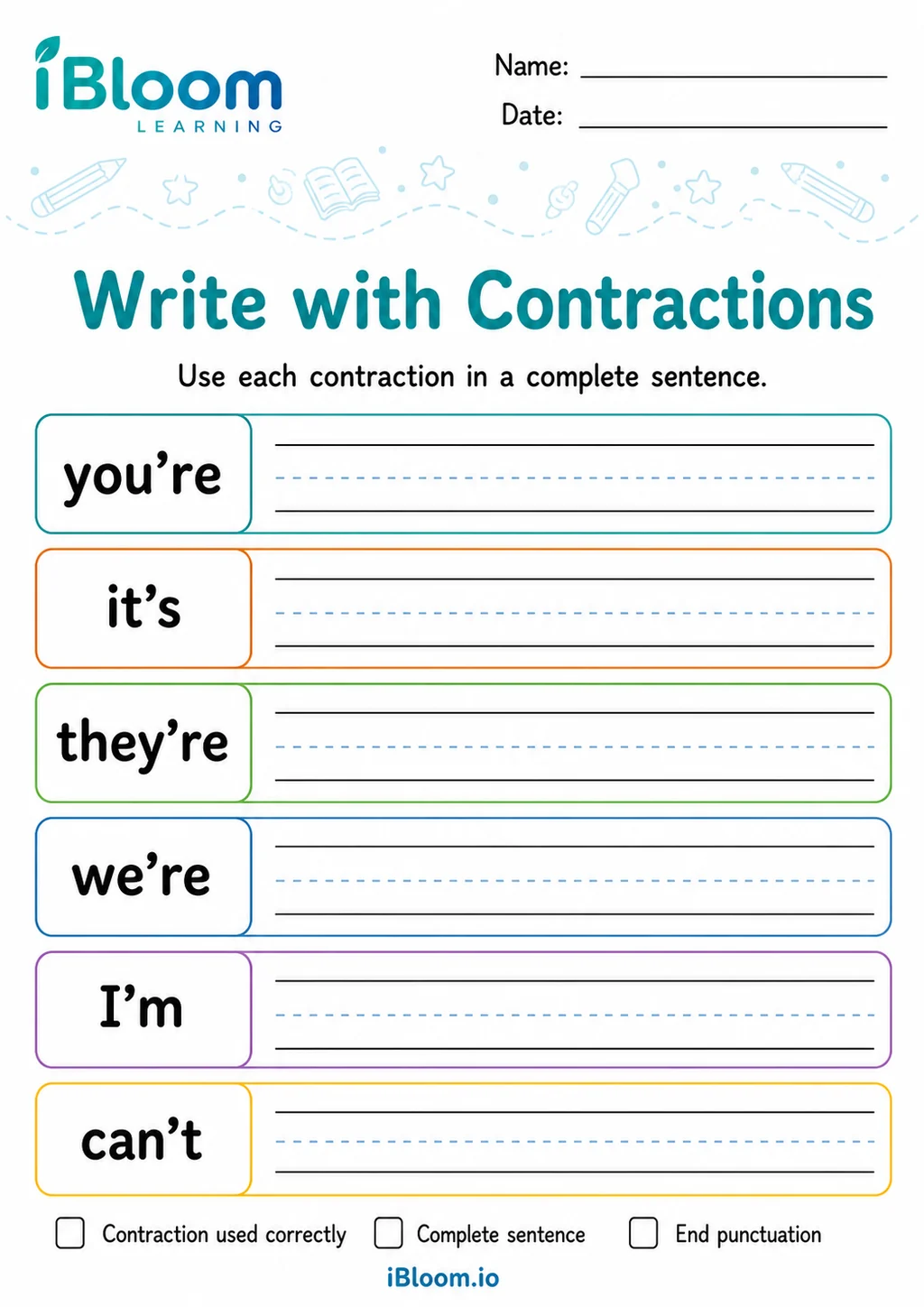
This Grade 2 printable gives students 16 sentence completions for confusing contractions and possessive words, including you’re/your, it’s/its, they’re/their and negative contractions. Context clues make each choice clear. The page includes an answer key and practices Common Core L.2.2.c.
Aligned to L.2.2.c
What does this worksheet practice?
Students use sentence meaning to choose between contractions such as you’re and possessive words such as your. Items also contrast it’s with its and practice negative contractions.
How can I work through an example?
For “The puppy wagged ___ tail,” test it’s by saying “it is.” “The puppy wagged it is tail” does not make sense, so its is the possessive choice.
- 1The puppy wagged its tail. → Its shows that the tail belongs to the puppy.
How can students check their work?
Expand a contraction such as you’re to you are and reread the sentence. For its and your, check whether the word shows ownership. These two checks help explain why “The puppy wagged its tail” has no apostrophe.
How to use this worksheet
- 1Read the complete sentence around each blank.
- 2For you’re, they’re, or we’re, test whether the words you are, they are, or we are fit.
- 3For its and your, check whether the sentence shows ownership.
- 4In Part B, choose a contraction or possessive form that fits the sentence meaning.
- 5Use the key to check the apostrophe and reread each completed sentence.
Common mistakes and quick fixes
The mistake
Choosing by sound alone.
The fix
Read the whole sentence and check its meaning.
The mistake
Adding an apostrophe to every ownership word.
The fix
Possessive its has no apostrophe.
The mistake
Forgetting the apostrophe in a contraction.
The fix
Check whether two words are shortened into one.
Common Core alignment
This page practices the language skill described in L.2.2.c.
Use apostrophes in contractions and frequently occurring possessives.
On this sheet: Students distinguish contractions from possessive forms in sentence contexts.
Show the official wordingHide the official wording
Use an apostrophe to form contractions and frequently occurring possessives.
What to practice next
Make more practice
Further reading
Questions parents and teachers ask
What does contractions and possessive words mean?
A contraction joins words and uses an apostrophe, as in you’re for you are. A possessive word shows ownership, as in your backpack or its tail. These 16 sentence choices practice telling those forms apart, along with negative contractions such as can’t.
How can a student tell your from you’re?
Read you’re as you are and see whether the sentence still makes sense. “You’re ready for the show” means “You are ready.” “Your backpack” shows ownership, so your fits. The worksheet uses sentence meaning to make this distinction. Use the sentence and the answer choices together.
How many questions are on this worksheet?
There are 16 multiple-choice sentence questions in two parts. The first part contrasts contractions with possessives, and the second uses additional sentence clues and negative contractions. The printable has two worksheet pages and two answer-key pages, so students can check each part on both pages.
Why does its sometimes have no apostrophe?
Its without an apostrophe shows that something belongs to it, as in “The puppy wagged its tail.” It’s with an apostrophe means it is. Try replacing it’s with “it is”; if that does not fit, its may be the possessive form.
How should students check a confusing contraction?
Read each option aloud inside the whole sentence. Expand a contraction such as they’re to they are, then check whether the sentence works. For a possessive, ask what belongs to whom. The answer key identifies the intended form for each item.