
About this worksheet
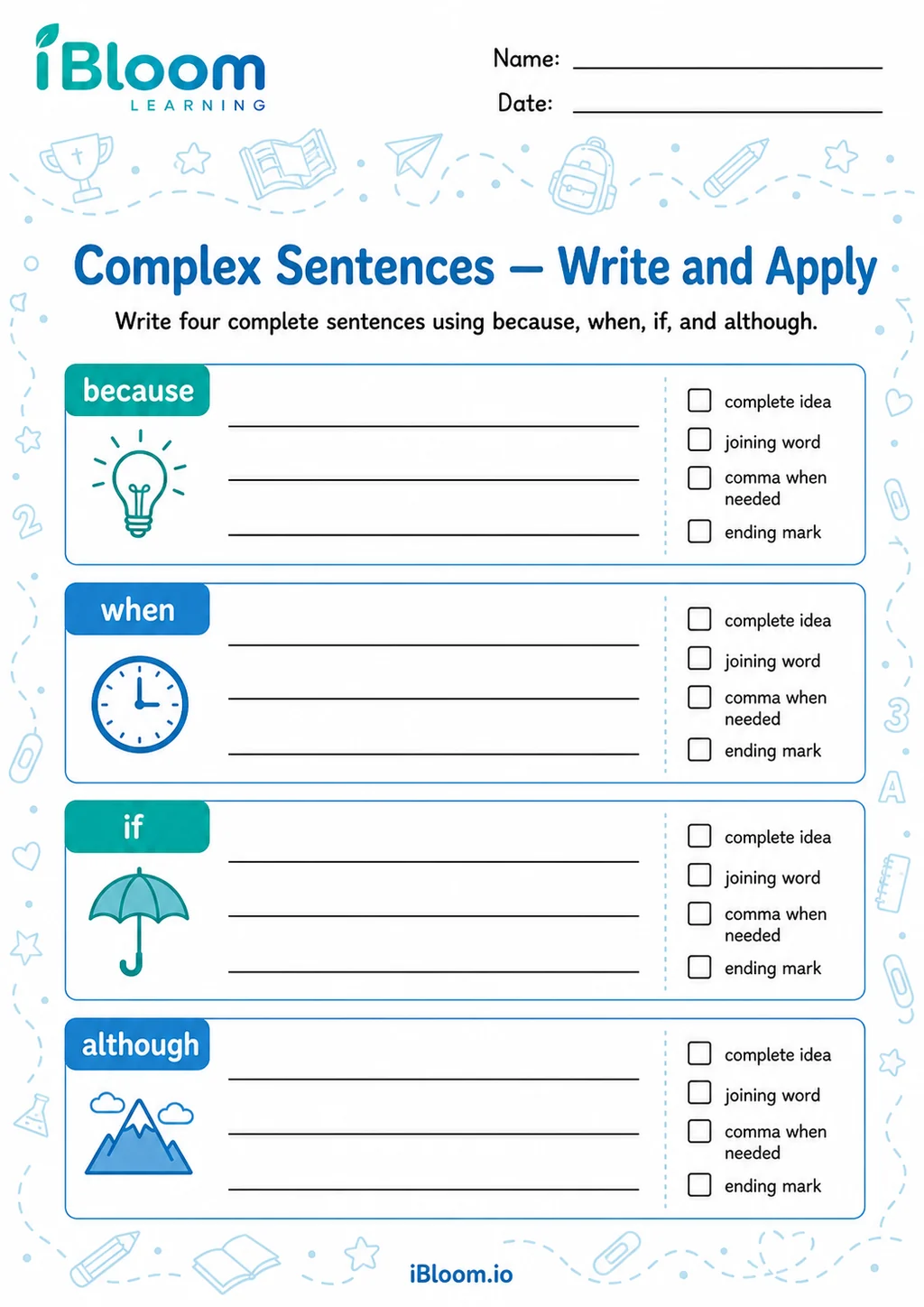
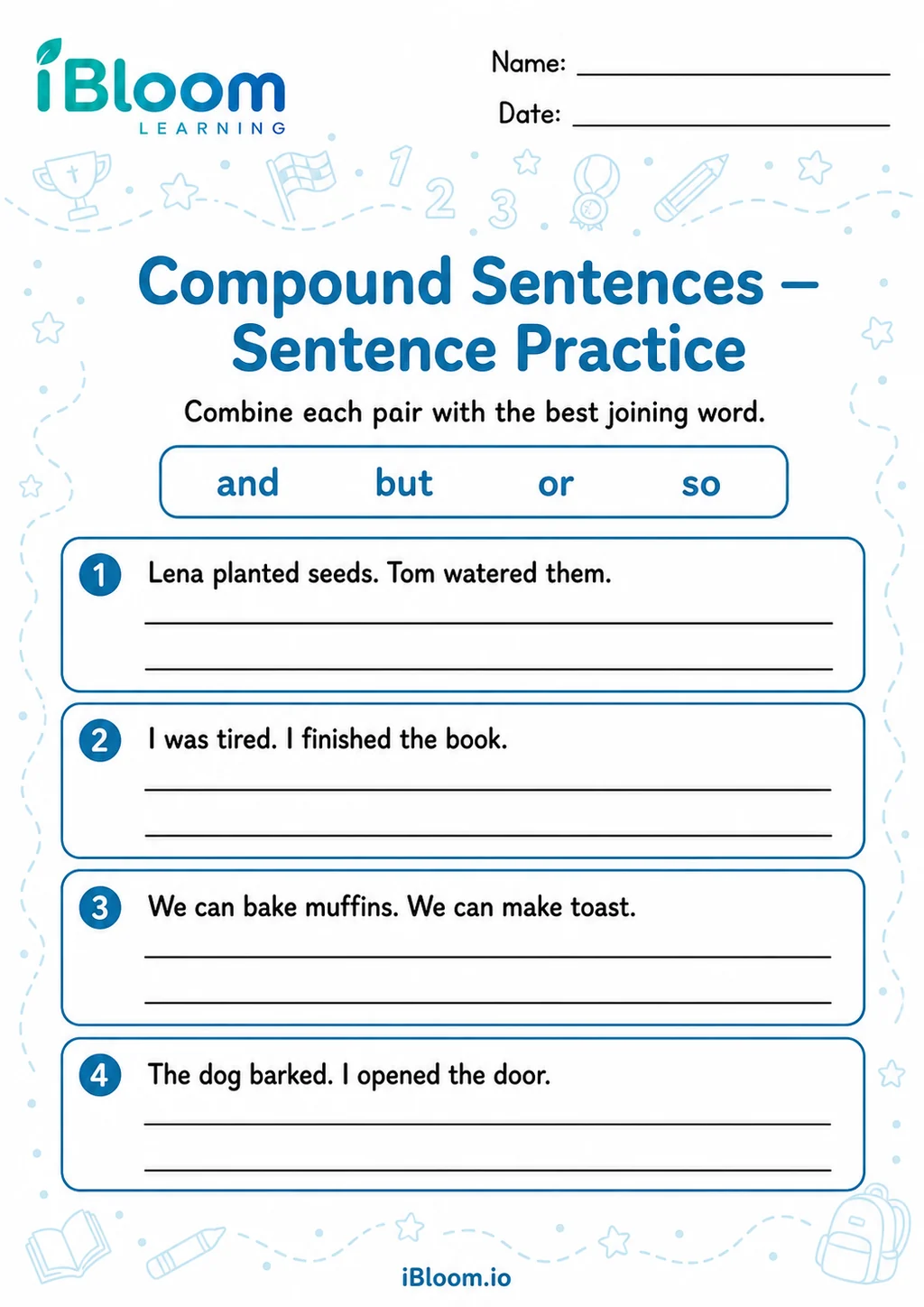
This free Grade 2 worksheet gives children guided practice completing complex sentences. It begins with four choices based on familiar starters: because, when, if, and although. Children then add their own endings to four starters and write four whole sentences from brief situations. The focus is keeping a complete thought after the starter while showing a reason, time, condition, or contrast. Children practice producing complex sentences, as described in Common Core L.3.1i. The separate answer key marks the fixed choices and gives samples for the eight answers that can vary.
Aligned to L.3.1i
Why does a starter need another part?
“Because I was hungry” tells a reason but leaves the reader waiting to learn what happened. Adding “I ate a snack” finishes the thought. The added part has a subject, I, and an action, ate.
In Part A, only one ending for each starter makes a complete sentence. The other choices are phrases, such as “a crunchy snack,” that leave the thought unfinished.
- 1Starter: Because I was hungry,
- 2Choose: I ate a snack.
- 3Complete sentence: Because I was hungry, I ate a snack.
- 4Check: “I ate a snack” makes sense by itself.
What do because, when, if, and although tell a reader?
Because gives a reason. When tells about time. If introduces a condition and tells what can happen when that condition is met. Although sets up a contrast: the hill was steep, yet the walkers still reached the top.
Part B uses each word once. Children complete starters about hot soup, a bell, a dry plant, and a heavy box. Ask them to explain how their ending fits the opening before they write it.
How does the last part build independence?
Part C gives a situation and a starting word, but children supply the whole sentence. They connect being cold with putting on a coat, sunset with outdoor lights, finishing a book with returning it, and rain with enjoying a walk.
Remind children to begin with the supplied word, put a comma after the opening part, and end the sentence with a period. Reread each whole sentence to check both grammar and meaning.
How to work through this worksheet
- 1Read “Because I was hungry” aloud and pause to show that the listener expects more.
- 2For Part A, try every ending and choose the one that finishes a complete thought.
- 3Before Part B, explain the meanings of because, when, if, and although with the printed starters.
- 4Let your child say each ending aloud, then write it after the comma and add a period.
- 5For Part C, use each situation to write a whole sentence, then check the starter, comma, and ending.
Mistakes to notice and ways to help
The mistake
Completing “Because I was hungry” with only “a snack.”
The fix
Add who did something and the action: “I ate a snack.”
The mistake
Writing “Although the box was heavy, it weighed a lot.”
The fix
Keep the contrast. An ending such as “I carried it inside” tells what happened despite the weight.
The mistake
Putting a period after “When the sun set” and leaving it alone.
The fix
Keep the starter attached to the complete thought with a comma: “When the sun set, the outdoor lights came on.”
Common Core alignment
Complete and write complex sentences using four familiar joining words.
On this sheet: Children add a main clause to each dependent starter and write complete complex sentences.
Show the official wordingHide the official wording
Produce simple, compound, and complex sentences.
What to practice next
Make more practice
Further reading
Questions parents and teachers ask
What makes the sentences on this sheet complex?
Each has an opening part that depends on another part to finish the thought. “Because I was hungry” gives a reason, and “I ate a snack” supplies the complete main thought. Joining those parts makes one complex sentence. The sheet repeats that pattern with four different starter words.
Do children need to know the term dependent clause?
Children can complete this sheet by thinking about an unfinished starter and a complete thought. Read both parts aloud and ask whether the sentence makes sense. If your child knows grammar terms, you can call the opening a dependent clause and the complete thought a main clause.
Are the answers in Part B the only correct endings?
No, Part B allows different endings that complete the grammar and fit the meaning. For hot soup, waiting for it to cool is one possibility. Check that the child supplies a complete thought and a sensible connection. The answer key marks these flexible responses with “Sample.”
How can I explain although simply?
Explain although as “even though.” In question 4, the hill was steep, but the walkers still reached the top. Have your child say that contrast aloud before choosing the ending. Later, the heavy box and rainy walk give two more chances to connect a difficulty with an outcome.
Where should the comma go in Part C?
Put the comma after the opening part that starts with Because, When, If, or Although. In “Because I was cold, I put on a coat,” it follows cold. Ask your child to find where the reason or time information ends, then check that the rest forms a complete thought.