
About this worksheet
This Grade 2 worksheet gives children practice joining complete ideas to form compound sentences. They use and, but, or, and so to show addition, contrast, choice, or result, then combine sentence pairs with a comma before the conjunction. The 16 questions move from guided completion to independent choices and sentence writing.
Aligned to L.2.1.F
What will children practice?
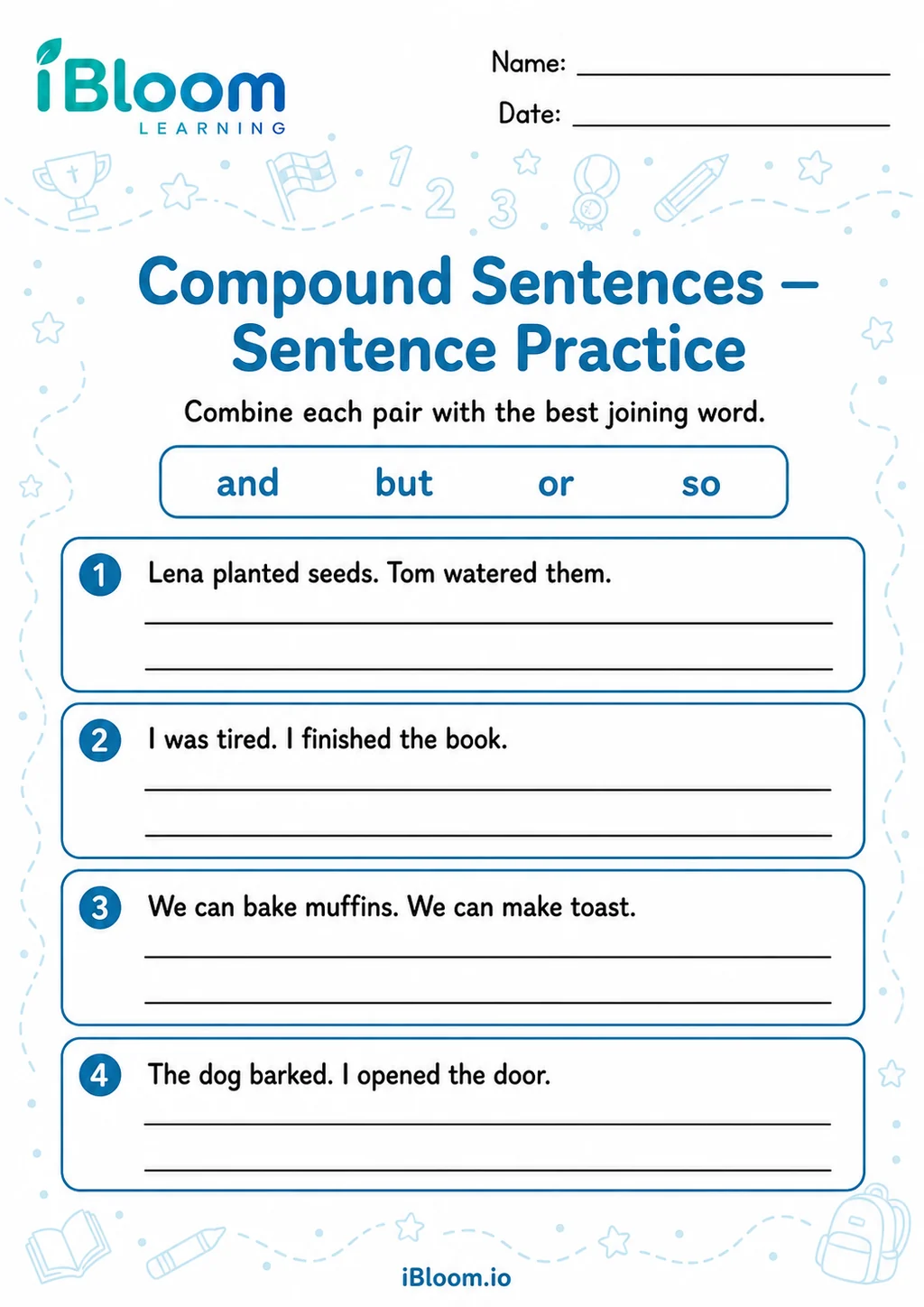
Parts A and B ask children to select a connector that fits the relationship between two ideas. Part C gives pairs of complete sentences to combine, with a comma before the conjunction.
- Part A: 8 sentence completions
- Part B: 4 connector choices
- Part C: 4 sentence combinations
Where does the comma go?
When a conjunction joins two complete sentences, place a comma before it. In “The room was dark, so I turned on the light,” both sides can stand as sentences.
How to use the worksheet
- 1Read both ideas before choosing a connector.
- 2Ask whether the ideas add, contrast, offer a choice, or show a result.
- 3For sentence pairs, check that each idea is a complete sentence.
- 4Place a comma before the conjunction joining the two sentences.
Common mix-ups
The mistake
Using and when the second idea contrasts with the first. Look for a clue that the ideas differ.
The fix
The mistake
Leaving out the comma before a conjunction joining two complete sentences.
The fix
The mistake
Choosing so when the second idea gives a choice. Use or for alternatives.
The fix
Curriculum alignment
This page practices Grade 2 conventions for forming and expanding sentences.
Produce, expand, and rearrange complete simple and compound sentences.
On this sheet: The worksheet questions give direct practice with this skill.
Show the official wordingHide the official wording
Produce, expand, and rearrange complete simple and compound sentences.
What to practice next
Make more practice
Further reading
Questions parents and teachers ask
What makes a compound sentence?
A compound sentence joins two complete ideas, often with a comma and a coordinating conjunction. On this worksheet, children use and, but, or, and so to show how the ideas connect. They also combine sentence pairs and check that both sides can stand as sentences.
When should a child use “but”?
Use but when the second idea contrasts with or differs from the first. For example, “I wanted to skate, but the pond was not frozen” shows that the second fact prevents the first idea from happening. The worksheet includes a clear context clue for this choice.
Does a compound sentence always need a comma?
For this worksheet’s sentences, place a comma before the conjunction when it joins two complete sentences. Read each side on its own: if each side has a subject and tells something, use the comma before and, but, or, or so.
How long does this worksheet take?
Plan for about 15 minutes, depending on how much time the child needs to write the final sentence pairs. The first questions are short completions; the last four ask children to combine ideas and add punctuation. The answer key includes sample sentences.
What is included in the answer key?
The key gives the intended conjunction for each completion and a sample compound sentence for each writing prompt. Other sentences can also be correct when they preserve both ideas and use a fitting conjunction with the comma in the right place.