
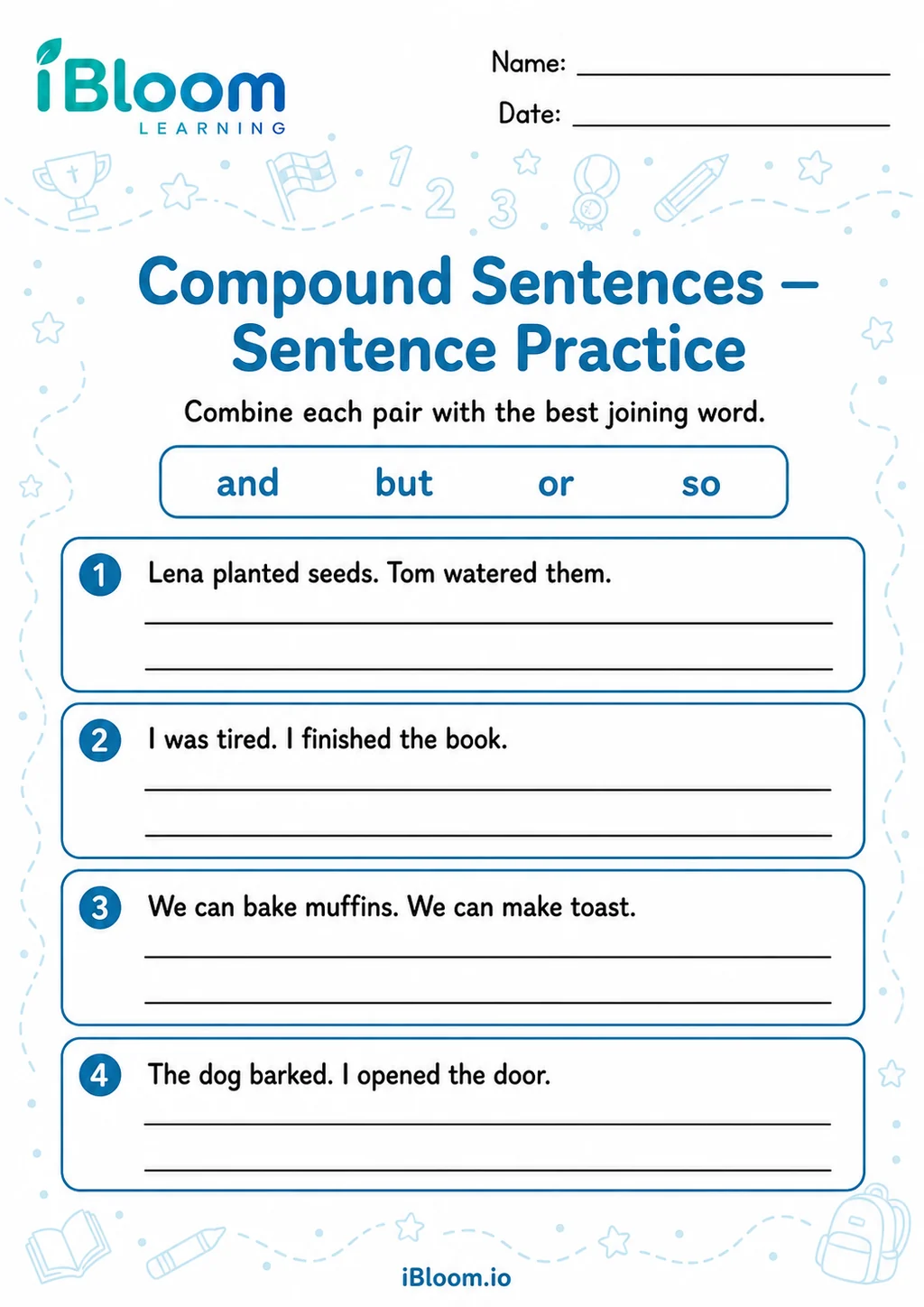
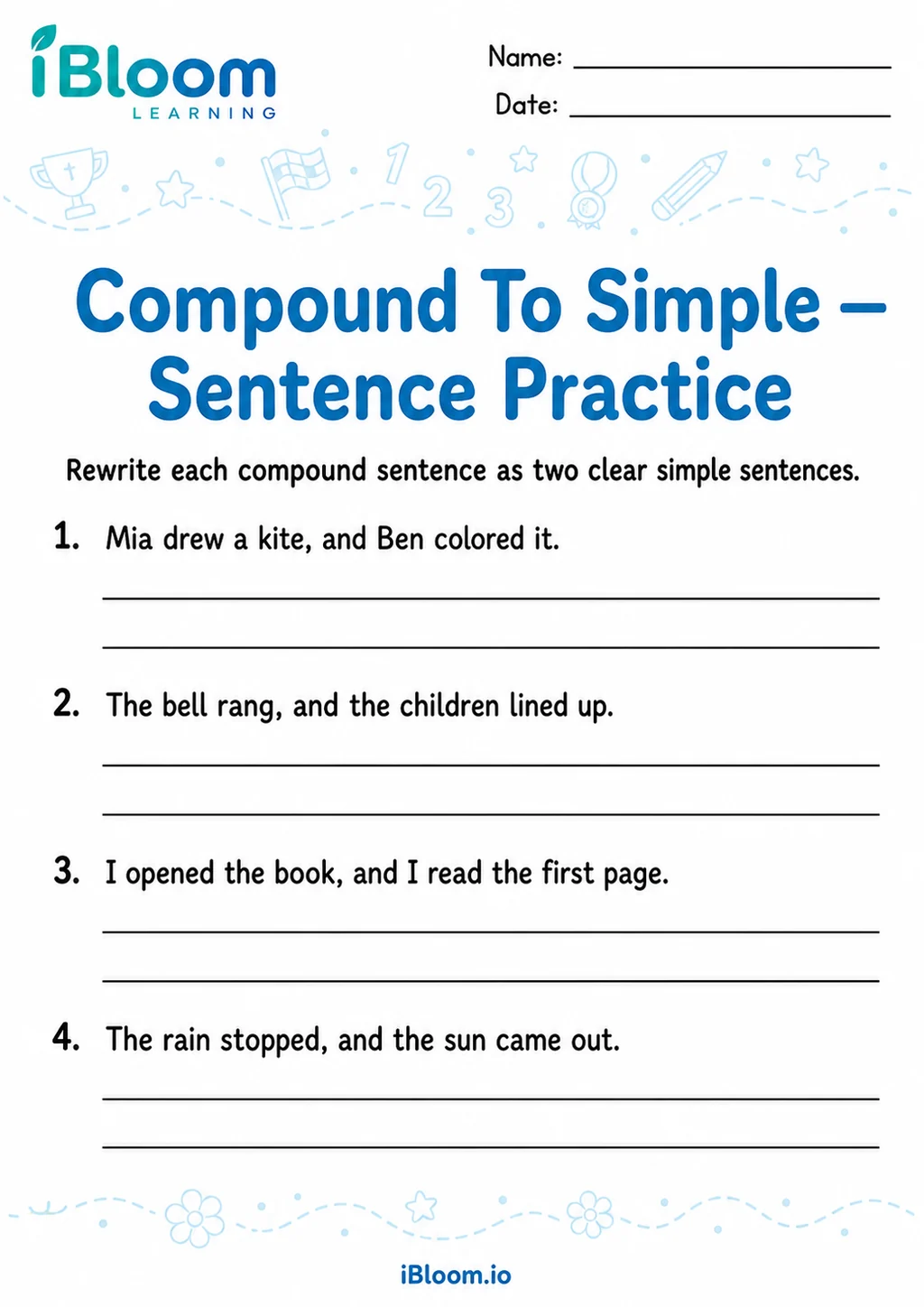
About this worksheet
This free printable worksheet helps Grade 2 children join two short ideas into one compound sentence with a comma and a joining word. In Part A, they pick and, but, or or so for four sentences such as “It was very cold, ___ we wore our coats.” In Part B, they spot which sentence is compound and where the comma belongs. In Part C, they write four sentences of their own, one for each joining word. It practices Common Core L.2.1.f, and the separate answer key gives a sample sentence for every writing line.
Aligned to L.2.1.f
What makes a sentence compound?
A compound sentence is two complete sentences joined into one. Each half has its own who and what happened: “Dad cooked dinner” and “I set the table.” Put a comma after the first idea, add a joining word, and you get “Dad cooked dinner, and I set the table.”
That is different from one idea with two names in it. “Sam and Mia swam” is a single idea about two children, so it has no comma. “Sam ran, and Mia swam” holds two ideas, one about Sam and one about Mia.
- 1Sam and Mia swam. → one idea, no comma
- 2Sam ran, and Mia swam. → two ideas: Sam ran / Mia swam
- 3Answer: Sam ran, and Mia swam.
How do children choose between and, but, or and so?
Each joining word has a job. Reading both halves aloud with each word tried in turn is the quickest check. In “Mia likes apples, ___ Sam does not,” the two ideas pull in different directions, so but fits. In “It was very cold, ___ we wore our coats,” the cold is the reason for the coats, so so fits.
- and: adds one more matching idea
- but: shows a difference
- or: gives a choice
- so: shows a reason and what happened because of it
What is on this worksheet?
Ten questions over two pages. Parts A and B are quick multiple-choice questions. Part C has four writing lines, one for each joining word, and every prompt gives a topic so that children do not have to invent one: a pet, something liked and not liked, a weekend choice, and a reason with a result.
Because answers in Part C vary, the key shows one sample sentence per line. Check each child’s sentence against the three-part pattern rather than against the sample.
- Part A: 4 questions, pick the joining word that fits
- Part B: 2 questions, spot the compound sentence and the right comma
- Part C: 4 writing lines, one each for and, but, or and so
- Answer key with a sample sentence on every writing line
How do you check a child’s compound sentence?
Use a three-part check: two complete ideas, a comma, then the joining word. Ask your child to cover everything after the comma and read the first part, then cover the first part and read the rest. If both halves sound like sentences, the sentence passes the idea test.
Next look for the comma before the joining word and a period at the end. A missing comma is easy to fix once you point to the exact spot.
How to use this worksheet at home or in class
- 1Say two short ideas aloud, such as “I like soup” and “my sister likes salad,” and ask how one sentence could hold both.
- 2Do question 1 together. Read it with each joining word and decide which one makes sense.
- 3Let your child finish Parts A and B alone, then read each finished sentence aloud.
- 4For Part C, have your child say the sentence before writing it, then write the comma before the joining word.
- 5Use the three-part check on each sentence: two complete ideas, a comma, a joining word.
- 6Check Parts A and B with the answer key and talk about any miss.
Common mistakes and quick fixes
The mistake
Choosing a joining word that does not fit, such as “It was very cold, but we wore our coats.”
The fix
Ask what the second idea is doing: giving a reason (so), a difference (but), a choice (or) or one more idea (and).
The mistake
Leaving out the comma: “I like pizza but I do not like olives.”
The fix
Have your child touch the spot where the first idea ends and write a comma there, before the joining word.
The mistake
Ending with only part of an idea after the joining word: “I like pizza, but not olives.”
The fix
Check that the second part has its own who and what: “I do not like olives” stands alone, but “not olives” does not.
Common Core alignment
Write complete simple and compound sentences.
On this sheet: Part C asks children to produce four compound sentences, one with each joining word, and Parts A and B build the pattern first.
Show the official wordingHide the official wording
Produce, expand, and rearrange complete simple and compound sentences (e.g., The boy watched the movie; The little boy watched the movie; The action movie was watched by the little boy).
What to practice next
Make more practice
Further reading
Questions parents and teachers ask
What is a compound sentence for 2nd grade?
It is two complete sentences joined by a comma and a joining word such as and, but, or or so. For example, “I ran, but Mia swam” holds two ideas: I ran, and Mia swam. Each part can stand alone, which gives children an easy test for whether a sentence is really compound.
When do you use a comma in a compound sentence?
Put the comma after the first complete idea and before the joining word, as in “We can walk to the park, or we can ride our bikes.” Question 6 checks exactly that spot. A sentence with only one idea, such as “Sam and Mia swam,” needs no comma.
Can children choose any topic in Part C?
Each writing line names its joining word and a loose topic: a pet, likes and dislikes, a weekend choice, and a reason with its result. Children can write whatever they like inside that frame. The key’s sample sentences are examples only, so any sentence with two ideas, a comma and the right word is correct.
Why do Parts A and B come before the writing?
Choosing a word is easier than inventing a whole sentence, so Part A lets children hear what each joining word does before they write. Part B then shows the shape of the sentence, comma included. By Part C, children have already seen four finished examples of the pattern they are asked to build.
My child left out the comma. Is the sentence wrong?
Treat it as a quick fix rather than a wrong answer. The two ideas and the joining word are the harder parts, so praise those first. Then point to where the first idea ends and ask your child to add the comma. Reading the sentence aloud with a small pause often helps children hear where it belongs.
Is there an answer key, and how long does it take?
Yes, the answer key is a separate two-page set with the correct bubbles filled in and a sample sentence on each writing line. Plan on about 20 minutes in all. Parts A and B go quickly and Part C takes the most time, so the writing can be saved for another day if attention runs short.