
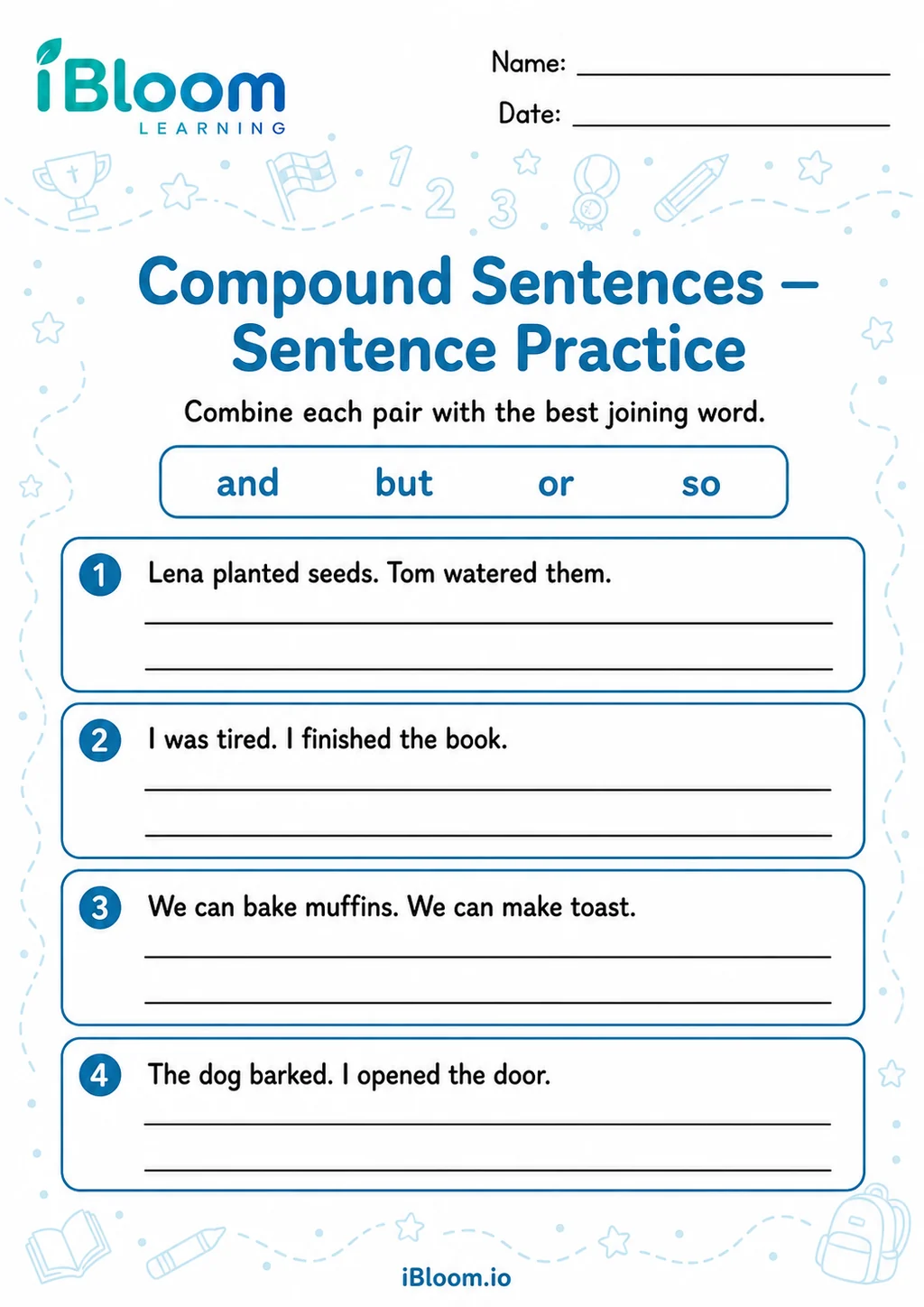
About this worksheet
This Grade 2 sentence starters worksheet has 14 questions about choosing an opening, adding when or where details, and varying sentence beginnings. Learners compare sentence options and choose revisions that make a sequence clearer. A separate answer key makes it easy to review choices together.
How do you choose a sentence starter?
A starter should connect clearly to the rest of the sentence. Time words such as first, soon, and yesterday can show when something happens. Read the whole sentence with each choice to see which one makes sense.
- 1First, pack your lunch.
- 2“First” gives a time order that fits the direction.
How can you revise a repeated opening?
When two nearby sentences begin the same way, keep the meaning and change one opening. A time word or a detail about place can make the sequence easier to follow.
How can you expand or rearrange a sentence?
Add a detail that answers where or when, or move a phrase to the beginning. Keep the sentence complete and use a comma after an opening phrase when it helps the reader.
How to use this worksheet at home or in class
- 1Read each sentence all the way through.
- 2In Part A, test both choices by saying the whole sentence aloud.
- 3In Part B, keep the original meaning as you revise.
- 4Add only a detail that makes the sentence clearer.
- 5Check for complete sentences and different openings.
Common mistakes and quick fixes
The mistake
Choosing an opening that does not fit the sentence meaning.
The fix
Read the whole sentence with the starter and check that the ideas connect.
The mistake
Changing the opening but losing the original event or idea.
The fix
Keep the key action and change only the order or added detail.
The mistake
Writing a phrase instead of a complete sentence.
The fix
Check that the sentence tells who or what and what happened.
What to practice next
Make more practice
Further reading
Questions parents and teachers ask
What does this sentence starters worksheet ask students to do?
Students choose openings that make sense, identify sentences that add a when or where detail, and select revisions with varied beginnings. The sheet has 14 multiple-choice questions over two pages, followed by a separate two-page answer key. It focuses on noticing how an opening affects a sentence.
What is a sentence starter?
A sentence starter is a word or phrase placed at the beginning of a sentence. “After lunch, we can read together” starts with a time phrase. A useful starter fits the meaning and leaves the rest of the sentence complete.
Why vary the beginning of sentences?
Repeating the same opening can make a short sequence sound choppy. In one question, “First we packed lunch. Next we ate” varies the starter and keeps the order clear. Students compare revisions to notice how a new opening can help a reader follow events.
How can I help my child choose an opening?
Read the whole sentence aloud with each answer choice at the beginning. Ask whether the phrase fits the meaning and whether the result is a complete sentence. For a time phrase such as “At sunrise,” pause briefly before reading the rest.
How long does the sentence practice take?
Plan for about 10 to 15 minutes for the 14 questions, with extra time to discuss why one revision reads more clearly. The separate answer key lists the correct option for each item. Students can also read their selected sentences aloud as a final check.