
About this worksheet
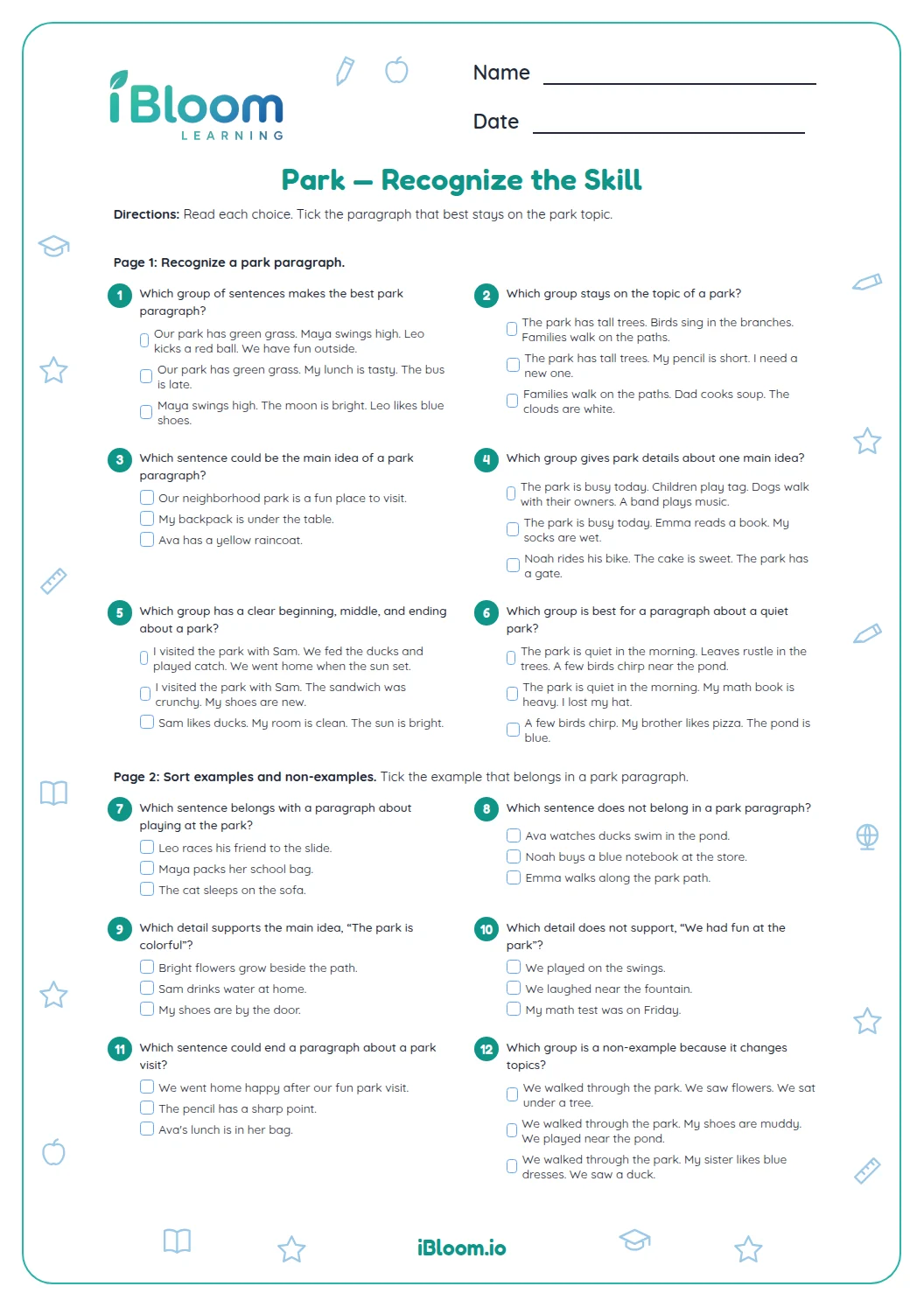
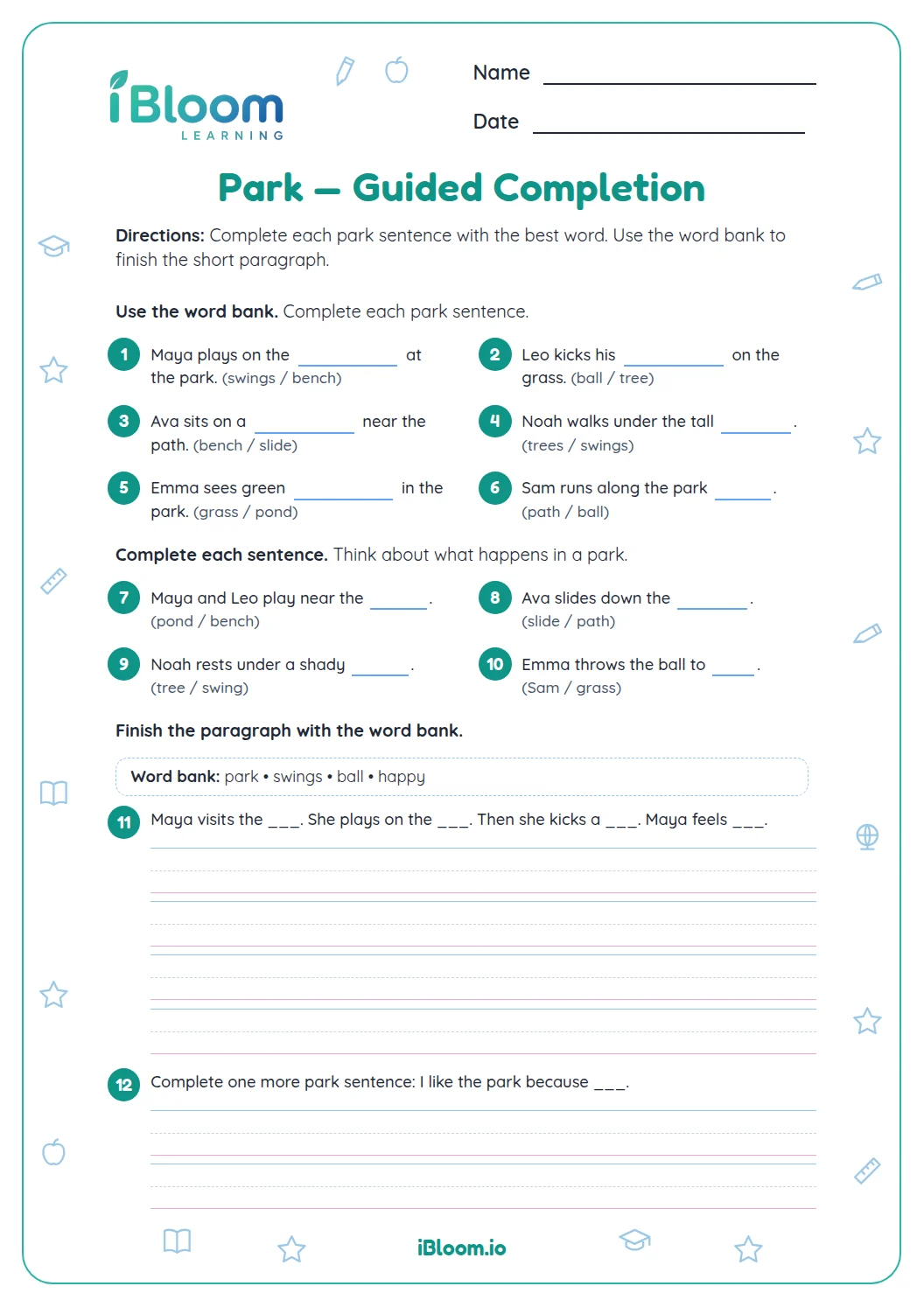
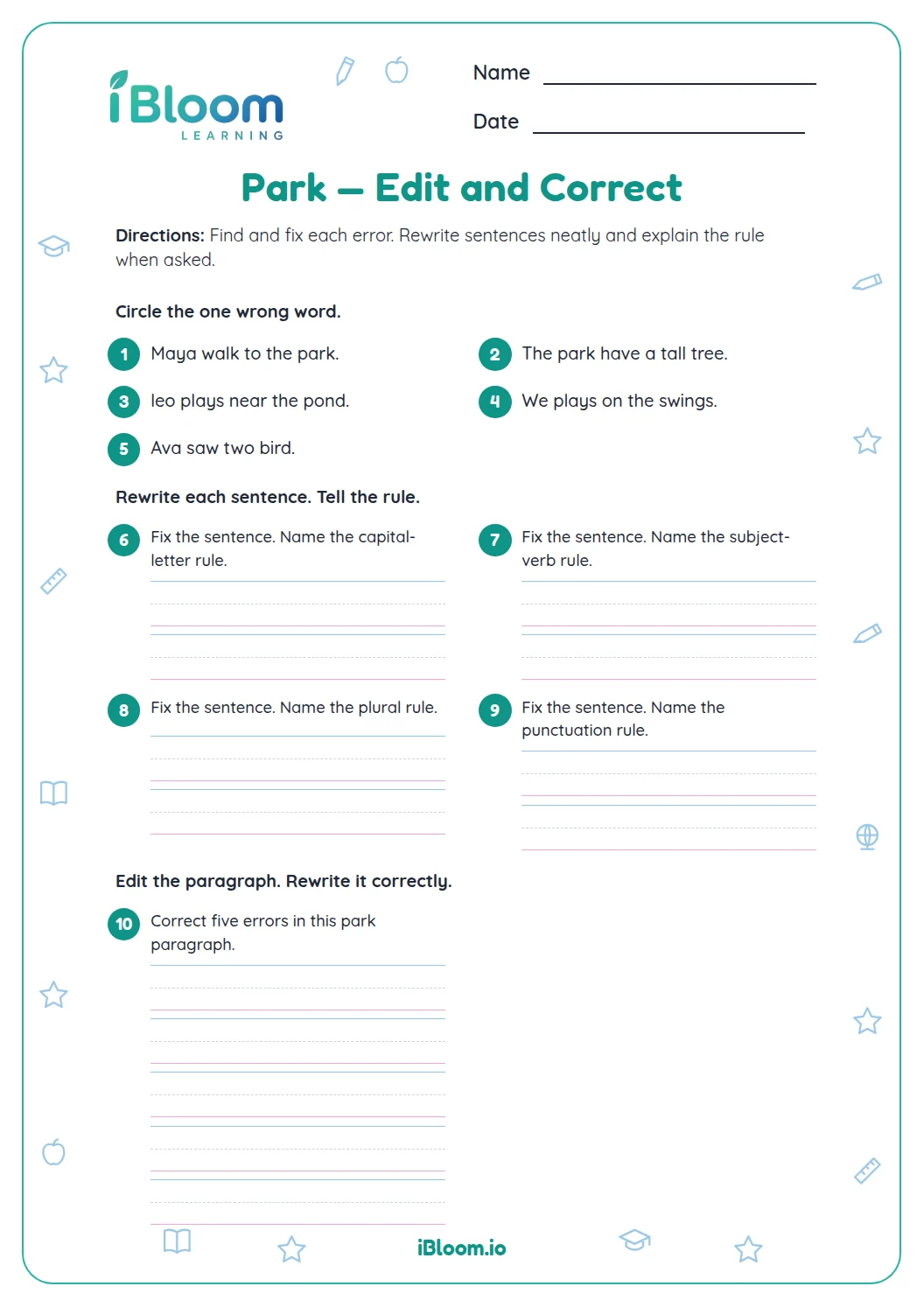
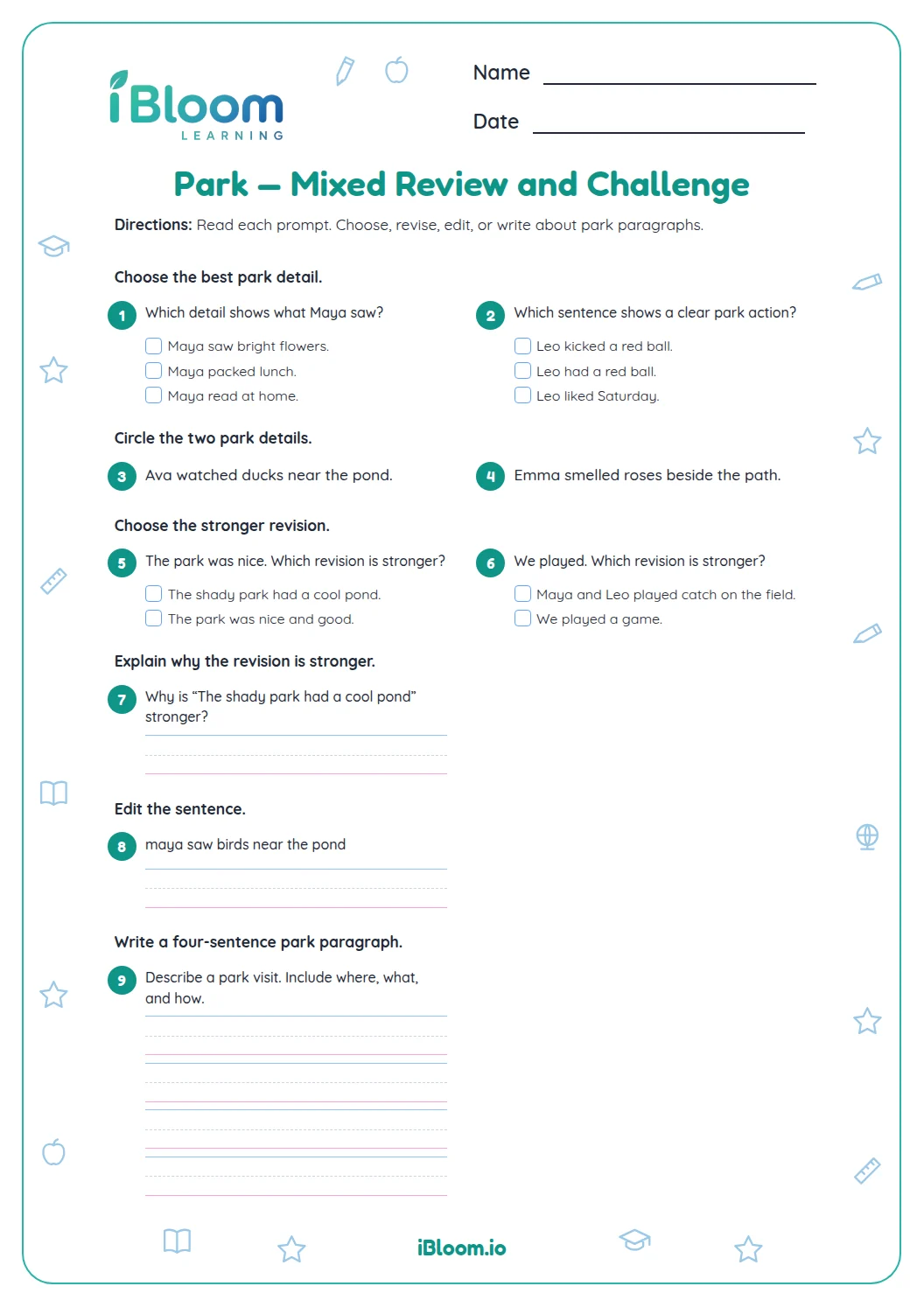
This Grade 2 park writing worksheet combines 15 multiple-choice, short-answer, and paragraph-writing tasks. Students choose relevant details, write about park visits, add sequence words, and check capitals and ending marks. The open prompts leave room for children’s own ideas, while sample answers give families a model of a complete response. The narrative tasks connect to CCSS W.2.3: recounting an event or short sequence with details and closure.
Aligned to W.2.3
Which details belong in a paragraph?
A useful detail supports the paragraph’s main idea. For a park visit, a kite above the grass fits better than an unrelated fact about a bus or backpack.
How can sequence words help a paragraph?
Words such as “first” and “next” show the reader the order of events. Add concrete details so the reader can picture what happens.
- 1Prompt: Write about playing at a park.
- 2Start with the main idea, then add actions: climb the slide steps, race across the grass.
- 3Use “then” to connect events in order.
What should you check when revising?
Read each sentence aloud. Check that it belongs with the topic, begins with a capital letter, and ends with punctuation. Add an ending that finishes the idea.
How to use this worksheet
- 1Read the prompt and name the paragraph topic.
- 2Choose details that belong with that topic.
- 3Put actions in an order that makes sense.
- 4Write complete sentences and use a linking word when helpful.
- 5Reread for capitals, ending marks, and a clear finish.
Common mistakes and quick fixes
The mistake
Adding an interesting detail that does not match the topic.
The fix
Ask whether the detail helps the reader understand this park paragraph.
The mistake
Listing actions without showing their order.
The fix
Use a word such as “first,” “next,” or “then” to guide the reader.
The mistake
Leaving a sentence without an ending mark.
The fix
Reread each sentence and add a period or another fitting end mark.
Common Core alignment
This worksheet practices sequencing events and adding relevant details in short narratives.
Write a short sequence with details and a sense of closure.
On this sheet: The park prompts invite students to narrate short events with details and sequence words.
Show the official wordingHide the official wording
Write narratives in which they recount a well-elaborated event or short sequence of events, include details to describe actions, thoughts, and feelings, use temporal words to signal event order, and provide a sense of closure.
What to practice next
Make more practice
Further reading
Questions parents and teachers ask
How many prompts are on this worksheet?
The page includes 15 items: detail choices, short responses, sentence editing, and open paragraph prompts about parks. Students move between selecting a useful detail and creating their own writing. The answer key models one possible response while allowing children to add their own details.
Do students need to write about a real park?
No. Students can write about a real park, an imagined place, or a park visit they remember. The prompts leave room for their own details, actions, and observations from a familiar or invented place. A made-up park is fine when the events and details fit together.
What makes a useful paragraph detail?
A useful detail fits the topic and helps explain what happens or what a place is like. For a park picnic, food brought along or something seen nearby can support the paragraph and help readers picture it. Strong details tell what a person sees, does, or notices in the park.
Are sample answers included?
Yes. The answer key provides correct choices and sample paragraphs. A child’s response can use different wording and still work when it stays on topic, includes clear details, and uses complete sentences. The sample is a guide; children can write a different paragraph that answers the prompt.
What should a child check after writing?
Reread to check that sentences stay on the park topic and events are in a sensible order. Check that each sentence begins with a capital, has ending punctuation, and gives the reader a clear finish. Reading aloud can make missing words or punctuation easier to notice.