

About this worksheet
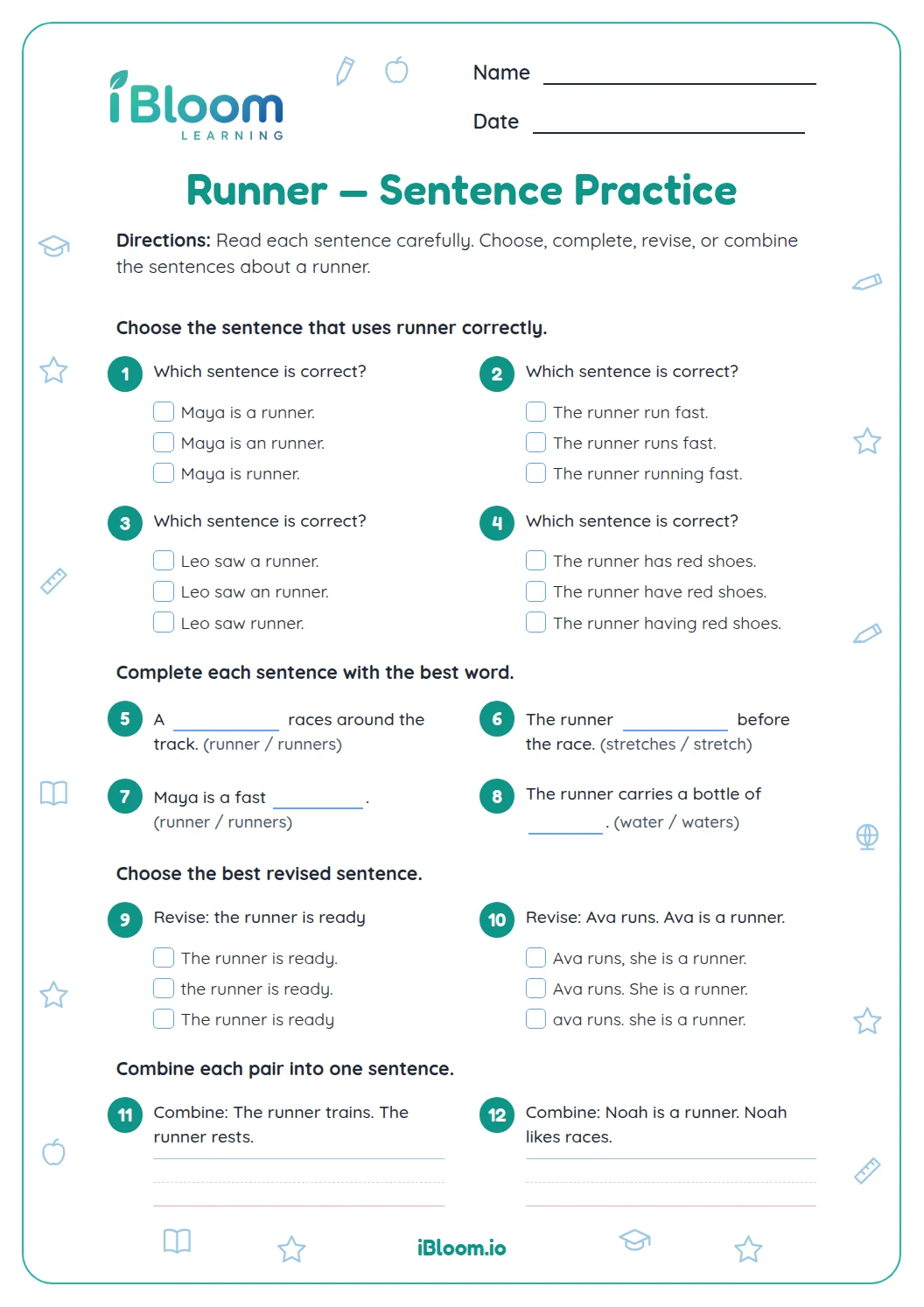
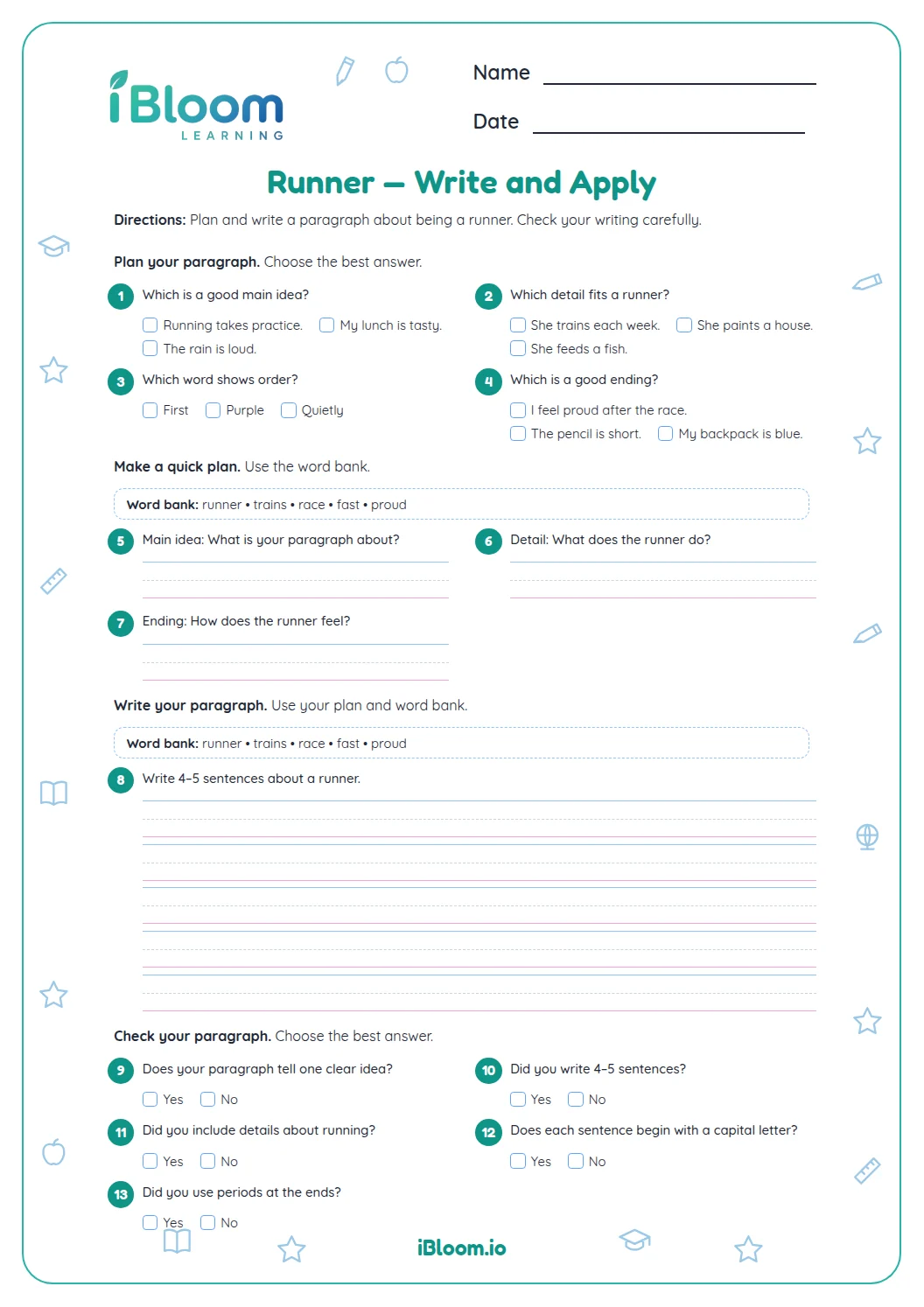
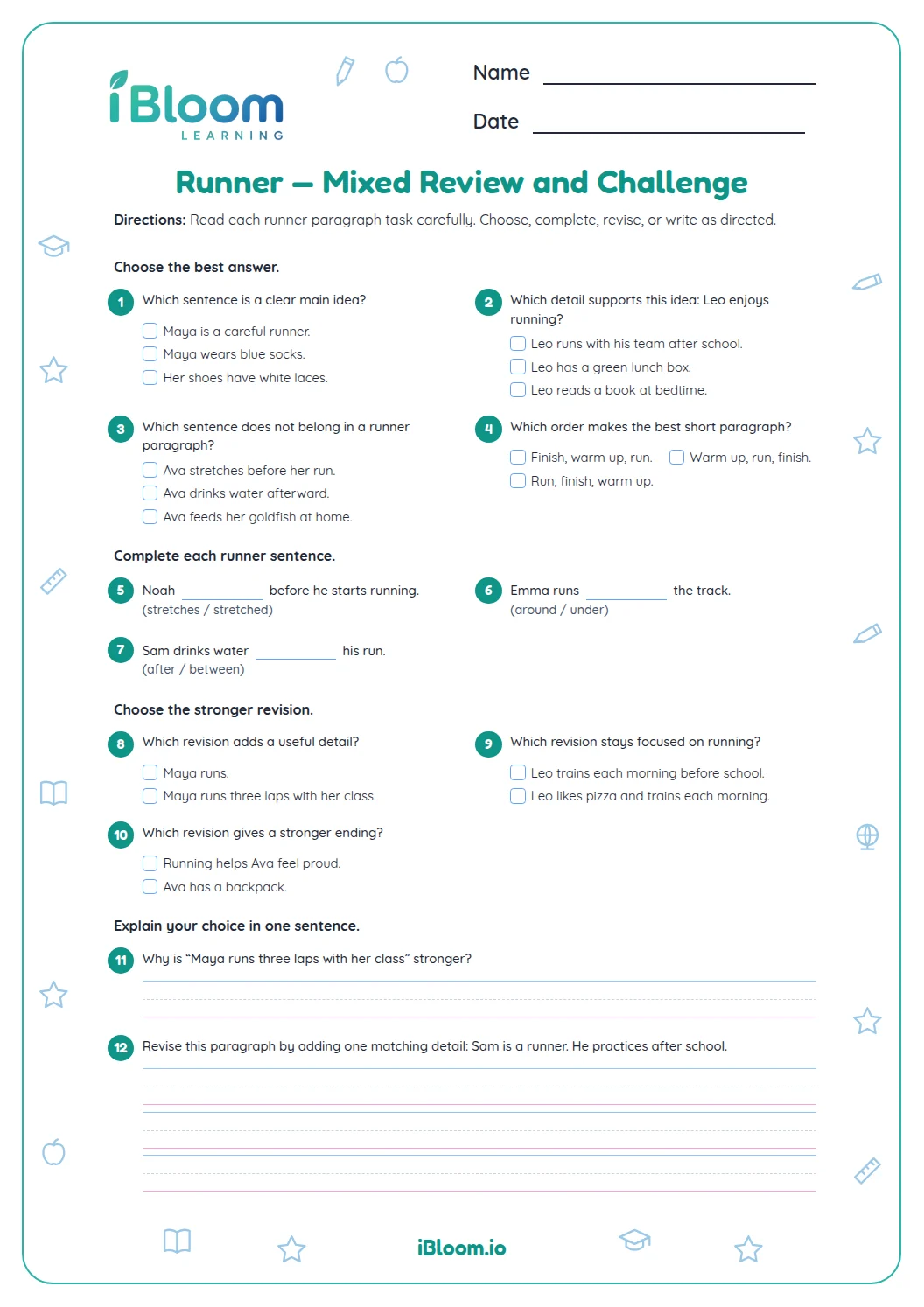
This Grade 2 writing worksheet teaches children to recognize run-on sentences and make two complete thoughts clear. It includes 16 items: eight sentence labels, four joining-word choices, and four written repairs or explanations. The sequence moves from recognition to revision. It practices CCSS L.2.1.f, with a separate answer key and sample responses.
Aligned to L.2.1.f
How can a reader spot a run-on?
A run-on joins two complete thoughts without a period or a joining word. Read the example aloud and listen for two ideas that could each stand alone. A period can separate them; a word such as and, but, or so can connect them clearly.
Question 2 has two complete thoughts with no boundary: “Leo packed his bag he checked his list.” It needs punctuation or a joining word.
- 1Leo packed his bag.
- 2He checked his list.
- 3Or: Leo packed his bag, and he checked his list.
What will children practice?
Eight items ask children to recognize run-ons and complete sentences. Four blanks practice joining words, and four written tasks ask for a repair or explanation. The sheet replaces the old repetitive multiple-choice sentences with a progression from recognition to revision.
How to use this worksheet
- 1Read each complete thought separately.
- 2Look for punctuation or a joining word between thoughts.
- 3Choose a joining word that matches the idea.
- 4Reread each repair to check that it sounds complete.
Mistakes to watch for
The mistake
Calling every long sentence a run-on
The fix
Check for two complete thoughts without a clear boundary.
The mistake
Adding a comma but no joining word
The fix
Use a period, or use a comma with a joining word.
The mistake
Choosing a joining word that changes the meaning
The fix
Reread both ideas and check that the connection makes sense.
Curriculum alignment
This worksheet practices the standard below through its questions.
Produce and expand complete simple and compound sentences.
On this sheet: Children distinguish complete thoughts and repair run-ons with sentence boundaries or a joining word.
Show the official wordingHide the official wording
Produce, expand, and rearrange complete simple and compound sentences (e.g., The boy watched the movie; The little boy watched the movie; The action movie was watched by the little boy).
What to practice next
Make more practice
Further reading
Questions parents and teachers ask
What is a run-on sentence?
A run-on sentence joins two complete thoughts without punctuation or a joining word to separate them. “Leo packed his bag he checked his list” is a run-on. A period or a joining word such as and can make the relationship clear.
How can a child fix a run-on?
A child can put a period between the thoughts and capitalize the next sentence. Another option is to connect the ideas with a joining word, such as and, but, or so, using punctuation where appropriate. The written items practice both approaches.
What are the answers to the joining-word blanks?
The intended answers are and, so, but, and while, in order. Each blank now includes choices that distinguish the intended connection: adding events, showing a result, contrasting ideas, or showing actions happening at the same time. Encourage children to reread each full sentence.
Does the worksheet ask children to write?
Yes. Four written questions ask children to repair a run-on, explain how a period helps, or create a sentence with two related ideas. The key supplies sample responses, so a different clear and correct sentence can also be accepted.
What does Runner mean here?
“Runner” is the worksheet’s shorthand for a run-on sentence: two complete thoughts run together without a needed boundary. Children first recognize those examples, then practice joining ideas and rewriting them as clear sentences. The page is designed for Grade 2 sentence work.