




About this worksheet
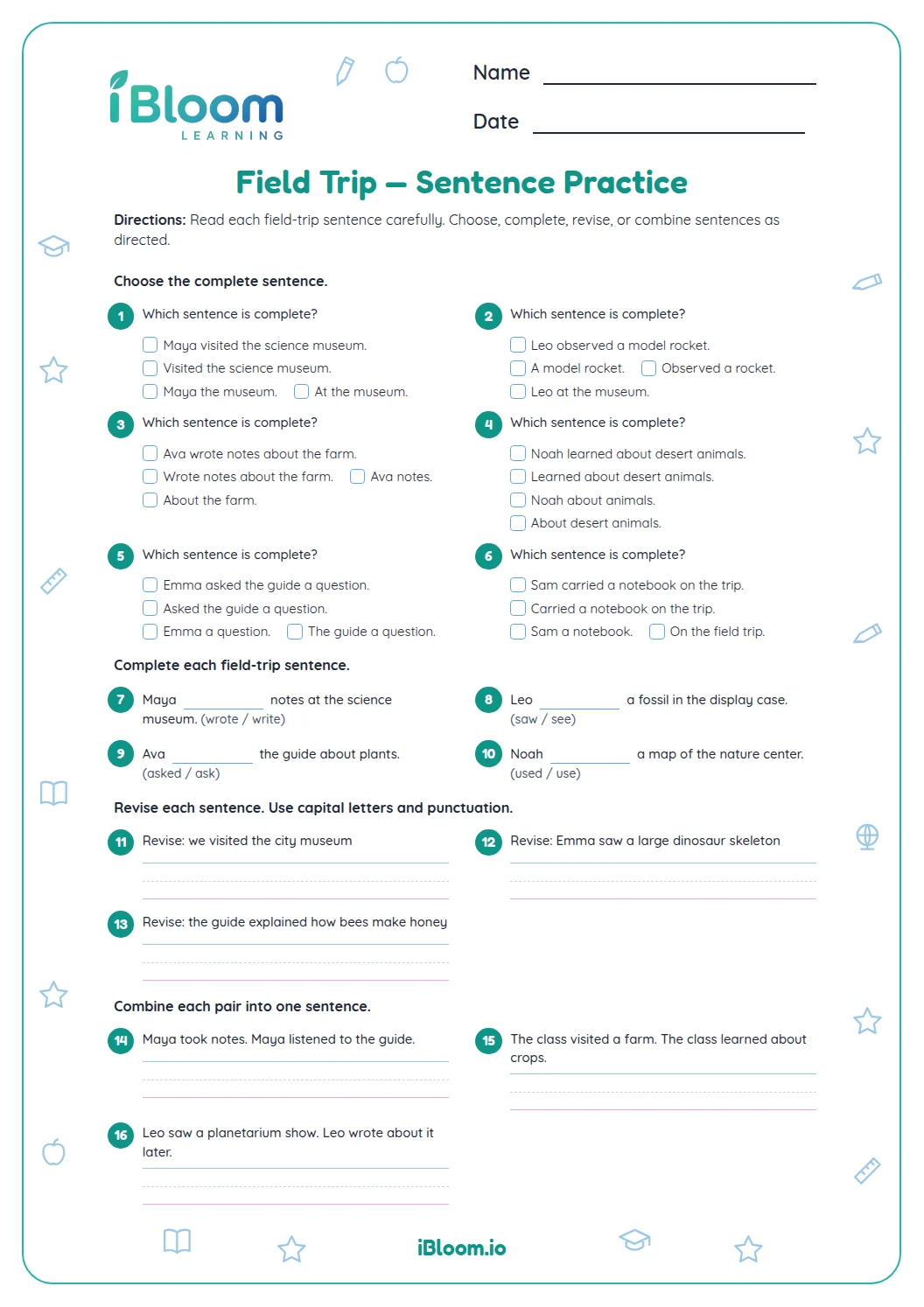
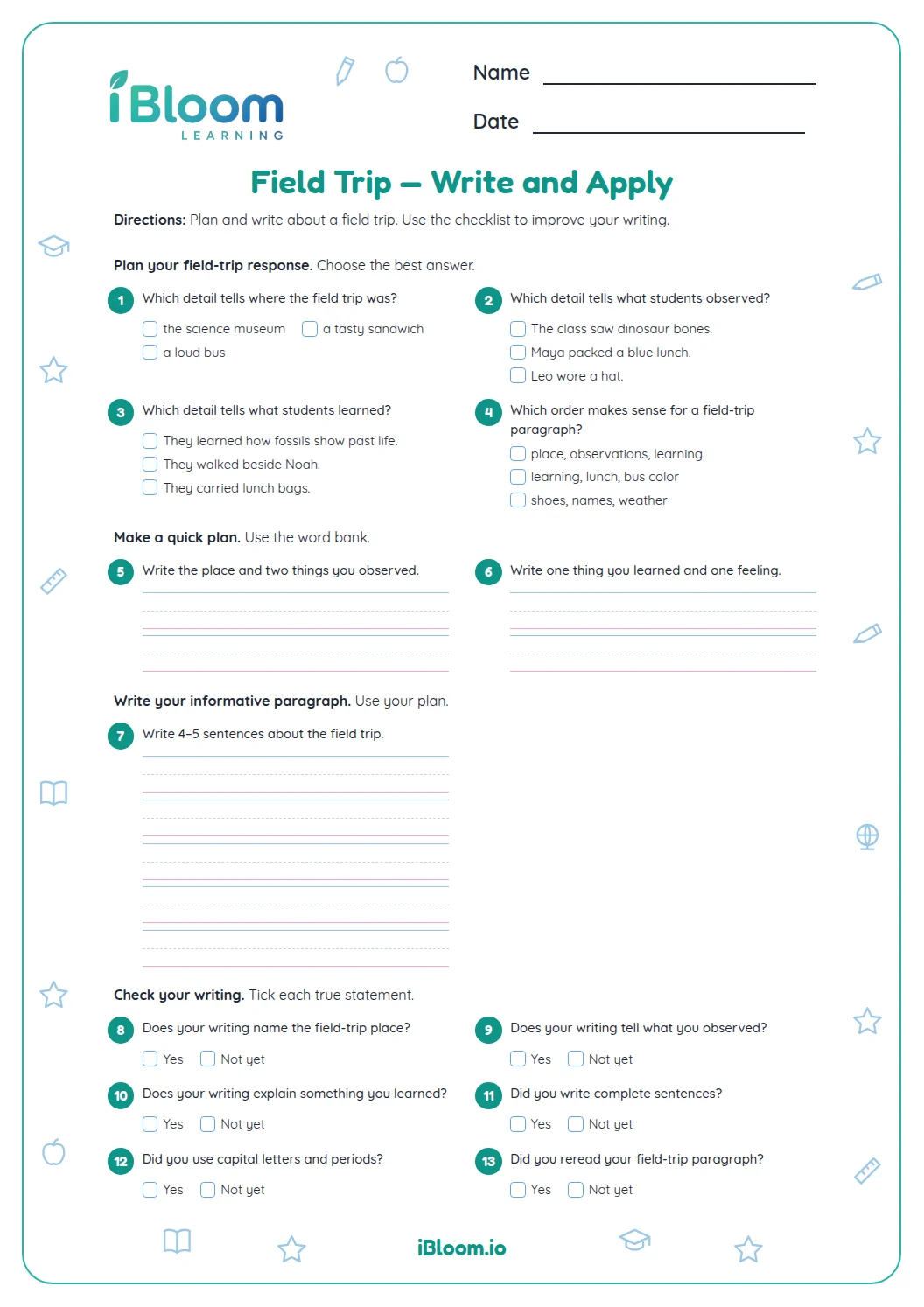
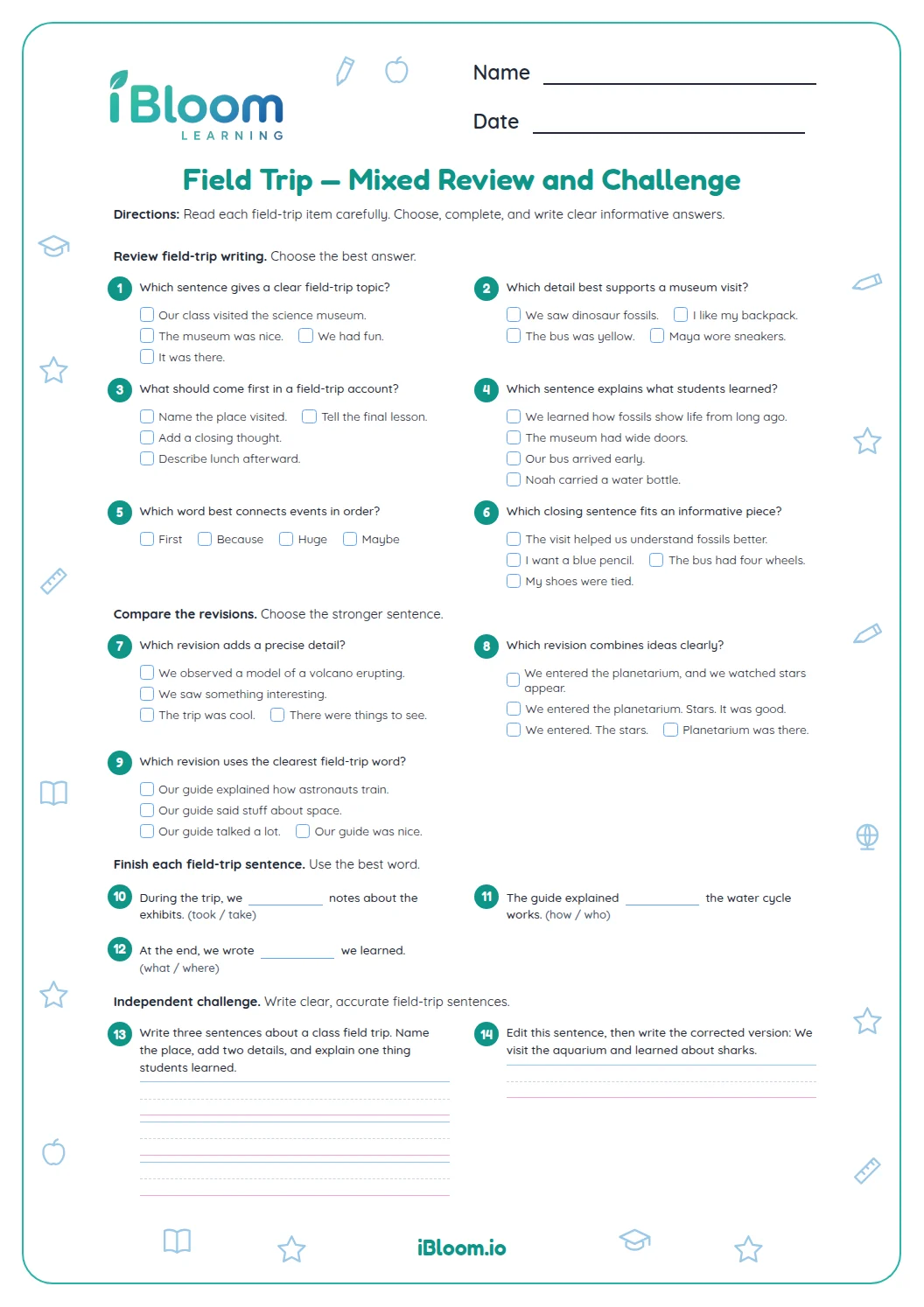
This Grade 3 worksheet uses field trips to practice informative writing. Students complete short notes about useful facts and topics, identify a report purpose, and write one focused question. Its 14 items use compact response spaces across two parts, with a separate answer key.
Aligned to W.3.2
Which field-trip prompts invite facts?
Informative prompts ask students to explain or describe real information. A question about how a planetarium shows stars can be answered by learning about its equipment; asking whether the trip was fun calls for an opinion.
- 1For example, asks how a planetarium shows the night sky, so research and facts can answer it.
How do topic and task make a prompt clear?
The topic names the subject, such as fossils. The task tells the writer what to do, such as explain how fossils form. In the example prompt, fossils is the topic.
How can you narrow a broad field-trip prompt?
Name one place and one learnable subject. A focused revision could ask what students can learn about fossils at a science museum, giving the writer a defined subject to investigate.
How to use this worksheet
- 1Look for words such as explain, describe, and how.
- 2Ask whether facts could answer the prompt.
- 3Identify the topic and what the writer must do.
- 4Replace broad wording with a place and a specific subject.
- 5Check your own question for a clear factual focus.
Common mistakes and quick fixes
The mistake
Choosing a question because it mentions a museum even though it asks whether the visit was fun.
The fix
Notice whether the answer is personal or can be supported with facts.
The mistake
Naming the place but not the topic.
The fix
Add the subject visitors will learn about, such as fossils or local birds.
The mistake
Writing a prompt that is still too broad.
The fix
Ask one clear how or what question about a specific detail.
Common Core alignment
The prompt-writing practice asks students to focus an informative explanation on a clear topic.
Students choose and create clear, fact-based prompts about field-trip subjects.
On this sheet:
Show the official wordingHide the official wording
Write informative/explanatory texts to examine a topic and convey ideas and information clearly.
What to practice next
Make more practice
Further reading
Questions parents and teachers ask
What kinds of field-trip topics appear on the page?
Students consider planetariums, farms, nature centers, museums, aquariums, zoos, and gardens. They decide which questions invite facts, which details fit a report, and how to narrow a broad field-trip topic into something a writer can explain. The worksheet uses examples from several familiar learning destinations.
How many questions are included?
There are 14 questions in three parts: ten short completions, three brief responses, and one writing prompt. The separate key lists expected words and gives a sample for the open-ended question. Students can check that each note supplies a useful fact or topic and that their prompt asks for information.
How can students tell a field-trip fact from an opinion?
A fact can be checked or explained with information, such as how a planetarium projector makes stars appear. A statement about whether a visit was fun tells what someone thinks or feels, so it is an opinion rather than a report detail.
What makes “Tell about our field trip” too broad?
It does not name a place, subject, or question to investigate. A clearer prompt might ask what students can learn about fossils at a science museum, giving the writer a defined topic and task to guide the report.
Can students use a different answer from the key?
Yes. The key gives examples for responses that can vary. A student’s prompt or fact can use different words and still be correct when it names a clear field-trip subject and asks for information that can be explained with facts.