





About this worksheet
This free printable worksheet helps Grade 3 students recognize a personal narrative: a true story the writer tells about something that happened to them. Six sets of three sentences ask which one is the writer's own story. Four rows hide a feeling word to circle, two questions check an order word and a past-tense verb, and one line asks for a true sentence of the child's own. It supports Common Core W.3.3.a and W.3.3.b, and a separate answer key shows every choice.
Aligned to W.3.3.a and W.3.3.b
What makes a sentence part of a personal narrative?
Three clues help. The writer is in the story, so the sentence uses I, my or we. Something really happened, so there is an event instead of a fact or an instruction. And there is often a feeling or a small personal detail, like Nana or a gold leaf.
A fact and an instruction can be about the very same topic and still not be a narrative. In question 1, “Frogs live in ponds” is true but is not about the writer, and “Hold a frog gently” tells the reader what to do.
- 1Which one is a personal narrative?
- 2Bikes have two wheels. → a fact about bikes, no writer in it
- 3Wear a helmet to ride. → an instruction for the reader
- 4My dad ran by my bike. → my dad, my bike: something that happened to the writer
How is a personal narrative different from a made-up story?
A personal narrative is true. A story about a fox that finds a gold key is fiction, even though it also tells an event. In question 4, “A fox found a gold key” is a made-up story about someone else, while “I found a gold leaf” is something the writer did on a walk.
Asking two short questions sorts most sentences: is the writer in it, and did it really happen? A sentence needs a yes to both.
Why do feeling words and order words matter?
A narrative is more than a list of events. A feeling word such as nervous, proud, sad or silly tells the reader how the writer felt. Order words such as first and then, and past-tense verbs such as caught, keep the events in a sequence that unfolds naturally.
Part B finds the feeling word in four sentences, and Part C practices an order word and a past-tense verb. Both are tools children will use again when they write longer narratives of their own.
- 111) First, I packed my bag. ___, I ran to the bus. → Then (what happened next)
- 212) Last week, I ___ a big fish with Grandpa. → caught (“last week” means the past)
What is on this worksheet?
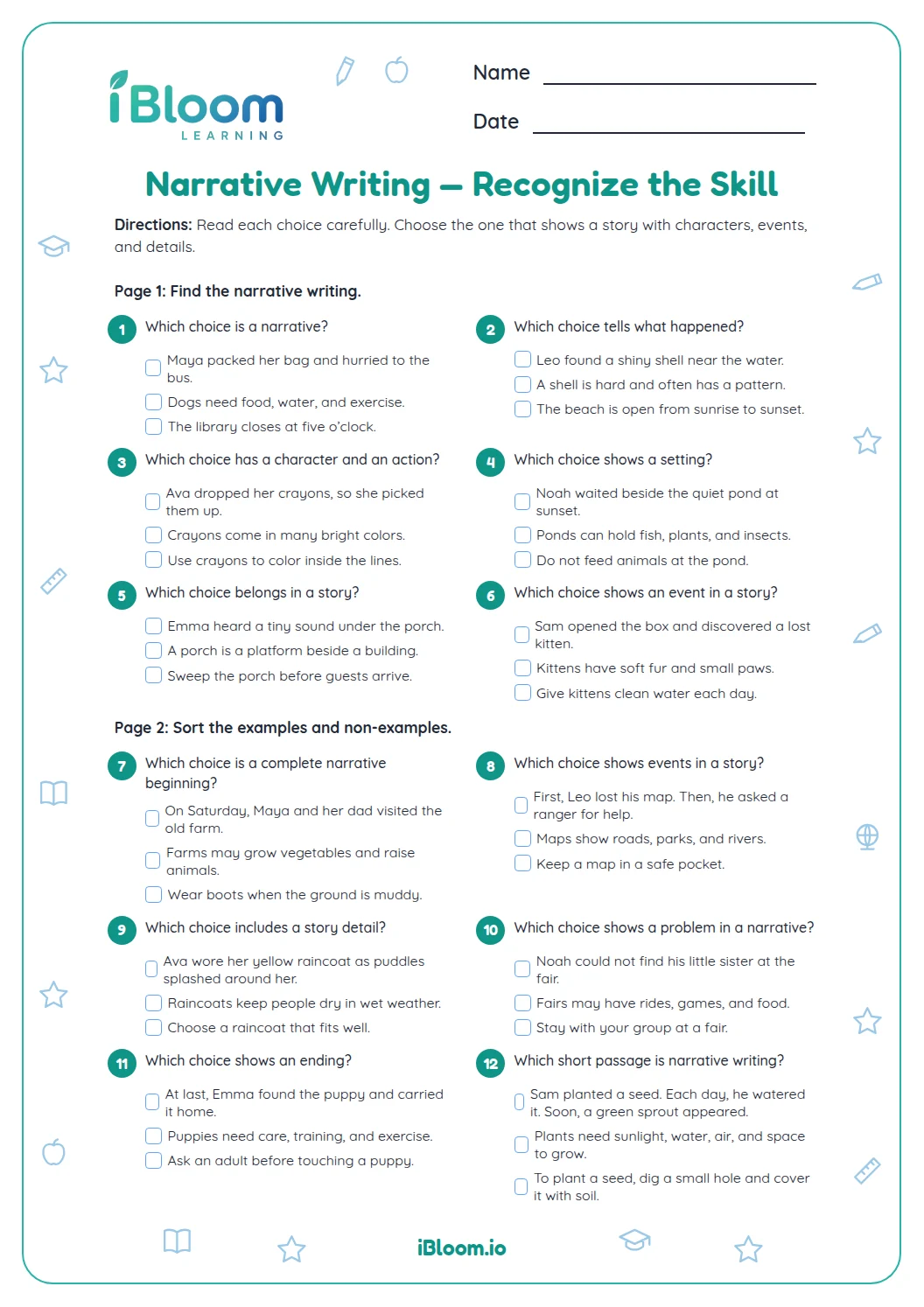
Thirteen questions in four parts, from recognizing a personal narrative to writing one sentence of your own. Part A has the most questions because choosing the writer's own story is the main skill.
- Part A, Find the personal narrative: six sets of three sentences
- Part B, Circle the feeling word: four sentences, one feeling word each
- Part C, Tell it in order: an order word and a past-tense verb
- Part D, Write your own: one true sentence that starts with I or My
- Answer key on its own pages, with a sample sentence for question 13
How to use this worksheet at home or in class
- 1Read the directions together and ask your child to say in their own words what “a true story about the writer” means.
- 2Do question 1 aloud. For each wrong choice, have your child say why it is only a fact or an instruction.
- 3Let your child finish Part A alone, then check it with the answer key. Talk through any miss using the clues I, my or we.
- 4In Part B, ask which word tells how the writer felt and whether your child has ever felt that way.
- 5For question 13, have your child say one true thing out loud before writing it. Check that it starts with I or My and tells what really happened.
- 6Finish by asking your child to say the sentence again with one feeling word added.
Common mistakes and quick fixes
The mistake
Choosing a true fact, such as “Teams practice a lot” or “Frogs live in ponds,” because it sounds correct.
The fix
Ask whether the writer is in the sentence. A narrative tells what happened to the writer, using I, my or we, not just what is true about the world.
The mistake
Picking “A fox found a gold key” in question 4 because it tells an event.
The fix
Check whether it really happened to the writer. This sentence is a made-up story about someone else, so it is not a personal narrative.
The mistake
Circling felt or was instead of the feeling word in Part B.
The fix
Ask, “How did the writer feel?” and listen for the answer: nervous, proud, sad or silly. The words felt and was only lead into the feeling.
Common Core alignment
Most US states teach writing with the Common Core standards or a close state version. These Grade 3 narrative writing standards name the narrator, event order and feelings that this sheet asks children to recognize.
Tell events in order, with a narrator who is part of the story.
On this sheet: Part A picks the sentence told by the writer, and Part C chooses the order word and past-tense verb that keep events in sequence.
Show the official wordingHide the official wording
Establish a situation and introduce a narrator and/or characters; organize an event sequence that unfolds naturally.
Use actions and feelings to show how the writer responded.
On this sheet: Part B finds the feeling word in each sentence, and question 13 asks for one true sentence of the child's own.
Show the official wordingHide the official wording
Use dialogue and descriptions of actions, thoughts, and feelings to develop experiences and events or show the response of characters to situations.
What to practice next
Make more practice
Further reading
Questions parents and teachers ask
What is a personal narrative for Grade 3?
A personal narrative is a true story about something that happened to the writer, told in the writer's own voice. It usually uses I or my, follows the order of events and includes a feeling or a detail. On this worksheet, “My dad ran by my bike” qualifies, while “Bikes have two wheels” is only a fact.
Why do the wrong choices in Part A look like good sentences?
Each set has one personal narrative and two sentences on the same topic that do a different job: a fact, an instruction or a made-up story. That is deliberate. Children must decide who the sentence is about and whether it really happened, not just whether it is true or well written.
Can a personal narrative be about something small?
Yes. Small moments make good personal narratives, such as baking with Nana, finding a gold leaf or slipping on the ice. What matters is that it really happened to the writer and that a feeling or detail makes it theirs. The sentence in question 13 can be about any small, true moment.
What should my child write for question 13?
Any one true sentence that starts with I or My and tells what happened, such as “I lost my first tooth at lunch today.” The answer key shows one sample, but every true sentence is correct. If your child writes a fact, ask who it is about, then help turn it into something that happened to them.
Why does question 12 use caught instead of catch?
A personal narrative tells about something that already happened, so its verbs are in the past tense. “Last week” is the clue. Catch and catching do not fit that sentence, while caught does. It is a small way to practice telling events as they happened, in order.
Is there an answer key for this worksheet?
Yes. A separate two-page answer key marks the personal narrative in each set, the feeling word in each sentence, the order word and the past-tense verb, plus a sample sentence for question 13. Print the two worksheet pages on their own and keep the key for checking together afterward.