




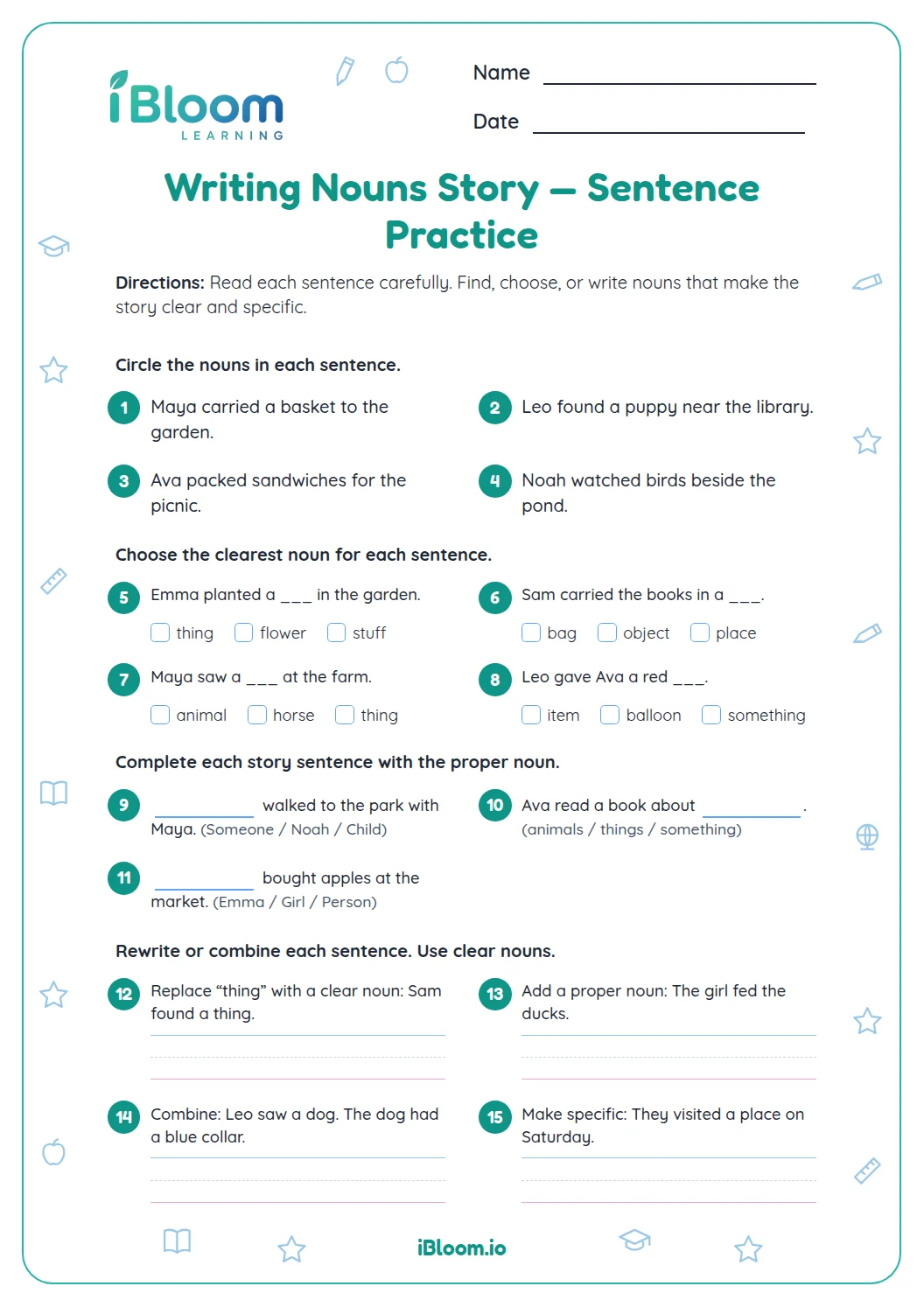
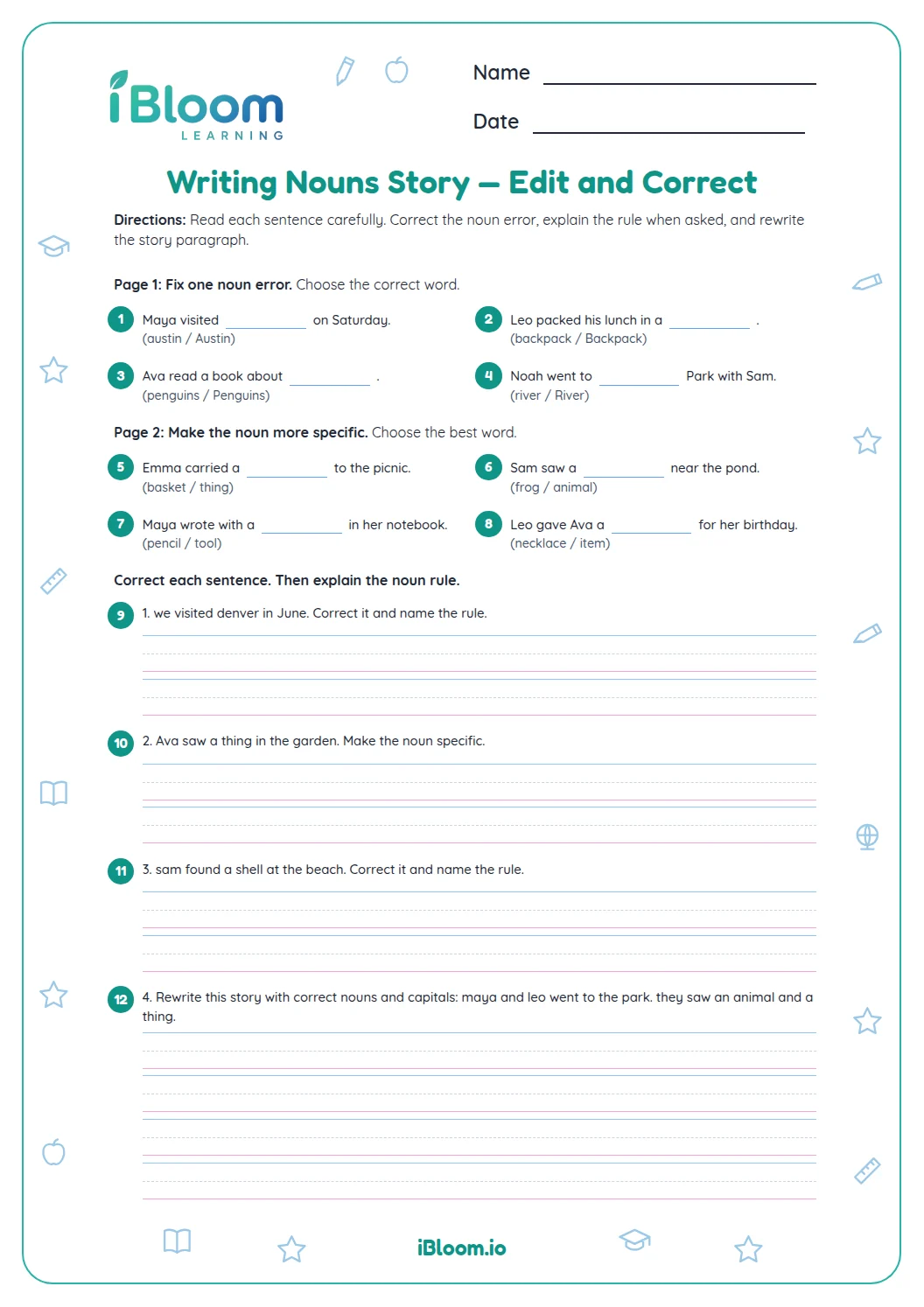
About this worksheet
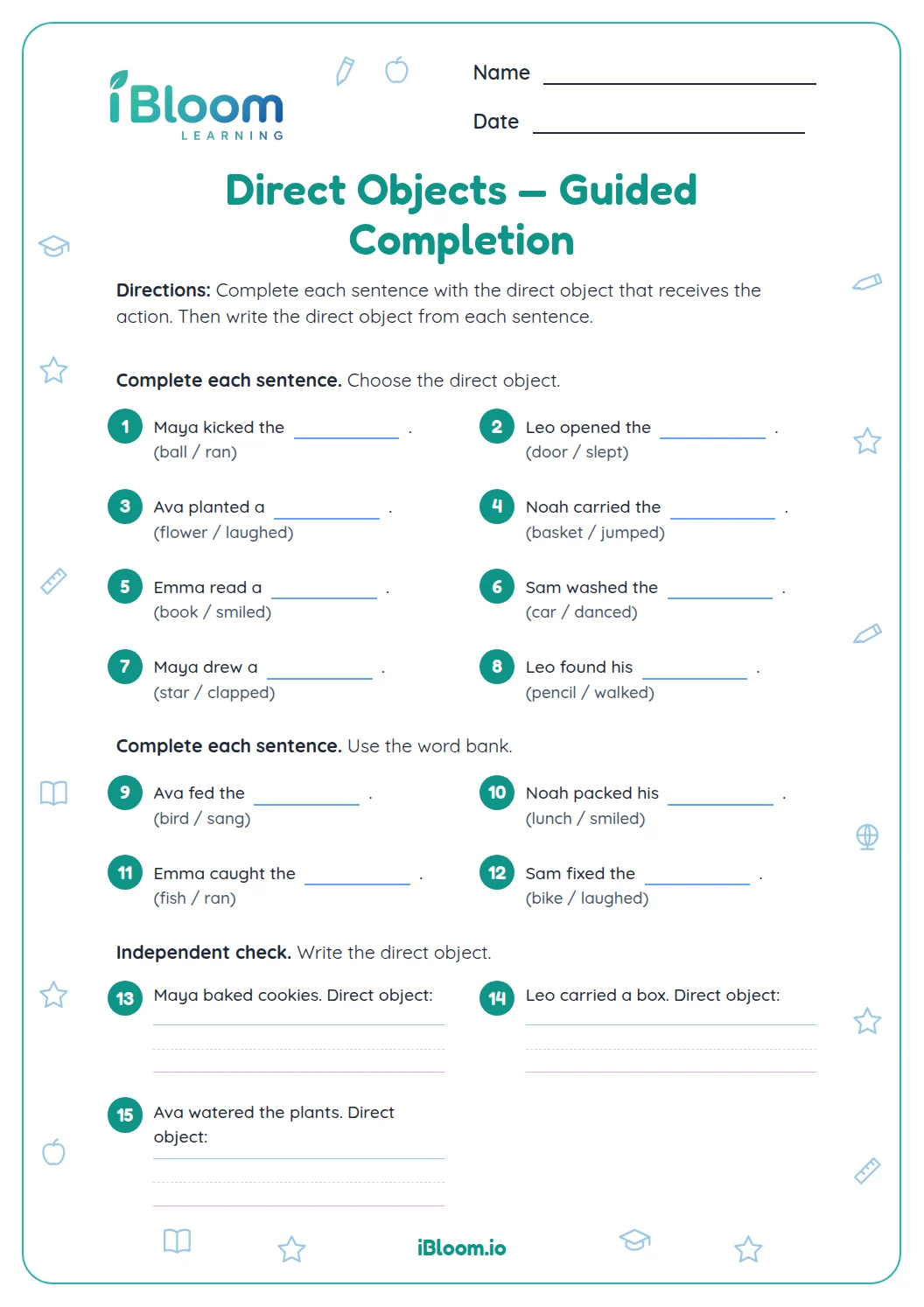
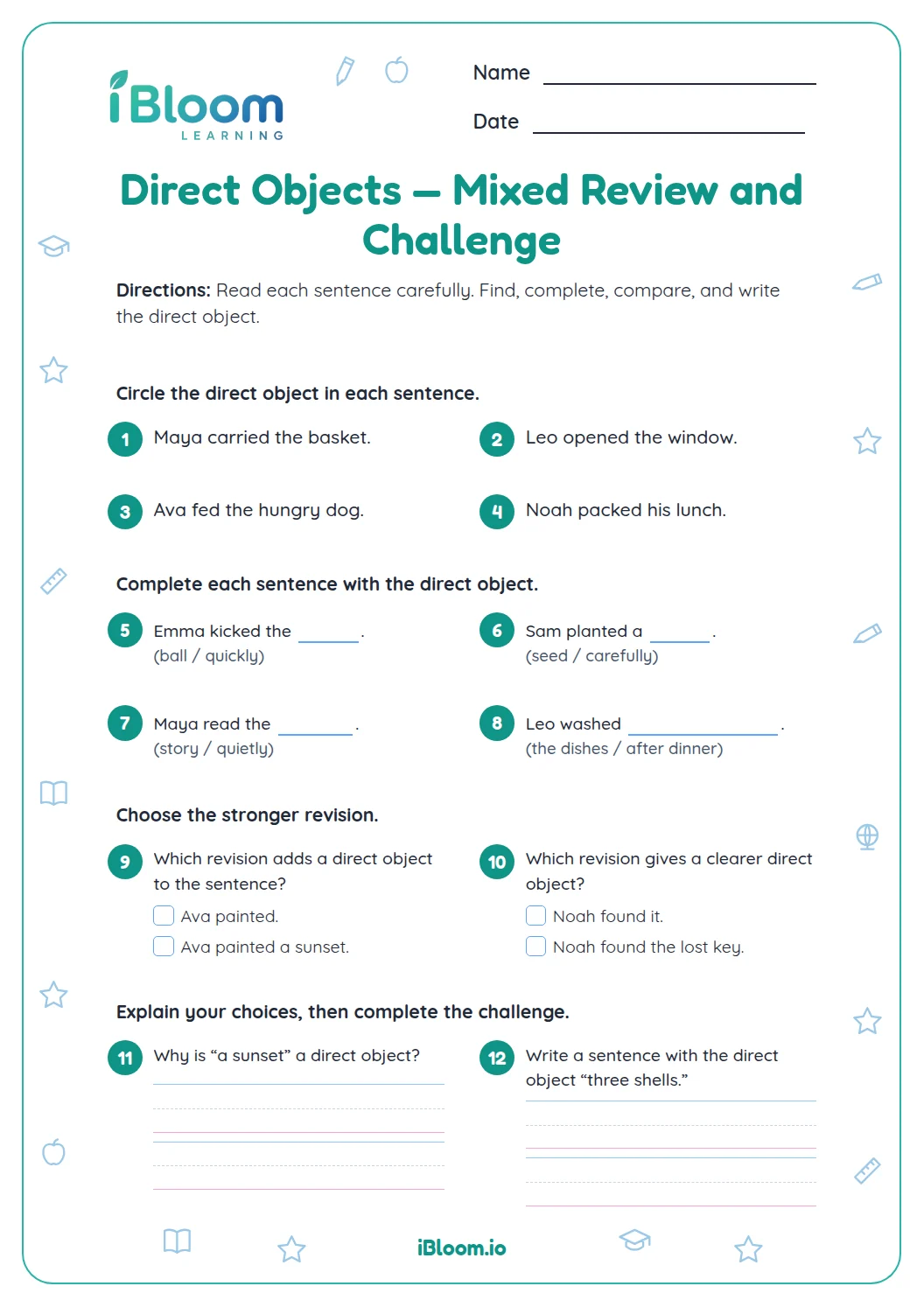
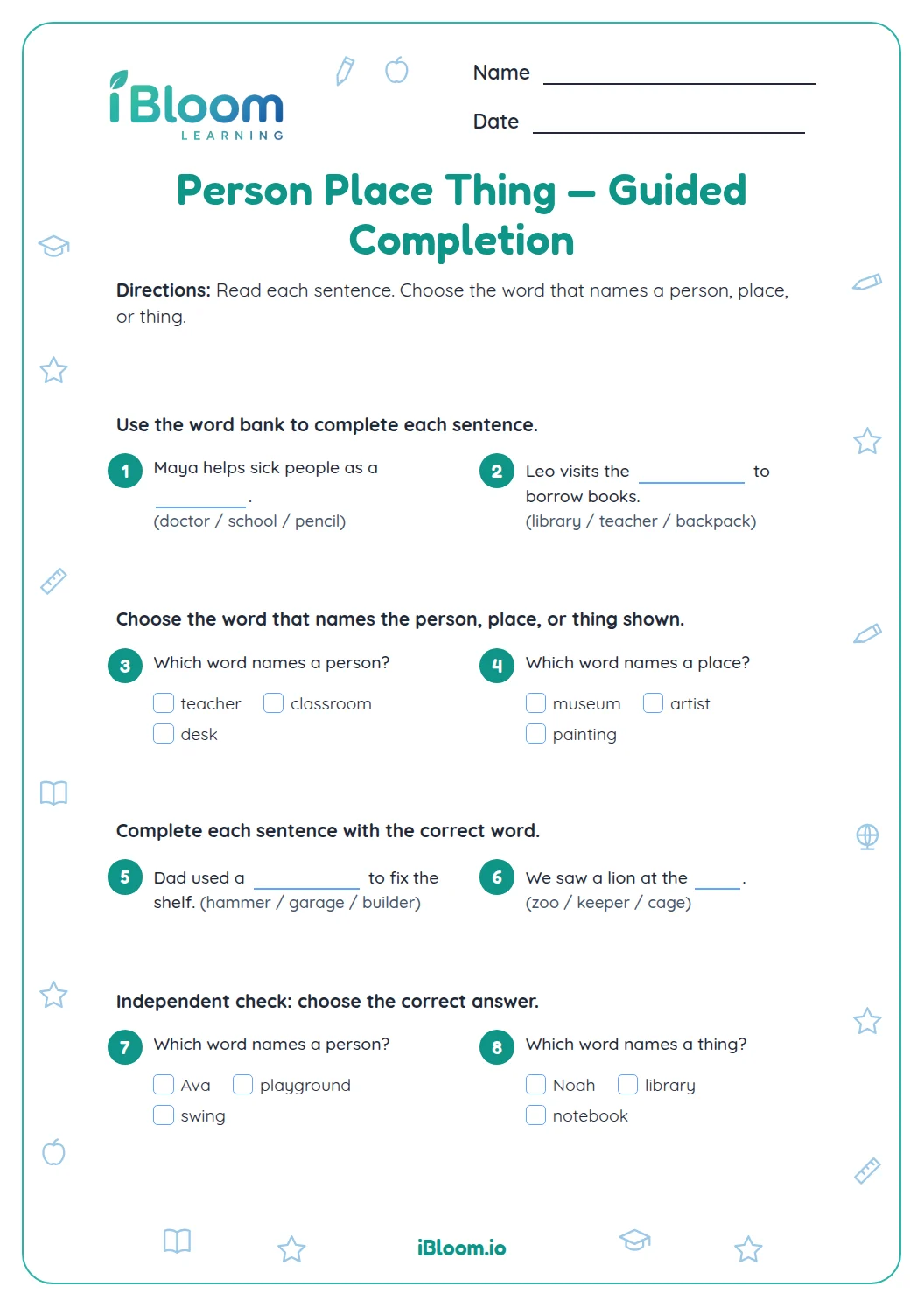
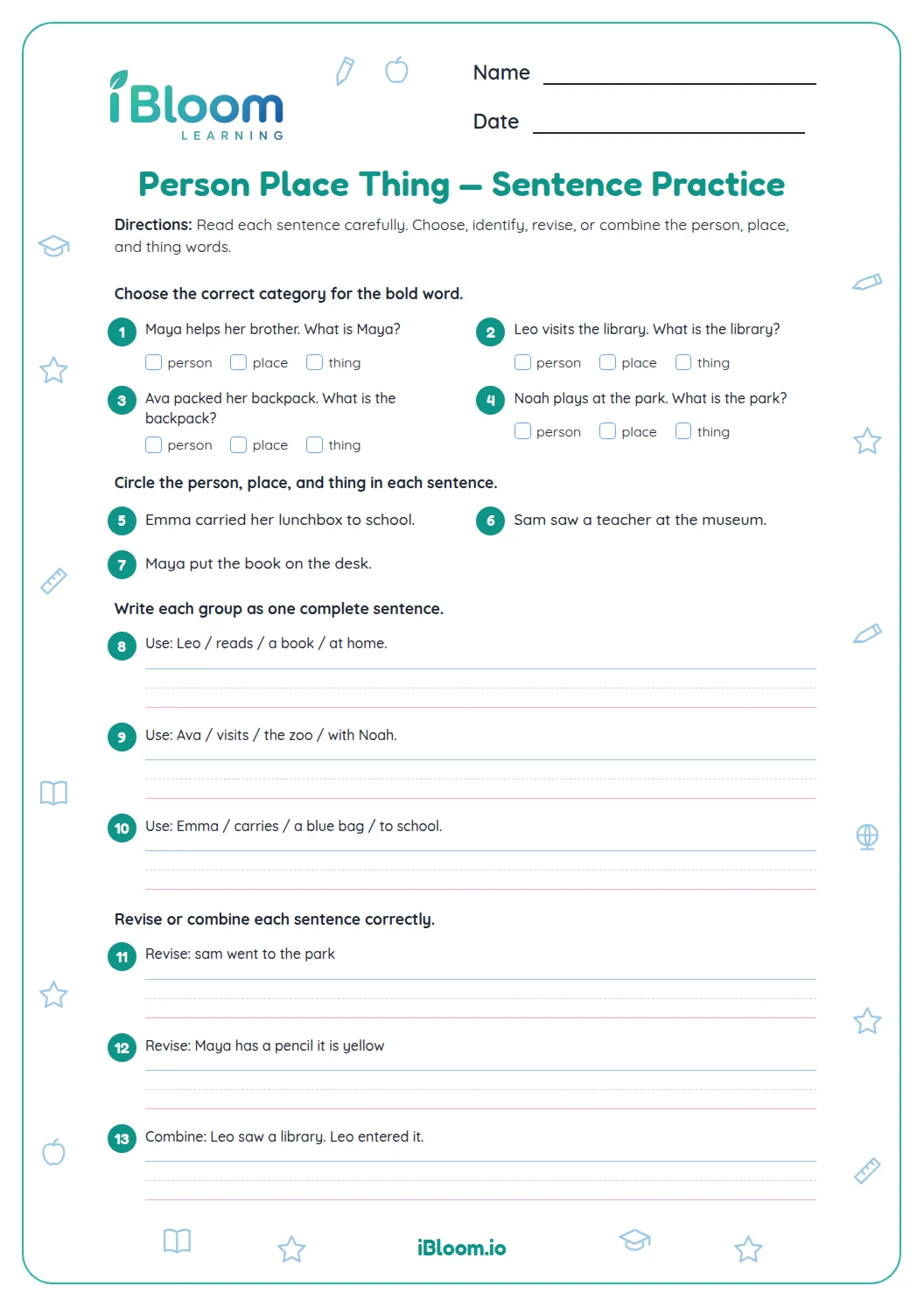
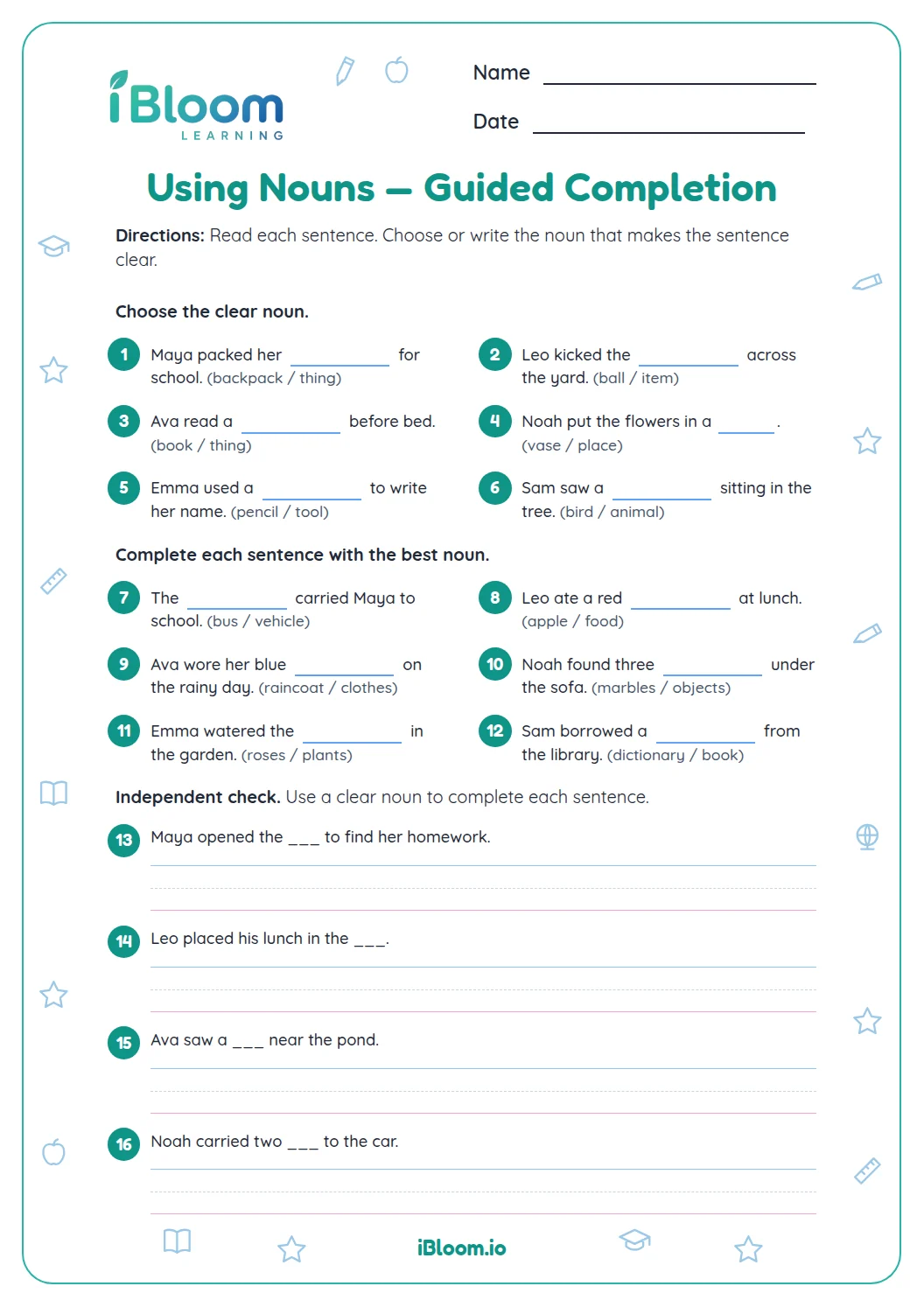
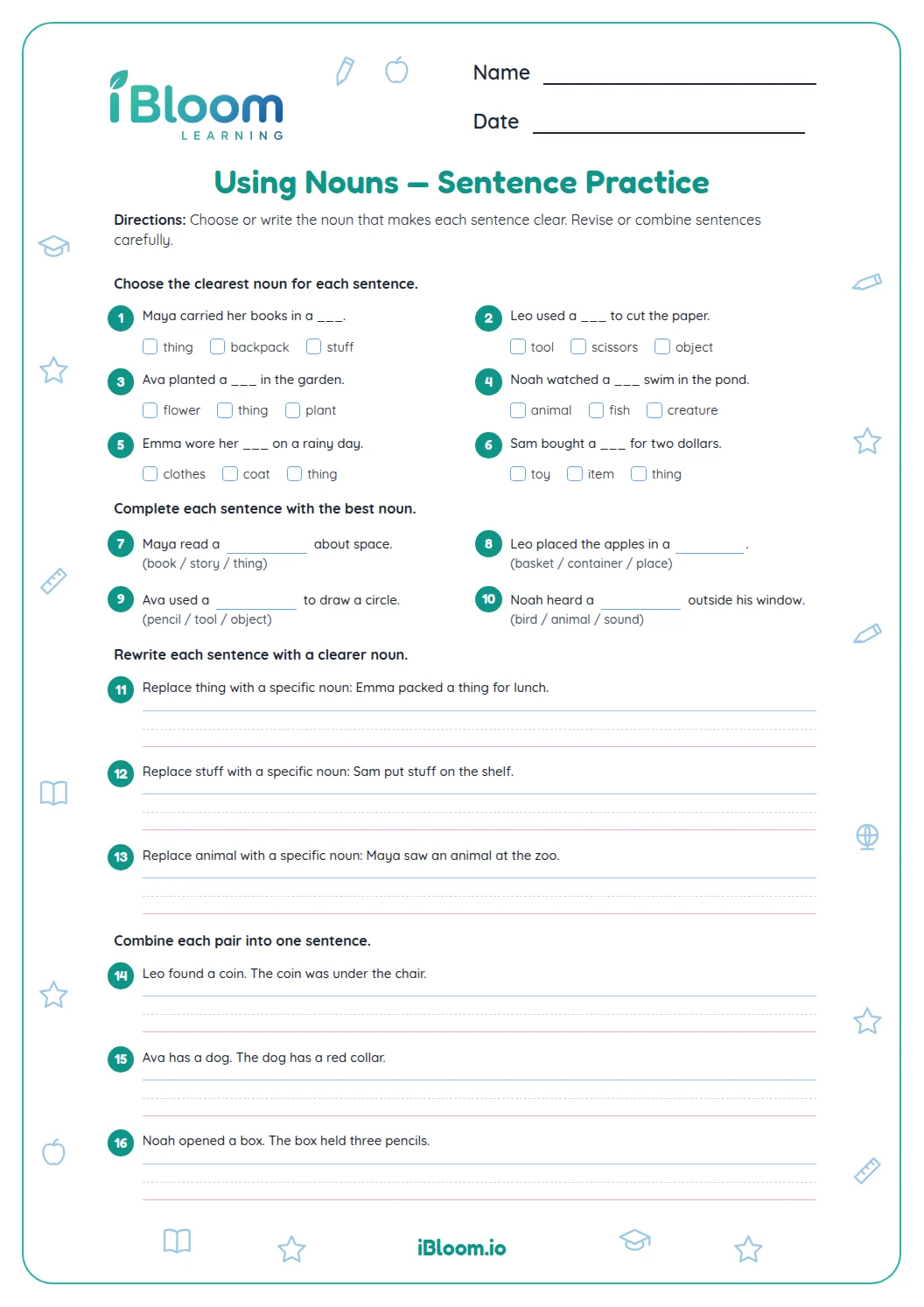
This Grade 3 worksheet turns direct-object practice into sentence writing. Children first identify four object nouns, then use a word bank to complete four sentences. Four final tasks ask them to write two sentences, replace an object, and explain why a noun is a direct object. The work practices noun functions in Common Core L.3.1a and sentence production in L.3.1i. A separate key supplies the fixed answers and sample responses for the writing tasks. Children can use their own ideas when a prompt invites an original sentence.
Aligned to L.3.1a and L.3.1i
How do you find the object noun?
A direct object receives the action of a verb. In the opening sentence, Maya does the packing and lunch receives the action. Ask the question after the verb: packed what? The answer names the object.
Part A asks for just the noun. A phrase such as “a lunch” includes a small word before the noun; children write lunch on the answer line.
- 1Maya packed a lunch.
- 2Action verb: packed
- 3Packed what? A lunch.
- 4Object noun: lunch
How does the word bank help children write?
Part B gives four short sentence completions. A suitable noun completes each action: bread for sliced, a kite for flew, plants for watered, and a song for sang. Children read each sentence aloud to check its meaning and grammar.
The sentence starters keep the action verb in place so the child can focus on supplying an object. Part C then asks for six complete sentences or explanations.
What makes a written answer correct?
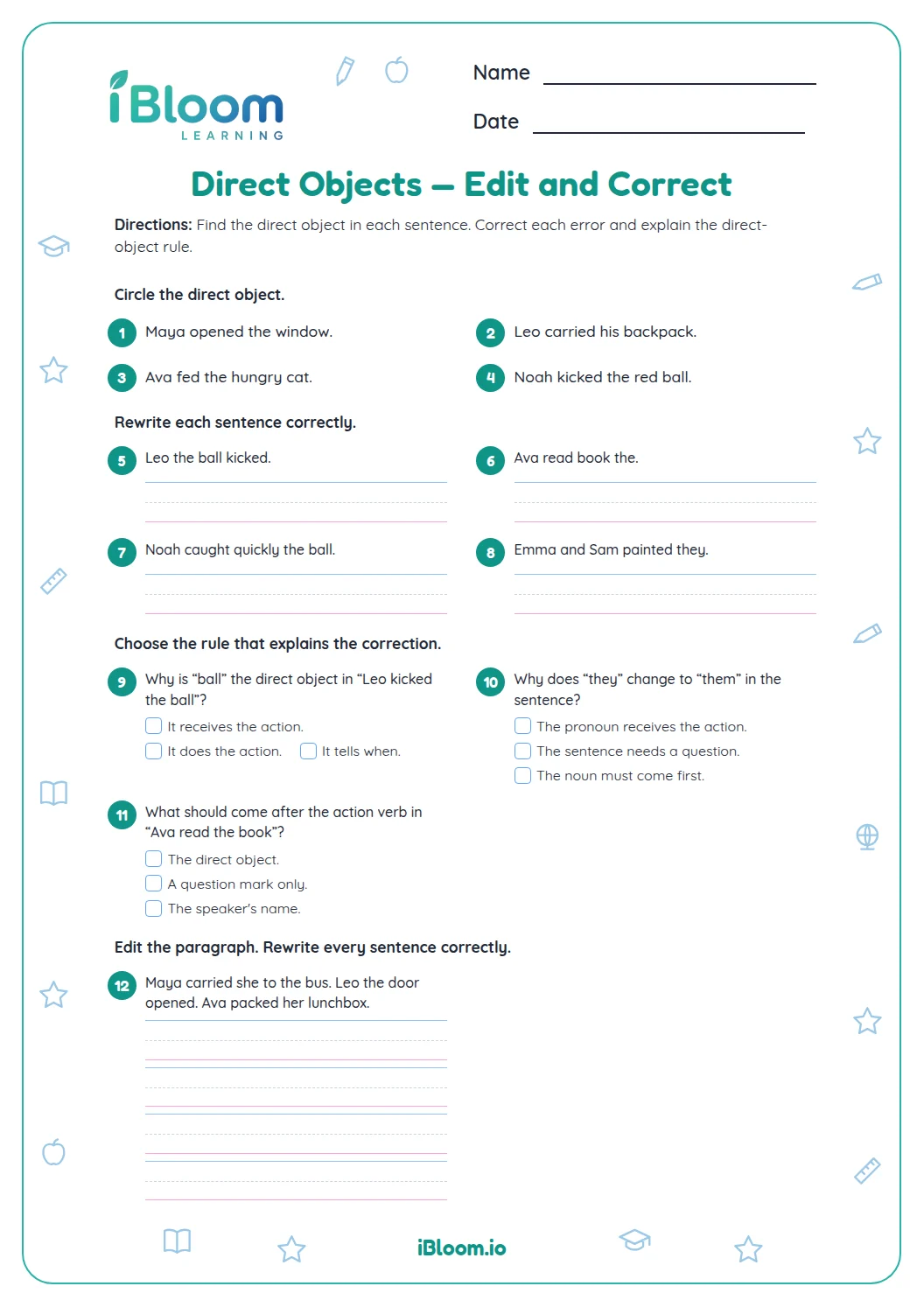
For questions 9 through 14, accept a complete, sensible response that follows the prompt. The child underlines the direct-object noun in each sentence-writing item. Question 11 keeps “The cook stirred” and replaces soup with another sensible object.
Question 12 asks why ball is a direct object: it receives the action of kicking. Questions 13 and 14 ask for new complete sentences with the named verbs. The key gives samples; accept another response that meets the prompt.
How to use this worksheet
- 1Read the first sentence and ask “packed what?” together.
- 2Have the child write only the object noun for each Part A item.
- 3Use each word-bank noun once in Part B and reread each sentence.
- 4In Part C, check the required verb and underline the object noun in questions 9 through 12.
- 5Compare with the key, accepting original sentences that meet the prompt.
Mistakes to notice and fix
The mistake
Writing Maya as the object in question 1.
The fix
Maya does the action. Ask what Maya packed to find lunch.
The mistake
Choosing an action word such as watered as the object.
The fix
First locate the verb; then find the noun that answers “watered what?”
The mistake
Writing “Carried a bag” for question 9.
The fix
Add someone who did the carrying, such as “I carried a bag.”
Common Core alignment
Explain how a noun receives the action of a verb in a sentence.
On this sheet: Children identify direct objects and explain the job of an object noun.
Show the official wordingHide the official wording
Explain the function of nouns, pronouns, verbs, adjectives, and adverbs in general and their functions in particular sentences.
Write complete sentences with an action verb and a direct object.
On this sheet: The final part asks children to write and revise simple sentences.
Show the official wordingHide the official wording
Produce simple, compound, and complex sentences.
What to practice next
Make more practice
Further reading
Questions parents and teachers ask
Should my child write the whole object phrase in Part A?
Write only the object noun in Part A. For “Maya packed a lunch,” the answer is lunch. This keeps the first four responses focused on nouns. You can say the whole phrase aloud, then ask which word names the thing that received the action.
Are the four word-bank answers interchangeable?
No, each word has one sensible place in these sentences. Bread goes with sliced, kite with flew, plants with watered, song with sang, seed with planted, and boxes with carried. Ask the child to read the complete sentence aloud after filling the blank, then cross off the word already used.
Must the sentences in Part C match the key?
No, the key gives samples for the four written responses. Questions 9 and 10 allow different subjects and object nouns, provided the required verb is used correctly. Questions 11 and 12 ask children to write new sentences with the named verbs. Question 12 needs an explanation that connects ball to the action kicked.
How can I help without supplying the object?
Ask the child to find the action verb first. Then repeat that verb with what or whom after it: “opened what?” or “thanked whom?” Give time to answer from the sentence. This routine provides a clue while leaving the noun choice to the child.
What does the final explanation show?
It shows whether the child understands the job of the noun. Saying that ball is a thing identifies its word class, but the question asks more: why is it a direct object here? A successful answer explains that the ball receives the action of being kicked.