





About this worksheet
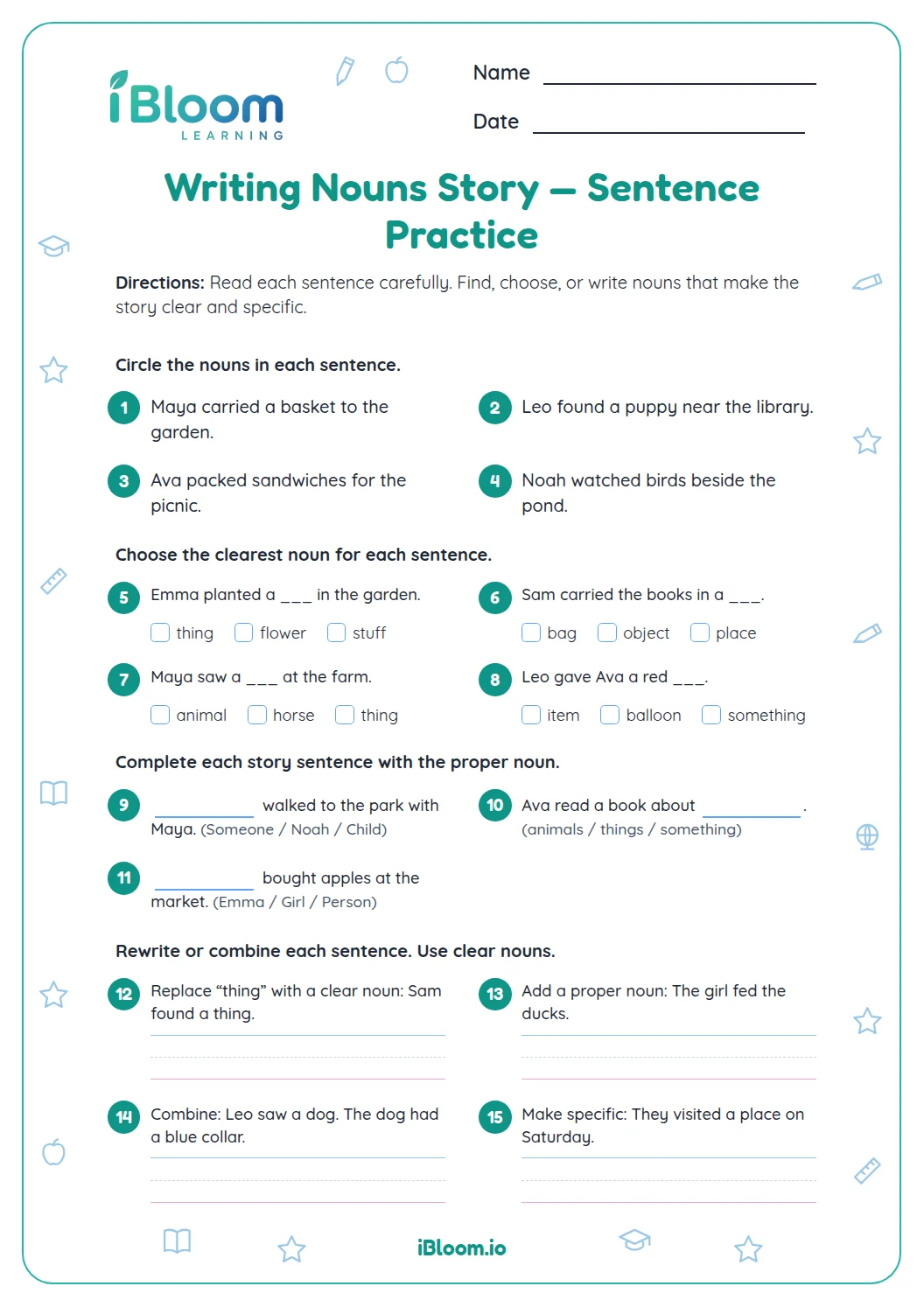
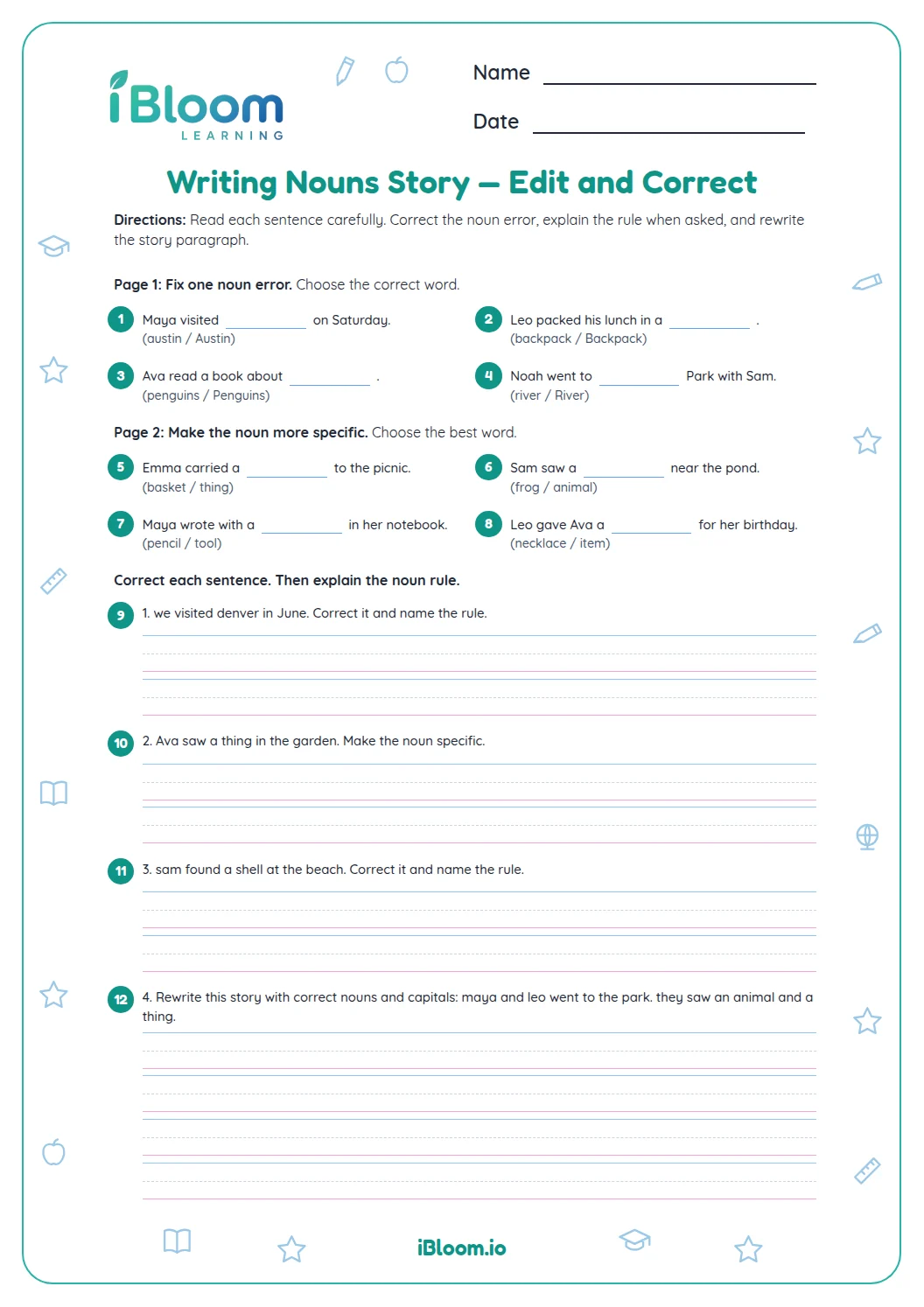
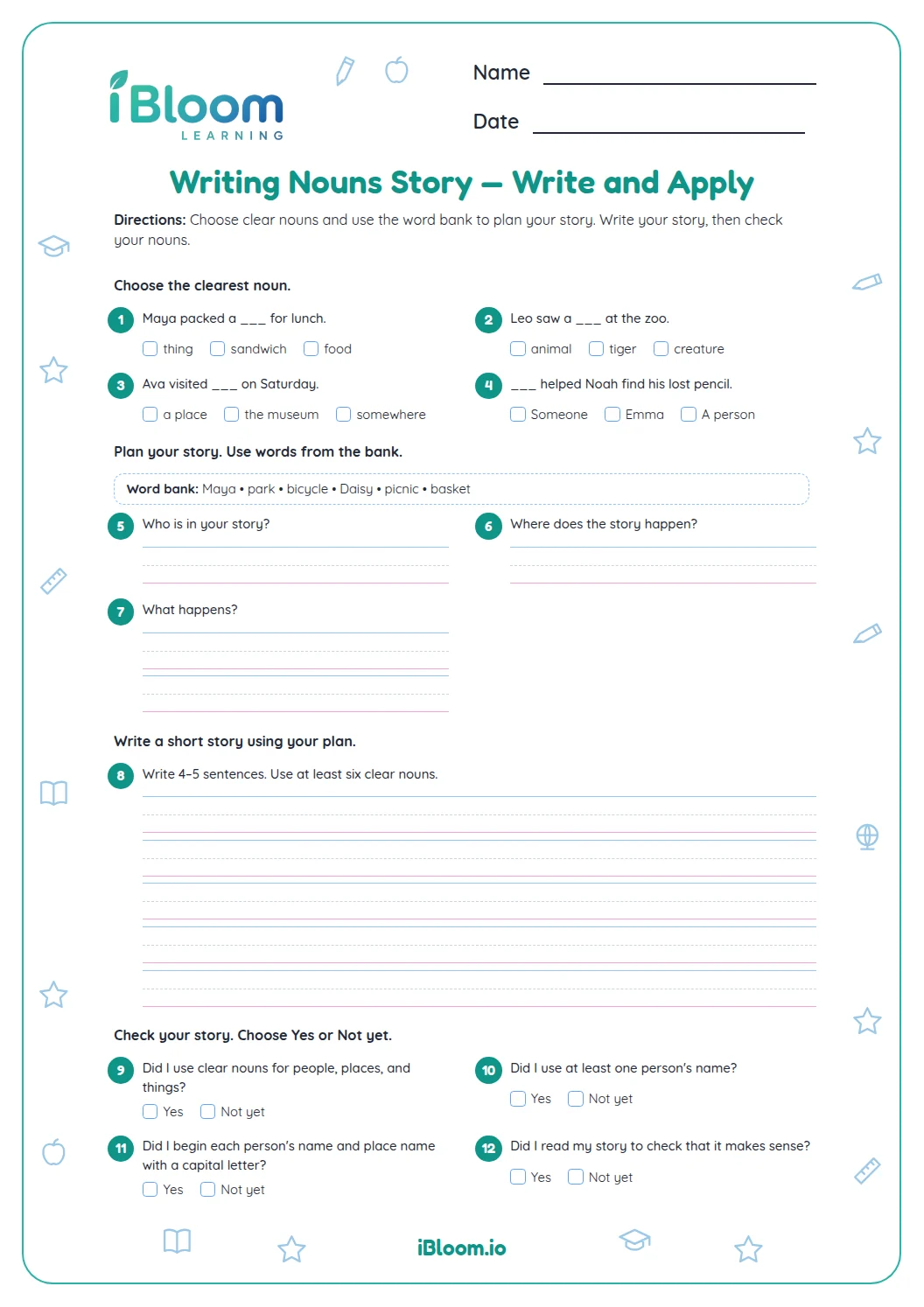
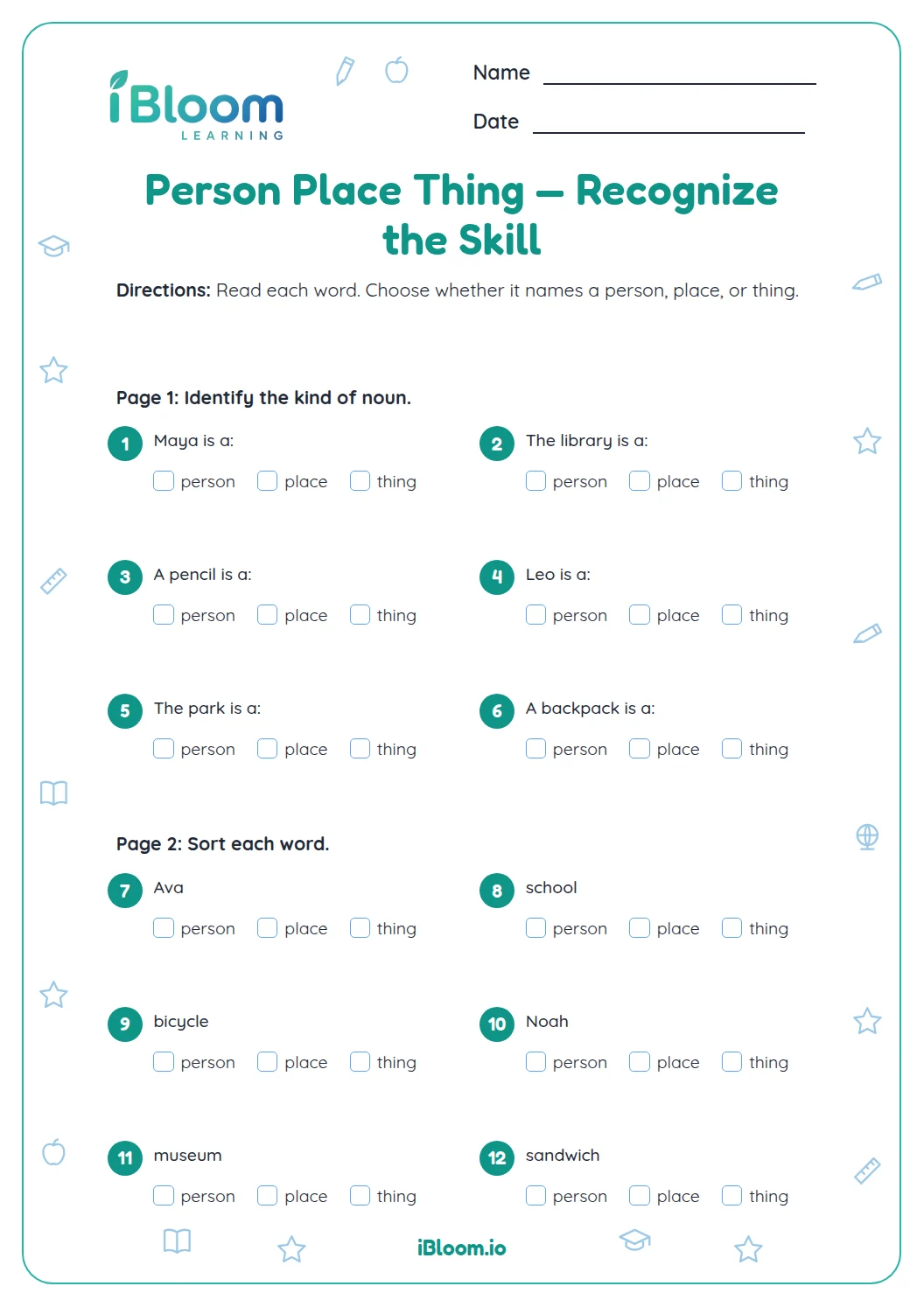
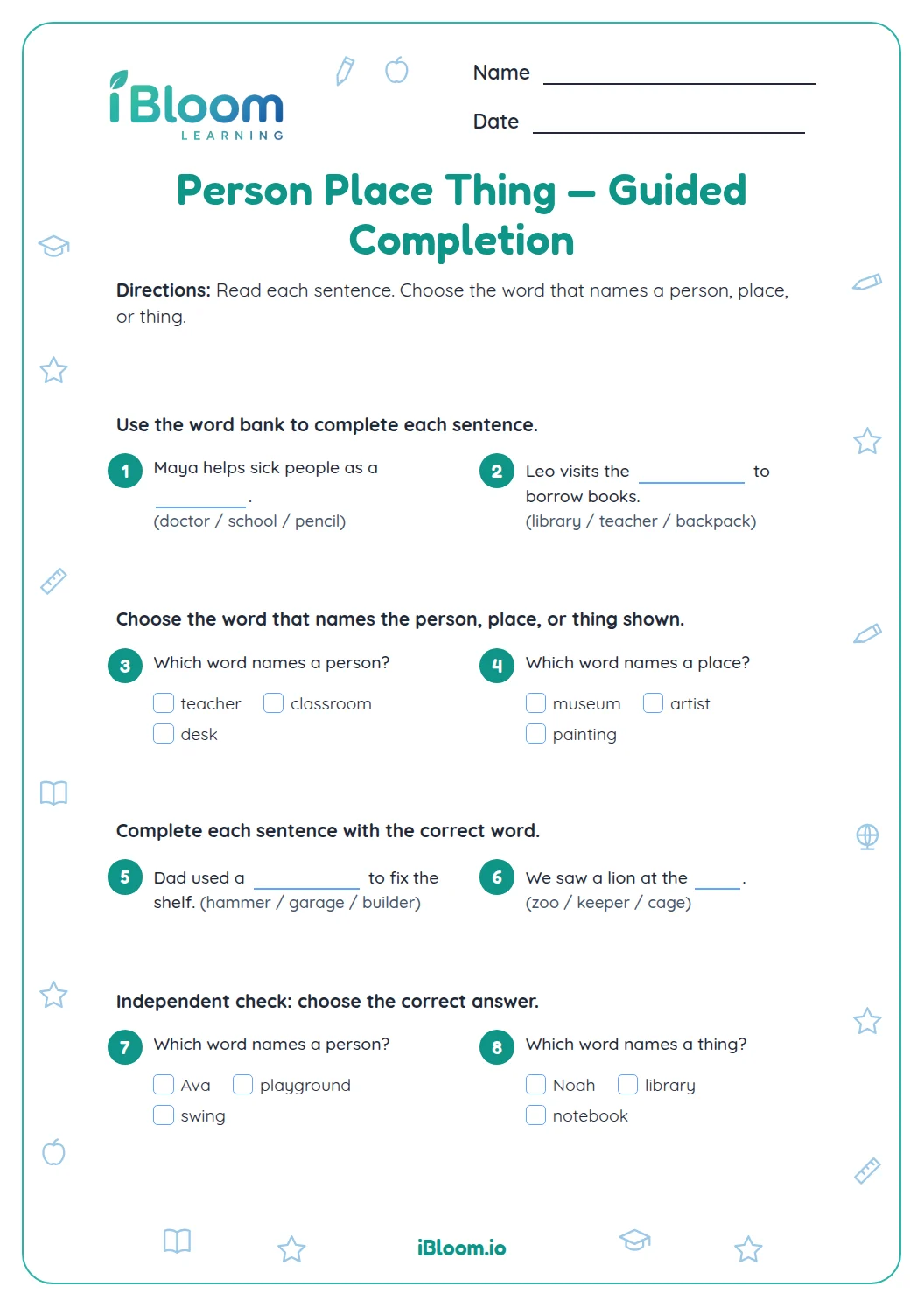
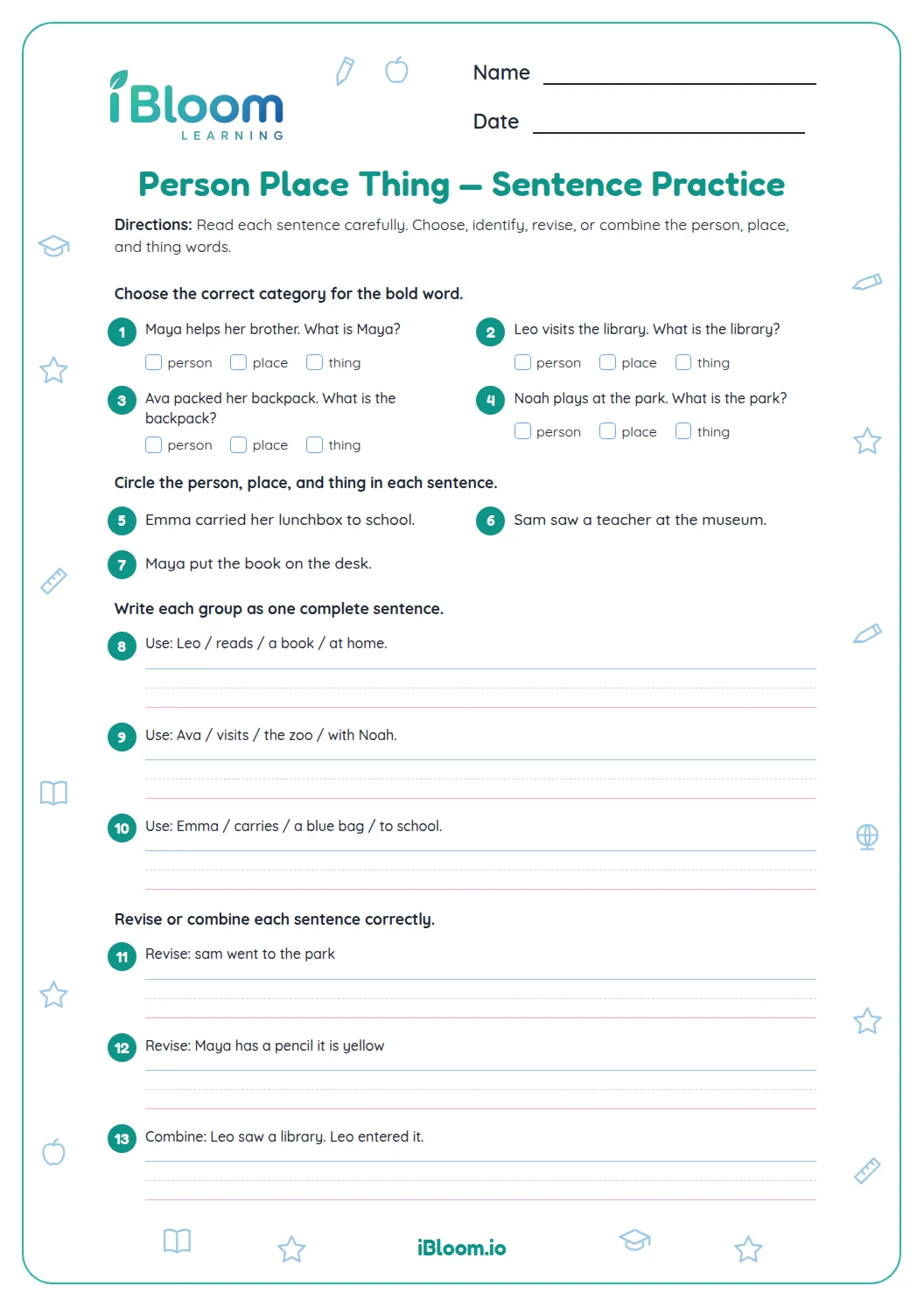
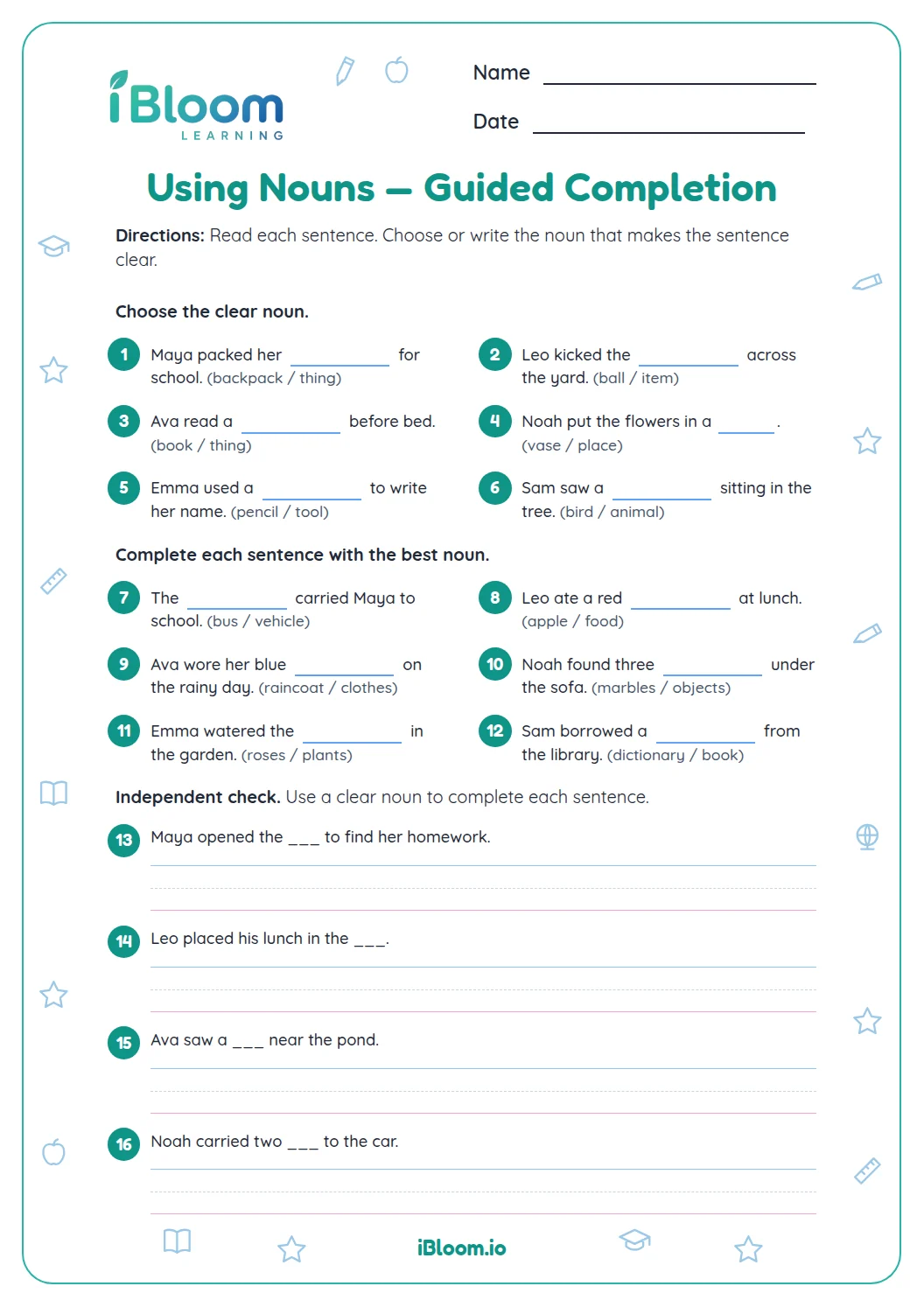
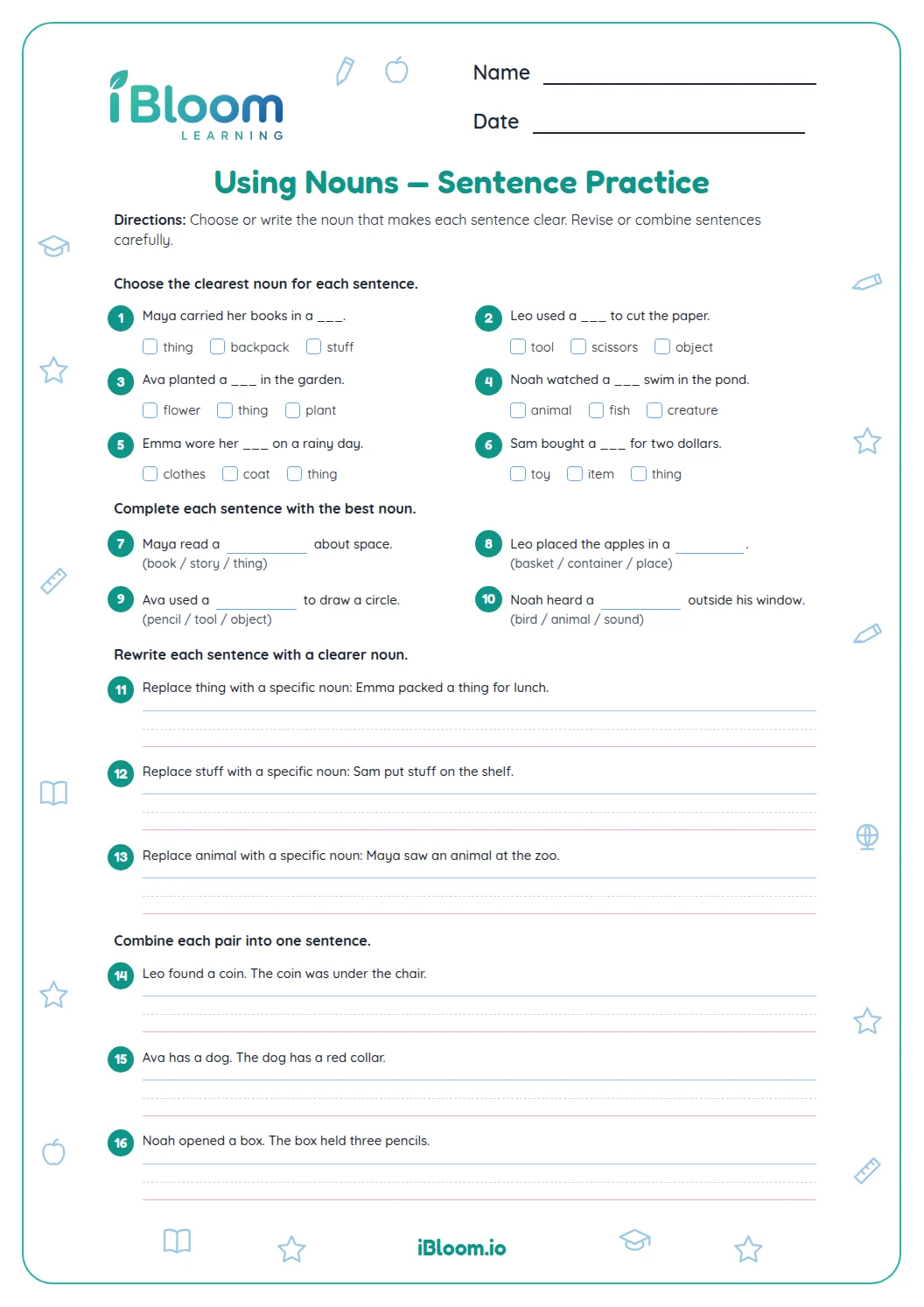
This free Grade 3 worksheet helps children recognize nouns and use specific names to make a story clear. Four short picnic sentences introduce Maya, a puppy, a park, and a basket. Children circle nouns, compare four sentence choices, complete six sentences with specific nouns, and finish with an explanation and a new story sentence. Common Core L.3.1a supports identifying nouns and explaining their role in a sentence. The answer key marks every fixed answer and gives samples for the two written responses.
Aligned to L.3.1a
Which naming words should children circle?
Part A follows Maya and a puppy to the park with a basket of sandwiches. Children circle every noun in each of the four rows.
Maya is a proper noun because it names a particular person. Basket and park are common nouns. They is a pronoun and is not circled in this noun-finding task.
How do the choices make story details clearer?
Part B compares sentences that use specific nouns with sentences that leave people, places, or things unnamed. One question asks specifically for a proper noun naming a place.
Part C gives six blanks with choices. Children choose the most specific naming word, so cup is more precise than container, and Leo identifies the person instead of someone.
- 1Leo lifted a ___. (basket / thing)
- 2Thing leaves the object unclear.
- 3Basket names the object Leo lifted.
- 4Complete sentence: Leo lifted a basket.
How do the final questions connect nouns and writing?
Question 15 asks what Maya does in “Maya opened the gate.” A useful explanation names Maya as the person who opened it.
Question 16 asks children to continue the picnic using a person’s name and a specific thing. Check that both nouns add clear details and that the sentence fits the picnic setting.
How to use this worksheet
- 1Read Part A in order, then circle every noun in the four rows.
- 2In Part B, compare how much each sentence tells about people, places, or things.
- 3Complete Part C using the most specific noun among the choices.
- 4Explain who opened the gate in question 15.
- 5Write a picnic sentence with a person’s name and a specific thing, then check the key.
Mistakes to check together
The mistake
Skipping Maya because it begins with a capital letter.
The fix
Maya names a particular person, so it is a proper noun.
The mistake
Choosing thing because it can fit almost any blank.
The fix
Try the more specific noun: basket tells the reader what Leo lifted.
The mistake
Using only pronouns in the final sentence, such as “He gave her it.”
The fix
Name the people and thing so the reader can follow: “Leo gave Maya a sandwich.”
Common Core alignment
Identify nouns, choose clear naming words, and explain who performs an action.
On this sheet: Part A identifies nouns; Parts B–C use specific names; question 15 explains Maya’s role in a sentence.
Show the official wordingHide the official wording
Explain the function of nouns, pronouns, verbs, adjectives, and adverbs in general and their functions in particular sentences.
What to practice next
Make more practice
Further reading
Questions parents and teachers ask
Does my child read a separate story passage?
The picnic setting develops through short sentences on the worksheet. Children meet Maya and a puppy, find nouns in four opening rows, and then practice choosing clear naming words. The later blanks add picnic events. The final prompt lets children contribute a new sentence using specific nouns.
Should children circle more than one noun in Part A?
Yes, circle every noun in each of the four rows. Maya carried a basket has two nouns: Maya and basket. The four rows contain seven nouns in all, counting repeated words. Ask what each word names, then check that carried, followed, and the pronoun They are not circled.
Why is Maya a noun?
Maya names a particular person, so it is a proper noun. The capital letter helps identify the name, but its naming function is what makes it a noun. In question 15, children explain its role more precisely: Maya names the person who opened the gate in that sentence.
Can thing and container also be nouns?
Yes, thing and container can be nouns, but these questions ask for the most specific choice. Basket tells what Leo lifted, and cup gives a more precise name than container. The goal is to choose naming words that help a reader picture the story’s people and objects clearly.
How should I check the final sentence?
Check for a complete sentence that fits the picnic and includes a person’s name and a specific thing. The sample uses Leo, Maya, and a sandwich. Other sensible details are welcome. Ask your child to identify the nouns and explain what each helps the reader understand about the new event.