



About this worksheet
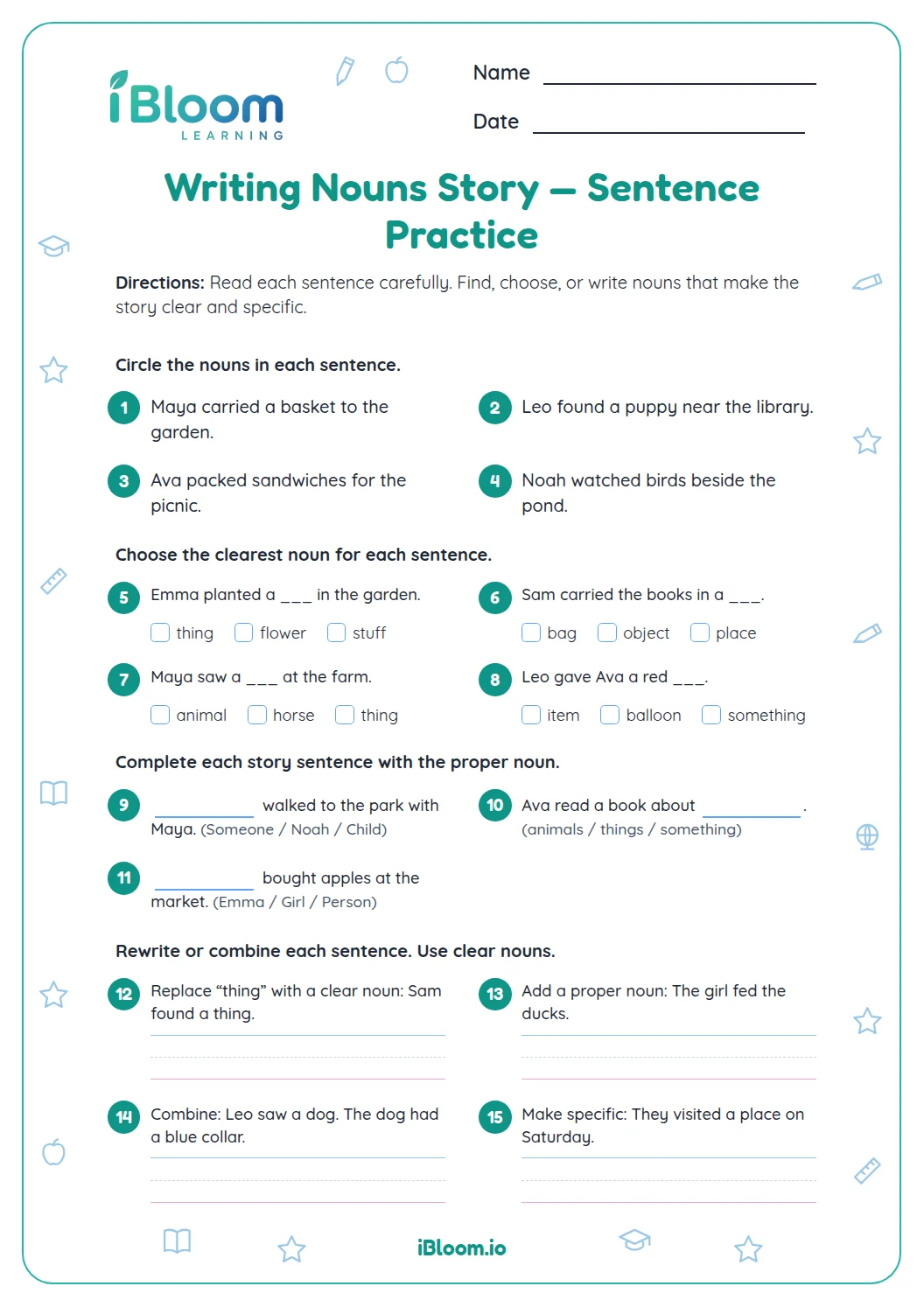
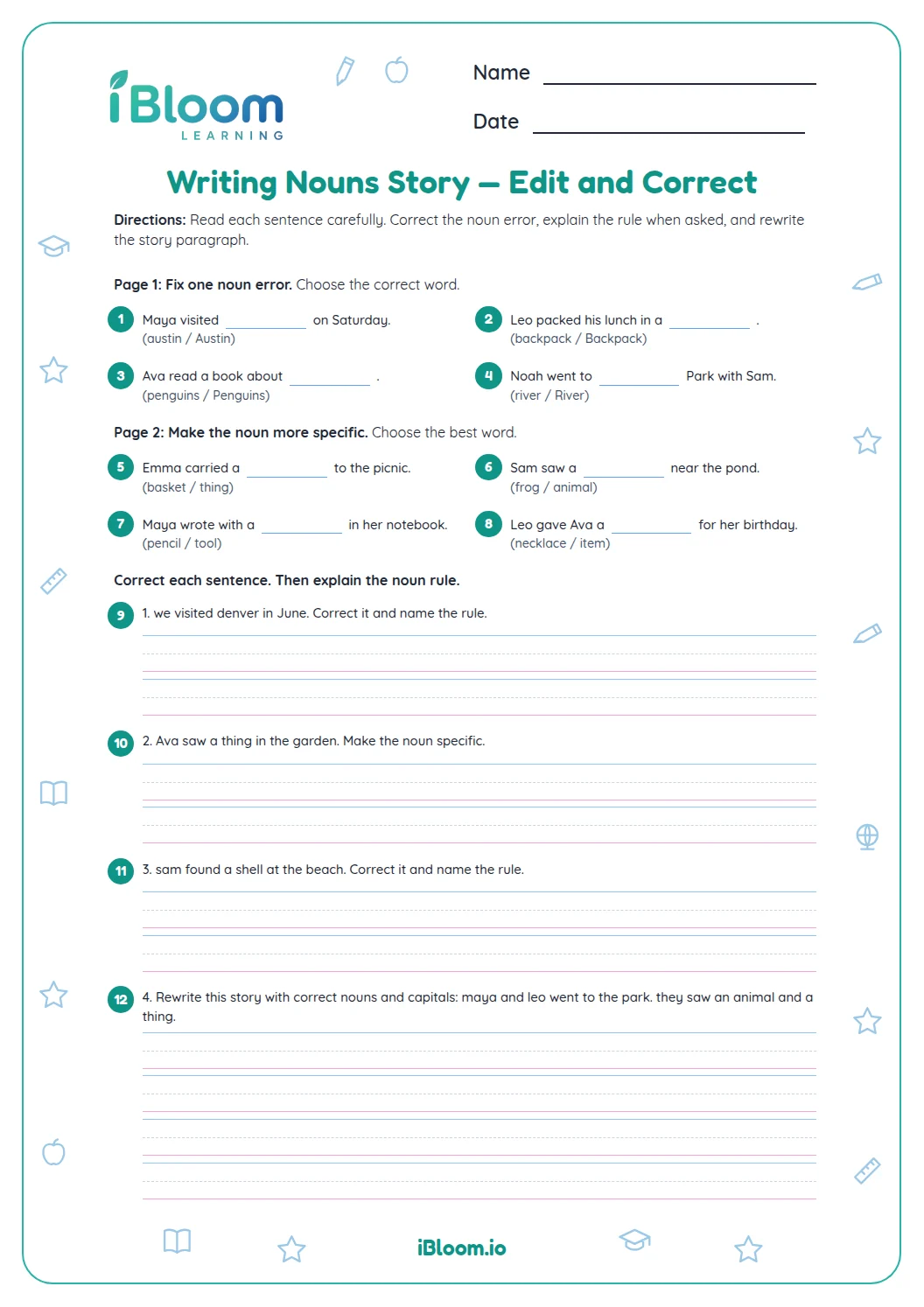
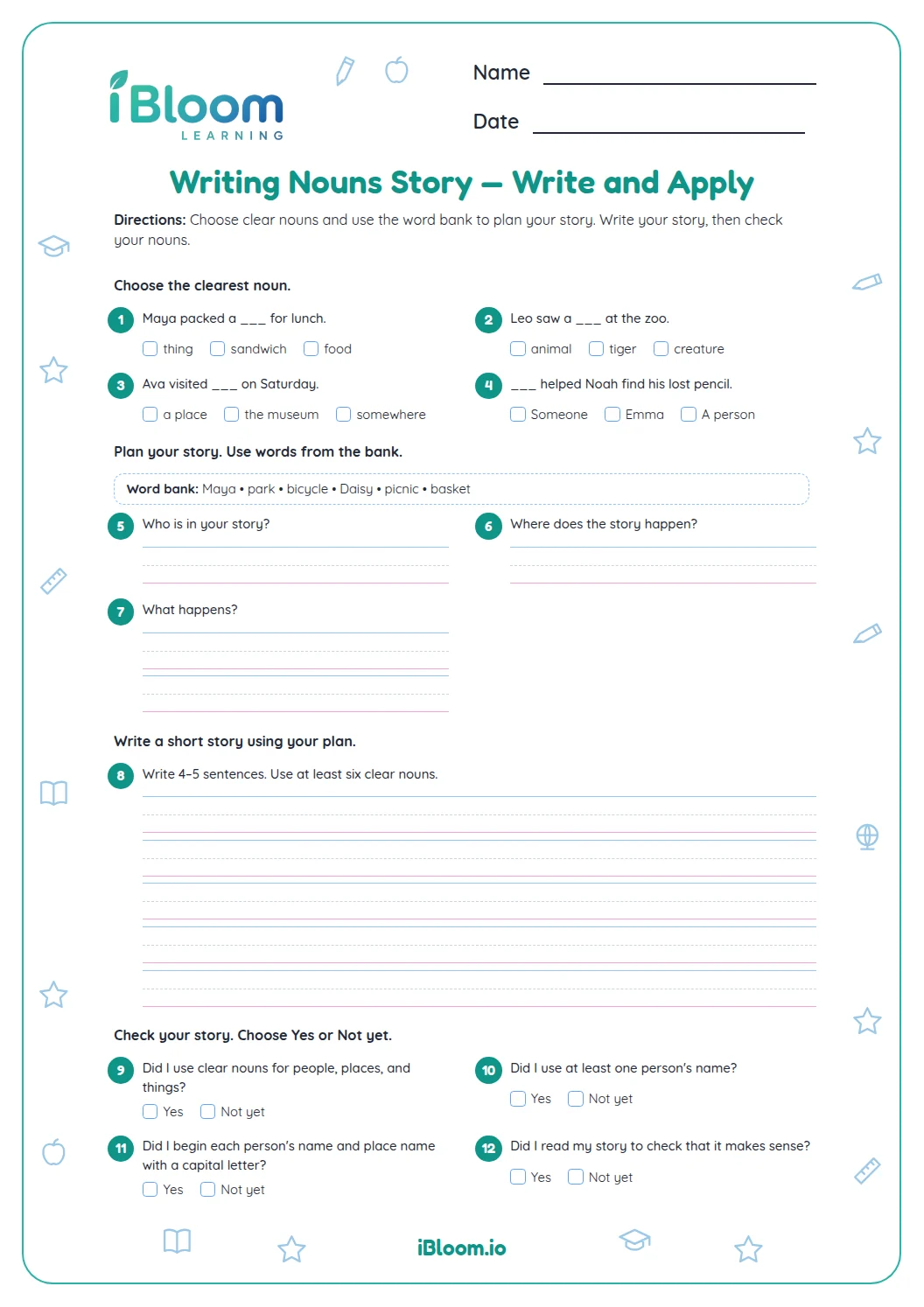
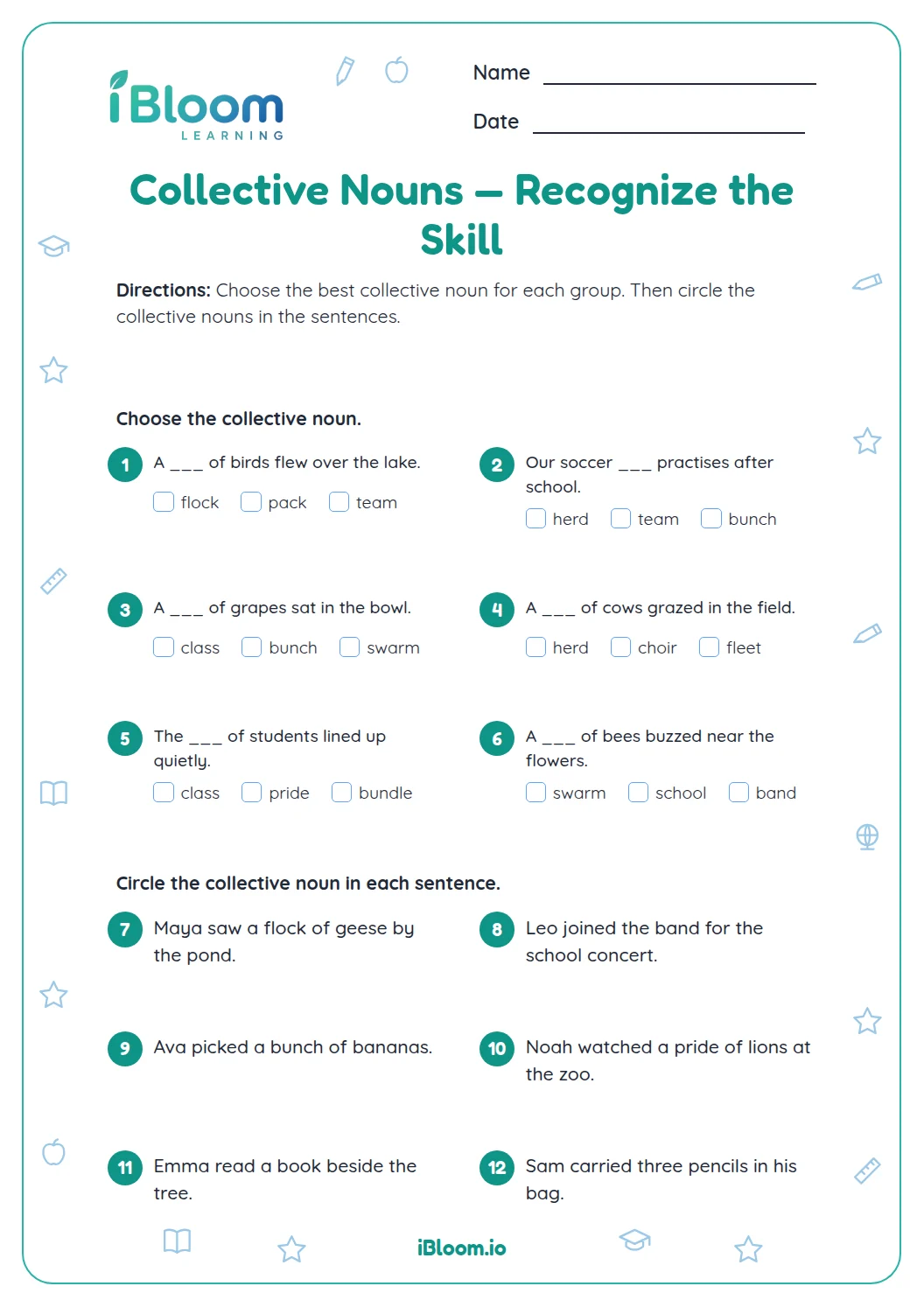
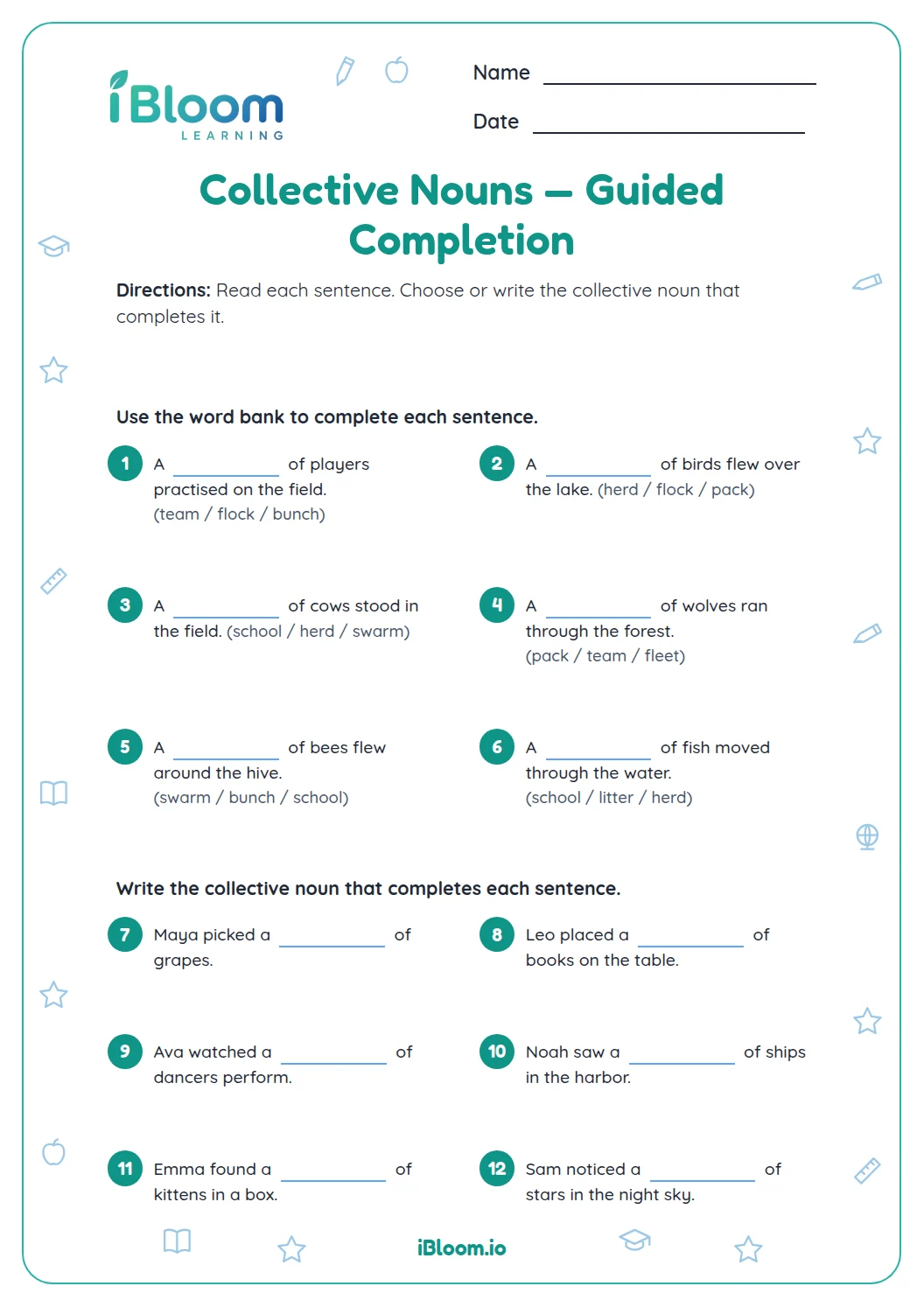
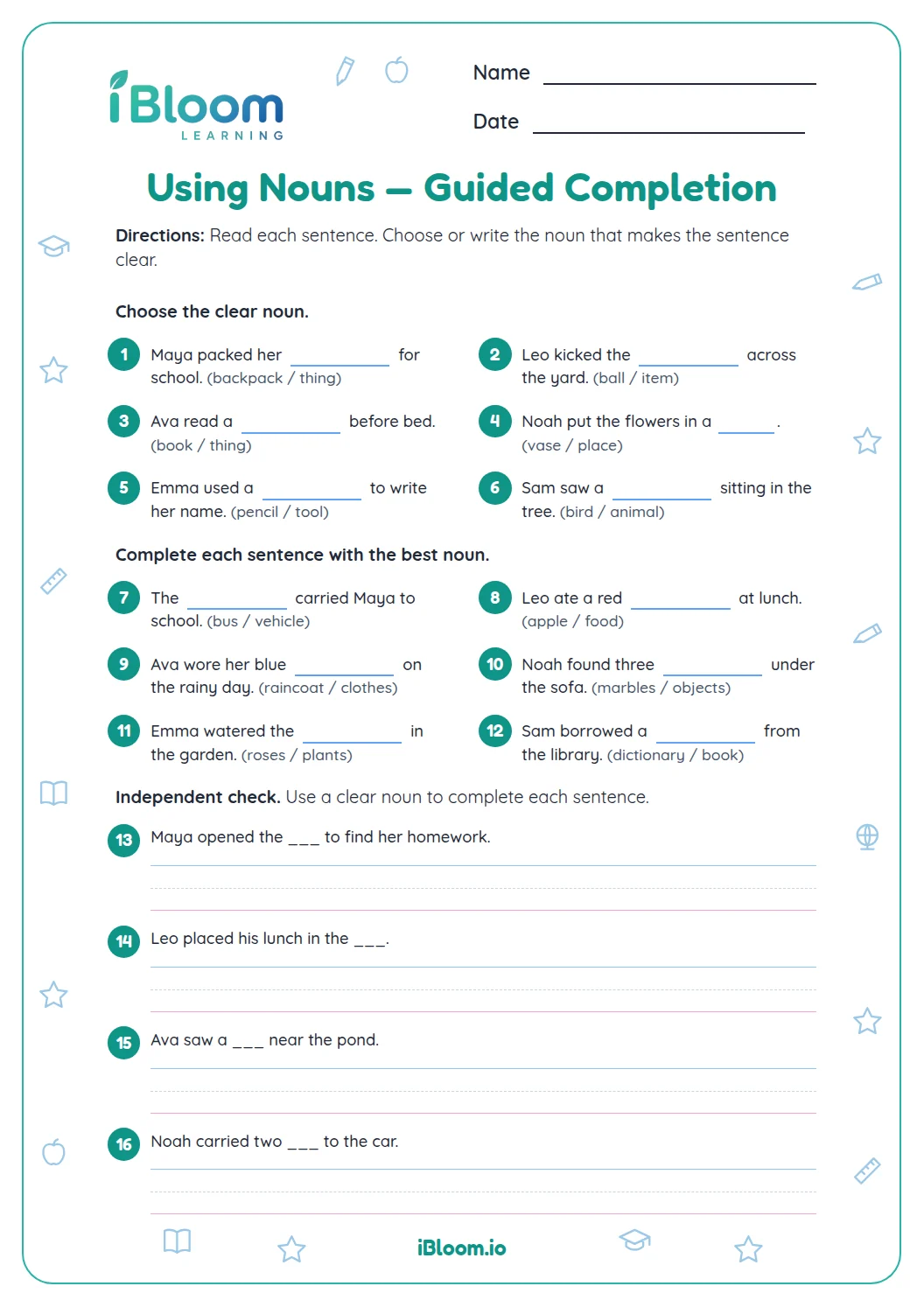
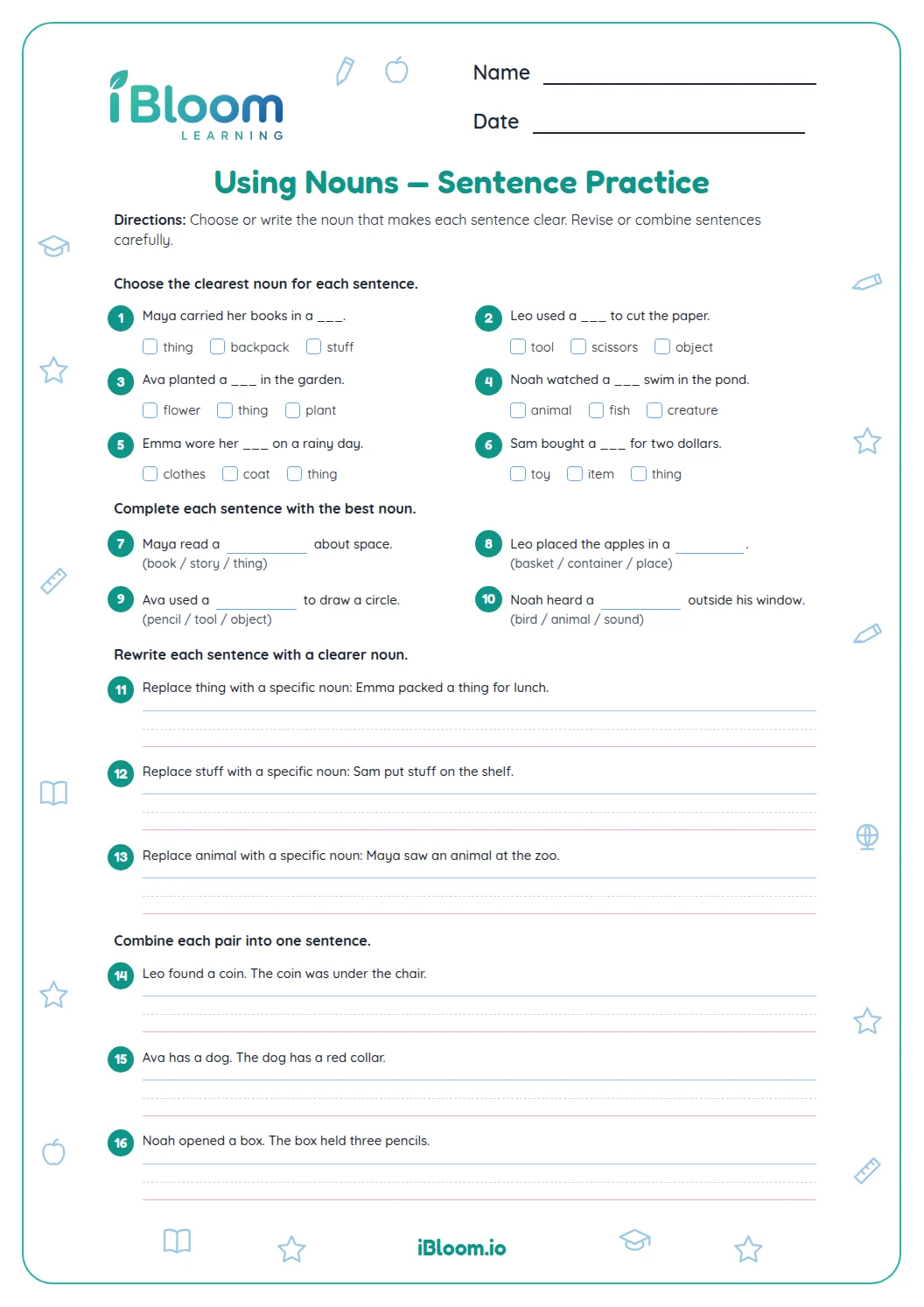
This free printable worksheet is a mixed review of nouns for Grade 3, with a writing challenge at the end. In Part A, children circle every noun in four short sentences about Maya, Leo, Emma and Noah. In Part B, they choose the noun that paints the clearest picture, such as sandwich instead of thing. In Part C, they decide which names need capital letters, from Central Park to Denver. In Part D, they rewrite two vague sentences with four stronger nouns of their own. It practices Common Core L.3.1.a and L.3.3.a, and the answer key is separate.
Aligned to L.3.1.a and L.3.3.a
How can you tell which words are nouns?
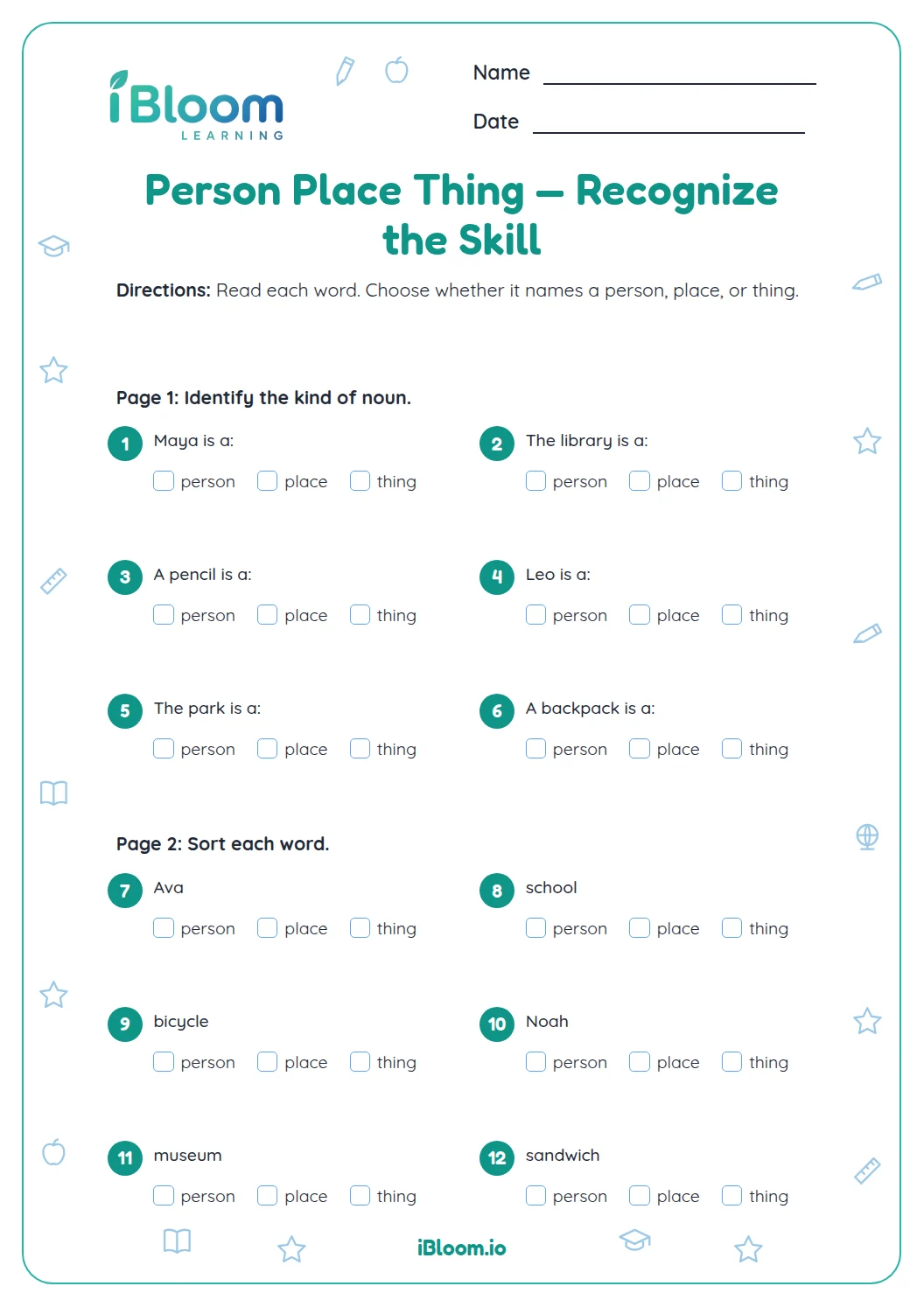
A noun names a person, a place or a thing. A quick way to find one is to ask who or what the sentence is about, and where things happen. Every answer is a noun, and names of people and places count too.
Part A uses this idea on four sentences. In question 3, the word funny tells what kind of books, so it is not circled, and her stands in for Emma, so it is a pronoun. The three nouns are Emma, teacher and books.
- 1Maya took her basket to the garden early.
- 2Who took it? Maya (a person)
- 3What did she take? her basket (a thing)
- 4Where did she take it? the garden (a place)
- 5Circle Maya, basket and garden. Her and early are not nouns.
Why swap a vague noun for a specific one?
Words like thing, place, animal and stuff are nouns, but they leave the reader guessing. A specific noun answers the question before the reader asks it. “Leo found an animal under the tree” could mean a worm, a frog or a bear, while “Leo found a squirrel” cannot.
Each blank in Part B has one specific choice next to one or two vague ones. In question 7, clothes and stuff would both make a true sentence, but only jersey tells you exactly what Noah wore to the soccer game.
When does a noun need a capital letter?
A noun that names one particular person, place or thing is a proper noun, and it starts with a capital letter. Central Park, Denver and Lake Erie each name one place, so every important word is capitalized. The plain nouns park, city and lake are common nouns and stay lowercase.
Question 11 puts both kinds together: lake and city are common nouns, and Lake Erie is the only choice that names one special place.
What is on this worksheet?
Twelve questions on two pages, in four parts that move from finding nouns to writing with them. The same children, Maya, Leo, Emma, Ava and Noah, appear across the sheet, so the final story feels like part of the same set.
- Part A, Find the nouns: circle the nouns in four sentences (12 nouns in all)
- Part B, Pick the clearer noun: four sentences, each with one specific noun among vague ones
- Part C, Capital letters for names: three choices about proper nouns
- Part D, Finish the story: rewrite two vague sentences on the writing lines
- A two-page answer key with every noun circled and a sample story
How to use this worksheet at home or in class
- 1Warm up by pointing to five things in the room or yard and saying the noun for each. Then swap one for a vaguer word, like thing, and ask which sounds clearer.
- 2Do question 1 together. Ask who took the basket, what she took and where, until your child finds all three nouns.
- 3Let your child finish Part A alone, then talk about any word they circled that only describes or replaces a noun, like funny or her.
- 4For Part B, have your child read each sentence aloud both ways before choosing the noun.
- 5In Part D, ask for four changes that each name a real person, place or thing. Read the finished story aloud together.
- 6Check with the answer key. Remember that the Part D model answer is only one possible story.
Common mistakes and quick fixes
The mistake
Circling a describing word as a noun, such as funny in “Emma and her teacher read funny books aloud” (question 3).
The fix
Ask “funny what?” The word that answers, books, is the noun. Funny only tells what kind.
The mistake
Leaving out names, as in not circling Maya, Leo or Emma because they seem different from other nouns.
The fix
Names of people and places are nouns too. Ask “who is in this sentence?” and every name will appear.
The mistake
Writing a place name in lowercase, such as central park or denver.
The fix
Ask “is this one special park or any park?” A name for one particular place gets a capital letter on every important word.
Common Core alignment
Most US states use the Common Core language standards or a close state version. These two Grade 3 standards match the parts of this sheet.
Explain what nouns do in sentences, and find them.
On this sheet: Part A finds the nouns in four sentences, and Part C sorts common from proper nouns.
Show the official wordingHide the official wording
Explain the function of nouns, pronouns, verbs, adjectives, and adverbs in general and their functions in particular sentences.
Choose words that make writing clearer.
On this sheet: Parts B and D replace vague nouns with specific ones.
Show the official wordingHide the official wording
Choose words and phrases for effect.
What to practice next
Make more practice
Further reading
Questions parents and teachers ask
What is the difference between a common noun and a proper noun?
A common noun names any person, place or thing, like park or lake, while a proper noun names one particular one, like Central Park or Lake Erie. Proper nouns start with a capital letter. Part C of this sheet asks children to pick the correctly capitalized choice for names like Denver.
Why is thing not a good noun in writing?
Thing is a noun, but it does not tell the reader what the object is. A specific noun lets the reader picture the sentence. “Maya packed a sandwich” shows more than “Maya packed a thing.” Part B trains children to notice that difference and pick the clear word.
Is a name like Maya a noun?
Yes. A name is a proper noun because it names one particular person. That is why Maya, Leo, Emma, Ava and Noah are all circled on the answer key for Part A. If a name gets missed, ask who is doing something in the sentence, and the name will be the answer.
What should a good answer to question 12 look like?
A good answer replaces child, place, animal and thing with four specific nouns, like Maya, beach, crab and shell. Many different stories are correct. Check that every vague noun is gone and that the new sentences still make sense. The key shows one sample, not the only answer.
Is her a noun in question 1?
No. Her is a pronoun: it stands in for Maya, so it is not circled. The nouns in “Maya took her basket to the garden early” are Maya, basket and garden. Early is not a noun either; it tells when Maya went. Question 3 has the same trap with her teacher.
Is there an answer key for this worksheet?
Yes. The two-page answer key shows the circled nouns for Part A, the correct choices in Parts B and C, and a sample story for Part D. You can print the worksheet on its own and keep the key for checking, or download both as a free PDF from this page.