




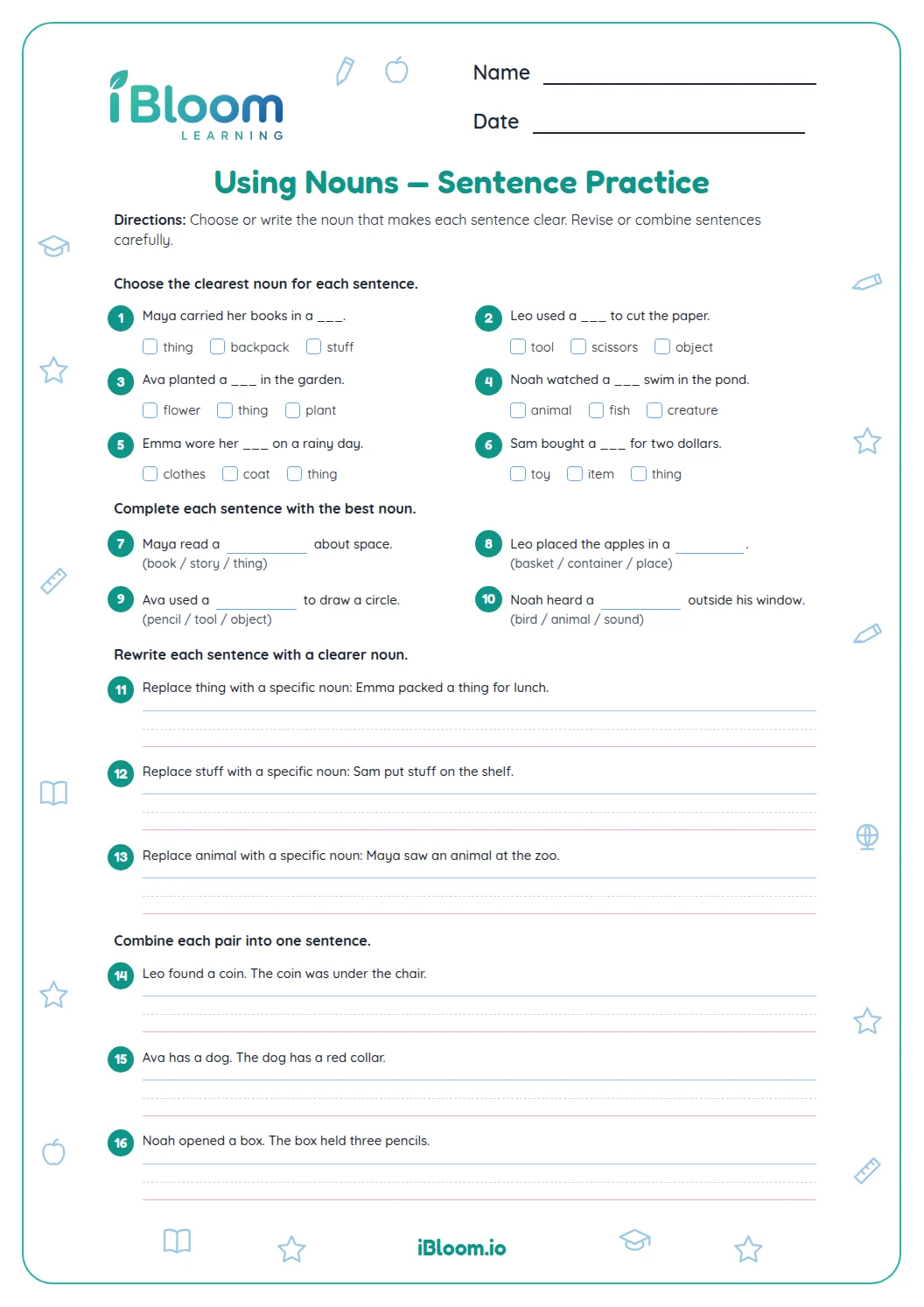
About this worksheet
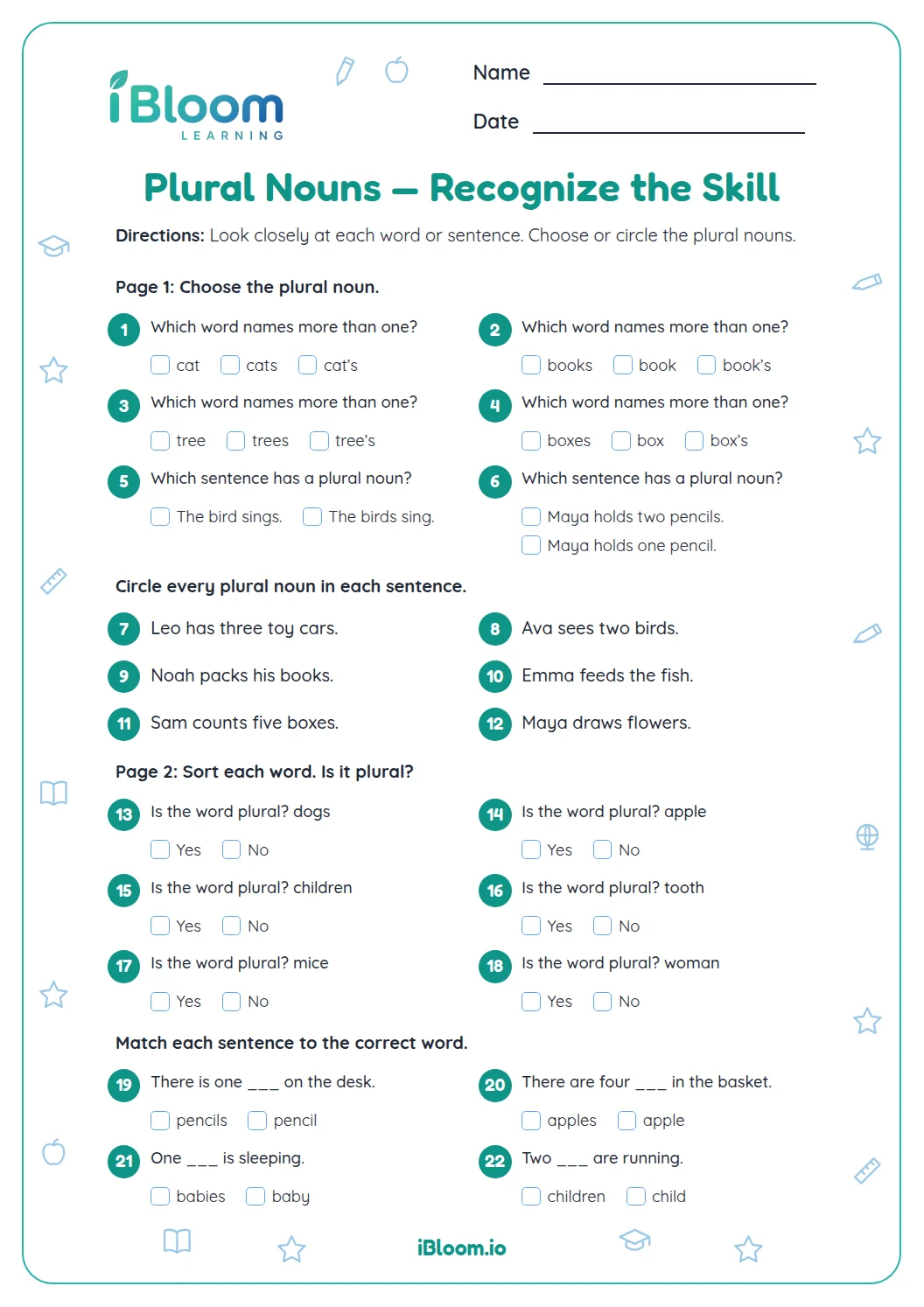
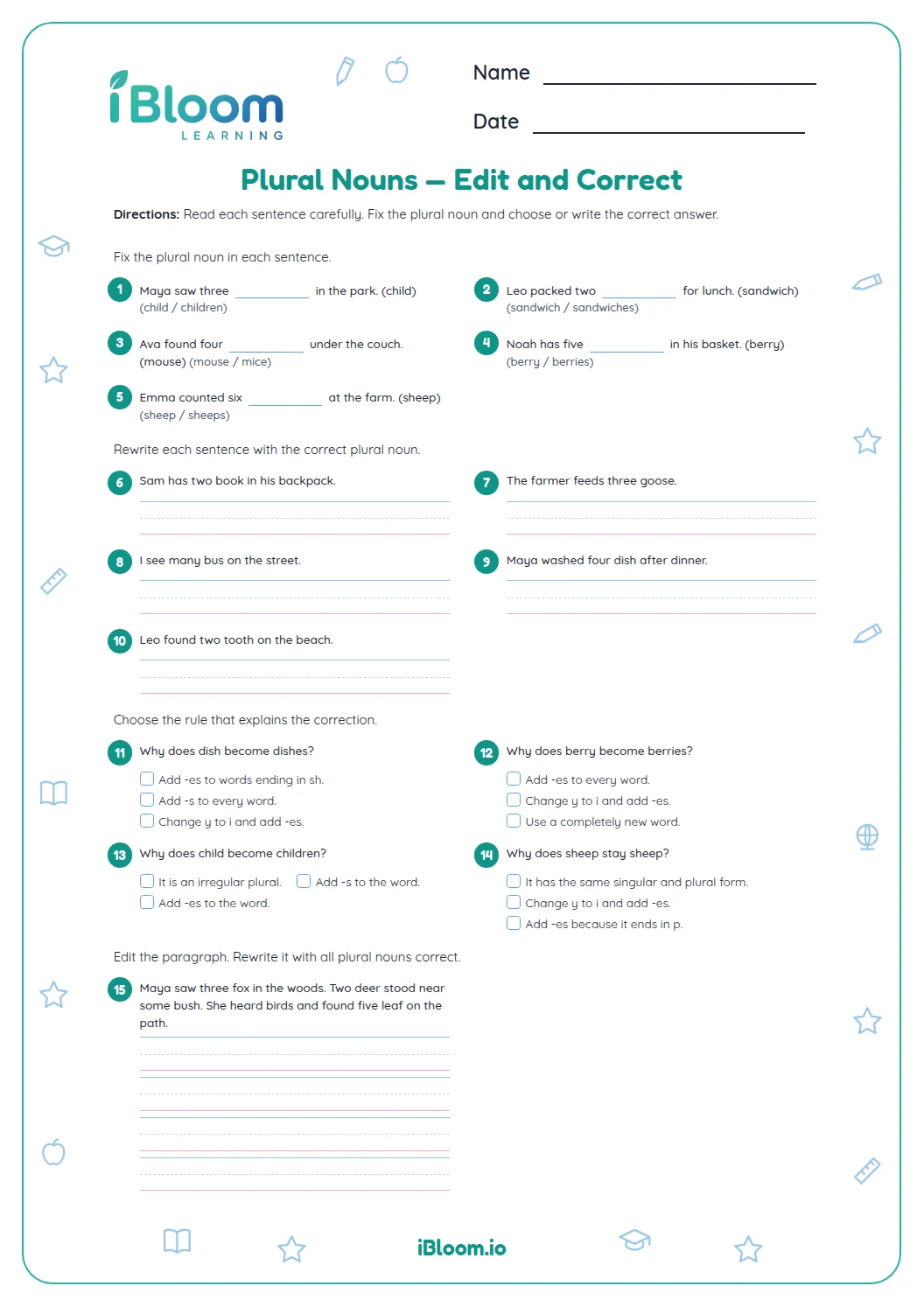
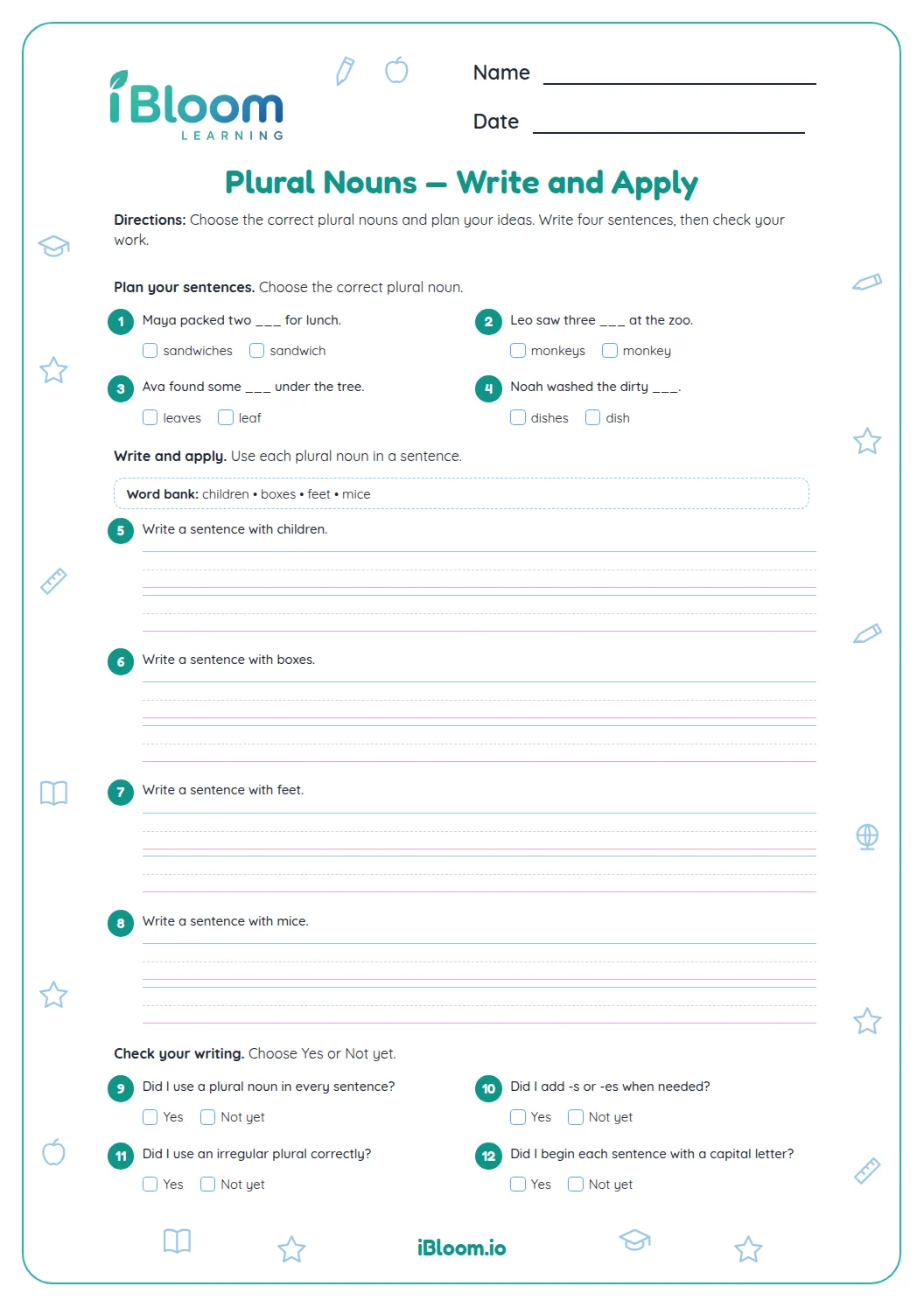
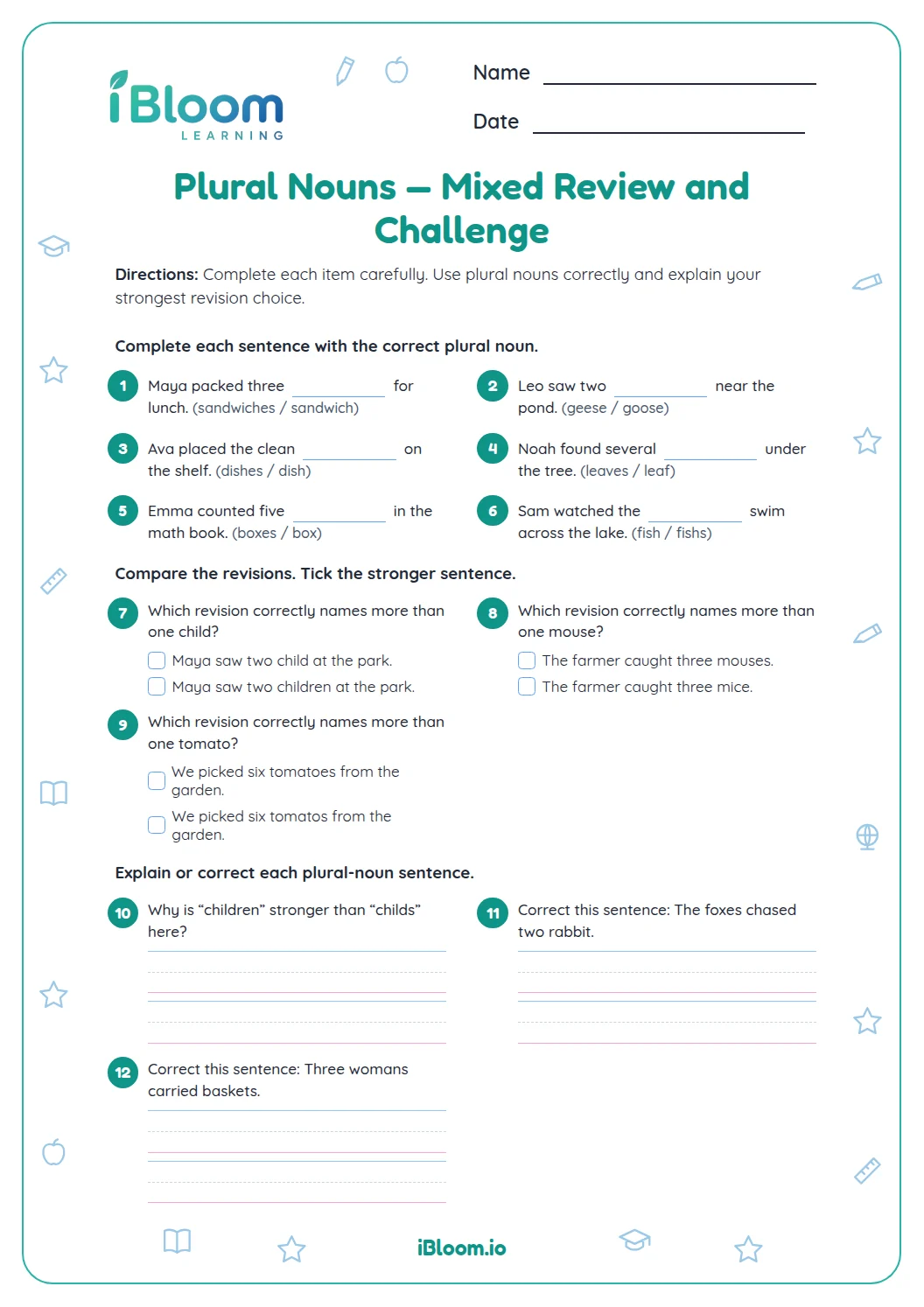
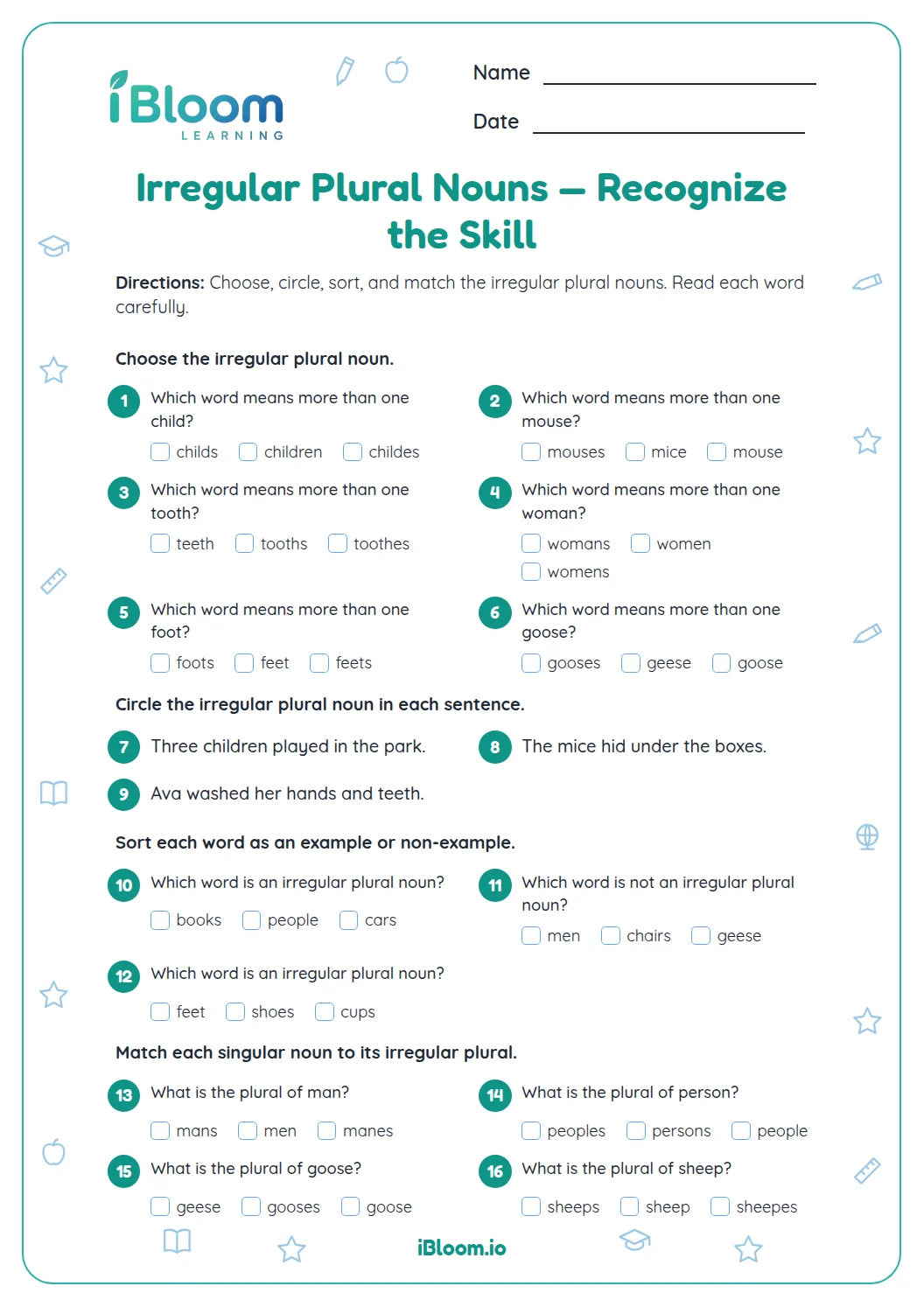
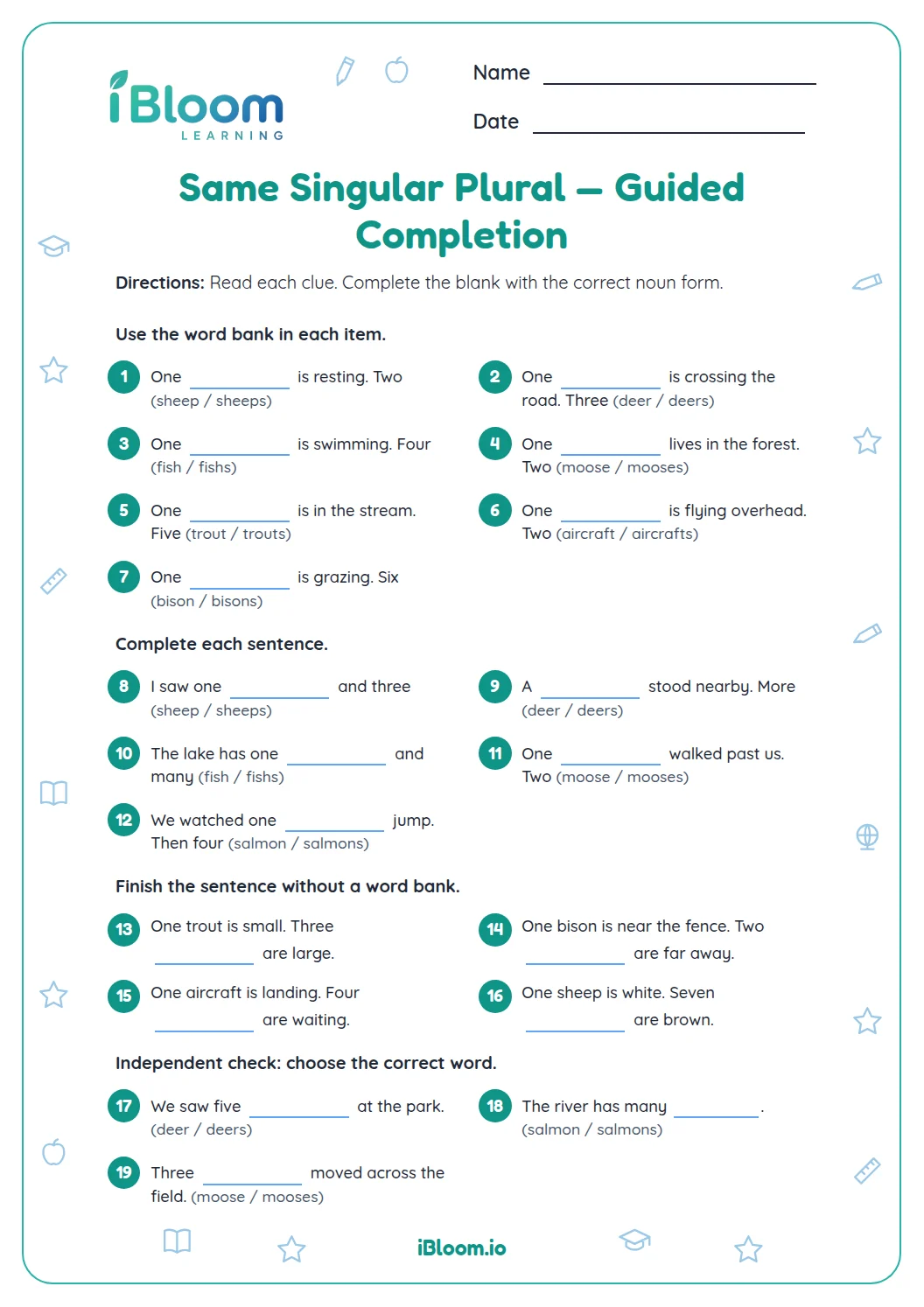
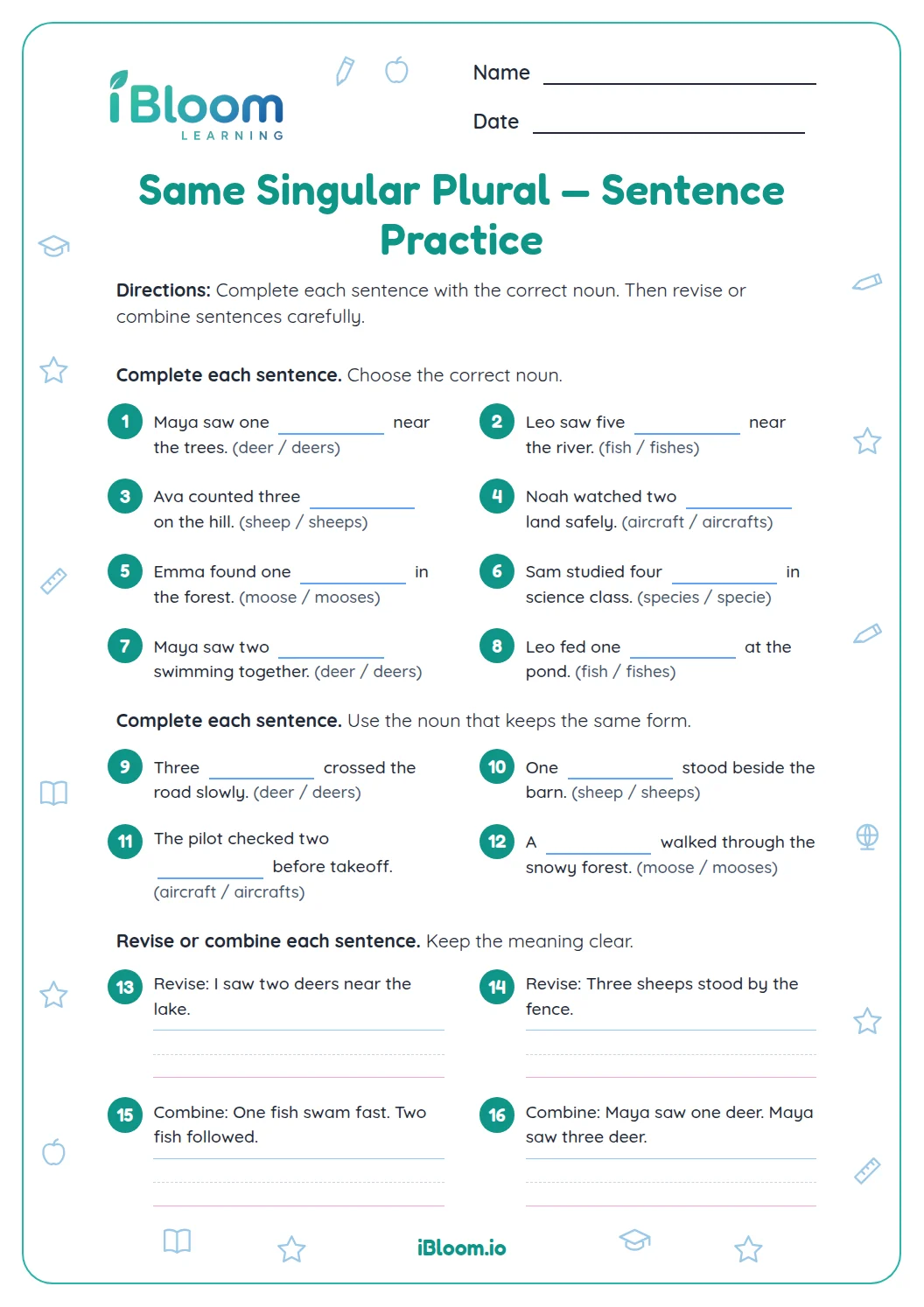
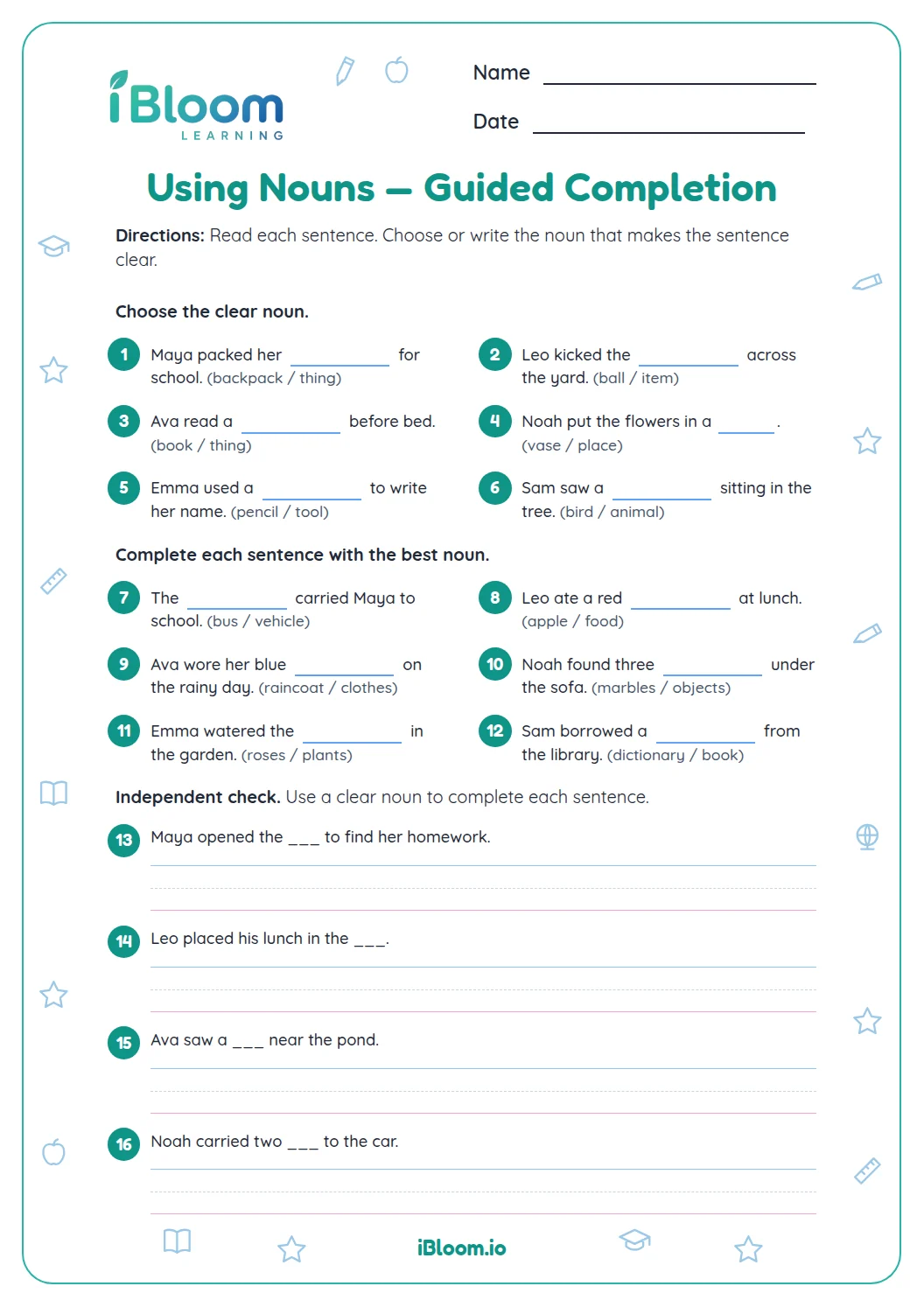
This Grade 3 worksheet gives students 16 chances to form and use plural nouns in sentences. Part A practices regular endings such as -s, -es, and -ies. Part B covers irregular forms, and Part C checks nouns whose singular and plural forms match. The separate answer key gives the target word or sentence for every item. The questions practice Common Core L.3.1.b.
Aligned to L.3.1.b
How do regular plural endings work?
Many nouns add -s. Nouns ending in s, x, sh, or ch often add -es. A noun ending in consonant plus y usually changes y to ies, as baby becomes babies.
- 1One box; two boxes.
- 2Add -es to a noun ending in x.
How can I recognize an irregular plural?
Some plurals change in a less predictable way, such as mouse to mice and tooth to teeth. In the final part, compare complete sentences to recognize nouns whose singular and plural forms are the same.
- 1One mouse; two mice.
- 2The plural changes its vowel.
How does a sentence help me choose?
Number words such as two, three, or many point to a plural noun. Read the whole sentence so the noun fits both its meaning and the grammar.
How can I use this worksheet?
- 1Read all the words in the sentence.
- 2Look for a clue that tells whether the noun is singular or plural.
- 3Use the noun’s spelling pattern or recall its irregular form.
- 4Read the completed sentence aloud.
- 5Check that the sentence sounds complete and makes sense.
Common mistakes and quick fixes
The mistake
Adding only -s to a noun such as box.
The fix
Notice the ending and use -es for boxes.
The mistake
Writing babys instead of babies.
The fix
For consonant plus y, change y to ies.
The mistake
Applying a regular ending to an irregular noun.
The fix
Recall the whole plural form, such as mouse to mice.
Curriculum alignment
This page practices the following standard through its questions and models.
Form and use regular and irregular plural nouns in sentences.
On this sheet: Children choose correct regular and irregular plural forms in sentence contexts.
Show the official wordingHide the official wording
Form and use regular and irregular plural nouns.
What to practice next
Make more practice
Further reading
Questions parents and teachers ask
How do you make most nouns plural?
Most nouns become plural by adding -s, as in bird and birds. Some take -es, and nouns ending in consonant plus y often change y to ies. Questions on Part A use short sentence clues to help students choose the correct form and read it in context.
When does a noun use -es?
Many nouns ending in s, x, sh, or ch add -es to make the plural. For example, box becomes boxes and dish becomes dishes. Look at the noun’s ending, then read the completed sentence to check the spelling.
What is an irregular plural noun?
An irregular plural does not follow the usual pattern of adding -s or -es. The word may change inside, as mouse becomes mice, or change its ending, as tooth becomes teeth. This worksheet practices these forms in sentence contexts.
Why practice plural nouns in sentences?
A sentence gives clues about whether one or more people, animals, or things are meant. Words such as two, three, and many often signal a plural noun. Reading the whole sentence also helps students see whether the chosen noun makes sense.
What should students do if two spellings seem possible?
Read the full sentence and look for number clues such as two or several. Then recall the noun’s spelling pattern or irregular form. The final questions compare sentences that use the same noun form for one or more than one, including deer, sheep, and fish.